Can you put modern tires on a classic car without spoiling it or creating a new problem? Sometimes, yes, but the answer starts with the wheels, the vehicle's documented requirements and the proposed tire's specifications. It does not start with a photograph of another owner's car. A tire can look period-correct while using radial construction, and an attractive replacement can still be wrong for the rim beneath it.
For a Calgary car that comes out for occasional summer drives, the practical goal is straightforward: preserve the character you enjoy while making a defensible road-use decision. Establish what the car actually has, separate display preferences from functional requirements, and resolve missing information before the old tires come off. If its present tires are questionable, do not drive it to an assessment simply because the journey is short.
This guide is for passenger-car owners sorting out that decision, not a restoration specification or permission to convert a particular vehicle. A prewar car with specialist wheels, a modified muscle car and an unmodified later classic can need very different answers. KMJ's role here is tire service; restoration engineering, wheel rebuilding and mechanical concerns belong with the appropriate specialists. Specialty-product availability and service suitability need individual confirmation.
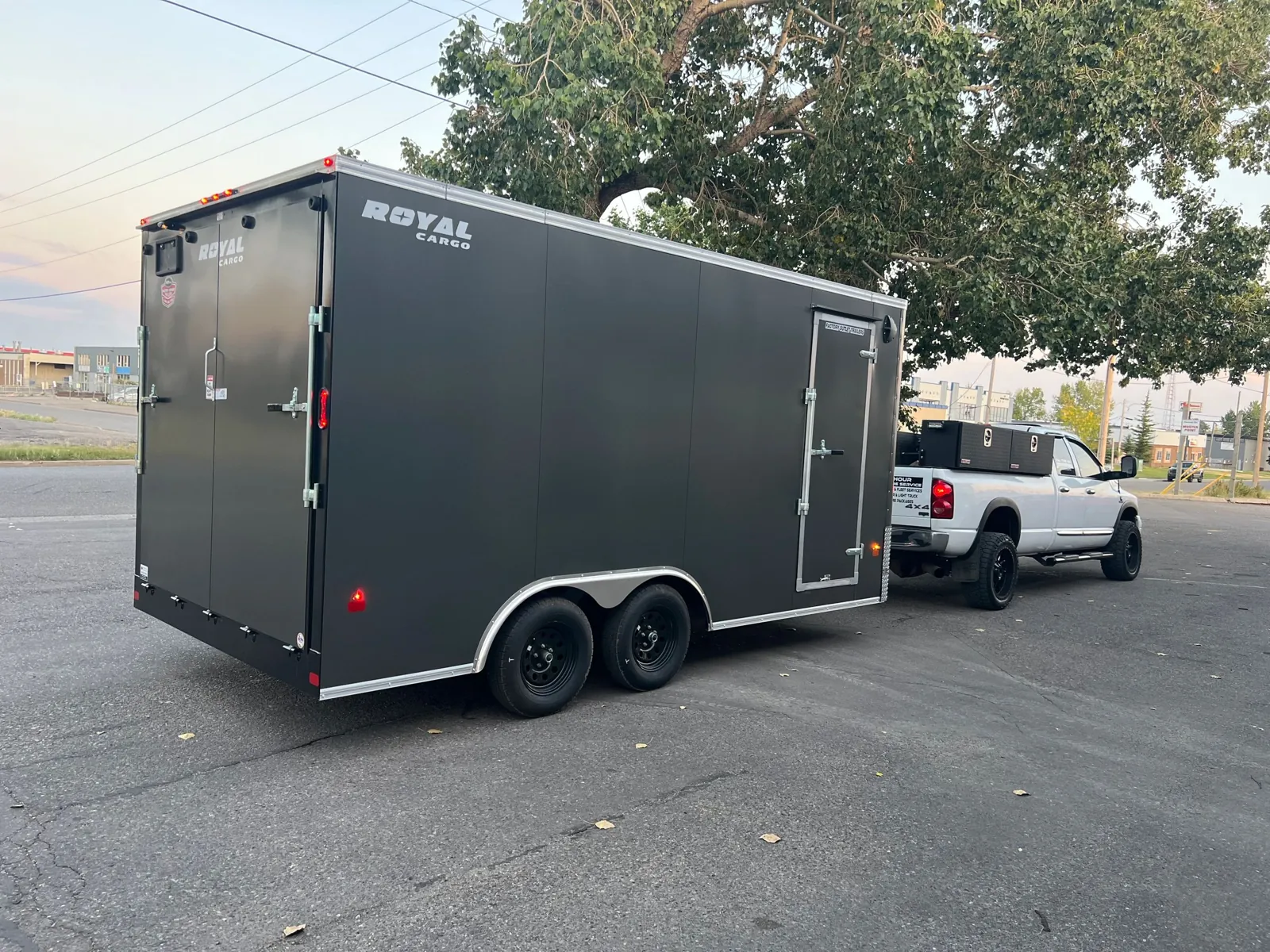
The photograph accompanying this guide shows a pickup and enclosed trailer from the KMJ photo library. It illustrates mobile-service logistics, not a classic-car restoration, a completed tire installation or an offer to transport your vehicle.
Start with the car you own, not the catalogue description
Write down the year, make, model and body style, then list known changes separately. A registration document identifies a vehicle, but it cannot tell a technician whether a previous owner changed its axle, fitted different wheels or altered ride height. The original specification is the starting point; the current configuration is what must safely work on the road.
Look for an owner's manual, workshop literature and receipts that identify installed components. Keep the source with each fact. "Original wheel size from manual" and "current wheel size from casting" are more useful entries than a single number copied into a notes app. If those entries disagree, you have discovered a question to resolve, not a reason to select whichever answer is more convenient.
Photograph the visible tire markings on every position, including the spare. Take a wider image showing the whole wheel and a close image of its markings if they are safely accessible. Do not crawl under an unsupported vehicle or remove parts simply to finish the paperwork. Let a properly equipped professional obtain hidden information.
This preparation makes a Calgary tire-buying consultation much more productive. Instead of asking for "something close to the old ones," you can present a defined vehicle, an incomplete or complete fitment record, and a clear description of the driving you want to do. An honest unknown is better than an inherited guess.
Choose the intended use before choosing the appearance
A stationary museum display, a car carried to events and a car driven on public roads do not present the same tire-selection problem. For road use, appearance remains a preference inside the safety requirements, not an exception to them. Brief trips still involve turns, braking, uneven pavement and exposure to other traffic.
Describe your actual use in plain language. Perhaps the car travels to local evening gatherings, or perhaps it makes full-day outings with luggage and a passenger. Mention highway travel, gravel access, the likelihood of rain and whether the vehicle will ever remain away from home overnight. "Summer car" is less informative than explaining what happens when the return journey is wet or unexpectedly cold.
Be equally candid about originality. Some owners want the original sidewall style and profile; others chiefly want predictable touring behaviour while keeping the original wheels. Neither preference is embarrassing. Trouble starts when a visual preference is treated as if it automatically answers questions about construction, load capacity or approved rim width.
Keep a short priority list with non-negotiable compatibility at the top, followed by road-use needs and then styling. When comparing budget and premium tire choices, remember that a higher price alone cannot establish suitability. A specialized appearance, unusual size or limited production run may influence cost without proving that a product is the right match for your particular car.
Treat the existing tires as evidence, not instructions
The tires already fitted may have served the car for years. That history is worth recording, but it does not establish that the previous selection was correct. A car with limited annual use can conceal clearance or loading problems simply because it rarely encounters the circumstances that expose them.
Record the manufacturer, product line, complete size marking, construction and any load or speed information. Note whether the front and rear markings differ. A restoration receipt saying "four new tires" is useful only if you can connect it to the tires now installed. Replacements may have occurred one at a time, and a spare may have remained untouched through several ownership changes.
Distinguish physical evidence from family recollection. "Bought during the restoration" is not a manufacturing date. "Always inflated to this pressure" does not identify the technical basis for that pressure. "Never rubbed before" may describe driving with one person and an empty trunk rather than the use you are planning.
The tire sidewall information guide helps organize modern markings, but vintage sizes may require specialist interpretation. Preserve the punctuation, letters and units exactly as shown. A missing construction letter or a casually rounded rim designation can change the meaning. Good photographs also let someone correct a transcription without asking you to inspect the vehicle again.
Period styling does not tell you the internal construction
Bias-ply and radial describe construction, not simply an old-looking and a new-looking tire. Sidewall graphics, a narrow tread appearance or a whitewall cannot reliably identify what lies inside. Read the actual markings and product specification instead of judging the silhouette.
Coker's current bias-look radial catalogue provides a useful concrete example. It describes tires built with radial internal construction while retaining styling associated with older bias-ply products, including traditional-looking size designations with an R added. That establishes that the category exists; it does not approve any listed tire for your car.
A change in construction should therefore be discussed as a fitment decision, not sold as a universal upgrade. The vehicle, wheels and complete tire set need to be considered together. Do not mix constructions on the strength of an enthusiast's anecdote, and do not use this article as a pattern for arranging a mixed set. Follow the applicable vehicle and tire-maker guidance for the actual combination.
Ask the supplier to identify the exact product and its construction in writing. Descriptions such as "vintage radial style" can be ambiguous in a casual conversation. If you want a period appearance with a particular construction, make those two separate requirements on the estimate. That small distinction prevents an order from satisfying the visual part while missing the functional one.
An old size conversion is a shortlist, not a final answer
Vintage sizing can involve numeric, alphanumeric or metric conventions. A conversion chart may suggest contemporary candidates, but a nearby outside diameter does not establish a complete replacement. The selected tire also needs an appropriate load capability, suitable wheel dimensions and clearance on the actual vehicle.
Avoid converting a marking from memory. Photograph it, identify the convention and obtain the candidate manufacturer's dimensional data. Ask what rim width was used for the published dimensions and what range of rim widths the manufacturer permits. A measurement quoted for one measuring rim is not a promise that the tire will have the identical shape on every other approved rim.
Separate bead-seat diameter from outside tire diameter. Those are different dimensions with different jobs. Similar overall height cannot make a tire fit an incompatible rim. Nor should an inch designation and a nearby metric wheel size be treated as interchangeable because a conversion calculator produces a close number.
A helpful comparison sheet has columns for original specification, present equipment and proposed product. Leave cells blank when the answer is unavailable, and assign the question to the vehicle specialist or manufacturer rather than filling it with an estimate. Once the fitment is established, the Calgary tire-brand directory can help frame local product discussions. It is not a promise that an unusual classic-car size or every specialty line can be supplied.
Identify the wheels before committing to the tires
The visible face of a wheel tells only part of its story. Diameter, width, offset, mounting arrangement and condition matter, while some useful identification may be on the reverse side. A wheel resembling the factory design could be a later reproduction or a modification with different dimensions.
Give the assessor any purchase receipt or manufacturer information you have for replacement wheels. If the car retains old wheels with uncertain history, ask what inspection and identification are needed before a tire can be selected. Matching the wheel's outward appearance to an online image is weaker evidence than a traceable part number supported by specifications.
Corrosion, cracks, distortion or uncertain repairs need professional assessment. Do not sand, weld, bend or coat a questionable area to make the wheel acceptable for mounting. Cosmetic restoration is not evidence of structural fitness, and fresh paint can make the underlying history harder to see. An appropriately qualified wheel specialist should handle questions outside routine tire work.
Some older designs require specialist equipment and expertise that should be disclosed before service is arranged. If the construction is unfamiliar, stop at identification; this is not a do-it-yourself disassembly task. The useful request is specific: "Can this exact wheel be inspected and serviced with your equipment?" It is better to hear that a specialist is needed before a scarce tire is ordered or the vehicle is immobilized.
Resolve tubes, valves and rim details as one system
Do not assume that an old car must use tubes, or that a modern-looking replacement makes a tube unnecessary. The answer depends on the tire's permitted use and the wheel's design and condition. Read the tire-maker's requirements and have the complete assembly assessed.
A tube is not a repair for a cracked wheel, a damaged casing or an incompatible bead fit. If someone suggests adding one merely because the wheel will not hold air, the underlying problem still needs a proper answer. Likewise, the fact that an assembly currently contains a tube does not prove it was assembled correctly in the past.
When tubes are specified, establish the required type, size and valve arrangement with the supplier. A valve that appears to emerge neatly through the wheel can still be the wrong component. Wire wheels or other specialist designs can introduce additional requirements; rely on the relevant manufacturer or wheel specialist, not a generic passenger-car mounting assumption.
Make the estimate explicit about tubes, valves and any other required components. That avoids comparing a complete proposal with a tire-only price. Tell the technician if an old assembly has sealant or an uncertain repair history. For a pressure-loss concern, discuss tire repair assessment in Calgary without presuming the answer will be a repair. Specialty construction, age or damage may make replacement or specialist referral the appropriate result.
Load capability matters even when the car stays local
A large older coupe can carry more than its driver: passengers, luggage, tools and event supplies all contribute to the load. Tire selection cannot be based only on an attractive stance or the belief that a car is lightly used. Distance and load are separate questions.
Use documented vehicle requirements and the proposed tire's specifications. If modifications materially changed the configuration or the required data are missing, get qualified help establishing the basis for selection. Do not take a modern tire's load marking, multiply it by the number of tires and declare the whole vehicle approved. Wheel ratings, axle limits and load distribution are separate constraints.
The tire load-index explanation is useful for understanding one piece of modern service descriptions. Some vintage-oriented products present their specifications differently, so request the manufacturer's data for the exact item. An unfamiliar marking should trigger clarification rather than an improvised equivalence.
Be alert when comparing products that look alike but have different specifications. A whitewall width, nominal size or familiar brand name does not establish identical capacity. Save the actual part number selected, along with the supporting specification sheet. That record makes it much easier to evaluate a future replacement if one tire is damaged and a seemingly similar version is suggested instead.
Build a supported inflation plan, not a round-number habit
Start with the vehicle's applicable inflation information. Transport Canada's inflation guidance explains why vehicle recommendations matter and why tire pressure should be checked cold. The maximum value molded on a tire is not a universal instruction for operating every car fitted with it.
A classic car introduces a complication when the original documents describe a tire construction or fitment that is no longer installed. Do not silently apply a forum pressure, a sidewall maximum or a modern vehicle's setting. Ask the tire manufacturer and a qualified vehicle specialist for guidance applicable to the proposed combination, and retain their answer with the configuration it covers.
Record separate front and rear instructions when they differ. Include the unit, the source and any stated loading condition. A note that says only "set to the usual pressure" is not helpful when someone else brings the car out of storage. A clear record also prevents a well-meaning helper from changing a deliberate front-to-rear difference simply because matching numbers look tidier.
Use a suitable gauge and inspect pressures before driving, not just after the tire has warmed in use. If a tire repeatedly loses pressure, investigate it rather than compensating indefinitely with more air. Temperature-related changes and leaks are different issues, and a vehicle that sits for weeks deserves a fresh check even if the previous outing was uneventful.
Deep tread is not a certificate for an old tire
Collector cars can wear tires very slowly. That makes tread depth an incomplete way to decide whether a set remains suitable for road use. Age, storage history, impacts, previous repairs and pressure-loss history all belong in the assessment alongside the remaining tread.
Continental's passenger-tire replacement guidance explicitly warns that apparent good condition and remaining tread do not settle an age-related replacement decision. Find the manufacturing date information where available and follow the relevant tire and vehicle manufacturers' inspection and replacement guidance. Do not translate a purchase date into a production date. Nor does a freshly restored car necessarily have freshly manufactured tires: the restoration may have reused a set that looked correct and still held air.
Visible cracking, a bulge, exposed material, an unexplained distortion or a history of running seriously underinflated is a reason to stop and obtain qualified advice. Absence of an obvious defect is not proof that the inside is sound. A photograph taken in flattering light is especially poor evidence for accepting an unknown used tire.
Treat a genuinely historic tire as a collectible object if that is its value to you, rather than asking it to remain a road component indefinitely. Preserve its markings in photographs before replacement and discuss keeping it separately if appropriate. That protects the historical record without making the road-use decision depend on sentiment. A practical tire-care routine remains relevant even when the odometer barely changes between seasons.
When the manufacturer's page disagrees with itself
An online catalogue can contain useful technical information and still need clarification. During preparation of this guide, Coker's Excelsior Roadster Radial 600R16 listing provided a real example: the description said the tires require a tube because of wheels of the era, while the specification table labeled the product tubeless. Those statements should not be silently collapsed into one universal answer.
The sensible response is to ask the supplier about the exact tire and wheel combination, referring to both statements and the item identifier. The wheel may introduce a requirement distinct from the casing's construction, but an owner should not invent that explanation as a substitute for confirmation. Save the response, including any conditions, before committing to the assembly.
This is also why a category page is not enough. It can establish that bias-look radials or collector-vehicle tubes exist, but the individual product and its application still require review. Coker's collector tube information distinguishes size and valve-stem arrangements and emphasizes matching the application.
Use the same discipline for inconsistencies between an old manual, a replacement wheel receipt and a current tire data sheet. Identify the conflict in a sentence, assign it to someone qualified to answer, and wait for a supported resolution. A quick purchase that leaves the compatibility question unanswered has not saved time; it has moved the uncertainty into the service bay.
Clearance means more than a parked photograph
A tire that clears the body with the car stationary and the steering straight ahead has passed only a limited observation. The real vehicle turns, carries people and moves through its suspension travel. Changed ride height, replacement wheels or body repairs can affect the space available.
Have proposed fitment assessed for the actual configuration. Do not supply a homemade clearance limit from this guide; there is no universal measurement here that approves every classic. Photograph previous rubbing marks and explain when any noise occurred. A mark inside a wheel arch is useful evidence even if the current owner did not witness the event that caused it.
Different products carrying the same nominal size can have different published dimensions and shapes. Compare the manufacturer information rather than assuming one approved brand or pattern makes every replacement in that size identical. Include the tire's intended wheel width in that discussion instead of looking only at tread width.
Wheel spacers, body trimming, altered stops or suspension changes are not automatic tire-service fixes. Those proposals require the appropriate vehicle specialist and applicable guidance. If a standard, supported fitment will not accomplish the appearance you want, recognize that you are considering a modification project. Keeping that distinction clear helps prevent a straightforward tire replacement from turning into an unplanned engineering experiment.
Balancing cannot approve the rest of the car
A newly mounted assembly may require balancing, and wheel balancing in Calgary addresses that tire-service task. It is not a general cure for every vibration, nor does a satisfactory balance result certify an old wheel, a damaged tire or the vehicle's steering and suspension.
Explain any symptoms before the work begins. Was there a vibration before the tire replacement? Did it start after storage, an impact or another repair? Was it associated with a particular road surface or with braking? Record what you actually noticed without trying to name the failed part. That history gives the right professional something concrete to investigate.
After service, do not accelerate to a higher speed merely to see whether a new vibration disappears. Stop safely and seek advice if the car feels abnormal. The first outing should be an opportunity to confirm normal operation after the required work, not an attempt to force an unexplained problem to resolve itself.
Ask what follow-up checks apply to the completed installation, including any wheel-fastener recheck instructions from the relevant manufacturer or service provider. Keep those instructions with the invoice. KMJ tire service does not substitute for a mechanical inspection of a classic car that has sat unused or has uncertain steering, brake or suspension condition; arrange that separately with a qualified specialist.
Whitewalls and trim deserve instructions of their own
A whitewall, redline or raised-letter design adds a visual requirement that is worth stating clearly before ordering. Specify the desired sidewall style for the exact product rather than assuming a catalogue photograph represents every size in the range. Some images illustrate a family of products instead of the item being purchased.
Discuss cleaning with the tire manufacturer. Do not assume that a household solvent, abrasive pad or a product used safely on painted bodywork is suitable for the sidewall. Cleaning advice can differ by product, and aggressive attempts to remove discoloration may create damage or obscure evidence you should have shown the supplier.
Decorative wheel trim can also complicate access to valves or service equipment. Tell the technician about scarce hubcaps, trim rings, locking arrangements and any unusual removal method. If documentation exists, provide it. A part that looks like a familiar snap-on cap may have a different retaining system, so forcing it is not a sensible way to identify it.
Before the visit, photograph the wheel faces and trim in ordinary light and identify existing damage. This is not about expecting a dispute; it gives everyone a shared starting point and helps ensure loose pieces are accounted for afterward. Keep cosmetic preferences separate from safety decisions. A desirable whitewall width cannot make an unsupported fitment acceptable.
Calgary's season matters even for a summer-only classic
A car used only in the warmer part of the year still needs a plan for a change in conditions. Consider the whole outing, including the return after sunset, rather than only the temperature when leaving the garage. This is a planning principle, not a claim about today's weather.
Look at the actual tire's intended conditions and manufacturer restrictions. A classic-looking tread is not a winter certification, and a performance-oriented product is not suitable for every temperature merely because it is newly manufactured. If the expected conditions fall outside the supported use, postponing the drive is a valid tire decision.
The distinctions in the all-season tire guide, all-weather tire comparison and Calgary winter tire guidance can help owners understand the categories. They do not mean that each category is available in your car's size or compatible with its wheels. An appropriate seasonal product still has to meet the vehicle's fitment requirements.
For a collector car that will be stored through winter, decide when road use will end and how the car will reach storage without depending on a last-minute fair-weather window. If more than one supported set is used, discuss seasonal tire changes only after the configuration of each set is established. A second set should simplify a known plan, not conceal unresolved wheel compatibility.
Storage should preserve the record as well as the rubber
Before putting the car away, document the installed tire identities, current condition and any unresolved concerns. Save the pressure guidance where it can be found next season. A storage note is especially valuable when a family member, caretaker or new owner may be the next person to move the vehicle.
Follow the vehicle and tire manufacturers' storage instructions for your arrangement. A car resting on its tires and loose tires stored separately are different situations. Do not improvise a lifting or support method from general tire-storage advice. Supporting a classic vehicle safely depends on its structure and suitable equipment, and belongs with someone qualified when you are unsure.
Protect tires from avoidable contamination and inspect the storage environment for leaks or equipment that could expose them to damaging substances. Avoid treating a cover or dressing as a substitute for suitable storage conditions. If something spills onto a tire, record the substance and seek manufacturer guidance rather than washing it off and assuming the issue has ended.
At return to service, review what changed during storage: pressure, visible condition, leaks and any work performed on the vehicle. A preserved worksheet lets you compare observations rather than reconstructing them from memory. Tires are only one part of recommissioning; an older car with uncertain mechanical readiness needs the relevant checks before driving, regardless of how tidy its tire set looks.
Plan the service location before moving a doubtful car
A car with questionable tires should not be driven across the city just to make assessment convenient. Explain the condition and ask about suitable options first. Depending on the vehicle, wheels and location, that might involve assessment where it sits, properly arranged transport, or work by a specialist with the required equipment.
For mobile tire service in Calgary, provide photographs of the access route and intended work area along with the vehicle details. Mention restricted clearance, a narrow garage entrance, a sloped driveway or a surface that may not support service equipment. The provider must decide whether the location and task are appropriate; the presence of a driveway does not establish that they are.
Check the KMJ mobile service areas and confirm your specific address and requirements. Geographic coverage alone does not prove that every vintage wheel design can be handled at every location. Likewise, a trailer photograph is not evidence that vehicle hauling is included in a tire service.
If loose assemblies are being brought for assessment, explain how they were removed and identify their original positions when known. Secure them appropriately for transport and keep loose trim separate and protected. Do not disassemble an unfamiliar wheel in order to make it easier to carry. Planning the handover is part of protecting both the car and the people working around it.
Include the spare in a changed-fitment decision
A spare hidden beneath a trunk mat can be easy to overlook during an otherwise careful replacement. Identify its tire and wheel, its condition and the instructions governing its use. Do not assume it is suitable merely because it was supplied with the car many years ago or fits neatly into the original storage space.
If the road wheels or tire configuration have changed, specifically ask whether the spare still works with the current vehicle. Mounting compatibility and permitted operation matter independently of whether the spare can physically be carried. A spare-wheel well may limit what can be stored, but that does not authorize using an incompatible emergency assembly.
Check that the equipment accompanying it belongs to the present arrangement. Wheel-lock keys, suitable fasteners where required and the vehicle's lifting instructions should not be discovered missing during a roadside stop. This is preparation, not a recommendation to change a wheel yourself in traffic or to use an unfamiliar old jack without assessment.
Write down an alternative recovery plan if no suitable spare is carried. Explain unusual wheel hardware and the vehicle's condition to a roadside provider when arranging help. Neither an aerosol repair product nor a display-only spare should be treated as a universal substitute. A deliberate plan is particularly useful when a scarce replacement size cannot be obtained quickly during a trip.
Two hypothetical owners, two different decision paths
Consider an owner of a largely original coupe who wants its traditional sidewall appearance for occasional road outings. The owner has the original manual, but the wheel markings have not been verified and the tire history is incomplete. The first step is not selecting the most attractive catalogue image. It is confirming the present wheels, assessing the old assemblies and obtaining specifications for appropriate candidates.
That owner may eventually find a supported product with the desired look, or may need to change the appearance preference. The decision follows evidence. If the required wheel information cannot be established, the purchase pauses while a specialist resolves it. There is no need to invent a substitute size just to keep a planned event date.
Now consider a modified touring car with documented aftermarket wheels. Its owner values road manners more than strict visual originality and plans longer drives with luggage. Here the useful information includes wheel specifications, modifications, expected loading and the tire manufacturer's approved application. A factory-era appearance chart is less decisive than the documented current configuration.
These examples are hypothetical, not KMJ customer stories or product recommendations. Their different paths show why "classic car tires" is not a single specification. Both owners should leave with a traceable choice and clear follow-up instructions, but the evidence required to reach that point can differ considerably. The common result is a supported configuration, not necessarily the same construction, sidewall treatment or brand.
Make the estimate answer the actual unresolved questions
Request an estimate that identifies the exact tire product and the basis for its suitability. Ask whether the proposed work includes mounting, balancing, valves or tubes where required, and how uncertain wheel condition will be handled. A clear scope is more useful than comparing headline prices for packages that contain different work.
If you are supplying tires yourself, discuss that before purchasing. Confirm whether the provider can handle the dimensions, wheel design and proposed assembly, and what documentation they need. A product being available online does not establish that a local technician has agreed to install it, that it fits, or that every accessory arrives with it.
Write down which questions remain open and who will answer them. For example, a tire supplier may need to confirm tube suitability while a wheel specialist assesses the rim. Do not ask the installer to resolve missing engineering information by trial fitting a product that should have been ruled in or out beforehand.
When those details are settled, use KMJ's online tire-service booking to begin arranging the appropriate visit and provide the relevant notes. Booking is not approval of an unreviewed modification or confirmation of specialty stock. A well-prepared request makes the remaining conversation shorter because it presents the real task rather than hiding the difficult parts behind the car's model name.
Keep a tire file the next owner can actually use
A useful handover file is small enough to maintain. Keep the selected product specification, invoice, wheel identification, pressure instructions and dated condition photographs together. Include any written clarification that resolved a conflict, especially advice about tubes, wheel compatibility or a non-original configuration.
Record changes when they occur. If a damaged tire is replaced with a different product, revise the file instead of leaving the original set description untouched. If the wheels are refinished or assessed by a specialist, keep that record without interpreting cosmetic work as structural approval. Separate what was inspected from what was simply cleaned or repainted.
The file should also distinguish current road equipment from historic parts retained for display. A future owner should not have to guess whether a carefully preserved old tire is intended for use or kept because its markings matter to the car's history. Label that distinction in the records rather than altering the tire itself.
The best classic-car tire decision is one you can explain without saying "it seemed close enough." Identify the car's present configuration, verify the wheel and tire combination, choose for the intended conditions, and preserve the reasoning. Then the finish, lettering and period silhouette can remain enjoyable details within a sound decision rather than distractions from unanswered questions.