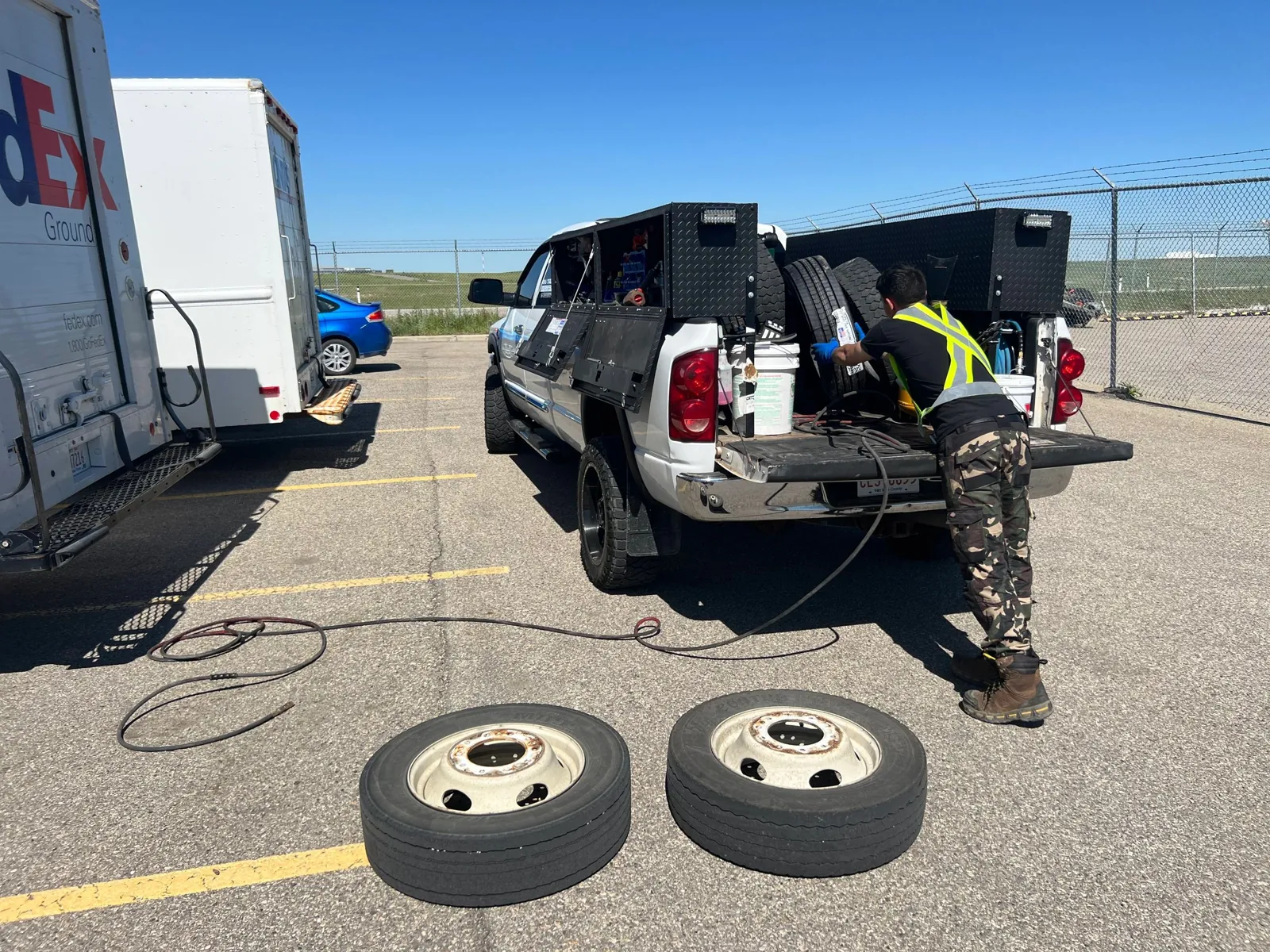
A small Calgary moving company has one 20-foot box truck that does most of the work. On a Tuesday in November the driver notices the inside rear tire on the passenger side looks a little soft. The outside tire beside it looks fine, so the truck finishes the day. On Wednesday morning the inside tire is clearly low, the outside tire has a shiny scuffed shoulder, and the owner is trying to work out three things at once: what size the tires actually are, whether one tire or two need replacing, and what pressure the truck should be running when it is full of furniture versus when it is empty.
That is the reader this guide is written for. You run a cube van, a cutaway box truck, a step van or a medium-duty straight truck in and around Calgary. You are not running a semi fleet with a full-time tire manager. You have one truck, or three, or eight, and the tires are one more thing on a long list. You want to know what to look at, what to write down, which decisions are yours and which belong to the vehicle maker, the tire maker or a mechanic.
The Short Answer
Start with the label on the truck, not the tire you can see. The vehicle's certification and tire information labels tell you the tire size, the axle weight ratings and the cold pressures the maker set. Then find out what the truck really weighs on each axle when it is working, because a box truck's load changes more than almost any other vehicle. Use the tire maker's load-and-inflation table to match pressure to that real load, check every tire cold with a gauge, including the inside duals, and treat a tire that keeps losing air as a problem to find rather than a tire to keep topping up.
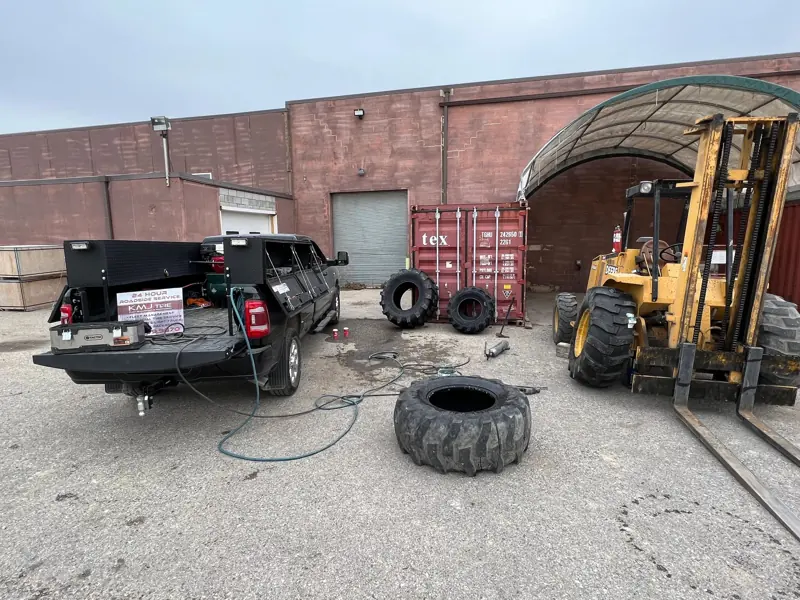
When you replace tires, do not go smaller in size or lower in load capacity than the original specification. On a dual rear axle, the two tires on each side work as a pair, so a new tire beside a worn one needs a deliberate decision, not a guess. If the truck needs help on the road or at the yard, KMJ's mobile commercial tire service in Calgary can come to the truck for tire work. Everything else in this guide explains how to make those steps practical.
What Counts as a Box Truck in This Guide
People use "box truck" loosely, and the tire answer depends on which kind you have. It helps to sort them into three rough groups by the wheels they ride on.
The lightest group is the cutaway van with a box built on the back. These often look like a large van at the front and a cube at the rear. Many ride on 16-inch light-truck tires, often with dual rear wheels. Their tire sizes look like ordinary truck sizes with "LT" at the end, and their tire choices overlap with heavy pickups and cargo vans.
The middle group is the medium-duty straight truck that many rental, moving, delivery and trades businesses use. These commonly ride on 19.5-inch commercial tires, and some on 17.5-inch tires. The sizes look different from car and pickup sizes, the load markings look different, and the shops that stock them are not always the same shops that stock passenger tires.
The heaviest straight trucks, such as larger beverage trucks or some dump and service bodies, run 22.5-inch tires like a highway tractor. If yours is in that group, much of the semi-truck thinking applies, and this guide's load and pairing sections still hold.
The point of sorting is simple: before you call anyone, know which group your truck belongs to. A 16-inch cutaway, a 19.5-inch straight truck and a 22.5-inch body truck have very different tire families, and a quote that starts from the wrong family wastes everyone's morning.
Read the Truck's Labels Before the Tire
Most trucks carry a certification label on the driver's door edge or door pillar, and many carry a separate tire information label nearby. Between them you will usually find the gross vehicle weight rating, the gross axle weight rating for the front and rear axles, the original tire size for each axle, and the cold inflation pressure the vehicle maker specified. Some upfitted trucks also have a second label from the company that built the box.
USTMA's replacement guidance is blunt about where specifications live: on the label inside the driver's door, in the glove box or fuel door, and in the owner's manual. That advice was written with ordinary vehicles in mind, but the principle carries straight over. The label tells you what the truck was certified to carry on the tires it was built with. The tires currently on the truck may or may not match it, especially on a used truck or one that has been through several owners.
Take a photo of every label on the truck and keep it with the truck's records. Then walk around and photograph the sidewall of one tire at each position: left front, right front, and at least one outer and one inner rear on each side. Inner duals are awkward to photograph, but the effort pays off the first time someone asks what size you need. If the tires on the truck do not match the label, write that down. It is one of the most useful facts you can bring to a quote.
If you want a refresher on what all the sidewall characters mean, KMJ's page on how to read tire sidewall information walks through the markings in plain language.
Commercial Tire Sizes Look Different for a Reason
On a 19.5-inch straight truck you might see a size such as 225/70R19.5 or 245/70R19.5. The first number is a nominal section width in millimetres, the second is the aspect ratio, R means radial construction, and 19.5 is the rim diameter in inches. The half-inch rim sizes, 17.5, 19.5 and 22.5, are typical of commercial tubeless tires. They are not interchangeable with 17, 19 or 22-inch passenger and light-truck rims, even though the numbers look close. A tire must match the rim diameter it was designed for exactly.
On a cutaway with 16-inch wheels you might see a size ending in LT, such as a 215/85R16 LT or a 225/75R16 LT. Those are light-truck sizes, and they follow light-truck load rules, which is a different system from passenger tires.
Commercial truck tires often show two load index numbers separated by a slash, for example a pair like 128/126 printed after the size. The first number is the load capacity of that tire when it is used as a single, such as on the steer axle. The second number is the capacity per tire when it is used in a dual pair. The dual figure is lower because two tires side by side share heat, road crown and load less evenly than one tire alone. If you only read the first number, you will overestimate what each rear dual tire can carry.
You will also see a load range letter or a ply rating, a speed symbol, and markings that tell you the maximum load and pressure. That maximum pressure is not a recommendation for daily use. Michelin states it plainly in its commercial pressure guidance: the maximum pressure marked on a tire should not automatically be treated as the right operating pressure for every application. For more on how load numbers translate into weight, see KMJ's guide to tire load index explained for Calgary drivers.
Why a Box Truck's Load Changes Everything
A highway tractor pulling the same kind of trailer every day has a fairly predictable load. A box truck rarely does. A moving truck can leave the yard nearly empty and come back carrying a full house. A flooring company's cube van might carry pallets of tile on Monday and two people with hand tools on Friday. A food distributor can start the route heavy and finish it light.
Michelin's method for setting commercial pressure begins with the load, not the tire: determine the load carried by each axle under representative operating conditions, using actual loaded weights rather than assumptions. Then identify the tire size and whether the axle is single or dual, then consult the tire maker's load-and-inflation table, and finally factor in the application and operating conditions.
For a small operator, "representative" is the key word. If your truck spends most of its working day heavy, set up around the heavy condition. If it spends most of its day light with occasional heavy trips, you have a decision to make about whether to run one pressure that covers the heavy case or adjust for heavy days. That decision belongs with your fleet policy and, where the truck maker gives specific instructions, with the vehicle maker. What should never happen is that nobody decides and the pressure drifts wherever the last person left it.
The other reason load matters is how it sits. Box trucks put a lot of weight behind the rear axle when the box is loaded from the back forward. A truck that is under its gross vehicle weight rating can still be over its rear axle rating if the load is stacked badly. That is a loading problem as much as a tire problem, but the tires are where it shows up first.
Weigh It Once, Then Write It Down
You do not need a scale in the yard to get useful numbers. Commercial scales are common at gravel pits, recycling depots, grain terminals and truck stops around the Calgary region, and many will print a ticket showing the weight on each axle if you position the truck on the platforms correctly. Ask how the scale works before you drive on.
Weigh the truck three ways if you can: empty with a full fuel tank and the normal crew, loaded the way it usually runs, and loaded the way it runs on its heaviest regular job. Write down the front axle weight and rear axle weight for each. Keep the tickets in the truck file.
With those numbers you can do three useful things. First, compare each axle weight with the gross axle weight rating on the door label. If the rear axle is close to or over its rating on heavy days, that needs attention from whoever loads the truck, and possibly a conversation with the truck dealer about whether the truck is right for the job. Second, divide the rear axle weight by four on a dual axle, or the front axle weight by two, to get an approximate per-tire load, then compare that with the tire's single or dual load capacity. Third, use the tire maker's table for that exact tire to find the cold pressure that supports that load.
A worked example helps, and this one is a composite rather than a real customer. Suppose a 19.5-inch box truck weighs a little over 5,000 kg on the rear axle when fully loaded. Divided across four dual tires, that is roughly 1,250 kg per tire. You would open the tire maker's load table for that exact size and load range, look in the dual column, and find the lowest listed cold pressure that supports at least 1,250 kg per tire. Then you would check that number against the vehicle maker's label. The label value is the baseline the truck was built around; the table tells you what the tire needs for the load. If they disagree, ask before choosing.
Toyo's load and inflation page makes a related point for optional sizes: its tables are there to help when a replacement size is not listed on the vehicle placard, and for the original size you go back to the placard or owner's manual. It also points to the Tire and Rim Association as the source of published load and inflation standards. In plain terms, tables are how you get from a weight to a pressure, but they work alongside the vehicle's own specification, not instead of it.
Pressure: Cold, Gauged, Every Position
Michelin's commercial checklist is short and worth following exactly. Check pressure when the tires are cold, because driving heats the air and raises the reading. Use an appropriate, calibrated gauge. Check every tire position, because a visual check cannot reliably tell you whether a tire is properly inflated. Compare each reading with your established cold inflation specification. Inspect the valve and valve cap. Investigate any tire that keeps losing pressure.
On a box truck the hardest step is "every position." The inside duals are the ones that get skipped. Their valves are harder to reach, sometimes they point the wrong way, and in a dark yard at 6 a.m. with a cold wind it is tempting to thump the outer tire and call it good. Thumping cannot tell you much. If the inside valve is hard to reach, ask about valve extensions or reorienting the valves at the next tire service so the inside valve can be reached with a straight-chuck gauge through the wheel's hand hole.
Calgary adds a wrinkle. Transport Canada points out that a tire that reads correctly in a warm garage will be underinflated when it is below zero outside, which is why checks should be done with cold tires. A box truck stored indoors overnight and then parked outside all day on a winter route can lose a noticeable amount of pressure between the bay and the first stop. If your truck lives in a heated shop, check it after it has sat outside long enough to reach outdoor temperature, or set your baseline knowing it will drop. If it lives outside, check it in the morning before the first run, when the tires have been cold all night.
Write every reading down. A sheet on a clipboard is fine. What you are looking for is a tire that reads a little lower each week than its neighbours. That trend is far more useful than any single reading.
Duals Work as a Pair
The two tires on each side of a dual rear axle are bolted together through the same hub and share the load between them. When both are the same size, wear and pressure, they share it roughly evenly. When one is lower or smaller than the other, the bigger, firmer tire carries more than its share, and the smaller, softer one tends to scrub and heat up.
That is exactly what happened to the moving company in the opening. The inside tire was losing air. As it softened, its rolling diameter dropped and the outside tire took more of the weight. The outside tire was not damaged by a curb or debris; it was overloaded by its partner. The scuffed shoulder on the outside tire was the sign. Replacing only the inside tire might have solved the leak but left an outside tire that had been working beyond its share for days, and the owner needed that tire inspected too.
Tire makers publish tolerances for how closely dual tires should match in diameter or tread depth. The exact number depends on the tire size and maker, so ask for the tire maker's figure rather than relying on a rule of thumb. In practice, the habits that keep duals healthy are simple: run both tires in the pair at the same cold pressure, keep their tread depths close, put matched tires together when you replace, and check both whenever one shows a problem.
Look between the duals as well. Stones, chunks of ice and wood scraps can wedge between the two tires on a gravel lot or a construction site. A rock wedged there can damage both sidewalls. In winter, packed snow and ice between the duals can hide a problem until it thaws.
Steer Tires and Rear Tires Have Different Jobs
Michelin describes steer, drive and trailer positions as having different priorities. For steer tires the priorities are handling, steering response, stability and even wear. Drive tires prioritize traction, durability and wear under acceleration and torque. Box trucks do not have a trailer axle, so the picture is simpler: the front axle is the steer position, and the rear duals are usually the drive position.
Many 19.5-inch trucks run what makers call all-position tires on both axles, which simplifies stocking and lets you rotate in some setups. Others run a rib pattern on the front and a more open traction pattern on the rear. Neither is automatically right. Michelin's own framing is that some tires are designed for multiple positions while others are optimized for one, and that the right choice depends on where the tire is mounted and how the vehicle operates.
For Calgary box trucks the question to ask is: where does the truck lose traction or wear tires fastest? A truck that struggles to pull away from snowy alleys and loading-dock ramps may benefit from a rear tire with more traction. A truck that eats its front tires on tight downtown turns may need a front tire chosen for scrub resistance. If you are not sure, KMJ's commercial tire services in Calgary page describes the commercial tire work the shop handles, and the team can talk through tread patterns for your route.
City Routes Wear Tires Differently Than Highway Miles
Michelin separates long-haul highway use from regional work with frequent stops, turns and varied roads. Long-haul use leans toward rolling resistance and even wear over high mileage. Regional operation leans toward durability, traction and resistance to scrub and irregular wear.
Most Calgary box trucks are regional or urban in that sense. They stop constantly, turn tightly in residential streets and industrial parks, reverse into docks, climb onto curbs to let traffic past, and spend more time between 0 and 50 km/h than at highway speed. That style of driving wears tires through scrubbing and shoulder abrasion rather than slow, even tread loss.
The practical consequence is that the "best" tire for a box truck doing deliveries in Forest Lawn or Bridgeland may not be the tire with the best fuel-economy story. It may be one that resists chunking at the shoulders, holds up to dock bumpers and curb contact, and gives predictable traction on a packed-snow side street. If your truck spends time on the Deerfoot or runs regularly to Red Deer or Lethbridge, that changes the balance again.
When you are comparing quotes, ask what kind of use the tire is designed for, not just its price. KMJ's article on budget vs premium tires in Calgary lays out how to think about the trade-off between upfront price and how long a tire lasts in your kind of driving.
Calgary Winter and Box Trucks
Transport Canada's winter tire guidance was written for everyday drivers, but three points in it matter for small commercial operators too. Below about 7 degrees Celsius, all-season and summer tires begin to lose elasticity and traction, while winter tires are designed to stay pliable at lower temperatures. Tires marked with the peaked mountain and snowflake symbol meet specific snow traction performance requirements. And as a tire wears, it loses traction; Transport Canada advises not to use tires worn close to 4 mm on snow-covered roads.
Commercial tires are a separate market from passenger winter tires, and not every commercial size is offered with the mountain-snowflake symbol. Some commercial drive and all-position tires carry it; many do not. If winter traction is a priority for your route, ask specifically whether the tire you are being quoted carries that marking, and do not assume an aggressive tread pattern alone means it does.
Alberta does not require winter tires on most vehicles, so the decision is usually yours. Think about where the truck actually goes in January. A truck running between warehouses on major routes that are cleared first is in a very different position from one that delivers to acreages, new subdivisions or rural shops where roads may be plowed late or not at all. Drivers who regularly head into the mountains should check the current rules for the routes they drive, because neighbouring jurisdictions set their own requirements.
Calgary's chinooks add another twist. A truck can go from minus 25 to plus 8 in a day, and pressure moves with it. Checking pressure only on mild days can leave you short on the coldest mornings.
KMJ's winter tires in Calgary page covers the winter tire options for lighter vehicles, including cutaway box trucks on LT sizes. For heavier commercial sizes, it is easier to describe the route and ask what is available in your size than to start from a catalogue.
When One Tire Keeps Losing Air
Michelin names four common causes of recurring pressure loss in truck tires: damage or punctures that create a path for air to escape, slow natural pressure loss through the tire itself, leaks at the valve or where the valve meets the rim, and leaks where the tire bead meets the rim. Its advice is to identify the source rather than continually adding air.
On a box truck, valve leaks and bead leaks are common. Steel commercial wheels can rust along the bead seat, especially on trucks that spend winters in salted slush. A bead that seated perfectly when the tire was new can start seeping once rust builds up. Valves take a beating from road grime and from being knocked when someone works on the inner dual.
A slow leak on an inside dual is easy to miss and costly to ignore, because the tire beside it starts carrying extra weight as soon as the leaky tire softens. If you see one tire in a pair reading lower than its partner week after week, book it in for a leak check. KMJ's Calgary tire repair service covers puncture repairs where the damage allows, and the technician can tell you if the leak is at the valve, the bead or the tread.
Not every tire can be repaired. Sidewall damage, large punctures, damage near the shoulder, and tires that have been driven flat may not be repairable. That call depends on what the technician finds when the tire is off the wheel.
Docks, Curbs and Alleys
Box trucks touch things. They back into docks with bumpers at tire height. They mount curbs on tight turns. They brush lane edges and concrete barriers in parkade entrances. Most of that contact lands on the sidewalls and shoulders.
Sidewall scuffs that only take off the surface rubber are common and usually cosmetic. Cuts, bulges, exposed cords, cracks that open when the tire is flexed, and gouges deep enough to catch a fingernail are not. Michelin's inspection guidance for off-road tires, which works as a general habit for any truck, says to look for punctures, cuts or dents in the tread and sidewalls, and to have visible damage examined internally and externally by a tire professional. The outside view is the only one a driver has. The inside view requires removing the tire, which is a job for a tire technician.
Take ten seconds at every walk-around to look at the outer sidewall of each outside dual and the front tires. If you see a bulge or a cut, do not drive the truck until someone has looked at it. A bulge means the internal structure has been damaged, and it can fail without warning, particularly when the truck is loaded.
For the inner duals, it is often easier to check during a planned visit. If the truck is in the shop for something else, ask the technician to look at the inner sidewalls while the truck is up.
Replacing Tires: Size, Load and Pairs
USTMA's replacement guidance sets out two rules that apply to every vehicle. Replacement tires should be the same size, load index and speed rating as the vehicle or tire maker recommends. And replacements should never be a smaller size or a lower load-carrying capacity than what was originally specified. USTMA calls that dangerous.
For a box truck, the first decision is how many tires to replace. If one tire on the steer axle is damaged and the other is half worn, many operators replace both so the front axle has matching tires. On the rear duals, a single new tire beside a worn partner will be a larger diameter and will carry more of the load, so replacing both tires in that pair is often the cleaner choice. USTMA also says that when replacing only one tire on an ordinary vehicle, pair it with the tire that has the deepest tread. The dual-axle version of that idea is to match the new tire with the closest partner you have.
The second decision is the tire itself. Commercial tires come in different patterns, load ranges and designs for steer, drive or all positions. A tire that fits the rim and the wheel well is not automatically a correct replacement. Check the load index for both single and dual use, check the load range against the label, and check that the tire is suitable for the position.
You can browse tires in Calgary by size for the light-truck sizes found on many cutaways. For 17.5 and 19.5-inch commercial sizes, it is usually quicker to send the size and load range along with a photo of the sidewall and ask what is available.
Retreads and Casing Value
Michelin treats the casing as an asset: a tire's structure can be retreaded if it has been looked after, and that can lower the cost per kilometre over the tire's life. Its pressure guidance links underinflation to heat, stress and casing damage, and it is honest that not every casing will qualify for a retread.
Retreading is common on larger commercial tires and less common on smaller sizes. Whether it makes sense for your 19.5-inch truck depends on what retread options exist for your size, how many trucks you run, and how your tires wear. For a single truck the economics often favour simply buying new. For a small fleet with a dozen of the same truck, it can be worth asking.
Either way, the habits that preserve a casing are the same as those that make a tire last: correct pressure for the load, no running underinflated, and removing a tire before it wears down to the cords.
A Composite Example: The Bakery Cube Van
A bakery runs one 16-inch cutaway cube van for wholesale deliveries. The van leaves at 4:30 a.m. with racks of bread and returns empty by noon. The tires are light-truck sizes, dual on the rear.
The owner's habit has been to fill the tires to the maximum on the sidewall "to be safe." The van rides hard, the rear tires are wearing in the middle of the tread, and the driver complains about the van skittering on icy back lanes.
What would help here is going back to the door label, which lists the cold pressures the van maker set for the front and rear. A loaded weigh at a nearby scale would show what the rear axle carries at 4:30 a.m. With that number, the tire maker's table gives the cold pressure that supports the load. That figure may be well below the sidewall maximum. Michelin notes that inflation above what the load requires changes the tire's footprint and can contribute to irregular wear, which fits what the owner is seeing on the rear tires.
The traction complaint on icy lanes deserves a separate look. If the van runs all-season LT tires, it may be worth asking about a winter or mountain-snowflake marked LT tire in the same size and load range. That is a tire choice; it does not need anything changed on the van.
A Composite Example: The Two-Truck Landscaper
A landscaping company runs two 19.5-inch box trucks from April to October, carrying sod, stone and equipment. In winter one truck is parked and the other does snow-related work.
The parked truck sits in the yard from November to April. Its tires lose pressure slowly over the winter and sit on the same spots for months. In spring, nobody checks the pressure before the first heavy load of stone.
The fixes are habits rather than purchases. Check and record pressure on the parked truck once a month, even if it does not move. Before the first heavy load in spring, check every tire cold, look between the duals for frozen debris, and walk around the sidewalls for cracks that may have opened over the winter. The working winter truck needs the same attention as any other: cold checks, attention to the inner duals, and a look between the pairs after every gravel or snow-pile job.
A Composite Example: The Moving Company, Revisited
Back to the moving company from the opening. The leaking inside dual was repaired after the technician found a nail in the tread. The outside tire beside it showed shoulder scrubbing from carrying extra weight, but no cuts or bulges. Its tread depth was still close to the other tires on the axle.
The owner's decisions were: keep the outside tire in service because it passed inspection, match the repaired inside tire's pressure to it, and add a weekly cold-pressure check on all six tires to the Monday routine. They also weighed the truck after a typical full move and found the rear axle was closer to its rating than they had assumed, so they adjusted how the crew loads heavy items toward the front of the box.
None of those decisions needed special equipment. They needed a gauge, a scale ticket, a clipboard and someone to look at the tires on purpose.
A Simple Tire Record for Each Truck
You do not need software. A one-page sheet per truck is enough, and it pays for itself the first time a tire problem comes up. Here is what to keep on it.
Truck identification: unit number, plate, year, make and body builder.
Label information: gross vehicle weight rating, front and rear axle ratings, original tire size for each axle, and cold pressures from the label.
Current tires by position: size, brand, model, load index pair, and the date code from the sidewall. Note which tires are inner and outer duals.
Scale weights: empty, typical and heaviest, front and rear axle, with dates.
Pressure log: date, each position's cold reading, who checked it.
Events: punctures, repairs, replacements, any tire that keeps losing air.
If you run several trucks and would rather not track all of this alone, the KMJ fleet tire management page describes the shop's commercial fleet tire services.
A Ten-Minute Walk-Around
Before the first run of the day, or at least once a week, walk the truck in this order. It takes less time than reading this section.
Start at the left front. Look at the tread across its full width for uneven wear. Look at the outer sidewall for cuts, bulges and cracks. Check the valve cap is on.
Move to the left rear. Look at both duals together. Do they look the same height? Is anything wedged between them? Look at the outer sidewall of the outside tire. Look as far as you can at the inner tire.
Go around the back. Look at both rear dual pairs from behind. A tire that is visibly lower than its partner needs a gauge check now.
Do the right side the same way, then the right front.
Once a week, add the gauge. Check every tire cold, including both inner duals, and write the numbers down.
If anything looks wrong, take a photo before you move the truck. It helps whoever looks at it next.
When a Tire Fails on the Road
Box truck tire failures tend to happen at the worst times: loaded, on a busy route, away from the yard. A little planning helps.
Make sure every driver knows to get the truck to a safe place as soon as possible, away from traffic, and to use hazard lights and warning devices according to your company's safety rules. Driving on a flat dual for any distance overloads its partner, so stopping early matters.
Keep the size of every tire on a card in the cab. When calling for help, give the size, which position failed (inner or outer, left or right), and whether the truck is loaded. Having that information ready shortens the call and makes it more likely the right tire arrives.
KMJ offers commercial roadside tire help in Calgary for tire problems. For anything beyond the tire, such as a damaged wheel stud, hub or brake component, the truck needs a heavy-duty mechanic or the dealer.
What KMJ Does and What Belongs Elsewhere
KMJ Tire sells and services tires and does oil changes. For a box truck, that means tire selection and supply, mounting, puncture repairs where the damage allows, wheel balancing and pressure checks. You can book commercial tire work online or contact the KMJ commercial tire team to describe your truck and route.
KMJ also offers oil changes in Calgary, which some operators like to schedule at the same visit as tire work when the truck is suitable for the shop.
Some things that look like tire problems are not tire problems. Uneven wear that keeps returning after correct pressure and matched duals can point to alignment, suspension or steering issues. Vibration that does not go away after balancing may come from the driveline or wheel ends. A wheel with damaged studs, cracked mounting holes or a bent flange needs a qualified mechanic. KMJ does not do alignments, brakes, suspension or other mechanical work, so those go to a heavy-duty shop or your dealer. A good tire technician will tell you when a pattern looks like it needs that kind of attention.
Questions to Have Ready Before You Ask for Tires
Getting an accurate answer quickly is easier if you can answer these questions.
What is the exact tire size on each axle, including any letters after the size? A photo of the sidewall answers this.
What load index pair and load range do the current tires show, and what does the door label specify?
Which positions need tires: steer, rear outer, rear inner? How many?
What does the truck weigh on each axle when working?
Where does it drive: city, highway, gravel, acreages, mountains?
Do you need winter traction, and is the mountain-snowflake marking important to you?
Is the truck at the yard, at a job site, or on the road?
Do you want to keep the tires that come off, or have them disposed of?
KMJ serves Calgary and surrounding communities; the KMJ service areas page lists where the team goes.
Paying for a Set Without Draining the Month
A full set of commercial tires for a 19.5-inch truck is a real expense for a small business, and it often lands at an inconvenient time. KMJ's tire financing in Calgary page explains the payment options available. Whatever you decide, avoid the trap of buying a cheaper tire with a lower load capacity than the truck needs. That choice tends to cost more later.
Frequently Asked Questions
Can I put LT tires on a 19.5-inch truck?
No. LT tires are made for light-truck rims such as 16, 17 or 18 inches. A 19.5-inch wheel needs a tire designed for 19.5-inch rims. The two are not interchangeable.
Should my front and rear tires be the same?
Not necessarily. Some trucks run all-position tires everywhere; others run different patterns on the steer and drive axles. What matters is that each tire suits its position and load, and that the size matches the specification.
Why are my dual tires wearing differently?
Usually because they are not sharing the load evenly. Check both tires in the pair at the same time with a gauge. A difference in pressure or tread depth is the most common reason. If both match and wear is still uneven, the cause may be mechanical, and a mechanic should look at it.
How often should I check the pressure?
Michelin suggests following a consistent schedule set by your maintenance program and operating conditions. For a small fleet, weekly checks with every tire gauged cold, plus a quick visual check before each shift, is a practical starting point.
Should I always fill to the maximum on the sidewall?
No. Michelin says the maximum is not automatically the right operating pressure. Use the vehicle label and the tire maker's load-and-inflation table for your actual load.
Do I need winter tires on my box truck in Alberta?
Alberta does not generally require them. Whether you need them depends on your routes, how early roads are cleared, and how much your business depends on getting through in snow. If you travel outside Alberta, check the rules for those routes.
My inner dual valve is impossible to reach. What can I do?
Ask your tire technician about valve extensions or repositioning the valves at the next service, so both tires in the pair can be checked easily.
Bringing It Together
Box truck tires are not complicated, but they are easy to neglect because nobody is assigned to think about them. The trucks work hard, their loads change constantly, and the tires that matter most are often hidden on the inside of a dual.
Start with what the truck says on its label. Find out what it weighs when working. Use the tire maker's tables to match pressure to that load. Check every tire cold, including the inners, and write the readings down. Treat a tire that keeps losing air as something to fix. Replace tires at matching size and load capacity, and keep dual pairs matched. Know which problems are tire problems and which belong to a mechanic.
If you want help with any of that, KMJ's Calgary commercial tire shop can look at your truck, talk through your route, and help you build a simple tire routine that fits how your business actually runs.