Here is the question that tends to arrive a week or two after a tire change: "My tires were balanced when they went on, so why does the steering wheel shimmy at 100 km/h on Deerfoot?" It is a fair question, and the honest answer has two halves. Sometimes the balance really is the problem, because a weight fell off, slush froze inside a wheel, or a curb knocked something out of true. Just as often, the balance is fine and the vibration is coming from something a wheel balancer was never designed to measure.
This guide is about telling those two situations apart. It explains what balancing actually corrects, what happens on the machine, why the same symptom can have very different causes, and how to describe a vibration so the right person looks at the right part. It is written for ordinary Calgary drivers: commuters, families, pickup owners and people who look after a couple of work vehicles. You do not need any tools to use it, only a little attention the next time something feels off.
One note on scope before starting. KMJ Tire works on tires and wheels and does oil changes. Balancing is part of tire work, so it belongs here. Some of the causes of vibration discussed below live in the vehicle itself rather than in the tire and wheel, and those belong with a qualified mechanic or alignment specialist. This article will point that out each time it comes up, so you know which conversation to have with whom.
The Short Answer for a Shaking Steering Wheel
If your vibration appeared right after new tires were mounted or after a seasonal changeover, shows up in a fairly narrow speed band, and you feel it mostly in the steering wheel or the seat, an imbalance is a reasonable first suspect. A rebalance of the tire-and-wheel assemblies is a quick, low-risk check.
If the vibration is present at every speed, changes when you brake, comes with a pull to one side, a clunk over bumps, or a noise that follows the engine rather than road speed, balance is a weaker suspect. Those patterns point toward the wheel, the tire's shape or parts of the vehicle that a balancer cannot see.
And if the shaking is violent, started suddenly after a hard impact, or comes with a visible bulge, a soft-looking tire or a warning light, the right move is to slow down, get somewhere safe and have the tire looked at before more highway driving. Balance is not a roadside question.
Everything else in this guide expands on those three paragraphs.
What "Balanced" Actually Means
Bridgestone's tire terminology glossary defines balance as a uniform mass distribution of a tire and wheel assembly about its axis of rotation. That definition is worth reading slowly, because it contains the whole idea. Balance is not a property of the tire alone, or of the rim alone. It is a property of the assembled pair, spinning around the centre of the hub.
Michelin's UK guidance says the same thing in plainer words: when people talk about wheel balancing, they are really talking about the tire and rim unit. A wheel is out of balance when one area of the tire or rim is heavier or lighter than the rest. Balancing compensates with a small added mass so the assembly rotates evenly.
Why is any of this needed? Because neither tires nor wheels are perfectly uniform. Michelin Canada puts it directly: tires and wheels are not perfectly uniform by nature, and even minor variations in weight distribution can cause imbalance once the wheel starts rotating. A tire has a splice where its layers overlap. A wheel has a valve hole. Rubber, steel and cord are not distributed with laboratory perfection. None of this is a defect. It is simply how real parts are made, and it is why every mounted tire gets balanced.
Michelin's UK page adds a useful detail: when tires are fitted, the slight imbalance in the tire and the slight imbalance in the wheel can combine and amplify each other. Two small, acceptable variations can stack into one noticeable one. That is the reason balancing is tied to mounting, rather than being something you do once and forget.
Bounce and Shake: The Two Kinds of Imbalance
The same Bridgestone glossary describes imbalance as a non-uniform distribution of mass that causes bounce, which it calls static imbalance, or shake, which it calls dynamic imbalance. Those two words describe what you feel quite well.
Static imbalance is the simpler one. Picture a heavy spot sitting in the middle of the tread, centred between the two sides of the wheel. As it rotates, it pulls the assembly up and down once per revolution. At speed, that becomes a vertical hop. In the car, it often feels like a rhythmic up-and-down patter rather than a side-to-side wobble.
Dynamic imbalance involves the heavy spot sitting toward one side of the wheel rather than in the middle. Bridgestone describes dynamic balance as having weight distributed equally on both sides of the wheel's axis of rotation, and notes it is also called spin balancing or computer balancing. When the weight is off to one side, the assembly does not just hop; it tries to wobble around a vertical axis as it spins. On a front wheel, that wobble travels up into the steering and can show up as a steering wheel that oscillates left and right at highway speed.
A simple way to picture it: tape a coin to the centre of a spinning dinner plate's rim and the plate wants to hop. Tape the coin to one edge of the rim, toward the front face, and the plate wants to wobble as well as hop. A modern balancer measures both effects and tells the technician where to place weight on the inner and outer planes of the wheel to cancel them.
You do not need to know which type you have. The machine measures that. What helps is knowing that "balance" covers both, so a good spin balance on both planes is the normal expectation for passenger and light-truck wheels.
What Happens on the Balancer
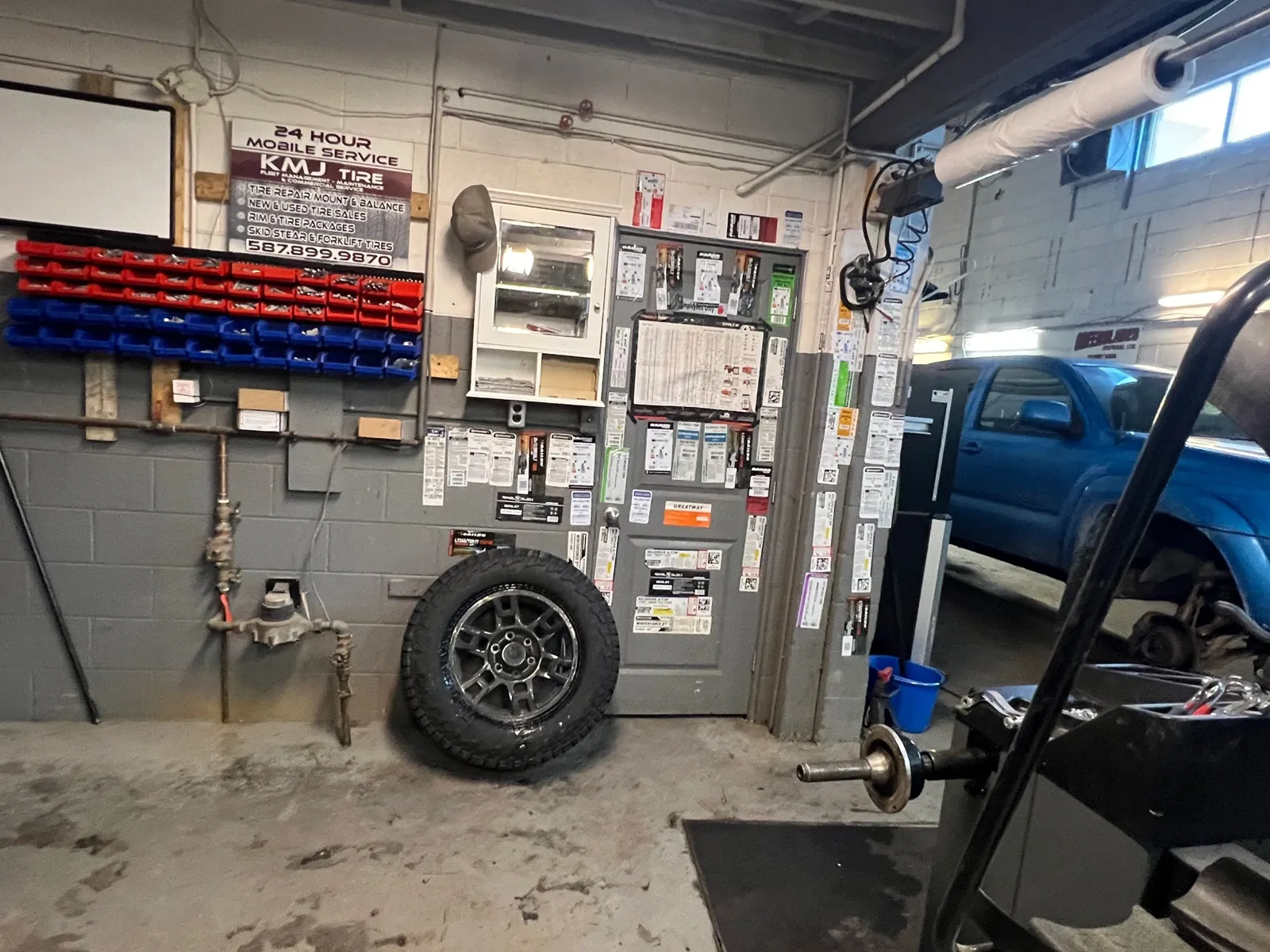
The photo at the top of this article shows a corner of a working tire bay: the shaft of a wheel balancer in the foreground, a mounted tire and wheel leaning against the wall, and a pickup in the next bay with a wheel off. That shaft is where the work happens.
Michelin's UK guidance describes the procedure in three steps. The professional uses a wheel balancer to detect the unbalanced areas of the tire and rim assembly. They then place weights on the outside or inside of the rim, at the locations the machine identifies, to compensate. The type of weight depends on the wheel: on steel rims, weights are hooked onto the rim flanges; on aluminium rims, adhesive weights are placed behind the spokes so the rim is not damaged.
In practice, the assembly is clamped to the balancer's shaft through the centre bore, usually with a cone or similar centring piece, then spun. Sensors read the forces as it turns. The machine reports how much correction is needed on each plane and where. The technician applies the weight, spins again to confirm, and moves on.
Two practical details from that description matter to drivers. First, the type of weight tells you something about the wheel: clip-on weights on the edge of a steel winter wheel are normal, and stick-on weights hidden inside an alloy wheel are normal. Second, those weights are small and physically attached to a surface that sees road spray, salt, gravel and car-wash brushes. They can fall off. A missing weight leaves the assembly exactly as unbalanced as it was before it was corrected.
Why the Wheel Has to Sit Perfectly on the Shaft
A balancer reading is only as good as the way the wheel is held on the machine. If the assembly is clamped slightly off-centre, the machine is measuring how that off-centre assembly spins, which is not how it spins on your hub.
Michelin Canada raises the same concern from the vehicle side. Its guidance notes that when a tire is not mounted correctly on the rim, or the wheel assembly is not centred accurately on the hub, it can lead to slight variations in how the wheel tracks, and that even minor mounting errors can add to wear over thousands of kilometres. The point is consistent: centring matters on the machine and on the car.
Balancer equipment makers offer a long list of cones, collets, spacer rings and flange plates for this reason. Hunter Engineering's balancer parts catalogue, for example, includes separate truck cones, light-truck spacer rings and model-specific collets. You do not need to know any of those parts by name. What it tells you is that different wheels need different centring methods, and that a heavy pickup wheel and a small sedan wheel are not held the same way.
For a driver, the useful takeaway is this. If a freshly balanced wheel still vibrates and nothing else has changed, asking for the assembly to be rechecked and remounted on the machine is reasonable. It is not an accusation; it is part of normal troubleshooting.
Why Every Mounting Gets Balanced, and Seasonal Sets in Calgary
Michelin's UK page says balancing should be carried out systematically whenever tires are replaced or refitted, and that balancing is associated with mounting. Michelin Canada's list of when to check alignment and balancing includes putting on new tires, hitting potholes, curbs or road debris, experiencing vibrations or steering instability, and changing tires for the season.
That last point needs a Calgary translation, because there are two very different ways drivers handle a winter changeover.
The first is two complete sets, each tire on its own wheel. At changeover time, the mounted assemblies come off and the other mounted assemblies go on. The tire is not removed from the rim. If the set was balanced when it was mounted and nothing has happened to it since, its balance has not been disturbed by the swap itself. That said, a season of potholes, curbs and slush is not nothing, and weights can be lost in storage handling or washing. A quick look at the weights and an honest description of how the set felt last season are worth more than assuming it is fine.
The second is one set of wheels and two sets of tires. Each changeover means dismounting the outgoing tires from the rims and mounting the incoming ones. Every one of those is a new tire-and-wheel combination, and by Michelin's guidance every one needs to be balanced again. There is no carrying the old balance forward, because the old weights were placed to cancel the old tire's variation, not the new one's.
If you are trying to decide between those two approaches, the balancing difference is one practical factor among several, alongside storage space, how often you want to handle loose tires, and how the wheels themselves are holding up. The seasonal tire changeover service in Calgary page explains how a swap works, and if you are considering a dedicated winter set on its own wheels, you can shop winter tires by size and compare options before deciding.
Where You Feel It: Steering Wheel, Seat or Floor
Bridgestone's tire cupping guidance gives a practical rule of thumb for locating an imbalance: vibration felt through the steering wheel suggests the front wheels may be unbalanced, and vibration felt through the seat suggests the rear wheels could be. If it is felt through both, have the tires checked for imbalance and possible cupping.
Michelin's UK page lists a wider set of places drivers notice imbalance: the steering wheel, the floor, the dashboard or the seats. Michelin Canada lists steering wheel vibration at high speed and vibration through the seat or floor among the common signs.
The steering-versus-seat rule is a useful starting point, not a certainty. Vehicles transmit vibration differently. A long-wheelbase pickup with a stiff frame can carry rear vibration forward. A small car with a light body can make a front imbalance feel like it is everywhere. Still, writing down where you feel it is one of the most useful things you can bring to a tire visit, because it lets the technician start with the most likely pair of wheels.
A small addition that helps: if the steering wheel visibly moves back and forth at a certain speed, say so. If the mirror shakes but the steering is calm, say that too. Precise descriptions beat strong adjectives.
Why It Shows Up at One Speed and Disappears at Another
Many drivers are puzzled that a vibration appears around 95 km/h, peaks around 105, and fades by 120. It feels like the problem fixed itself. It did not.
Michelin's UK guidance explains that imbalance is sometimes only felt at certain speeds that represent natural vibrating frequencies in the vehicle's suspension and structure. Every vehicle has speeds at which parts of it respond more strongly to a repeating force. A spinning imbalance produces exactly that kind of repeating force, once per revolution. When the wheel's rotation lines up with one of those natural responses, the vibration becomes noticeable. Above or below it, the same imbalance is still there; it is just less amplified.
Michelin Canada's FAQ gives a typical range for balancing symptoms: vibration in the steering wheel or floor at highway speeds, typically 90 to 120 km/h. That is a helpful marker for Calgary drivers, because it lines up with Deerfoot, Stoney, Glenmore and the highway out to the mountains. City streets at 50 or 60 often will not show a modest imbalance at all.
The practical lesson: a vibration that only appears in a speed band and is otherwise smooth fits an imbalance pattern quite well. A vibration that is present from walking pace upward, or gets steadily worse with speed without a peak, fits less well.
Things a Balancer Cannot Fix
This is the most important section in the guide, because it explains why "it was just balanced" and "it still vibrates" can both be true.
A balancer measures mass distribution. It does not measure whether the tire is round, whether the wheel is straight, whether the tire is stiff in one spot and soft in another, or whether something on the vehicle is loose. Bridgestone's terminology glossary separately defines radial runout as a measurement of out-of-roundness: rotating the inflated tire and measuring how far the tread surface varies up and down from a true circle. It also defines lateral runout gauges for side-to-side checks. Those are different measurements from balance, made for different reasons.
Here are the common things that can produce a vibration that balancing will not cure.
A wheel that is no longer true
A curb strike or a deep pothole can bend a wheel's flange or put a slight wobble in it. Michelin's UK page notes that if a wheel has been hit, for example by a kerb, the rim may have been damaged and the wheel may need to be rebalanced, and to have it checked by a professional if in doubt. Rebalancing a bent wheel can reduce the symptom by adding weight to offset the shape, but it cannot make the wheel round again. If a technician tells you a wheel needs an unusual amount of weight, or that it visibly wobbles on the machine, take that seriously.
A tire that is out of round or has an internal problem
A tire can have a spot that is slightly taller or stiffer than the rest, or, after impact damage, an internal problem that changes its shape. The assembly may balance perfectly on the machine and still push the vehicle up once per revolution on the road. Equipment makers recognise this gap: Hunter Engineering describes pairing its Road Force Elite balancer with its tire changer for match-mounting, to help eliminate vibration problems that balancers alone cannot fix. Match-mounting simply means rotating the tire on the rim so its high spot lines up with the wheel's low spot. Not every tire bay has that kind of equipment, so it is fair to ask what is available rather than assuming.
A flat spot from parking
Tires that sit in one position for a long time, particularly in cold weather, can develop a temporary flat spot that causes a thump on the first drive. That usually fades as the tire warms. A balancer will not help, and it does not need to. If a vibration disappears after the first several kilometres of every cold drive, that pattern is worth describing exactly.
Uneven or cupped tread
A tire whose tread has worn into dips and humps will keep producing vibration and noise even after a perfect balance, because the road surface is now hitting an uneven tread. That is covered in its own section below.
Problems in the vehicle itself
Worn steering or suspension parts, a warped brake disc, a damaged axle shaft or a loose component can all produce vibration that feels a lot like a tire problem. These are outside tire work. If balancing and a tire inspection do not explain the vibration, the next stop is a qualified mechanic. KMJ does not perform suspension, steering or brake work and does not diagnose those systems; the honest answer from a tire technician in that situation is "the tire and wheel check out, please have the vehicle looked at."
Balancing Versus Alignment: Two Different Jobs
Michelin Canada makes this distinction clearly. Alignment controls where the tire points and how it contacts the road. Balancing controls how the tire rotates once it is moving. A vehicle can be perfectly aligned but still vibrate from imbalance; a perfectly balanced wheel can still wear unevenly if the alignment angles are wrong.
The symptoms differ in a useful way. Michelin lists alignment signs as the vehicle pulling to one side on a straight road, an off-centre steering wheel when driving straight, and uneven or rapid wear on one edge of the tread. Balancing signs are vibration at highway speed and scalloped or cupped wear.
So a quick sorting rule: shaking points toward balance; pulling points toward alignment. Both can happen at once, especially after a hard winter impact, which is why Michelin recommends checking both when mounting new tires and after a significant pothole or curb strike.
Michelin's UK page notes that alignment is about the vehicle's suspension rather than the tire and wheel assembly, and that it is a complex operation that must be done by an equipped specialist. KMJ does not set alignment angles. If your car pulls, or a tire is wearing on one edge, take that to an alignment specialist, and bring your tire observations along so they have the full picture.
Cupping: The Wear Pattern That Points Beyond Balance
Bridgestone describes tire cupping as tread that looks as though someone scooped out part of it every three to four inches around the circumference, which is why it is sometimes called scalloping. It is a pattern of uneven high and low spots rather than a smooth wear across the face.
Bridgestone lists several causes. Misalignment can create uneven stresses that show up as cupping or a sawtooth pattern at the tread edges. Worn shocks, struts and bushings can let the tire bounce instead of rolling smoothly, creating uneven pressure points. An out-of-balance assembly can cause some sections of tread to meet the road with greater force than others. And lower-quality tires may be more susceptible on a vehicle that already has a worn suspension or imperfect balance.
Michelin Canada describes imbalance from the other direction: an unbalanced wheel oscillates as it turns, creating localised stress zones on the tread, and over time that can produce flat spots or cupping and put extra strain on suspension and steering parts.
Two practical conclusions follow. First, if your tires are already cupped, rebalancing them will not erase the cupping. The tread shape is now part of the tire. The vibration may improve, but a hum or rumble from the uneven tread will often remain. Second, cupping is a signal to look at more than just balance, because the list of causes includes suspension wear and alignment. A tire inspection can confirm the pattern; anything beyond the tire belongs with a mechanic.
Bridgestone also points out that cupped tread interrupts the tire's continuous contact with the road, which can reduce traction in an emergency. That is a safety issue, not just a comfort one, and a good reason not to leave noticeable cupping on a vehicle for a whole winter.
If you are already looking at replacement, the Calgary tire buying guide walks through the basics of choosing a size and type, and the comparison of budget versus premium tires is useful if you are weighing construction quality against price.
Calgary Conditions That Knock Balance Off
Calgary is hard on balance in specific, predictable ways. None of these are exotic. They are simply what happens to wheels on prairie roads with long winters.
Snow and slush packed inside the wheel
When wet snow or slush packs into the inside of a wheel and freezes there, it is added mass in one spot. The assembly is no longer balanced, even though nothing on the tire or wheel has changed. The classic sign is a vibration that appears after driving through slush or after the vehicle sat overnight in a parkade with snow on it, and then fades once the ice melts or breaks loose. Before asking for a rebalance in that situation, look at the inside of each wheel through the spokes and see whether there is a lump of ice. If there is, letting it melt in a heated space is often the whole fix.
Mud and gravel on pickups and SUVs
Gravel roads, construction sites and acreage driveways can coat the inside of a wheel in mud that dries hard. The effect is the same as ice: uneven added mass. Off-road tires with deep tread blocks can also hold packed mud. If you drive off pavement regularly, a wash of the wheel barrels before a balance check saves time and gives the machine an honest reading.
Potholes and curbs
The freeze-thaw season produces potholes, and parking against snowbanks hides curbs. Michelin's guidance lists hitting potholes, curbs or road debris as a reason to check balance and alignment. An impact can knock off a weight, shift the tire on the bead slightly, or bend the wheel. If a vibration starts right after a specific hit, that is a strong clue: describe the hit, and ask for the wheel to be checked for damage as well as rebalanced.
Lost weights from washing and road spray
Salt, gravel and touchless car-wash chemicals all work on adhesive weights over a season. Clip-on weights on steel wheels can be knocked off by curbs and ice chunks. A clean rectangular patch inside an alloy wheel, or a small clean notch on a steel wheel flange, often marks where a weight used to be. That is worth pointing out at your visit.
Studded tires
Studs add small amounts of mass around the tread. A properly studded tire is balanced after studding as part of normal mounting. If you are considering studs, the tire studding service in Calgary page explains that option, and it makes sense to plan studding and mounting together so the assembly is balanced in its finished state.
Heavier Assemblies: Pickups, Large Tires and Work Vehicles
Bigger, heavier tire-and-wheel assemblies are not harder to balance in principle, but they are less forgiving of small errors. A light-truck tire on a large wheel carries more mass, so a given percentage of imbalance means a larger force at speed. Aggressive tread blocks can hold mud and snow. And heavy wheels need correct centring on the machine, which is why equipment makers sell specific cones and spacer rings for light trucks.
If you run a lifted pickup with oversized tires, expect balancing to need more weight than a stock sedan does. That alone is not a warning sign. What matters is whether the assembly balances to the machine's tolerance and stays smooth on the road. If a large tire cannot be brought into balance with a sensible amount of weight, that is a clue that the tire, the wheel or the mounting position needs a closer look rather than more weight.
For businesses running work trucks or vans, vibration reports from drivers are valuable data. A driver who notes the date, unit number, speed band and where the vibration is felt gives you a clear trail to follow. KMJ's commercial tire services and fleet tire management pages describe how tire work is organised for multi-vehicle operations, and the same principle applies: tire and wheel questions get answered at the tire level, and anything mechanical goes to the fleet's mechanic.
Electric Vehicles and Heavier Cars
Many electric vehicles are heavier than comparable gas vehicles and often run on large-diameter wheels with low-profile tires. Low-profile tires have short sidewalls, which absorb less of a small imbalance before it reaches the cabin. Michelin Canada's discussion of wheel diameter notes that lower-profile tires on larger wheels increase steering responsiveness, while taller sidewalls improve impact absorption and ride comfort. The same trade-off applies to vibration: a car on low-profile tires tends to transmit small irregularities more directly.
That does not mean every EV vibrates. It means precise balancing and careful centring matter on those wheels, and that a driver may notice a small change sooner. If you drive an EV, the EV tire guide for Calgary covers how tire choice interacts with vehicle weight and wheel size.
A Simple Vibration Log You Can Keep on Your Phone
The single most useful thing you can bring to a tire visit is a clear description. Technicians can only test so many kilometres. Your daily commute already includes hundreds. A short note on your phone, filled in once or twice, can save a lot of guessing.
Record the speed where the vibration starts, the speed where it is strongest, and the speed where it fades. Record where you feel it: steering wheel, seat, floor, mirror, or a combination. Note whether it changes when you lift off the accelerator and coast, and whether it changes when you brake. Note whether it is present on the first cold drive of the day and then fades, or is consistent all day. Note the road: smooth new pavement, rough concrete, or every surface. And note what happened just before it started: new tires, a changeover, a pothole, a car wash, a slushy drive, a long parking stint.
Coasting is a particularly useful test on a safe, straight road. If the vibration stays the same while coasting in neutral at the same road speed, it is tied to road speed, which fits tires and wheels. If it changes sharply when you lift off or apply power, it may be related to the driveline instead, which is a mechanic's question. Only try this where it is legal and safe, with no traffic close behind you.
Braking tells you something too. A vibration that appears or gets much stronger only under braking points toward brakes, not balance, and should be checked by a mechanic.
Worked Example: The Week-After-Changeover Shimmy
Here is a realistic, composite example of how the log helps. A driver has a compact SUV with two sets of tires, each on its own wheels. The winter set went on in late October. About ten days later, on a slushy afternoon, the steering wheel starts to shimmy between about 95 and 110 km/h on Stoney Trail. It is smooth at city speeds. The next morning, after a night in a heated garage, the shimmy is gone. Two days later, after another slushy drive, it returns.
Reading that pattern: a steering-wheel vibration points toward a front assembly. A speed band of 95 to 110 fits a once-per-revolution imbalance. The on-off pattern tied to slush and heated parking strongly suggests ice building up inside a wheel and then melting. The first, free check is a look inside the front wheels after the next slushy drive. If there is packed ice, the fix is to clear it carefully, not to rebalance.
Now change one detail. The shimmy appears on a dry day and stays every day, heated garage or not. That is no longer an ice pattern. The likely next step is a balance check on the front assemblies and a look for a missing weight, which is exactly what tire work covers. If the assemblies balance correctly and the wheels and tires check out, the remaining causes sit in the vehicle and belong with a mechanic.
Worked Example: The Pickup That Vibrates Everywhere
A second composite example. A half-ton pickup on all-terrain tires has a vibration felt mostly in the seat. It starts around 60 km/h and gets steadily stronger with speed, with no clear peak. It also changes when the driver lifts off the throttle. There was no recent tire change, but the truck spends weekends on gravel roads.
Reading that pattern: a seat vibration points toward the rear. But the steady build with speed, rather than a band, fits balance less well, and the change on lifting off the throttle suggests something tied to the driveline. Mud packed inside the rear wheels is still worth ruling out, because it is cheap to check and gravel driving makes it likely. A rear balance check and inspection of the rear tires for damage or uneven wear is a reasonable tire-level step. If that does not explain it, the throttle-sensitive part of the pattern is a strong reason to see a mechanic rather than paying for repeated balancing.
The point of both examples is the same. The log turns a vague complaint into a short list of likely causes, and it tells you when to stop chasing tire answers.
When a Vibration Means Stop, Not Book
Most balance-related vibrations are a comfort and wear issue that can be booked for the next convenient time. Some vibrations are not. Pull over safely and get help if the vibration starts suddenly and is severe; if it follows a hard impact and is accompanied by a visible bulge, cut or a tire that looks low; if a tire pressure warning comes on at the same time; if you hear a rhythmic thumping that gets faster with speed; or if the steering suddenly feels very different. A tire that is losing air or has internal damage can vibrate before it fails.
In those situations, do not try to finish the highway trip to see whether it settles. Get off the road, check the tire visually from a safe position, and arrange help. KMJ's roadside tire emergency help in Calgary page explains the emergency options, and if the tire needs attention where it sits, mobile tire service in Calgary describes how service at your location works. If the damage turns out to be a repairable puncture, the Calgary flat tire repair page explains what makes a repair possible, and any repaired tire is rebalanced after it is remounted.
What to Tell the Shop When You Book
When you book a balance check, the booking note is your chance to save time. A good note might say: "Steering wheel vibration 95 to 110 km/h, smooth below 90 and above 120. Started after winter changeover. No pull. Not affected by braking. Checked inside wheels, no ice." Three lines like that tell a technician which assemblies to start with and which causes are already ruled out.
Mention any recent impact, even if it seemed minor. Mention whether the tires are on their own wheels or were remounted on shared wheels. Mention aftermarket wheels, spacers or a recent wheel change, because centring and fit matter. And mention if you have locking wheel nuts, so the key is ready.
You can book wheel balancing online, and the wheel balancing in Calgary page describes the service itself. If you have a specific question beforehand, the KMJ tire questions page covers common ones, and you can contact KMJ about a vibration question if your situation does not fit a standard visit.
What to Ask After the Balance Is Done
A balance check produces information, and it is reasonable to ask for it. Useful questions include: Which assemblies needed correction, and roughly how much? Did any wheel or tire look damaged, bent or unevenly worn? Did any assembly need an unusually large amount of weight? Were old weights removed before new ones were placed? Were any assemblies remounted or checked for runout?
The answers help you decide what happens next. If one wheel needed far more weight than the others, that wheel deserves attention. If the technician noticed cupping or edge wear, that is your cue to see an alignment specialist or mechanic. If everything balanced easily and looked healthy, and the vibration persists, you have just ruled out the tire and wheel, which is real progress even though it does not feel like it.
Then drive the same road at the same speeds and compare against your log. A good result is the vibration gone in the same speed band. A partial result, smaller but still present, is worth reporting back rather than accepting, because it suggests a second cause on top of the imbalance.
Balancing, Tire Life and Rotation
Balancing is not just about comfort. Michelin's UK guidance says imbalance can accelerate wear of the tire tread and suspension components, and Michelin Canada says proper balancing allows the tire to rotate smoothly and promotes uniform tread depth. The tire is cheaper to keep healthy than to replace early.
Rotation and balance often come up together. Bridgestone's rotation guidance is about moving tires between positions to even out wear, which is a separate job from balancing. Moving a balanced assembly from front to rear does not unbalance it; the weights travel with the wheel. But rotation time is a natural moment to look at weights, check for a vibration that has crept in, and ask for a recheck on any assembly that has been feeling rough. If an assembly is remounted, a fresh balance follows.
A sensible habit for most Calgary drivers is simple: balance whenever a tire is mounted on a wheel, recheck after a hard impact or a new vibration, and use rotations and seasonal changeovers as the moments to look for lost weights and early wear patterns. There is no need to rebalance a smooth, undamaged set on a calendar schedule for its own sake.
New Tires: Why a Vibration on Day One Is Worth Reporting
If a vibration appears immediately after new tires are mounted, report it promptly rather than waiting to see if it settles. A brand-new tire is not supposed to need a break-in period to stop shaking. Common causes on day one are a weight that was placed incorrectly or came off, an assembly not perfectly centred on the machine, a tire that did not fully seat on the bead, or a tire or wheel with more runout than the balance can cover.
All of those are quick to check, and the sooner they are checked the clearer the cause. Bring your speed band and location notes. If you are shopping now, you can compare all-weather tires for Calgary or shop tires by size in Calgary first, and every mounting includes balancing as part of the job.
Reading Your Own Wheels at Home
You can do a useful visual check without lifting the vehicle. With the car parked on level ground, the parking brake set and the engine off, look at each wheel. On steel wheels, look along the rim edge for clip-on weights and any clean notches where one used to be. On alloy wheels, look through the spokes at the inner barrel for stick-on weights, and for clean rectangles in the brake dust that show a missing one. Check for any visible dents, cracks or flat spots on the rim edge, especially after a winter of curbs.
Look at the tread too. Run your eye around the circumference looking for scalloped dips, a raised band, or one edge worn more than the other. Bridgestone's cupping guidance describes scallops spaced every few inches around the tire; once you have seen them, they are hard to miss. The guide to reading your tire sidewall can help you confirm the size and date code while you are down there.
Do not try to add or move weights yourself. Placing a weight without a balancer is guesswork, and adhesive weights need clean, prepared surfaces to stay put. The home check is about noticing, not fixing.
A Calgary Balancing Checklist in Plain Words
Before the visit, check inside the wheels for packed ice, snow or mud, and clear or melt it if it is there. Drive your usual route and note the speed band and where you feel the vibration. Try a safe coasting test and a gentle brake test, and note whether either changes the vibration. Look at the wheels for missing weights and visible damage, and at the tread for cupping or edge wear. Write down any recent impact, changeover, tire change or car wash.
During the visit, share your notes in a few lines, mention whether the tires are on their own wheels, and mention any aftermarket wheels or spacers. Ask which assemblies needed weight and how much, and whether anything looked damaged or unevenly worn.
Afterwards, drive the same route at the same speeds. If the vibration is gone, you are done. If it is reduced but present, report it. If it is unchanged and the tires and wheels checked out, the next conversation is with a qualified mechanic, and your notes will help them as much as they helped the tire technician.
The Bottom Line
Wheel balancing corrects one specific thing: uneven mass in the tire-and-wheel assembly. It does that very well, and it belongs with every tire mounting. It does not straighten a bent wheel, make an out-of-round tire round, erase cupped tread, set alignment angles or fix worn parts in the vehicle. Most of the confusion around vibration comes from expecting a balance to cover all of those at once.
The good news is that a few minutes of observation sorts most cases. A shimmy in a speed band, felt in the steering wheel, appearing after a changeover or a slushy drive, is very likely a tire and wheel question. A vibration everywhere, tied to braking or throttle, with pulling or clunks, is likely something else. Knowing which is which saves you from paying for the wrong fix, and it gets you to the right specialist sooner.
If your question is about the tires and wheels themselves, KMJ is a local Calgary tire shop set up for exactly that work. Bring your notes.
Sources
Michelin Canada, Wheel Alignment and Balancing: Why They Matter (michelin.ca). Michelin UK, Wheel alignment, wheel balancing: when to do it? (michelin.co.uk). Bridgestone Canada, Tire Terminology and Tire Cupping: Causes, Problems and Prevention, and Tire Rotation (tires.bridgestone.com). Hunter Engineering, Road Force Elite balancer parts and accessories (hunter.com). Statements about KMJ's services reflect its published service pages. Technical statements are general and do not replace a vehicle's own manual or a professional inspection.