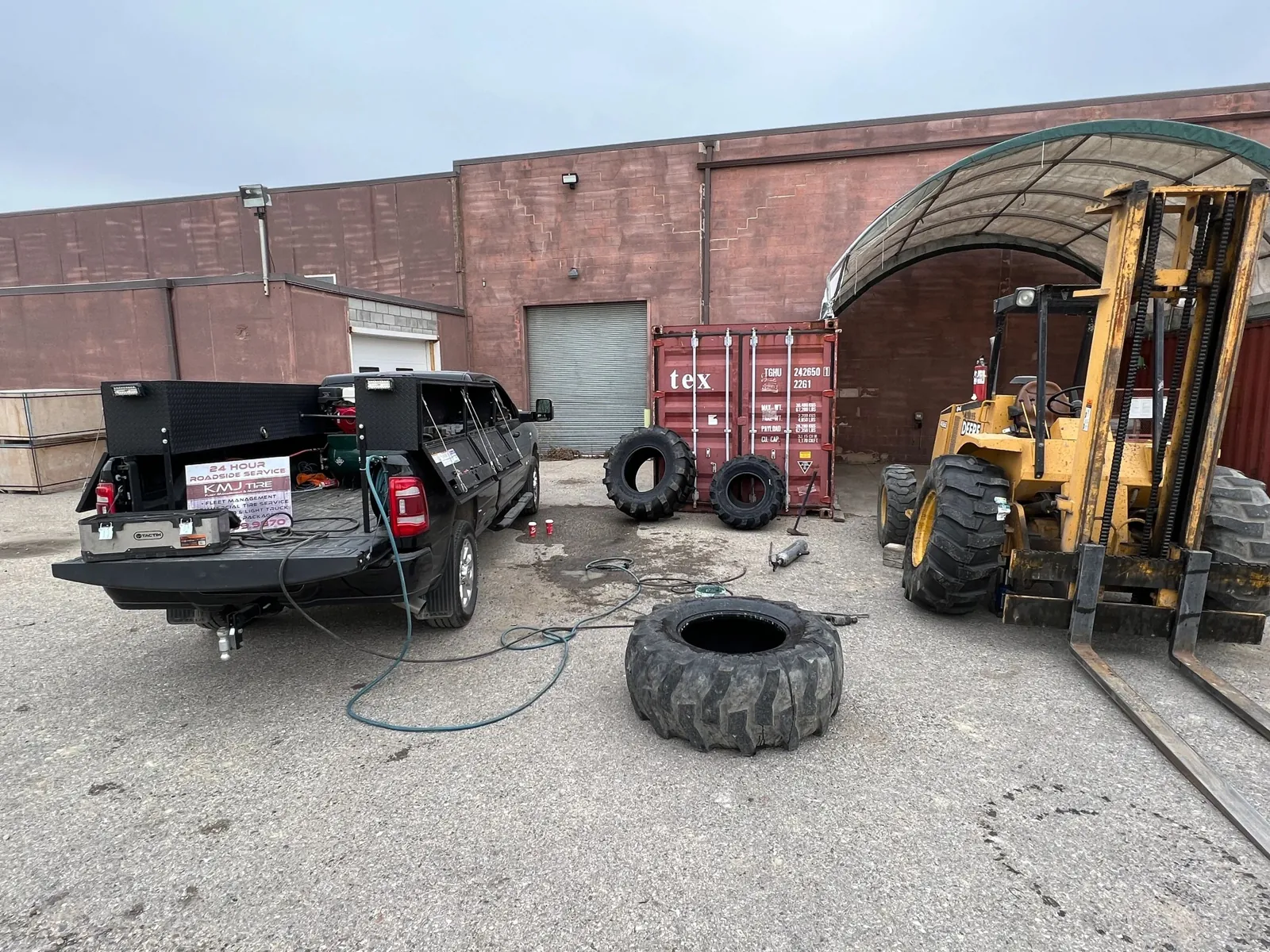
A building-supply business in southeast Calgary runs two forklifts. One lives inside the warehouse and never leaves the concrete. The other spends its day in the yard, moving bundles of lumber and pallets of bagged product across gravel, cracked asphalt and, at this time of year, a mix of packed snow and frozen ruts. In the same week in November, the yard truck picks up a screw near the loading area and one front tire goes flat, and somebody on the warehouse floor notices that the inside truck's tires have rubber missing along one edge and a shiny, uneven look on the face. The operations manager now has a short list of questions. Are these the right tires for each machine? Can the yard truck run something that will not go flat? Is the indoor truck safe to keep using this week? And who is actually allowed to change any of it?
This guide is written for that manager, and for the owner of a small shop, a warehouse lead or a farm-yard operator who has one or two lift trucks and no full-time equipment department. It explains the tire families you will hear about, how to match them to Calgary floors and yards, what wear looks like, how tire condition connects to stability and steering, and where the tire decision ends and the forklift dealer's decision begins.
The Short Answer
Start with the forklift, not the tire. The truck was built around a tire type, and its data plate, manual and dealer documentation describe the load it was rated for. Cushion-tire trucks and pneumatic-tire trucks are different machines with different wheels and clearances, so you usually choose between tire options within the family your truck already uses, not across families.
Within that family, choose for the surface. Smooth indoor concrete suits cushion tires. Rough or outdoor surfaces suit pneumatic-style tires, either air-filled for ride and traction or solid for puncture resistance. Have operators check wheels and tires every shift, including air pressure on air-filled tires, and remove a truck from service when a tire is damaged, chunked or worn to its replacement point. Replace tires on the same axle together and match them. If a wheel has to come off, the truck must be blocked securely and the work done by someone qualified. KMJ provides forklift tire sales and service in Calgary. Anything beyond the tires, such as brakes, steering, the mast or hydraulics, belongs with your forklift dealer or a qualified lift-truck technician.
Start With the Truck, Not the Tire Catalogue
People often start by asking which tire is best. The more useful first question is what the forklift was designed to run on. A lift truck is a counterbalanced machine, and its tires are part of how the weight is carried and how the truck sits. Changing tire type can change the truck's height, its stance and the way it carries a load.
The data plate is the starting document
Every lift truck has a data plate, sometimes called a capacity plate or nameplate. The Canadian Centre for Occupational Health and Safety (CCOHS) points operators to it for the truck's maximum load limit and notes that the load limit decreases as the load centre is raised. That plate is written for the truck as built and equipped. If you are thinking about any change that alters how the truck sits or carries weight, the person to confirm whether the plate still applies is the forklift maker's dealer, not a tire catalogue and not a guess.
Before you call anyone about tires, take a clear photo of the data plate and keep it with the truck's records. It helps the dealer confirm the model, and it gives you the rated capacity when you are comparing what the truck is asked to lift every day.
Cushion trucks and pneumatic trucks are built differently
Toyota Material Handling sells separate lines of internal-combustion forklifts for cushion tires and for pneumatic tires. Its cushion-tire trucks use smooth rubber tires mounted on a metal band and are designed for smooth indoor surfaces, with compact dimensions and a tight turning radius for working in narrow aisles. Its pneumatic-tire trucks are presented as the outdoor machines, with larger tires that give better shock absorption and traction on gravel, dirt and uneven ground.
The practical lesson is that the tire question usually sits inside a family. A cushion-tire truck uses press-on tires fitted to a band, and a pneumatic-tire truck uses rims that take air-filled or solid pneumatic tires. Converting a truck from one family to the other is not a simple tire change; it involves wheels, ground clearance and how the machine was engineered. If a yard has outgrown an indoor truck, the honest conversation is usually about using the right machine for the yard, and that conversation belongs with the forklift dealer.
The Tire Families You Will Hear About
Tire makers and dealers use several names for forklift tires, and some of the names overlap. Trelleborg, an industrial tire maker that supplies forklift makers, groups its forklift range into solid resilient tires, solid press-on tires, pneumatic tires and polyurethane tires. Here is what each name usually means in a Calgary shop or yard.
Cushion tires, also called press-on tires
A cushion tire is a band of solid rubber bonded to a steel band. It is pressed onto the wheel rather than mounted and inflated. It sits low, it has no air to lose, and it gives the truck a compact footprint that works well between racks. Most are smooth, though some have grooves or a tread pattern for a little more grip on wet or dusty floors.
The trade-off is ride and grip on anything rough. A cushion tire has very little give, so every crack, dock plate edge and stone goes straight into the truck and the operator. On gravel or broken pavement it has little to bite with. Toyota describes its cushion trucks as optimized for indoor use: they may handle adjacent paved surfaces, but they are not designed for rough or uneven outdoor terrain.
Air-filled pneumatic tires
These look like heavy-duty truck or equipment tires, with deep tread and an inflation valve. Air gives them a cushion that absorbs bumps and lets the tread conform to rough ground, which is why they are common on yard trucks, lumber yards and construction sites. Toyota notes that air-filled pneumatic tires give a smoother ride and better traction than the solid alternative but are more susceptible to punctures.
That puncture risk is the main reason operators look at alternatives. A yard covered in screws, nails, banding, broken pallets and scrap metal can put an air tire out of service at the worst time of day.
Solid pneumatic tires, sometimes called solid resilient
A solid pneumatic tire is built to fit the same kind of rim an air-filled pneumatic tire uses, but it is made of dense rubber with no air chamber. Many have a softer inner layer and a harder outer tread to keep some cushioning. Toyota describes them as more durable and more puncture resistant than air-filled tires and suited to rough or debris-covered surfaces.
The trade-off is weight, ride and heat. A solid tire carries more rubber, and it does not absorb bumps the way air does. On long runs across rough ground, operators will feel the difference. Whether a solid pneumatic tire suits a particular truck, rim and duty is a question to settle with the tire supplier and, where the truck's set-up changes, the forklift dealer.
Polyurethane press-on tires
Polyurethane tires are another press-on type, usually seen on electric trucks, pallet trucks, reach trucks and other warehouse equipment working on very smooth floors. They are generally chosen for specific indoor applications, often where narrow aisles and a smooth slab are the whole operating world. They are not a yard tire.
Foam-filled pneumatic tires
Some operators fill an ordinary pneumatic tire with a foam compound so it cannot go flat. This keeps the outer tire, rim and tread pattern, but replaces the air with a filling. It changes the tire's weight and ride, and it changes what can be done when the tread wears out or the casing is damaged. KMJ's equipment tire page lists foam-fill and solid tire options alongside forklift and skid-steer tire sales and service, so it is one of the options worth discussing if punctures are your recurring problem.
Matching Tires to Calgary Floors and Yards
The surface decides more than anything else. A quick walk around the actual route the truck takes each day will tell you more than any brochure.
A smooth warehouse slab
A clean, sealed, level concrete slab is where cushion and polyurethane tires do their best work. The truck sits low, turns tightly and does not need tread to find grip. The risks on a slab are less about the tire and more about what is on it: oil, water, shrink-wrap scraps, loose banding and dust. CCOHS lists oil spots, wet spots, loose objects and holes among the hazards operators should watch for while travelling. Clean floors protect the tires as well as the people.
In Calgary winters, a smooth slab can change character near the doors. Trucks and people carry in snow, grit and meltwater, and the first few metres inside a dock door can be wet and gritty for hours. That is where a smooth press-on tire is most likely to slip. It is a housekeeping problem first; the tire choice is second.
Dock plates, trailer floors and thresholds
Every dock creates edges: the dock plate lip, the gap between plate and trailer, the threshold of a roll-up door, expansion joints and patched concrete. Low-profile press-on tires hit these edges hard. Repeated impact is one reason cushion tires chunk along the edge of the face. CCOHS lists ramps, flooring with different surfaces and the condition of the loading dock among workplace design factors that contribute to forklift incidents.
If your trucks cross the same damaged plate or broken threshold a hundred times a shift, fixing that one spot may do more for tire life than any tire upgrade.
Gravel yards, broken asphalt and frozen ruts
Outdoor yards are where pneumatic-style tires earn their keep. Gravel shifts, asphalt crumbles at the edges, and in a Calgary winter the yard can go from slush to rock-hard ruts overnight after a chinook breaks. A cushion-tire truck in that yard is fighting the ground with every move, and the operator is absorbing the shock.
Air-filled tires give the best ride and grip there, but they are exposed to whatever is lying in the yard. Solid pneumatic tires give up some ride in exchange for not going flat. Foam-filled tires sit somewhere between, depending on the build. The yard's debris load usually decides it: a clean gravel pad and a scrap-strewn lumber yard are not the same place.
Trucks that cross between inside and out
The hardest case is the truck that does both: unloading trailers in the yard, then driving into the warehouse to put product away. Toyota notes that pneumatic-tire trucks can be used indoors, but only in facilities that can accommodate their larger turning radius and higher ground clearance. That is the real constraint: aisle width, rack layout and door clearances.
For a truck that crosses all day, many operators settle on solid pneumatic tires, because they handle the yard without the puncture risk and stay predictable on the slab. But a truck that tracks mud, grit and snow from the yard onto the warehouse floor creates its own slip hazard inside. The tire choice works best with a mat, a cleaning routine or a defined transition area at the door.
Calgary Weather and Forklift Tires
Calgary does not have a forklift tire rule of its own, but its weather changes the way tires behave and wear.
Cold rubber and cold air
Rubber stiffens in the cold. A yard truck parked outside overnight at minus twenty starts the shift on tires that are harder and less grippy than they will be once they warm up. On air-filled tires, the air inside contracts as well, so a tire checked in a heated shop and then used outside can be lower than you think. Check air-filled tires in the conditions they actually work in, and do it before the first lift rather than after the truck has warmed up.
Freeze-thaw yards
A chinook can turn a frozen yard into slush in an afternoon, and the next cold night freezes the slush into ruts. Those ruts are hard on every tire, but especially on low-profile tires that drop into them and on sidewalls that get scuffed by frozen edges. Clearing or grading the main travel lanes after a thaw-freeze cycle protects both the truck and the load.
Salt, grit and meltwater on the slab
Ice melt and grit tracked into a warehouse act like sandpaper on press-on tires and polyurethane treads, and wet grit is slippery. A short cleaning routine at the doors on bad-weather days reduces both tire wear and slip risk. It is an easy thing to put on the shift checklist.
Snow on the travel route
A forklift is not designed for snow clearing, and pushing through deep snow with forks low can hide holes, curbs and debris. Keep the forklift travel route cleared, mark known hazards, and treat a snowy yard as a reason to slow down and take more care. CCOHS reminds operators to match speed to the load and to workplace conditions, including slippery surfaces.
Reading Wear Before It Becomes a Problem
Forklift tires rarely fail without warning. The warning just has to be noticed and acted on.
Cushion and press-on wear
A press-on tire wears down from its original diameter. As it wears, the truck sits lower, the forks sit lower and the ride gets harsher. Some makers mark a wear line on the sidewall; others publish a minimum diameter. Ask your tire supplier which applies to the tires on your truck, and write the answer in the truck's record.
Uneven wear across a pair tells its own story. If the left and right tires on the drive axle have worn to different diameters, the truck is no longer sitting level, and operators may notice it pulling or feeling different when lifting. That is a reason to measure both and plan replacement, not to run the low one until it fails.
Chunking, cracking and flat spots
Chunking is rubber torn away from the face or edges, usually from impacts, debris or sharp turns on rough surfaces. Cracking can come from age, heat, ozone and repeated flexing. Flat spots can appear when a truck is spun on the spot or locked up under braking. All of these reduce how evenly the tire carries load and can make the truck vibrate or bounce.
A small nick on the edge is something to note and watch. Large chunks missing from the face, cracks that reach toward the steel band or rubber separating from the band are reasons to take the truck out of service until the tire is replaced.
Wear indicators and replacement bands
Some solid tires include a visible wear indicator. Trelleborg's Pit Stop Line, for example, is a bright orange band that appears as the tire wears; the company states that when it appears the tire has approximately 100 hours of life remaining, giving time to order replacements and schedule fitting. Trelleborg also says industrial solid tires are typically replaced with about a quarter of their life remaining. Treat those as the maker's statements about its own products rather than a universal rule, but they illustrate why a clear replacement point matters: too early wastes tire, too late puts the truck and operator at risk.
If your tires do not have an indicator, decide on a measurement and write it down, so different supervisors do not make different calls on the same tire.
Pneumatic tread, cuts and pressure
Air-filled forklift tires show the same kinds of trouble as any heavy tire: worn tread, cuts in the tread or sidewall, bulges, exposed cords and objects stuck in the tread. A bulge or exposed cord is a stop-now sign. A screw in the tread is a reason to call for tire repair on punctured air tires rather than to keep topping up and hoping. Solid pneumatic tires do not lose air, but they still chunk, crack and wear, so they still need looking at every shift.
Pressure on Air-Filled Forklift Tires
CCOHS includes air pressure, if pneumatic tires are fitted, in the visual pre-use check operators should do before starting the truck. That one line covers a lot of ground.
Use the right number
The correct inflation pressure comes from the forklift maker's documentation and the tire maker's information for that tire size and construction. It is not the highest number a compressor will deliver, and it is not a number borrowed from a pickup truck. If the decal or manual is missing, ask the dealer or tire supplier for the correct figure and record it where operators can see it.
Check cold and check every tire
Check pressure before the truck has been working, with a gauge that reads in the range of forklift tires. Check every air-filled tire on the truck, including any that are hard to reach. A low tire on one side makes the truck lean slightly toward that side, and a lift truck carrying a raised load is the last machine where you want an unplanned lean.
Treat repeat loss as a fault
A tire that needs air every few days has a cause: a puncture, a leaking valve, a damaged bead seat or a cracked rim. Keep a simple note of which tire, how much, how often. That record helps whoever looks at it find the cause faster.
Leave inflation of damaged assemblies to trained people
Inflating a tire that has been run flat or has visible damage can be dangerous, especially on multi-piece rims. If a tire has been run low or flat, or the wheel looks damaged, leave it deflated and get it inspected by a qualified tire technician rather than reinflating it on the spot.
How Tire Condition Shows Up in Stability and Steering
A forklift is a balance between the load on the forks and the weight of the truck behind the front axle. Tires are where that balance meets the ground. When they are mismatched, worn unevenly or underinflated, the truck does not sit the way it was designed to sit.
Lean and load handling
CCOHS reminds operators that a lift truck is less stable when a load is raised and that loads should be kept close to the front wheels. A truck leaning a few degrees because one drive tire is low or worn more than the other will carry that lean up the mast. At low heights it might not be noticeable; with a load near the top of the mast it matters much more.
Steering and braking feel
Worn or mismatched steer tires change how a truck responds to the wheel. Chunked or flat-spotted tires can make the truck vibrate or skip under braking. If operators report that a truck feels different, take it seriously and check the tires first. If the tires look fine and the truck still feels wrong, that becomes a brakes or steering question for the forklift dealer or a qualified lift-truck technician, not a tire shop.
What CCOHS lists among mechanical causes
CCOHS includes malfunction of brakes and steering, along with poor maintenance and the age of forklifts, among factors that contribute to forklift incidents. Tires are not named in that list, but they are part of the daily check and they affect how the brakes and steering perform on the floor. Keeping tires in good condition supports the rest of the machine; it does not replace the rest of the machine's maintenance.
Replace in Pairs, Match Across the Axle
On most forklifts the drive tires carry most of the load, and the steer tires guide the truck. The two tires on each axle should be the same type, size and construction and close in wear.
Why pairs matter
Two tires of different diameter on the same axle tilt the truck and make it pull. Two tires of different construction, say one solid and one air-filled, behave differently under load and over bumps. Replacing a single tire on an axle where the other is half worn creates exactly that kind of mismatch.
When one tire is damaged early
Sometimes a single tire is ruined by a puncture or an impact while its partner is still in reasonable shape. That is the moment to measure both and decide deliberately. If the remaining tire is close to new, a single replacement may make sense. If it is well worn, replacing both keeps the truck level and the axle balanced. Write down which choice you made and why.
Steer tires and drive tires are separate decisions
Steer and drive tires wear at different rates and often differ in size. They do not have to be replaced at the same time, but each pair should be kept matched. Many operators plan drive and steer replacements separately so the truck is out of service for less time on each visit.
Worked Example One: An Indoor Distribution Floor
This is a composite example, not a single real customer. A small distribution business in the northeast industrial area runs two propane cushion-tire trucks on a sealed concrete slab, loading and unloading trailers at four dock doors.
The supervisor notices that the drive tires on the older truck are chunked along the outer edges and that the truck bounces slightly when crossing the dock plates. Looking closer, the plates on doors two and three have a raised lip where they meet the floor, and both trucks hit it many times a shift. The tires on the newer truck are starting to show the same pattern.
The useful steps are straightforward. The supervisor takes the older truck out of service for drive-tire replacement, because the chunks reach well into the face. They photograph the data plate and the tire sidewalls, measure the remaining diameter where the maker gives a figure, and arrange press-on replacement through a tire supplier who can fit press-on tires. The raised plate lips go to facilities maintenance for repair. The newer truck's tires go on a watch list, with a note to check them weekly until the plates are fixed.
What does not happen is just as important. Nobody tries to fit a pneumatic tire to a cushion-tire truck, nobody keeps running chunked tires until the truck is due for its scheduled maintenance, and nobody blames the tires for a problem the floor created.
Worked Example Two: A Lumber and Building-Supply Yard
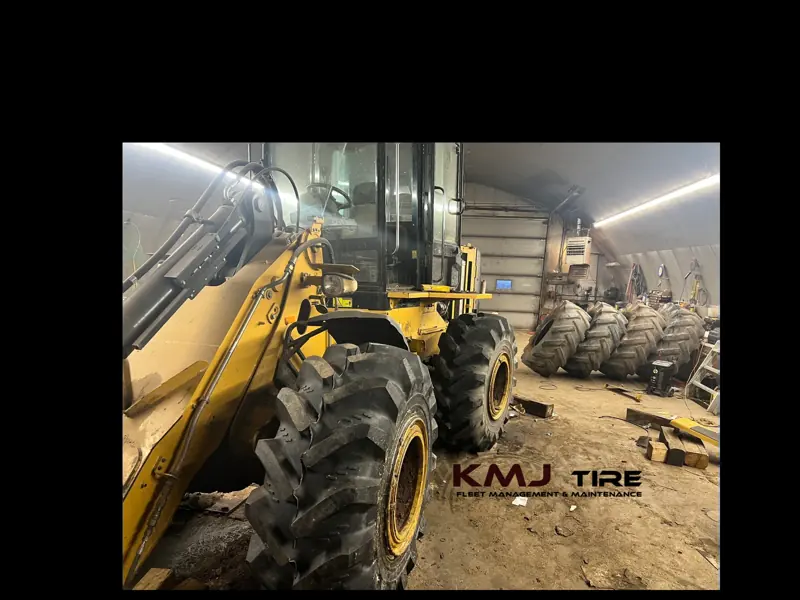
Also a composite. A building-supply yard on the southeast side runs a rough-terrain pneumatic forklift outdoors, moving bundles from trailers to racks across gravel and broken asphalt. The front tires are air-filled. Over one month the truck has two flats from screws and one from a piece of banding that cut the sidewall.
The manager's first question is whether to switch to solid tires. The second is whether that is allowed.
A sensible path starts with the yard. Screws and banding are coming from somewhere, often a specific unloading area or a cutting station. A magnetic sweeper on the travel lanes and a bin for cut banding near where bundles are opened reduce the problem at the source. Then the tire options are compared honestly: air-filled tires with prompt repair when they are punctured, solid pneumatic tires that will not go flat but ride harder, or foam-filled tires. The manager confirms with the tire supplier that the chosen option suits the existing rims and duty, and checks with the forklift dealer whether the change affects anything on the truck's set-up or data plate.
The operators are told what changed and what to watch for. A harder-riding solid tire will feel different on the same gravel, and operators should slow down where they used to rely on the air tire's cushioning.
Worked Example Three: A Small Manufacturer With One Truck Doing Everything
A small fabrication shop on the city's edge has one forklift. It unloads steel from flatbeds in the yard, carries it into the shop and moves finished work back out. It currently runs air-filled pneumatic tires. In winter, the yard is icy, the shop floor is wet near the door and the forklift tracks slush everywhere.
This composite example has no perfect tire answer. Air-filled tires grip best in the yard. Solid pneumatic tires would stop the occasional puncture from metal offcuts. Neither solves the wet floor inside the door.
The owner decides to keep air-filled tires for winter grip, adds a pressure check to the start of each shift, and keeps a puncture-repair contact handy for the inevitable metal sliver. A scraper mat and a squeegee routine go in at the shop door. A cleared, sanded travel lane in the yard reduces how much ice the truck has to cross. In spring, the owner will look at the puncture record and decide whether solid tires make more sense for the drier months.
The Daily Check Your Operators Already Do
CCOHS advises that operators inspect the forklift every day, including at the beginning of each shift and before each use, starting with a visual circle check before starting the truck and then an operational check with the key on. Wheels and tires are part of that visual check: wear, damage and air pressure if the tires are pneumatic.
Making the tire part of the check useful
A tick box that says "tires OK" does not tell anyone much. A slightly better version asks four short questions per tire: is there visible damage such as chunks, cuts or bulges; is anything stuck in it; for air tires, is the pressure in range; and does the operator notice anything different in the ride or steering? The answers can be written in a sentence. Over a few weeks, the record shows which tires are changing.
Who acts on the check
CCOHS advises that problems found during the daily inspection be reported to the supervisor immediately. Decide ahead of time who makes the call to take a truck out of service for a tire problem and who arranges the work. If nobody owns that decision, a damaged tire tends to run for one more shift, and then one more.
Following your jurisdiction's requirements
CCOHS also advises checking with your jurisdiction for any requirements on the frequency of checks and maintenance. In Alberta, that means the provincial occupational health and safety rules for your workplace. Your safety lead or the forklift dealer can point you to the parts that apply to your operation. Following them is your responsibility as the employer; this article is not a substitute for them.
Working Safely When a Wheel Comes Off
Changing a forklift tire is heavy work. The truck is heavy, the wheels are heavy, and press-on tires need a press to fit. CCOHS sets out several general safety procedures for servicing forklifts that apply directly to tire work: allow only qualified persons to service and maintain equipment; follow the manufacturer's service and maintenance schedule; block the forklift securely when removing wheels; do not work beneath elevated trucks or forks unless they are securely supported by approved blocks; and do not start a forklift that is on a lift hoist or wheel stands.
What that means for a small operation
If your staff are not trained for wheel removal, the job belongs with someone who is. A floor jack and a couple of wood blocks under a lift truck is not a plan. Arrange the work with a supplier who has the equipment and procedures for it, whether that is in a shop or at your site.
Getting the truck ready
You can make the job faster and safer by having the truck parked on level, solid ground, with the forks lowered, the parking brake on, the key out and the area clear of traffic. Tell the technician which tire or tires need work, what type they are, and whether the truck is electric, propane, gas or diesel. If the truck has been run flat, say so.
What a Tire Shop Does, and What It Does Not
It helps to be clear about where tire work stops.
The tire side
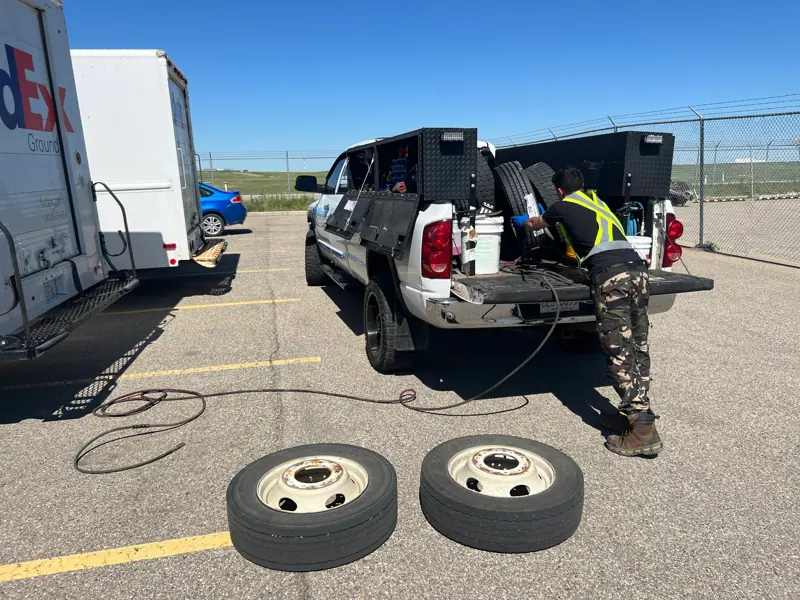
A tire supplier can help you identify the tire type and size you have, compare options within that family, source replacements, fit them, repair suitable punctures in air-filled tires, check and set pressure, and talk through wear patterns. KMJ's mobile tire service can come to your yard for tire work on site, and its commercial fleet tire management is aimed at businesses that want tires looked after on a routine rather than only when something fails. Whether a particular job, such as a press-on replacement, is done on site or needs the wheel brought in is a question to ask when you call.
The forklift side
Brakes, steering, mast, chains, forks, hydraulics, counterweight, engine, battery, electrical systems and the capacity rating belong with your forklift dealer or a qualified lift-truck technician. CCOHS notes that CSA's lift-truck standard recommends planned maintenance inspections, an annual inspection and a lifting capacity inspection, all done by a trained, qualified maintenance technician. A tire visit is not one of those inspections and should not be treated as if it were.
When the two overlap
A truck that pulls to one side might have mismatched tires, or it might have a steering or brake problem. Check the tires first because it is quick and cheap to rule out. If the tires are matched and in good condition and the truck still pulls, the investigation moves to the forklift side.
Planning Tire Work Around Shifts
A forklift out of service usually means work waiting. A little planning keeps tire work from landing at the worst moment.
Order before you need to
Forklift tires come in many sizes and types, and the exact tire for an older truck may take time to source. When the record shows a tire approaching its replacement point, start the conversation then, not the day it fails. Ask for the tire to be confirmed against the truck's existing tire markings and, ideally, a sidewall photo.
Pick the window
Most operations have quieter hours: before the first shift, during a lunch break or at the end of the day. Schedule tire work for those windows and tell the technician the time limits. If there are two trucks, plan for one to cover while the other is down.
Keep a spare pair in mind
Some operations with high-wear press-on tires keep a spare set of wheels with new tires already pressed on, so a change becomes a wheel swap. Whether that makes sense depends on the truck, how many trucks you have and how fast the tires wear. It is worth a conversation if downtime is costly for you.
After hours
Tire failures do not always happen in business hours. If an after-hours flat would stop a shipment going out, know in advance who you would call. KMJ lists after-hours tire emergencies among its services, and the areas KMJ serves around Calgary are listed on its site.
Keeping a Simple Tire Record per Truck
A one-page record per truck is enough for most small operations. It does not need software.
What to write down
Note the truck's make, model and serial number from the data plate; the tire type, size and construction for steer and drive positions, copied from the sidewall; the date each tire was fitted; the supplier who fitted it; the replacement point you agreed on; and, for air tires, the correct pressure. Then add each daily-check note that mentions a tire, each repair and each replacement. KMJ has a short guide to reading the markings on a tire sidewall that helps with copying the sidewall information correctly.
Using the record
After a few months, the record answers questions that are hard to answer from memory. Which truck eats tires fastest? Do the punctures cluster after a certain kind of delivery? Did the harder-riding solid tires reduce downtime or just move the problem? That information makes the next tire decision a decision instead of a guess.
Load and duty notes
If a truck regularly handles loads close to its rated capacity, write that down too. Tires on a truck that works near its limit all day wear differently from tires on a truck that lifts light pallets. For a general primer on how load ratings are read on road tires, KMJ's site has an explainer; forklift tires use their own ratings, so confirm forklift-specific figures with the tire supplier.
Questions to Ask Before You Order
These questions help you get the right tire the first time.
About the truck
What make, model and capacity is it? Is it a cushion-tire or pneumatic-tire truck? Is it electric, propane, gas or diesel? Has it ever been changed from its original tire type? Does anyone have the manual?
About the work
Where does the truck drive: slab only, yard only or both? What is on the ground: clean concrete, gravel, scrap, banding, ice? How many hours a day does it run? How heavy are the typical loads compared with the data plate?
About the tires
What is on the truck now, according to the sidewall? Have punctures, chunking or uneven wear been a recurring problem? Do the current tires have a wear indicator? Is there a reason to consider a different construction within the same family? If you are weighing budget versus premium tire trade-offs, the same reasoning applies on a smaller scale: compare expected hours of service and downtime, not just the purchase price.
About the job
Can the work be done on site, or does the wheel need to come to the shop? How long will the truck be out of service? What should be ready when the technician arrives? Does anything about the change need the forklift dealer's confirmation?
Common Mistakes Worth Avoiding
A few patterns come up again and again with forklift tires.
Running a press-on tire past its replacement point
Because a cushion tire cannot go flat, it is easy to keep running it long after it should have been replaced. The truck sits lower, rides harder and carries load less evenly. Set a replacement point and stick to it.
Mixing tires on an axle
A new tire beside a half-worn one, or a solid tire beside an air-filled one, puts the truck out of level. Keep each axle matched.
Borrowing a pressure from a different machine
Forklift air tires have their own correct pressure. A number from another vehicle or another truck is not a substitute.
Treating a yard truck problem as a tire problem only
If a truck keeps getting punctures, the yard has a debris problem. If a truck keeps chunking tires, the floor or dock has an edge problem. Tires are where those problems show up, not where they start.
Doing wheel work without the right equipment
Lifting a forklift is not like lifting a car. If the people on site are not trained and equipped for it, the job belongs with someone who is.
Where KMJ Fits
KMJ Tire is a local Calgary tire shop that sells and services tires and offers oil changes. Its commercial location is listed on 48 Avenue SE, and its commercial tire services page names forklifts alongside semis, trailers and skid steers. For a business with lift trucks, that means help with identifying, sourcing and fitting forklift tires, repairing suitable punctures on air-filled tires, setting pressure and talking through which tire family and construction fits the work.
If you would rather explain the truck and the problem first, you can talk to KMJ's commercial tire team with the data plate photo and a sidewall photo handy. For routine tire appointments, you can also book a tire service time online. If you are spreading the cost of a larger tire order across the fleet, KMJ lists tire financing options on its site.
Your forklifts are probably not the only vehicles you run. If you also need tires for delivery pickups or vans, you can browse tires for the rest of your fleet, and KMJ offers oil changes for the company pickups. For drivers who want a short refresher on everyday tire safety habits, the site has one.
What KMJ does not do is forklift mechanical work. Brakes, steering, masts, hydraulics, batteries, engines and capacity inspections stay with your forklift dealer or a qualified lift-truck technician.
Final Thoughts
Forklift tires look simple, but they sit right where the machine's balance meets the floor. The right choice starts with the truck's own design, then follows the surface it works on: cushion or polyurethane for clean slabs, pneumatic-style for yards, and a deliberate choice between air, solid and foam-fill when punctures are part of the job. Calgary adds cold rubber, freeze-thaw ruts, slush at the doors and grit on the floor to that decision.
Back at the building-supply yard, the manager ends the week with a plan. The yard truck gets its punctured tire repaired, a magnet sweeper goes on the unloading lane, and solid pneumatic tires go on the list for discussion before the next replacement. The indoor truck comes out of service until its chunked drive tires are replaced as a matched pair, and the damaged dock plate goes to maintenance. Both trucks get a one-page tire record. None of it is complicated, but all of it depends on noticing the tires every shift and acting on what you see.