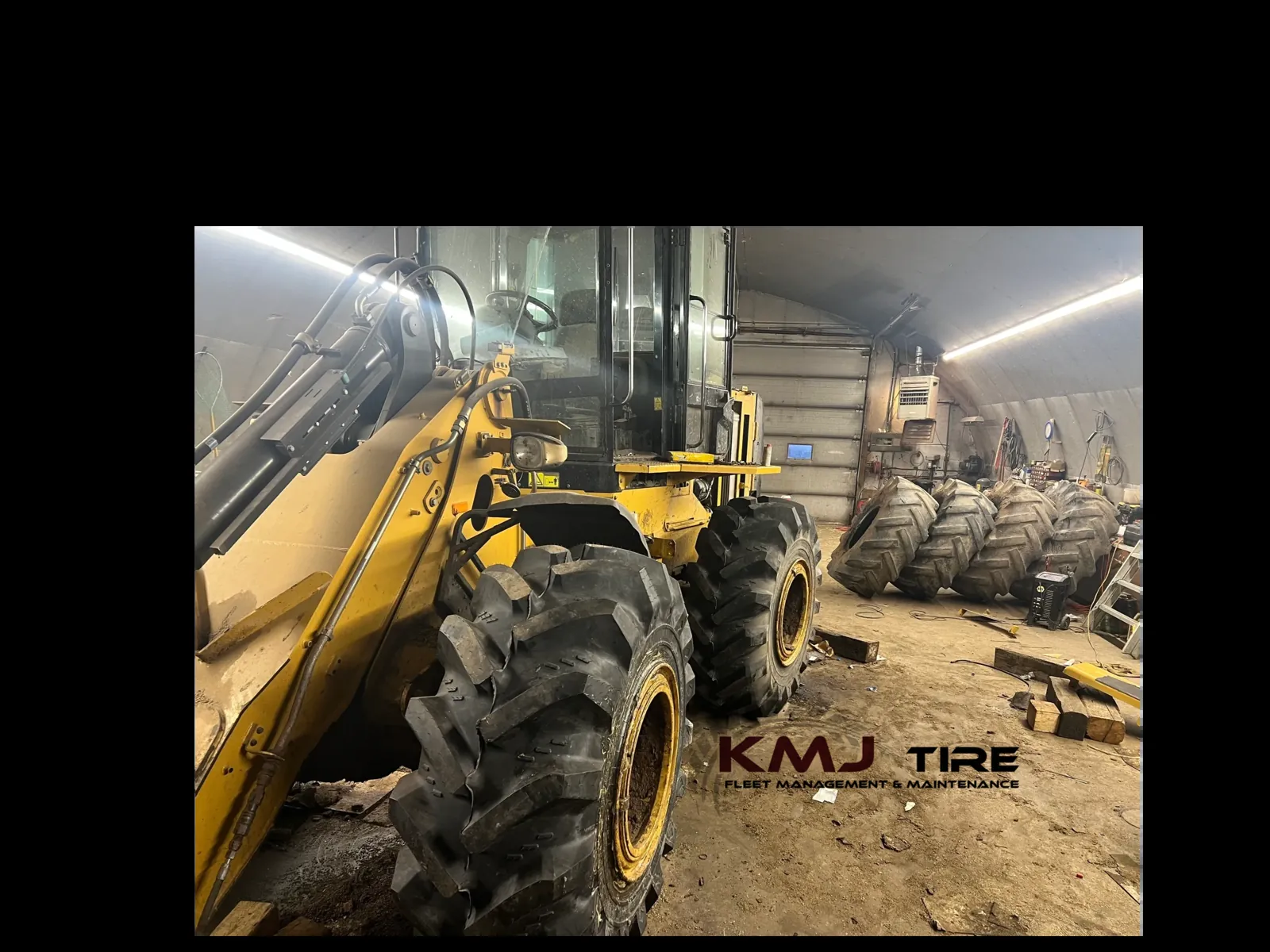
Here is a question that lands on our desk every November in some form: "We picked up a used wheel loader to push snow on our lots this winter, and it will move gravel in the yard come spring. The tires on it are about half worn, the sidewall says L-3, one has a cut in the shoulder, and nobody knows what pressure they should run. Do we keep them, change them, or change the way we run them?"
The honest answer is that a loader tire is chosen for a job, not for a machine. The same loader can need a different tread, a different pressure on each axle and a different inspection routine depending on whether it is stacking snow on a flat commercial lot in Forest Lawn or loading pit-run gravel on a sharp, rocky face east of the city. Most of the decisions come down to four things you can read or measure yourself: the sidewall codes, the load each axle carries, the surface the machine works on and the condition of the casing. This guide walks through each one, using the manufacturers' own published guidance, so you can decide with evidence instead of folklore.
The Short Answer
Keep the tires if the casing is sound, the cut stops in the rubber without exposing cords, the wear is roughly even across the axle and the tread type suits the surface you actually work on. Change them if cords are visible, the bead area is damaged, the rubber has been soaked in oil or solvent, or the tread design is badly wrong for the job. Set pressure from the tire maker's load and inflation table for the load each tire carries, check it cold, and expect the front axle to need a different number from the rear because the front carries the bucket.
That paragraph is the whole decision in miniature. Everything below explains where each piece of it comes from and how to apply it to a Calgary operation that may change surfaces with the season.
What a Loader Asks of a Tire That a Truck Does Not
A highway truck tire is built to roll for hours at speed under a fairly steady load. A loader tire lives a completely different life. It travels slowly, it turns hard, it pushes into piles, and the load on the front axle swings from light to heavy every time the bucket fills and dumps.
Firestone's off-the-road databook makes the speed difference explicit. In its notes on load and inflation tables, it lists a maximum of 10 km/h (5 mph) for loader and dozer service, compared with 50 km/h for earthmover service and 40 km/h for grader service. It also defines what "loader service" means in those tables: dig-and-load operation, with travel distances of up to 76 metres (250 feet) one way. A loader working inside those limits is doing the job its tire tables were written for. A loader carrying full buckets across a large site, or travelling between yards, is doing something else, and that matters for heat, which we will get to.
The other big difference is how weight moves. With an empty bucket, much of the machine's weight sits toward the rear, where the engine and counterweight live. With a full bucket raised, a large share of the total load transfers forward onto the front tires. A tire that is perfectly happy on the rear axle may be working much closer to its limit in the same position up front. That is why loader tire tables separate front and rear loads instead of giving one figure per tire, and why a single "the loader runs 50 psi" note on a clipboard is rarely the complete story.
Reading the Sidewall Before You Trust Anyone's Memory
The first job with a used machine is to read what is actually on it. Previous owners swap tires, mix brands and forget. The sidewall is the only record you can rely on, and off-road tires carry more of it than passenger tires do. If you are used to car tires, our page on reading tire sidewall markings covers the passenger-vehicle basics; the off-road version has a few extra layers.
The size
Off-road sizes come in a few formats. A marking such as 17.5R25 gives a nominal section width in inches, an R for radial construction, and a rim diameter in inches. A marking like 17.5-25, with a dash where the R would be, is the traditional way a bias-ply tire of similar nominal size is written. Wider low-profile sizes add an aspect ratio: Michelin's sidewall guide uses 35/65 R 33 as its example, explaining that 35 is the nominal section width in inches, 65 is the series (a height-to-width ratio of 0.65), R is radial construction and 33 is the rim diameter in inches.
Do not assume that two tires with similar numbers are interchangeable. A metric-style low-profile size and an inch-style size can both fit the same rim diameter while differing in overall diameter, width and load rating. The dimensions in the manufacturer's data are what tell you whether they match.
The TRA code
This is the code people skip and the one that tells you the most about whether a tire suits your work. The North American industry classification, published by the Tire and Rim Association and repeated in manufacturers' databooks, combines a letter for the machine type with a number for the tread type and depth. Firestone's databook lists the loader codes this way: L-2 is loader traction regular tread, L-3 is loader rock regular tread, L-4 is loader rock deep tread and L-5 is loader rock extra deep tread. Smooth versions carry an S, such as L-3S, L-4S and L-5S, for loader smooth tread in regular, deep and extra deep depths.
Michelin's selection guide groups the letters as C for compactor, E for earthmoving, G for grader and L for loader and bulldozer, and lists the numbers as 1 lined, 2 traction, 3 normal, 4 deep, 5 very deep and 7 flotation. Michelin also adds its own suffixes on some tires, such as T for traction and R for rock, so an L3T is a normal-depth loader tire biased toward traction. You will sometimes see a tire carrying two codes, such as G-2/L-2, which simply means the same tread is rated for both grader and loader use.
Strength markings: ply rating and stars
Bias tires describe their strength with a ply rating, such as 12PR, 16PR or 20PR. It is a strength index rather than a literal count of layers in a modern tire. Radial off-road tires usually use stars instead: one star, two stars or three stars, with more stars meaning a stronger casing that can carry more load at higher pressure. In the Michelin XHA2 range, for example, the 17.5R25 and 20.5R25 sizes carry one star while the 26.5R25 and 29.5R25 sizes carry two. Some radial tires also show a load index and speed symbol, like the 176A2 marking on that 17.5R25.
Firestone's databook adds an important caution: the figures listed under a ply rating are a maximum load and inflation pressure, not a target. Running a 20PR tire at its maximum when your machine and work only need far less is not a margin of safety; it is a harder, more cut-prone tire with a smaller footprint. If you want a refresher on how load ratings work in general, our explainer on how tire load index ratings work is written for road tires but covers the same principle.
Compounds and other letters
Off-road tires are often built in more than one rubber compound for the same tread. Firestone's abbreviations list includes CRC for cut-resistant compound and TC for transport compound, and Michelin marks some tires with a rubber type such as B4. You will also see TL for tubeless, LD for loader-dozer versions and markings that say a tire is regroovable. None of these letters are decoration. When you replace one tire, write every marking down before you start shopping, because a tire that matches size but not compound, star rating or tread code can behave differently from its partner on the same axle.
L-2, L-3, L-4 or L-5: Matching Tread to the Surface
Tread choice is a trade between grip, cut resistance, heat and ride. Deeper treads carry more rubber to wear away and protect the casing from rocks, but deeper lugs also flex more and build more heat at a given speed and load. Traction treads open up the pattern to bite into soft ground and clear mud and snow, at the cost of less rubber touching hard, sharp surfaces. Smooth treads put as much rubber on the ground as possible for abrasion and cut resistance where traction is less of a concern.
Michelin's selection guide puts it plainly: the right tread design depends largely on the ground conditions where the equipment operates, and the factors to weigh include traction needs, abrasion and cut risk, and the rate of wear. Here is how that applies to the work Calgary loaders typically do.
Snow clearing on paved lots
A loader pushing snow on a commercial parking lot spends most of its time on asphalt or concrete under a layer of packed snow and ice, at low speed, with frequent direction changes. Cut risk is low compared with a gravel face; traction is the limiting factor; and heat is rarely a concern in winter at walking pace.
An L-2 traction tread is the traditional choice for that kind of work, and Michelin describes its L2/G2 XTLA as using a large ground contact area and an aggressive non-directional tread to provide traction across a wide variety of surfaces. Many operators run L-3 tires on snow perfectly well, especially when the same machine spends summer in a yard. What tends to disappoint is a deep or smooth rock tread on hard-packed ice: a lot of rubber, but fewer edges to grip with.
Snow work has its own hazards. Curbs hidden under windrows, steel drain grates, broken asphalt edges and parking stops can all cut a shoulder or a sidewall. Pushing a full blade or bucket into a frozen pile also loads the front tires hard. The tire choice should reflect the lot, not just the season.
Gravel yards and pit work
Moving crushed rock, pit-run or recycled concrete is the opposite problem. Traction is usually adequate; the threats are cuts, chips and abrasion from sharp stone, especially on the face of a pile where the tire scrubs while the bucket digs. That is where L-3 rock treads earn their keep, and where L-4 and L-5 deep and extra deep treads come into play on harsher faces.
Michelin's XHA2 is an example of a radial L-3 tire marketed for construction and quarry work, with a reinforced sidewall and a deeper tread designed for damage resistance. Its published 17.5R25 specification lists a tread depth of 35/32 of an inch (29 mm), compared with 32/32 (26 mm) for the L-2 XTLA in a 15.5R25 size. Those numbers are for two different sizes and treads, so they are not a head-to-head comparison, but they show the kind of difference a code makes in rubber on the ground.
Mixed yards and seasonal machines
Most small Calgary contractors do not have the luxury of one machine per surface. A landscaping company's loader might load topsoil and mulch from April to October, then push snow from November to March. A farm loader near Airdrie or Okotoks might clean corrals, move bales and clear yard snow in the same week.
For mixed work, the question becomes: which surface is costing you the most? If the machine spins in snow and mud but the tires look clean, traction is the weak point. If the tires are chipped and cut but grip is never a complaint, cut resistance is. Choose for the surface that shortens tire life or stops work, and accept a compromise on the other. If the swing between seasons is extreme, a second set of mounted tires on their own wheels is sometimes the practical answer, though it means storing and handling heavy assemblies safely. Our farm and equipment tire service around Calgary covers the agricultural side of that kind of mixed use.
Bias or Radial on a Loader
Both constructions are still sold for loaders, and both have a place.
Bias tires build the casing from layers of cord running at angles across the tire. The sidewall and tread work together as one fairly stiff structure. That gives a firm sidewall, which some operators like on side slopes and for stability with a heavy bucket, and the tires generally cost less to buy. The trade-offs are more heat build-up in longer travel, a footprint that changes shape more as the tire flexes, and a rougher ride.
Radial tires run the casing cords straight across from bead to bead and put a belt package under the tread. The sidewall and tread can work more independently, so the tread stays flatter on the ground and the sidewall absorbs more of the flexing. Michelin claims its all-steel radial body reduces the risk of flats compared with conventional bias-ply tires, and markets the XHA2's casing as designed to absorb impacts and limit tread movement to reduce heat. Those are manufacturer claims tied to particular products, but the general principle, a flatter footprint and lower heat in many conditions, is why radials dominate larger loaders.
What you should not do is mix constructions on the same axle. Two tires of different construction will deflect differently under the same load, which affects how the load shares between them and how the machine sits. If a previous owner has left you a radial on one side and a bias on the other, that is something to correct rather than run.
Pressure: Why One Number Is Never the Whole Story
The most common pressure mistake on loaders is treating the tire like a car tire with a single figure on a door placard. Loader tires do not work that way.
Michelin's off-road pressure guide states that the correct operating pressure depends on how the tire and equipment are used, and lists the factors: type of machinery, type of soil, length of operating cycles, materials transported and loads. Its product pages repeat the same rule in plainer terms: the inflation pressure must always be appropriate for the load per tire, the speed of travel and the work to be done.
The published load tables show what that means in practice. For the Michelin XTLA in 15.5R25, the table gives loads for a loader in two separate columns: front laden and rear unladen. At 3.5 bar (51 psi), it lists 5,350 kg per tire for the front laden position and 4,300 kg per tire for the rear unladen position. The 17.5R25 XHA2 table follows the same pattern, listing 6,250 kg front laden and 5,000 kg rear unladen at 3.5 bar. In other words, the tire maker expects front and rear tires on the same loader to be doing different jobs, and the tables let you choose a pressure for each axle from the load it actually carries.
Working out a pressure, step by step
The process is the same whichever brand you run, as long as you have that brand's own table for that exact size and casing:
First, find the axle loads. The machine's operator manual or the manufacturer's specification sheet usually lists the operating weight and the front and rear axle loads, empty and with a rated bucket load. If you have added a heavier attachment, a snow pusher or counterweight, those numbers change.
Second, divide each axle load by the number of tires on that axle to get a load per tire, using the laden figure for the front and the unladen figure for the rear, as the tables do.
Third, find the lowest pressure in the tire maker's table that carries that load per tire for the machine type and position. Do not borrow numbers from another brand's chart or from a different star rating. The figures are specific to the casing.
Fourth, check whether the tire maker calls for any adjustment for your type of work. Firestone's tables, for example, note that for slope and ditching service, inflation pressures should be increased by 15 psi (100 kPa) with no increase in load rating. That is a good example of a pressure change made for stability and casing protection rather than for more carrying capacity.
Fifth, write the result down by axle, and keep the table you used with the machine's paperwork.
If you cannot find the axle loads or the right table, that is exactly the kind of question to bring to a tire professional before the season starts rather than after a failure.
Why underinflation and overinflation both cost you
Michelin summarizes the two failure directions this way. Insufficient pressure can cause an abnormal rise in operating temperature, which may lead to irreversible damage to internal components and destruction of the tire from rapid pressure loss. Excessive pressure can cause rapid and uneven wear and make the tire more sensitive to road hazards, including tread damage and casing breakage.
On a loader, underinflation usually shows up as sidewalls that bulge and flex far more than they should with a full bucket, and as a machine that rocks and wallows. Overinflation shows up as a bouncy, skittish machine that loses traction easily and tires that cut more readily on sharp stone, because a hard tire cannot wrap around a rock and instead lets the rock push into it.
Calgary Cold and the Pressure You Measure
Michelin's guidance is to check off-road tire pressure when the tires are cold whenever possible, and it adds two warnings worth taping inside the cab: never deflate a hot tire, and remember that pressure increases as temperature increases. A tire measured after an hour of loading will read higher than the same tire first thing in the morning, and letting air out to "fix" a hot reading leaves it low once it cools.
Calgary adds a twist. Many small contractors park their loader in a heated bay overnight and run it outside at minus twenty-five. The air inside the tire cools along with everything else, and its pressure falls with it.
You can estimate the size of that drop with basic gas physics. Pressure in a sealed tire scales with absolute temperature, which means you have to add atmospheric pressure to the gauge reading and work in kelvins. Take a tire set to 50 psi on the gauge in a 15°C building. In absolute terms that is about 64.7 psi at 288 K. Roll it out into a yard at minus 25°C, which is 248 K, and once the air inside cools it will sit at roughly 64.7 × 248 ÷ 288, or about 55.7 psi absolute. Subtract atmospheric pressure and the gauge now reads around 41 psi. That is an approximate figure that ignores small changes in tire volume, but it shows the scale: a tire that was correct indoors can be meaningfully underinflated in the yard.
There is no single fix for that, but there is a good habit. Decide where the machine actually works, then check and set the pressure when the tires have reached the temperature of that environment and have not yet been worked hard. If the machine lives indoors and works outdoors through a cold snap, a cold check outdoors before the shift is more meaningful than a warm check indoors. And if a chinook takes the yard from minus twenty to plus eight in a day, expect pressures to climb again.
Michelin also notes that nitrogen inflation does not reduce the recommended pressure-check frequency. Nitrogen has its supporters in off-road fleets, but it does not change the physics of temperature, and it does not stop leaks from a damaged valve, a corroded rim or a cut.
Heat, Travel Distance and TKPH
If your loader stays in a small area and digs, loads and reverses, heat is rarely the limiting factor, especially in a Calgary winter. If the same machine starts carrying material across a large site, that changes.
Off-road tire makers use a rating called TKPH (tonne-kilometres per hour) or TMPH (ton-miles per hour) to describe how much work a tire can do before heat builds up beyond what its rubber can tolerate. Michelin's selection guide calls TMPH an important measure of an off-road tire's working capacity and explains that tires of the same size and tread pattern may use different rubbers, each with a different TMPH. It also notes that those values depend on the tire's load capacity, its allowable operating speed and a standard ambient temperature of 38°C. Firestone's databook, for its part, tells buyers to consult a company representative for the TKPH ratings of its bias tires.
You do not need to calculate TKPH for a loader that clears a parking lot. You should know it exists if your work involves load-and-carry over distances well beyond the 76-metre dig-and-load assumption in loader tables, longer stretches at the machine's top speed, or summer work on hot pavement. In those cases, tell your tire supplier how far the machine travels with a load, how fast and for how long, so they can check whether the compound and tread you are considering suit the work.
A Practical Inspection Routine
Michelin's off-road inspection guidance gives a sound framework, and it scales down well to a contractor with one or two machines. It starts with the vehicle stationary and secure. That sounds obvious, but loaders are heavy and articulated, and walking between the frames of a machine that could move is how people get hurt. Lower the bucket to the ground, set the parking brake, fit the articulation lock if the machine has one and follow the machine maker's procedures.
From there, the list is straightforward:
Check the wheels and rims. Michelin advises checking wheel torque according to the vehicle manufacturer's recommendations and inspecting rims for visible damage. A cracked, bent or heavily corroded rim is a reason to stop and get help, not to keep working.
Inspect the tread and sidewalls for punctures, cuts or dents. Michelin's guidance is that visible damage calls for a thorough internal and external examination by a tire professional.
Look for casing damage. Michelin says not to run tires with visible or damaged cords, separation between components, deterioration caused by petroleum or corrosive products, or abrasion of the inner rubber from running with too little pressure.
Check the valve caps every time. Michelin's advice is simple: when in doubt, replace the cap. On a loader that works in mud, slush and grit, a missing cap lets debris into the valve core, and a valve that sticks or leaks is an easy way to lose pressure overnight.
Check wear at several points around each tire, using a depth gauge or the tread wear indicators where they are present, and compare tires on the same axle. Michelin recommends consulting a tire professional if wear is abnormal or differs between tires on the same axle.
How often
There is no universal interval in the sources, and the right frequency depends on your work. A sensible pattern for a small operation is a quick walk-around and visual check at the start of each shift, a pressure check with a gauge weekly or whenever conditions change sharply, and a closer look with tread depth readings at each service interval or seasonal changeover. Keep a simple log by tire position: front left, front right, rear left, rear right. Over a season, that log will tell you more than any single inspection.
A note on lifespan
Owners often ask how many years or hours a loader tire should last. Michelin's answer is that there is no single service-life expectancy for an off-road tire, because rubber changes over time at a rate that depends on climate, storage, load, speed, pressure and damage. It recommends regular checks by a qualified tire professional to decide whether a tire is suitable for continued service. Hours on a meter and a date code are useful context; the condition of the casing is what decides.
Cuts, Chunks and Exposed Cords: Repair, Watch or Retire
Loaders collect damage. The question is which damage you can live with.
Michelin's off-road repair guidance starts from a clear premise: not all off-road damage is repairable, and the decision depends on the type, location and size of the damage, how close it is to other damage and the overall condition and wear of the tire. Because damage can extend beyond what is visible from the outside, the tire must be deflated, dismounted from the rim and inspected before any repair.
It also lists cases where a tire should not be repaired: when the bead wire is exposed or deformed; when the tire has been damaged by greasy substances, solvents or corrosive products; when the damage is outside the repair areas the tire maker specifies; and when the damage exceeds the limits set by the maker of the repair materials.
For damage that is less clear-cut, Michelin draws a useful line. If the carcass is visible, the tire should go for repair immediately if the damage is repairable, and be removed from service if it is too worn to justify repair. If the damage is limited to the rubber and the plies are not visible, the right action depends on the tire's age and condition. For a tire that has been in service for some time, Michelin indicates it may stay in service as long as the damage is inspected regularly, because it could worsen. For a relatively new tire, a preventive repair may make sense.
That framework answers the question from the opening. A shoulder cut that stops in the rubber on a half-worn L-3 is usually a "watch it" tire: mark the cut with a paint pen, photograph it with a ruler beside it and check whether it grows. A cut that shows cord, or one that sits near the bead, is a "stop and have it assessed" tire.
When you do need a professional assessment, our tire repair in Calgary page explains how we approach repairs, and the same principle applies to large tires: repairability is decided after the tire is off the rim and inspected inside, not from a phone photo alone.
Oil, fuel and hydraulic fluid
One of the easiest ways to ruin a sound loader tire is to let it sit in fuel, oil or hydraulic fluid. Michelin lists deterioration from petroleum or corrosive products as casing damage and says contaminated tires may be unsuitable for repair. If a hose lets go and sprays a tire, clean it promptly with a method the tire maker approves, and have the hose repaired by whoever services the machine. A slow drip onto the same spot of the same tire every night is a slow way to buy a new tire.
Wheels, Rims and Where Tire Work Stops Being a Yard Job
Earthmover wheels range from single-piece rims to multi-piece assemblies with removable flanges, bead seat bands and lock rings. Michelin's XHA2 and XTLA specifications list recommended and approved wheel widths for each size, such as a 14.00/1.5 recommended wheel for the 17.5R25 XHA2 and 12.00/1.3 for the 15.5R25 XTLA. Firestone's databook lists a rim and flange height for each tire too. Those figures matter: a tire mounted on a rim it was not designed for may not seat, carry or wear correctly.
Firestone's industrial notes add another boundary: consult a rim manufacturer when inflation pressure exceeds 800 kPa (116 psi). Most loader tires run far below that, but it is a reminder that the rim has its own limits, separate from the tire's.
The bigger point is safety. A large inflated tire holds a lot of stored energy, and a multi-piece rim depends on every component being the right part, undamaged and correctly seated. That is why Michelin's repair guidance insists the tire be deflated and dismounted before repair work, and why servicing these assemblies is specialist work. For an owner, the safe line is simple: checking pressure, looking for damage, keeping caps on and watching cuts are yard jobs. Deflating, demounting, mounting, seating beads and inflating a large off-road assembly are jobs for people trained and equipped to do them. If you see a cracked lock ring, a bent flange or rust scale around the bead seat, deflate only if it is safe to do so from a position out of the rim's path, and get trained help.
On the machine side, KMJ's work is the tires. Axle, hydraulic, brake and drivetrain problems on a loader go to the equipment dealer or a qualified heavy-equipment mechanic. If a tire is wearing oddly because of something mechanical, we will tell you what we see on the tire, and the machine owner can take that to the right specialist.
Matching Tires Around the Machine
Many loaders drive all four wheels through a fixed drivetrain. If the tires on one axle have a noticeably different rolling circumference from those on the other, the drivetrain has to absorb the difference as the machine travels. How much difference a particular machine tolerates is a question for its manufacturer, and some publish limits. For tire buyers, the takeaway is to replace tires in axle pairs at minimum, to keep the same size, construction and tread code on an axle, and to tell your tire supplier the tread depth of the tires staying on the machine.
The manufacturers' data shows how much size matters. Michelin lists a rolling circumference of 3,995 mm for the 17.5R25 XHA2 and 3,795 mm for the 15.5R25 XTLA. Those are different sizes, so the difference is expected, but it shows why a "close enough" size swap is not close enough on a four-wheel-drive machine. Wear changes circumference too: a new tire next to a well-worn one on the same axle is a mismatch in its own right.
When you are choosing between new tires, the brand pages on our site, such as Michelin tires in Calgary, Firestone tires in Calgary and Bridgestone tires in Calgary, give a sense of the makers we work with. For off-road sizes, availability changes, so we confirm the exact tire, tread code and casing for your machine before quoting anything.
Fill, Ballast and Stability: A Machine Decision, Not a Tire Upgrade
Some loaders run foam-filled tires or liquid ballast, and owners sometimes ask about adding either to stop flats or improve stability. Both change the weight of the machine, how the tire flexes and, in some cases, how the machine's stability ratings apply. Fill also changes how the tire behaves after damage, because it cannot be repaired the same way as an air-filled tire.
Because those effects reach beyond the tire, the starting point is the machine maker's operator manual and the tire maker's guidance, not a tire supplier's opinion alone. If your manual allows a fill option, it will say so. If it does not mention one, ask the equipment dealer before changing anything. When you buy a used machine, check whether the tires are already filled: tap them, look for a fill valve or markings and ask the seller. A filled tire behaves very differently if you try to check its pressure or let air out.
Storing Spares and Seasonal Sets
A spare loader tire, or a second set kept for the other season, ages in storage like any other tire. Michelin's guidance for off-road tire storage is to keep tires indoors when possible, in a clean, dry and well-ventilated room away from direct sunlight and bad weather. It says to keep them away from chemicals, solvents and hydrocarbons, from objects that could pierce the rubber, and from heat sources, flames, sparks and sources of ozone such as transformers, electric motors and welding stations. It notes that limited outdoor storage does not adversely affect tire life if done properly, but indoor storage is preferred.
That list has a direct Calgary application. A Quonset or garage that houses a welder, a compressor and a battery charger is a common place for spare tires to end up, often right next to the bench. Move them to the far end, away from the welding station and electric motors.
Handling matters too. Michelin warns against lifting a tire directly with a crane hook, recommends flat straps rather than metal slings or chains, and says a telescopic forklift should pick a tire up from under the tread rather than at the beads. Bead damage from careless handling can turn a good spare into scrap before it is ever mounted.
For a mounted seasonal set, keep the assemblies clean, label the position each one came off, record the pressure and tread depth when you take them off, and check the pressure again before they go back on.
Two Worked Examples
These are composite scenarios built from typical questions, not records of specific customers.
The snow contractor's second-hand loader
A small property-maintenance company buys a compact wheel loader in October to clear three commercial lots in southeast Calgary. It arrives on four L-3 radial tires of the same size and brand, roughly half worn. One front tire has a 4 cm cut in the shoulder that shows rubber but no cord. The pressures read 44, 45, 38 and 52 psi.
The first step is the sidewall: same size, same star rating, same tread code on all four, so there is no construction mix to fix. The cut stays in the rubber, so under Michelin's framework this is a tire to watch rather than to repair immediately: the owner marks it, photographs it with a tape measure and adds it to the weekly check. The pressures are all over the place, so the owner finds the front and rear axle loads in the operator manual, adds the weight of the snow pusher they plan to fit and looks up the tire maker's table for that size and star rating. That produces one pressure for the front and a lower one for the rear. Because the machine lives in a heated bay but works outside in the cold, the owner sets those pressures with the tires cold outdoors before the first shift.
The tread question comes last. L-3 is a rock tread, not the first choice for packed snow, but the tires are sound and half worn. The owner decides to run them this winter, watch how the machine pushes on ice, and plan an L-2 set for next season if traction proves to be the limit. That is a reasonable decision. Swapping sound tires mid-season for a marginal traction gain is rarely worth the cost.
The gravel yard with a sidewall problem
A landscape supply yard north of the city runs a mid-size loader on recycled concrete and crushed rock. The operator notices one rear tire losing a few psi a day. On inspection there is a cut low on the sidewall near the rim, and the inside of the cut looks frayed.
This is a different category. Low sidewall damage near the bead, with something fibrous visible, falls into Michelin's "carcass visible" territory, and near the bead it may be outside the repairable area altogether. The right move is to stop working on that tire, have it deflated safely, demounted and inspected inside. If it turns out to be non-repairable, the owner now needs one tire for an axle where the partner is already part-worn. The owner gives the supplier the size, tread code, construction, star rating and the tread depth of the remaining tire, and decides with them whether to replace one or two.
The longer-term fix is upstream. If recycled concrete with exposed rebar is part of the daily diet, an L-4 or L-5 tread or a cut-resistant compound may last longer, and cleaning the loading area regularly will save more tires than any tread choice.
What to Have Ready Before You Reach Out
Large tire questions are much faster to answer when the details are on hand. Before you send KMJ your loader tire size and photos, gather:
The full size and every marking on the sidewall: size, R or dash, TRA code, star or ply rating, compound letters, load index if present, brand and tread name. A clear photo of the sidewall section that shows all of these is ideal.
The machine make, model and approximate weight class, and whether it has any added attachment or counterweight.
The work it does: snow, gravel, mixed, farm yard, demolition. Mention how far it carries loads and how fast.
The tread depth of each tire, measured at several points, and photos of any cuts, with a tape measure in the frame.
Whether the tires are air, foam-filled or ballasted, and the pressures you currently run, measured cold.
With that, we can tell you whether the tires on the machine suit the work and what a replacement would involve. Our commercial and loader tire service in Calgary page explains the range of commercial work we handle, and our mobile tire service at your yard covers work done on site. If a machine is down with a tire problem, our emergency tire call-outs page describes how to reach us. You can check KMJ's service areas around Calgary to confirm coverage, and anyone running several machines may want to look at fleet tire management for equipment yards.
Planning the Purchase, Not Just the Tire
A full set of loader tires is a significant purchase for a small operation, and it pays to plan it rather than react to a failure. Start with the log: if two tires are likely to reach their limit within a season, replacing an axle pair at a planned time is cheaper than an emergency in the middle of a snow event. Our budget versus premium tire trade-offs page is written for road tires, but the same thinking applies: the cheapest tire per unit is not always the cheapest per working hour, especially in a cut-heavy environment. For larger purchases, there is also information on tire financing options in Calgary.
When you are ready to look at what is available, you can browse tires in Calgary or book a tire service appointment. For off-road sizes, the most reliable route is to send the sidewall details first so the exact tire can be confirmed for your machine.
And do not forget the vehicles that support the loader. The pickup that tows the trailer or carries the crew between lots spends the same winter on the same ice, and winter tires for the crew truck are part of the same plan.
Questions Loader Owners Ask
Can I run car-style "max pressure" from the sidewall?
No. Firestone's tables state that the figures under a ply rating are a maximum load and inflation pressure. The right pressure comes from the load per tire, the position, the speed and the work, using the maker's own table.
Should the front and rear pressures be the same?
Not necessarily. Manufacturers' loader tables separate front laden and rear unladen loads because the bucket shifts weight forward. Different pressures front and rear are normal.
Is an L-5 always better because it has more rubber?
No. Deeper treads resist cuts and wear longer on harsh faces, but they flex more and can build more heat. On packed snow or soft ground, a traction tread will usually grip better. Choose for the surface.
Can a loader tire be repaired like a car tire?
Some damage can be repaired, but only after the tire is demounted and inspected, and only if the damage is within the repairable area and the repair-material limits. Exposed or deformed bead wire, chemical contamination and damage outside approved areas rule out repair under Michelin's guidance.
Why does my pressure drop overnight in winter?
Partly physics: cold air inside the tire reads lower, and the drop from a heated bay to a deep-cold yard can be several psi or more. If the pressure keeps falling after the tire has cooled, look for a leak at the valve, bead or a cut.
Does nitrogen let me check less often?
Michelin says no: nitrogen inflation does not reduce the recommended check frequency.
Can I mix a radial and a bias on the same axle?
It is not a good idea. Different constructions deflect differently under load. Keep construction, size, tread code and casing strength matched on each axle.
Is it safe to mount my own loader tires?
Large off-road assemblies, especially multi-piece rims, hold a great deal of energy. Checking, cleaning and watching damage are owner jobs; mounting, demounting and inflation are for trained, equipped technicians.
The Short Version
Read the sidewall before trusting anyone's memory: size, construction, TRA code, star or ply rating and compound. Choose the tread for the surface that costs you the most: traction for snow and soft ground, rock for gravel and demolition, deeper for harsher faces. Set pressure by axle from the tire maker's own load table, check it cold, and expect the front to need more than the rear. In a Calgary winter, check pressure in the conditions where the machine works, not in the warm building. Watch cuts that stay in the rubber, stop on cuts that show cord or sit near the bead, and keep oil and fuel off the tires. Store spares indoors away from welders and motors, handle them by the tread and never by the beads. And leave mounting and demounting of large assemblies to people trained and equipped for it.
If you have a loader on the wrong tires for the season ahead, the most useful thing you can do today is photograph the sidewalls, measure the tread and write down how the machine is used. With that in hand, the decision usually becomes obvious.