Before taking a motorhome out of Calgary, establish three things: the tires are suitable for the vehicle, the loaded vehicle is within its ratings at every relevant position, and the tires are in serviceable condition at the correct cold pressures. A full-looking sidewall and plenty of tread cannot answer all three questions. Neither can last year's scale ticket if the people, equipment or water load have changed.
The practical starting point is a small departure file: vehicle and tire specifications, current loaded weights, the applicable manufacturer's load-and-inflation guidance, inspection history and a plan for help if something goes wrong. Build it before the day you want to leave. This guide shows what belongs in that file, how to avoid misleading averages and how to turn the information into a useful tire-service conversation.
The focus is a self-propelled motorhome, not a pickup carrying a slide-in camper or a utility trailer. Motorhome layouts vary substantially. Some use light-truck tires, some use larger commercial-style tires, some have dual rear wheels, and some add another axle. Your vehicle, chassis, wheel and exact tire documentation take precedence over a general guide. No pressure or replacement size in this article is prescribed for your particular coach.
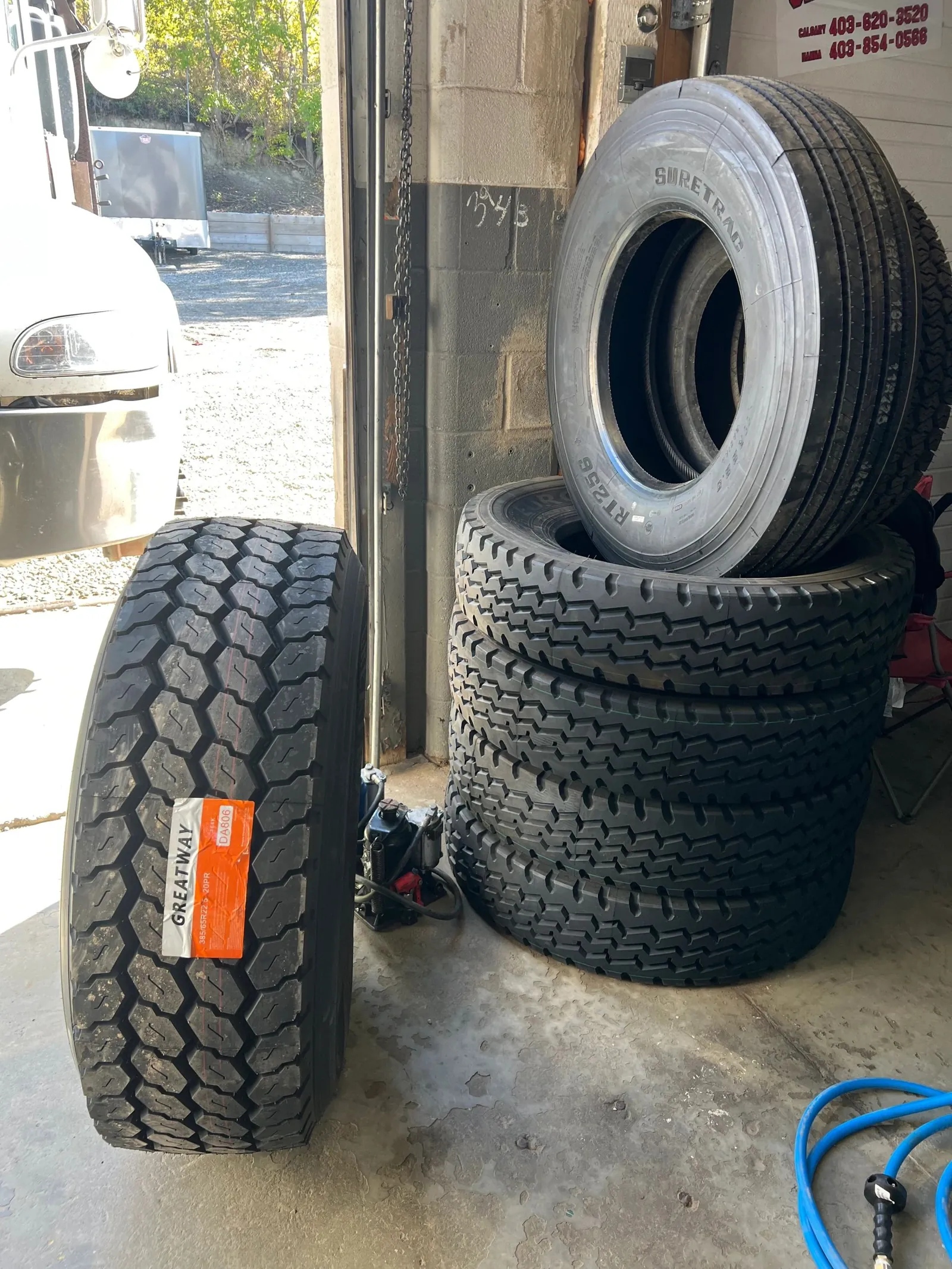
The real KMJ-library photo shows loose commercial tires beside the workshop doorway: an upright rib-pattern tire, stacked block-pattern tires and another labelled tire. It illustrates different commercial tire forms. It does not show a motorhome, establish an RV fitment or promise that those pictured products are available. The motorhome decision must be based on documentation, not a resemblance to a tire in a photograph.
Begin with the vehicle you actually own
A motorhome has more than a marketing name. Record the model year, coach model, chassis identification and the relevant vehicle identification information. Find the tire label, gross vehicle weight rating and axle ratings, and preserve clear copies. Note whether any manufacturer-issued information updates the original specification. If the vehicle has been converted or modified, obtain the documentation applicable to that change.
This prevents an easy mistake: looking up a tire based on a similar-looking motorhome online. Two coaches with the same broad body style may use different chassis, axle capacities, wheels and tire specifications. A previous owner may also have fitted replacements that are not the correct reference for the next purchase. The installed set is evidence about what is there, not automatic evidence about what should be there.
Our Calgary tire buying guide gives the general questions for a purchase. For a motorhome, add the chassis and coach documentation at the start rather than after someone has prepared a quote. It is much easier to compare suitable products once the required application is clear than to justify an attractive option that was selected from incomplete information.
Read every tire position, including the hidden ones
Write down the full brand, model, size and service description at each position. On dual-wheel vehicles, identify inner and outer tires separately. Include the spare if one is carried. Accessible photographs can help preserve the wording, but do not crawl beneath an unsupported vehicle or put yourself in danger to read an inward-facing sidewall. Arrange professional access where needed.
Also record the manufacturing date codes and any known repairs. A set may look uniform while containing tires installed at different times. That is not a diagnosis by itself; it is information that matters when reviewing service history and matching requirements. A spare can be much older than the tires in regular use, even when its tread appears untouched.
The tire sidewall information page helps decode markings. Keep size, construction, load and speed information distinct from decorative lettering or a product-family name. If a code is incomplete or unreadable, leave the field unresolved rather than inventing the missing characters. An unresolved specification is a reason to obtain better information before ordering, not a reason to assume the most convenient match.
Make a map rather than a list of six numbers
A simple position map prevents records from becoming ambiguous. Label front left and front right, then rear left inner, rear left outer, rear right inner and rear right outer where applicable. Add each additional axle explicitly. A record reading "rear pressure okay" hides the exact positions that are hardest to reach and easiest to overlook.
Use the same labels on pressure readings, inspection notes and service invoices. If a wheel assembly changes position, record the move. You do not need a fleet-management system to do this; a page in the departure file is enough. The goal is to connect a later observation to the actual tire rather than to an approximate corner of the vehicle.
This map also helps when seeking assistance. The difference between an inner dual and a front single matters to equipment, access and assessment. A clear description does not guarantee a particular service can be performed on site, but it lets the provider evaluate the request with relevant information. Treat the map as a communication aid, not as instructions to remove heavy assemblies yourself.
Ratings are limits, not measured travelling weights
Gross vehicle weight rating is the manufacturer's maximum rating for the complete vehicle. Gross axle weight ratings apply to individual axles. Other limits can apply to wheels, tires and a vehicle or trailer being towed. A rating tells you a boundary; it does not tell you what the motorhome weighs today with people and equipment aboard.
Actual weight changes with fuel, water, food, tools, batteries, accessories and personal gear. An unloaded factory figure is not a substitute for a travelling measurement. Neither is a previous owner's estimate. Michelin's RV guidance specifically bases the load discussion on the fully loaded vehicle, including passengers, cargo, fuel and water.
The load index explanation describes the tire marking, but tire capacity alone cannot raise the motorhome's vehicle or axle ratings. Installing a higher-capacity tire does not authorize additional cargo beyond those limits. Keep the distinction visible in the departure file: one column for the documented rating, another for the measured travelling load, and another for any question still requiring a qualified answer.
Pack for the scale as you pack for the road
The most useful weighing represents the trip configuration. Include the usual people, supplies, equipment and relevant fluid loads. A coach weighed empty during an errand may tell you something about the empty vehicle, but it does not settle the departure condition. Record what was aboard so the ticket can be interpreted later.
Fluid loads deserve particular attention. Fresh water, waste water and fuel do not always occupy the same locations, and their levels change through a trip. You do not need to predict every litre at every stop to recognize that an unusually light scale visit can give false confidence. Discuss the expected operating range with the vehicle documentation and a qualified professional where the margins are limited.
List substantial additions since the last weighing. A battery installation, rear carrier, larger equipment load or another accessory can matter even if each purchase seemed modest by itself. This is not an instruction to modify the vehicle or move equipment contrary to its mounting requirements. It is a reminder that the current configuration, not the memory of the original one, belongs on the scale record.
Axle totals can conceal a heavy side
Michelin recommends weighing individual wheel positions to understand side-to-side distribution. A motorhome is not necessarily balanced simply because its floor plan looks symmetrical. Tanks, appliances, storage compartments and personal loading can place more weight on one side of an axle than the other.
Here is a hypothetical arithmetic example, not a tire specification. An axle weighing 4,000 kilograms might carry 2,200 kilograms on one end and 1,800 on the other. Dividing the axle total by two produces 2,000 kilograms, which understates the heavier end by 200 kilograms. The average is mathematically correct and still the wrong description of that wheel position.
Use a suitable weighing service that can obtain the needed measurements safely. Michelin's guide describes methods that require the vehicle to remain as level as possible and enough space for the weighing arrangement. Do not drive partly off a public scale platform on your own initiative. Confirm the facility's method and permission. If you only have axle totals, label that limitation clearly and get the missing information before treating an average as a complete position-level assessment.
Turn weights into a pressure plan with the correct table
A load-and-inflation table must match the exact tire specification and application. Single and dual use can have different capacities. Units also matter: kilograms and pounds are not interchangeable, and pressure may be displayed in psi, kilopascals or bar. A table found through an image search is not a sufficient source unless its product, units and current applicability are confirmed.
Work from the vehicle requirements and the tire manufacturer's relevant documentation, with qualified assistance where needed. Michelin's RV guide stresses equal inflation across an axle and correct pressure for the load. The plan must also respect wheel and other component limits. It should not be assembled by choosing whichever of several unrelated numbers gives the softest ride.
Keep a copy or reference to the table and the resulting instructions in the departure file. Record who resolved any conflict with the placard or other documentation. The commercial tire service information is a starting point for discussing the tire-work side; confirm motorhome suitability, equipment and the exact task before arranging service. This guide makes no promise that every coach or procedure can be accommodated.
Why equal pressures do not mean equal loads
The load at each end of an axle can differ while the approved pressure plan still calls for the same cold pressure across that axle. Michelin explicitly emphasizes maintaining the same inflation across an axle for control and handling. That principle is not an invitation to ignore the heavier side; it is a reason to establish the load information and use the correct application guidance.
Do not independently lower one tire because its corner appears lighter. Do not invent a side-to-side pressure adjustment to compensate for uneven packing. Address loading within the vehicle's instructions and have the pressure plan determined from the appropriate data. A pressure setting should not disguise an overloaded wheel position or an unsuitable distribution.
The written result should be unambiguous: which axle, which tire specification, what cold target and which source supports it. If the coach has different front and rear requirements, say so plainly. A future driver should not have to infer whether a handwritten number belongs to the front tires, all tires or a temporary storage condition. Clear records prevent good technical advice from being lost in a vague handover.
Dual tires need separate attention
Two tires sharing one side of an axle are not a main tire and a backup. They operate as a pair under the vehicle's load. Michelin warns that underinflation in one can overload the other and that a companion tire may need assessment after its partner has been operated underinflated. A tire that still looks inflated may have carried more than its intended share.
Measure and record inner and outer pressures individually using suitable equipment and access. Have valve hardware, extensions and any monitoring equipment assessed for compatibility and condition. Do not add random extensions because a valve is inconvenient to reach, and do not treat an external pressure display as proof that all service checks are unnecessary.
Pairing also involves size, wear and spacing requirements. Michelin's guide discusses matched duals and adequate clearance so the tires do not contact one another in use. These are professional fitment and service matters, not a driveway instruction to change wheel offsets or pair whatever tires are available. The driver contribution is a complete position map, accurate history and timely reporting of pressure loss or damage.
Never reinflate a suspect heavy tire as an experiment
A tire that has been operated substantially underinflated or flat may be damaged internally. Michelin's RV manual warns that reinflating such assemblies can be dangerous, particularly where steel-casing fatigue damage or wheel damage is involved. The right response is qualified assessment with appropriate equipment, not simply adding air until the sidewall looks normal.
Tell the service provider how the condition was discovered, any known pressure reading and whether the vehicle was driven. If one tire in a dual arrangement was affected, report that clearly so the companion's exposure can be considered. Unknown distance or pressure should remain unknown rather than being minimized to make the situation sound easier.
The tire repair information explains why repairability is an assessment rather than an automatic response to a hole. For a motorhome, identify the tire category and vehicle details before assuming a passenger-car procedure applies. Do not attempt mounting, demounting or reinflation of a suspect heavy assembly using improvised methods. The consequences are not limited to ruining an inexpensive component.
Cold readings are the basis for the routine
Michelin recommends checking RV tire pressures before long trips and each morning before driving during a long journey, as well as before and after storage. Cold means the condition specified by the manufacturer, not a tire that merely feels comfortable to touch after travelling. Driving generates heat and can increase the pressure reading.
Do not bleed a warmed tire back to a cold target simply because its reading rose on the road. Michelin specifically warns against bleeding hot tires. If readings or symptoms are concerning, investigate according to the vehicle and tire guidance instead of making a casual adjustment at a fuel stop. Pressure monitoring can assist observation, but it does not replace the maintenance routine.
For Calgary departures, temperature differences between a heated building and the outdoors are relevant. Transport Canada notes that a tire adequately inflated in a warm garage can be underinflated in freezing conditions outside. The Be Tire Smart guide supports routine care. If freezing conditions, valve moisture or access complicate an RV pressure check, arrange an appropriate checking method with the provider rather than ignoring the requirement or improvising around it.
The dashboard system is a helper, not the entire inspection
A motorhome may have an original or added tire-pressure monitoring system. Identify the actual equipment, which positions it covers, what its warnings mean and how it should be maintained. Do not assume a display covers an inner dual or spare just because it shows several reassuring numbers.
Michelin's RV guide says monitoring systems should not be considered replacements for regular inflation checks. A sensor also cannot inspect tread damage, a deteriorated sidewall, an unsuitable repair or the complete wheel assembly. Combine the system's information with the prescribed maintenance and professional inspection schedule.
If a sensor stops communicating, distinguish missing data from a normal reading. Note the affected position and follow the system and vehicle instructions. Replacing or adding monitoring hardware should respect valve compatibility and service requirements. The departure file should name the system and preserve its instructions so another driver is not left interpreting unfamiliar warnings while navigating a large vehicle through traffic.
Age and tread answer different questions
A motorhome may travel relatively few kilometres while its tires spend years exposed to time, load and environmental conditions. Deep tread does not prove that the tire remains suitable indefinitely. Read date codes, keep purchase and installation records, and follow the exact manufacturer's service-life and inspection guidance.
For Michelin RV tires, the reviewed guide recommends at least annual specialist inspections after five years in service and precautionary replacement at ten years from manufacture, including spares, even if they appear serviceable. Those are Michelin-specific recommendations, not a promise that any tire is safe until ten or a universal rule for every brand. Damage, wear, use and the applicable vehicle guidance can require earlier action.
When comparing replacement choices, use the tire brands information as an introduction, then obtain the actual product's documentation. Ask how manufacturing age, installation date and inspection requirements will be recorded. A sales invoice and a date code serve different purposes, and neither should be silently substituted for the other when planning future inspections.
Look beyond the most visible tread blocks
Inspect accessible areas for cuts, bulges, embedded objects, irregular wear and other changes, using safe access. Tread measurements should represent different places across the width and around the tire where appropriate, not just the easiest central groove. Have inaccessible areas assessed professionally rather than declaring the whole tire good from its visible outer face.
Uneven wear is a reason to investigate, not permission to diagnose the chassis from one photograph. Michelin's guide discusses several possible patterns and emphasizes qualified assessment. Mechanical causes and repairs belong with a suitable RV or chassis specialist. KMJ's scope is tires and oil changes; this article does not offer mechanical work.
If there is a ride complaint, preserve the circumstances and ask what assessment is appropriate. The wheel balancing information explains one tire-service process, but balancing does not repair every defect or solve every mechanical vibration. A useful conclusion states what was found, what was corrected and whether another specialist needs to assess the vehicle before departure.
A spare deserves a practical plan, not a checkbox
Some motorhomes carry a spare; others rely on an assistance plan and suitable service equipment. Neither arrangement should be assumed from the size of the vehicle. Identify what is actually supplied, where it is stored and what the manufacturer expects the driver to do in a tire emergency.
If there is a spare, include its size, age, condition and pressure requirements in the record. Confirm whether it is a complete assembly and whether any limitations apply. Do not assume that carrying a heavy spare means the driver can safely lift the coach or handle the assembly at the roadside. Equipment ratings, support points, location and traffic exposure all matter.
If there is no spare, ask the assistance provider how the vehicle's tire specification and location will affect the response plan. The emergency tire-service page is a contact starting point, not a promise of an immediate replacement in every size. Preserve the full specification in the departure file so a provider can assess options without relying on a hurried, incomplete reading beside traffic.
Route planning starts with conditions, not tire optimism
A motorhome trip leaving Calgary can encounter very different conditions along the route. Do not let a mild departure afternoon stand in for the mountain section, the overnight stop or the return journey. Use current road and weather information near departure and follow the rules that apply to the vehicle on each route.
Tire markings, axle configuration and vehicle classification may affect requirements in other jurisdictions. This guide does not issue a universal legal rule for every motorhome or every highway. Check the responsible provincial or state authority and the vehicle documentation where traction devices are involved. A tire category label alone does not establish that the entire trip plan is compliant or suitable.
Our Calgary winter tire guide, all-weather tire information and all-season tire explanation help separate common categories. They do not guarantee availability or suitability in an RV size. Sometimes the sensible trip decision is to change timing or routing rather than expecting a product description to remove every limitation imposed by weather and the vehicle.
A replacement quote should identify the complete job
Ask a quote to state the exact tire product and specification, quantities and positions, and the work included. Clarify valve or monitoring-system requirements, wheel-condition assessment and any relevant balancing or fitment tasks. A total price without a clear scope makes it difficult to compare options or understand what remains unresolved.
Explain the motorhome dimensions, axle layout and location before discussing an appointment. Equipment and access must suit the vehicle. Do not assume a facility that services a passenger car can automatically accommodate every motorhome, or that a mobile provider can perform every heavy-vehicle task in a campground. Confirmation protects everyone's time without requiring a promise before the facts are known.
The mobile tire-service overview and service-area information are useful starting points for that conversation. Ask whether the specific vehicle, work and location are suitable. No part of this article promises a particular price, response time, inventory level or capability beyond what the provider confirms for the actual request.
Compare cost without turning tread life into a guarantee
A motorhome tire purchase can involve several large assemblies, so cost matters. Compare like-for-like specifications and job scopes before deciding one quote is cheaper. A different load capability, product category or incomplete installation scope is not an equivalent offer simply because the nominal size looks familiar.
Expected service life is not a guaranteed number of years or kilometres. Usage, storage, condition and manufacturer recommendations all matter. A low-mileage owner may reach an age-related replacement decision before using all the tread. That changes the financial comparison from a high-mileage commercial vehicle without making any one tire automatically the best choice.
The budget and premium comparison helps frame trade-offs, while browsing the tire range can begin a specification-led discussion. Confirm the exact product before relying on a listing. Keep the focus on suitability, documented limits and the complete service required rather than a promise that the most expensive option will solve every future concern.
Storage needs a return-to-service step
A parked motorhome remains a loaded vehicle. Michelin's RV guidance includes storage considerations such as cleaning, protection from sunlight, suitable surroundings and manufacturer-specific inflation instructions. Follow the applicable tire, wheel and vehicle directions together; do not copy a storage pressure from another owner's coach or exceed component limits.
If a storage procedure changes a setting or requires a particular support arrangement, record both the action and the return step. Never improvise lifting or support methods for a heavy vehicle. Tire preservation is not a reason to use jacks, stands or suspension components outside the manufacturer's instructions and equipment ratings.
Before returning to travel, review pressures, condition, inspection timing and any changes made during storage. A seasonal tire-service discussion can help organize tire-related work, but a full motorhome recommissioning may involve other qualified specialists. Keep those responsibilities separate. A tire appointment is not a declaration that the entire stored vehicle is mechanically ready for a long trip.
Build the departure file in one afternoon
Start with the vehicle label and handbook references, then add the position map and full tire specifications. Include date codes, installation records and the latest inspection findings. Add the scale ticket with a note describing people, supplies and fluid levels, plus any position-level measurements and unresolved limitations.
Next, preserve the approved pressure plan and its source. Make it obvious which targets apply to which axles and what cold-check method is required. Include monitoring-system instructions and the contact details or process for assistance. Keep a copy accessible offline so a weak signal does not hide the information when it matters.
Finish with an open-items list rather than a vague "ready" box. Examples might be obtaining a missing inner-dual code, resolving an unexplained pressure loss or confirming a facility can accommodate the vehicle. If an item affects suitability for travel, resolve it before departure. Organization does not itself make a tire safe, but it makes missing evidence much harder to overlook.
Worked example: the couple with a new rear carrier
Imagine a couple who used their motorhome comfortably last year and added a rear carrier for this season. They also packed more equipment for a longer trip. The old scale ticket is still in the glovebox, and none of the tire sizes has changed. It is tempting to conclude that the tire plan remains valid.
The better conclusion is that the configuration has changed and the relevant loads need rechecking. Equipment behind an axle can affect distribution in ways a simple cargo total does not capture. The carrier and vehicle also have their own limits and installation requirements. This article does not calculate the effect for an unknown coach or approve the modification.
They gather the installation documentation, pack in the intended travel configuration and obtain appropriate measurements. If a limit is exceeded or a position is unsuitable, they change the plan within the vehicle's requirements and verify again. Buying a higher-rated tire is not used as a shortcut to increasing the coach's approved capacity. The example is hypothetical, but the decision sequence is broadly useful: new configuration, new evidence, then a confirmed departure plan.
Worked example: an inner dual loses pressure
A second hypothetical owner notices that one inner rear tire repeatedly needs attention. The outer tire appears normal, and the coach has not travelled far since the last reading. The owner wants to top up the inner tire and begin the trip because the tread on both looks deep.
The repeated loss needs a proper assessment. If the tire has been operated substantially underinflated, reinflation and continued travel cannot be treated as routine. The service provider needs the known readings, distance and position information, and the companion tire may also require inspection because it could have carried extra load. A good-looking outer sidewall does not settle that question.
The useful outcome is an identified cause, a condition assessment and an appropriate repair or replacement decision under the applicable limits. The owner then records the result and verifies the complete pressure plan before departure. This example is not a promise that every leak is repairable or that every companion tire must be replaced. It shows why the pair's history matters more than a quick visual impression of the two tires.
Worked example: low kilometres, older tires
A third owner has a motorhome that travels only a few short trips each year. The tires still have substantial tread, but the records show they have been in service for several years. The owner is unsure whether annual inspections and age guidance apply when the odometer barely moves.
They do. Michelin's reviewed guidance distinguishes service-life considerations from tread wear and recommends regular qualified assessment, including its stated annual inspection point after five years in service. An owner using another brand should consult that manufacturer's policy rather than automatically importing Michelin's numbers. The vehicle manufacturer's instructions also remain relevant.
The practical next step is to identify each tire's manufacture date, installation history, condition and applicable guidance. A tire specialist can assess suitability for continued service; a calendar reminder then preserves the next inspection requirement. Low mileage is useful history, not proof that time and storage have stopped affecting the tires. The owner makes a decision from documented condition and instructions rather than from the amount of tread alone.
Keep units attached to every number
A scale ticket from one facility may use kilograms while a manufacturer table uses pounds. A pressure display may use kilopascals while the service record uses psi. The numbers are not interchangeable, and copying a bare number into a worksheet can turn an otherwise careful process into a serious misunderstanding. Write the unit beside each value at the time it is recorded.
When a conversion is necessary, retain the original value and label the converted result separately. Use a reliable conversion tool and have the final load-and-inflation interpretation checked against the correct manufacturer's table. Do not round early to make a value fit a convenient row, and do not extrapolate beyond a table's published range. The point of the worksheet is to preserve evidence, not to manufacture a reassuring answer.
A useful row might contain position, measured load, original unit, source ticket, tire specification, applicable table and the confirmed cold-pressure instruction. Missing fields remain visibly missing. This format makes it easier for a tire professional to review the reasoning and spot a unit mismatch before any setting is changed. It also keeps a future trip from depending on somebody remembering what an unexplained number meant months earlier.
Buying a used coach does not transfer complete tire history
A seller may provide an invoice for two tires while the motorhome carries six or more. Read the invoice for the positions and specifications it actually documents. Do not extend that evidence to the rest of the vehicle. Likewise, a recent vehicle inspection does not necessarily contain a complete internal tire assessment or the loaded wheel-position measurements needed for your own trip configuration.
Start a fresh position map and attach whatever reliable history is available. Ask specifically about prior pressure-loss events, roadside repairs, storage, impacts and replacements. If the seller does not know, record the uncertainty without interpreting it as a clean history. Your travelling load may also be materially different from theirs, so their pressure notes need review rather than automatic adoption.
Before a long departure, arrange the appropriate assessment for the equipment and uncertainties you actually have. The aim is not to assume a used motorhome is unsafe; it is to avoid treating the purchase itself as proof that every tire question has already been answered. A clear starting record gives the new owner a useful maintenance baseline that the sales conversation alone cannot supply.
Handover details that prevent departure-day confusion
If more than one person drives or manages the motorhome, agree on who checks and records pressures, who holds the documents and what symptoms require stopping the trip plan. A shared responsibility is not useful if each person assumes the other completed it. Keep the process simple enough to follow on a busy morning.
After service, review the invoice and findings while questions can still be answered. Confirm the tire positions, specifications and any follow-up instructions. If another specialist must assess a concern, do not let that referral vanish beneath the excitement of the trip. A successful tire installation and an unresolved chassis concern can both be true at the same time.
For a tire-related appointment, use the online scheduling information only after confirming the motorhome and job can be accommodated. Describe the work rather than selecting a generic passenger-car assumption. The goal is a clear handover from vehicle information to an appropriate service plan, not a last-minute scramble around a departure date that was chosen before the condition was known.
Sources and the final departure decision
The principal technical source is Michelin's May 2025 RV tire guide, available through its official reference-document page. The reviewed sections cover load and inflation, individual wheel-position weighing, dual fitment, pressure checks, repair assessment, service life, storage and the dangers of reinflating assemblies operated underinflated. Michelin-specific recommendations are identified as such rather than presented as universal rules for every tire brand.
Cold-weather pressure context also comes from Transport Canada's winter tire guidance. Exact vehicle, chassis, tire and wheel documentation governs the motorhome in front of you. The examples in this guide are invented teaching scenarios, not customer stories, measured tests, current weather reports or assurances about product availability. For more general education, the KMJ tire blog keeps the different tire topics separate from a particular vehicle's inspection result.
A departure decision should now be concrete. The required fitment is identified, the current travelling loads are understood, the pressure plan is documented and the tires' condition has been appropriately assessed. Missing information or unresolved damage is still a reason to pause, even if the itinerary is attractive. With those questions answered, the motorhome's tires become a managed part of the trip rather than a collection of reassuring-looking circles that nobody has fully checked.