A container tips over in the garage and leaves oil beneath a stored tire. Can you wipe it off and use the tire? Do not assume that a clean-looking surface proves the rubber is unaffected. First deal with the spill safely, identify what touched the tire, and keep the affected assembly out of use until you have appropriate tire-specific advice. Gasoline, oils and solvents are not ordinary road dirt, and adding a stronger cleaner can make the original problem harder to assess.
Continental's passenger-tire storage guidance says to keep tires away from gasoline, oils, solvents and other harsh chemicals because they can degrade rubber. Michelin's commercial truck tire manual describes petroleum contamination that can cause swelling, blistering or a spongy condition. Those sources do not provide a universal home test or a safe exposure time for every passenger tire. The practical answer is to document the contact, stop further exposure, and ask the tire manufacturer or a qualified tire professional how the particular tire should be handled.
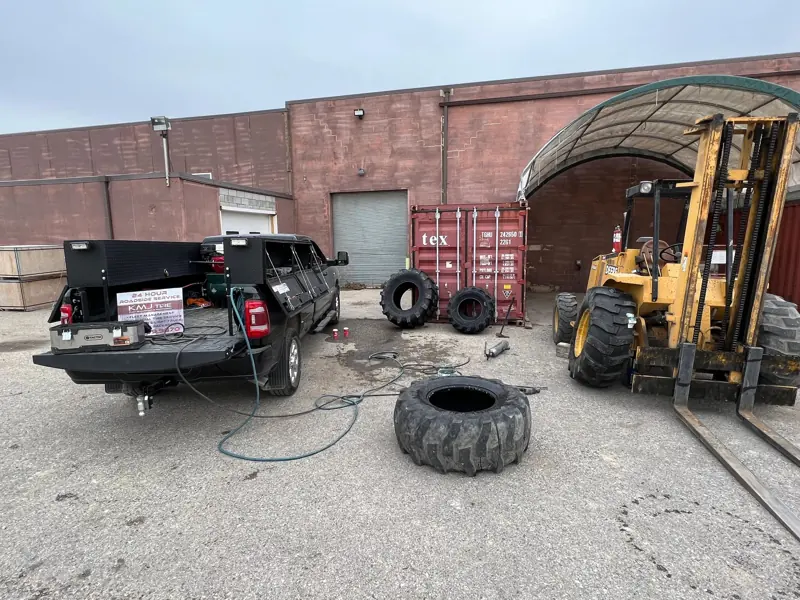
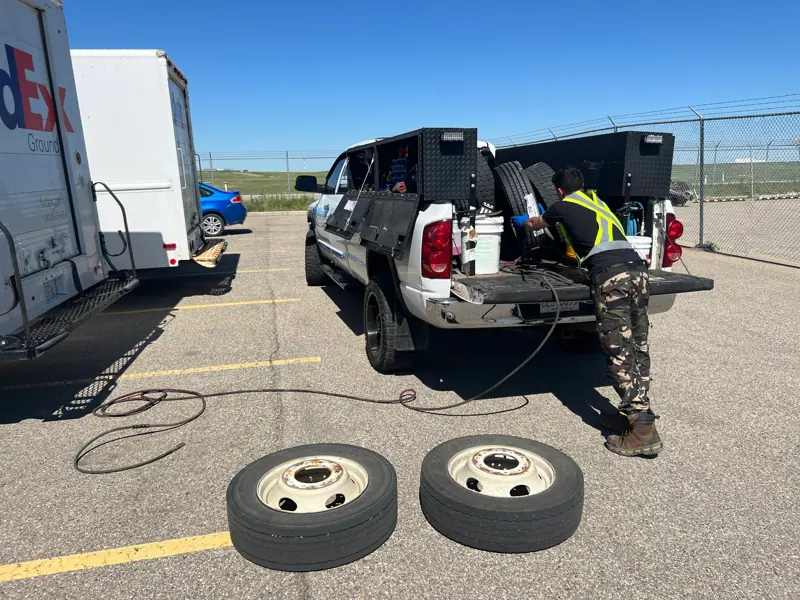
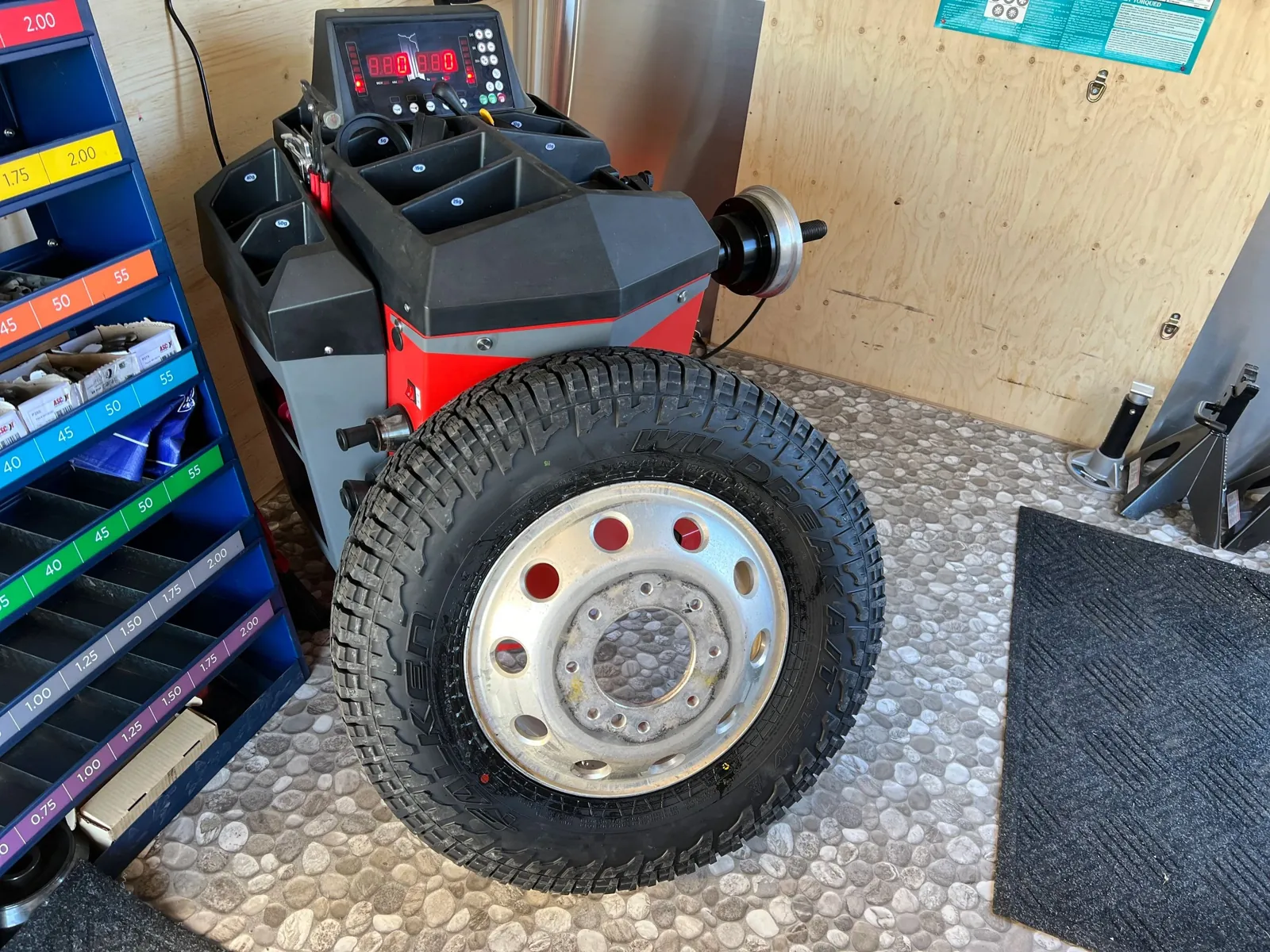
This guide covers an accidental chemical exposure in a Calgary garage, driveway or work area. It is not a hazardous-material cleanup procedure, a recipe for restoring damaged rubber or a claim that every small splash requires the same outcome. The KMJ photograph shows a tire and wheel beside balancing equipment. It illustrates ordinary tire-service context; it does not show contamination, a chemical inspection or a tire approved for continued use.
1. Deal with the spill before you deal with the tire
If the substance presents an immediate fire, breathing or contact hazard, follow its label, safety data sheet and the appropriate emergency guidance. Keep people and pets away. Do not enter a hazardous area just to take a better photograph of a tire, and do not start the vehicle to move it through a spill without knowing whether that is safe. A tire question comes after people are protected.
For an unknown liquid, resist identifying it by touching, tasting or deliberately smelling it. Colour alone is unreliable. A reused container can also have a misleading label. If there is uncertainty, tell the responsible cleanup professional exactly that. Do not invent a product identity to make the situation easier to describe. “Unknown fluid from an unlabelled container” is useful information, even though it does not yet answer the tire question.
Keep the two work streams separate. The person addressing the environmental or building hazard may not be evaluating the tire's suitability for use. The tire professional may not be equipped to clean up a chemical spill. Make the boundary explicit so nobody assumes the other task was completed. A cleaned garage floor does not certify a tire, and a removed tire does not make the floor safe.
KMJ's practical tire-care information is useful for ordinary maintenance, but it is not a substitute for the substance's handling instructions. KMJ offers tires and oil changes, not hazardous-material response. If a vehicle leak or damaged mechanical system caused the spill, have that problem handled by an appropriate qualified specialist.
2. Write down what the tire actually contacted
Once it is safe to gather information, record the product name, manufacturer and identifying label details. Keep a photograph of the original container if one is available. Note whether the material was fresh product, used fluid or an unknown mixture. A manufacturer's product name is more informative than “garage chemical,” and used fluid may not have the same known composition as an unopened container.
Describe where contact occurred. Was the tire standing in a puddle, brushed by a wet rag, sprayed on the sidewall or stacked beneath a leaking shelf? Did liquid reach the tread, outer sidewall, bead area or the inside of an unmounted tire? You do not need to diagnose the result, but these observations help another person understand the exposure instead of imagining a different event.
Record the time you discovered it and the last time the area was known to be clean. If the start time is unknown, say so. A precise-looking duration built from a guess is worse than an honest range. Do not assume the spill happened moments before you found it simply because you had not noticed a smell earlier.
Include any action already taken, even if you now think it was unhelpful. If someone wiped the surface, applied a cleaner or moved the tire, that belongs in the record. The purpose is not to assign blame. It is to preserve the sequence so the assessment can distinguish the original exposure from later handling and avoid repeating a treatment that was already tried.
3. Identify the tire, not just the vehicle
Write down the tire brand, full model name, size and service description. Photograph the relevant identification markings where accessible. If it is mounted, record which wheel position it occupied when discovered. For a loose seasonal set, assign each assembly a simple label such as A, B, C and D. Keep the label in the photograph sequence so close-ups do not become detached from the correct tire.
KMJ's sidewall-information guide can help you recognize the information you are trying to record. Do not substitute a wheel casting number or a vehicle identification number for the tire's markings. The vehicle information is useful too, but the manufacturer needs to know which tire product encountered the substance.
An incident involving one tire does not automatically describe every tire in the set. Two assemblies might have been standing in the same puddle while two others remained on a higher shelf. Record the actual contact path rather than declaring the entire set either damaged or unaffected. If liquid could have transferred between stacked tires, note that uncertainty rather than treating the visible wet tire as the only possible exposure.
You do not need to remove a wheel yourself to fill a missing field. If a marking cannot be accessed safely, explain that to the professional arranging the assessment. Do not crawl under an unsupported vehicle, dismantle an assembly or handle a chemically contaminated object without suitable instructions merely to complete a tidy inventory sheet.
4. Ordinary grime and petroleum exposure are different questions
Road dust and routine seasonal dirt are familiar cleaning problems. A known fuel, lubricant or solvent exposure introduces a different concern: interaction with the tire material. Continental's tire-storage guidance recommends detergent, water and a tire brush for normal pre-storage cleaning, while separately warning against chemical exposure. Those two points should not be merged into a promise that the normal cleaning method reverses every spill.
A wash can remove something from a surface without proving what happened beneath it or during the contact period. That is the central distinction. It is why “the oily shine is gone” and “the tire is suitable for service” are not equivalent observations. The first may be visible; the second requires consideration of the actual tire and exposure.
At the same time, avoid making the opposite leap and declaring every unfamiliar stain a chemical failure. A photograph of a mark may not establish its source or significance. State what is known, preserve the history and ask for an assessment. The goal is an evidence-based decision, not a dramatic conclusion from the colour of a patch.
A useful initial description is “this tire stood in spilled product X for an unknown period; this area was wet; nothing has been applied since.” That gives the evaluator a starting point. “It looked dirty, so we cleaned it until it looked new” hides the information that would help determine what happened and what needs closer attention.
5. Visible changes are reasons for concern, not a home grading scale
Michelin's truck tire manual describes petroleum-related swelling in tread, blistering on sidewalls and a softer or spongy condition. It directs disposal when the described contamination conditions are present. That is commercial-tire manufacturer guidance, not a universal numerical tolerance for every car tire. It supports taking these changes seriously rather than treating them as a cosmetic inconvenience.
Do not press, cut or scrape the rubber to compare its softness with another area. Do not buy a measuring instrument and invent a pass threshold from an online excerpt. A manufacturer may use specialized assessments in a particular context, but that does not turn a driveway comparison into an approved inspection procedure. Record visible changes and let the appropriate professional decide what examination is needed.
A lack of obvious swelling also does not establish that every chemical exposure was harmless. The source guidance does not offer an owner-visible sign that clears all cases. This is particularly important when the substance, duration or contact area is uncertain. The absence of one symptom cannot answer a question that depends on several unknowns.
Describe changes neutrally: where the mark is, whether its appearance changed between photographs, and what was observed before any treatment. Avoid attaching the word safe to a tire simply because it still holds air. Pressure retention and material condition are different issues. One observation cannot substitute for all the others a tire assessment may require.
6. Do not use a stronger chemical to undo the first one
An understandable reaction to grease is to reach for a powerful degreaser, brake cleaner, fuel, thinner or another workshop solvent. That can add a second exposure before the first has been understood. Do not assume a product suitable for a metal tool or garage floor is appropriate for tire rubber. Read the tire manufacturer's guidance and obtain instructions for the specific situation.
Avoid mixing cleaning products. The chemical-handling risks belong to the products' own instructions and qualified cleanup guidance, not to improvisation in a tire article. Nor should you heat a tire to dry it, burn away residue or sand the tread to reach what appears to be clean material. Removing visible contamination through aggressive treatment does not establish that the tire has been restored.
A dressing or gloss product is not a corrective treatment for suspected contamination. Continental specifically says stored tires do not need a dressing before being put away. Covering a mark with shine can make documentation more difficult without answering the underlying question. Preserve the original appearance in photographs and seek advice before applying anything that changes it.
KMJ's tire-service questions page can help you prepare a practical enquiry. Bring the product label and explain exactly what has already touched the tire. Ask what handling is appropriate before transporting it. The most useful service conversation begins with the actual exposure history, not with a request to make the tire look presentable again.
7. Keep an exposed stored tire out of the ready-to-fit pile
During a busy November changeover, a bagged wheel can move from garage corner to vehicle without anyone revisiting its history. If an assembly has an unresolved exposure, keep its status clear. Use a written note attached to the record or storage location so another household member does not assume the set is ready merely because it has been placed with the other winter equipment.
Do not tightly bag or relocate contaminated material using a generic storage routine before confirming safe handling. Continental's ordinary advice about storing clean, dry tires is not a chemical-containment procedure. The product's hazards may affect packaging, ventilation and transport. Ask the relevant professional how the object should be contained and moved, if it can be handled at all.
For seasonal tire-change arrangements, disclose the issue before the service begins. State which assembly is affected or uncertain and provide the exposure record. This gives the provider a chance to explain whether it can assess the tire and what further manufacturer guidance is needed. It is not an instruction to fit the set first and investigate later.
The label should describe the unresolved question without inventing a diagnosis. “Do not fit pending assessment: possible oil contact, found November 10” is more informative than “bad tire” or “cleaned tire.” Include who has the photographs and case reference. A visible status note protects the handoff when the person arranging the changeover is not the person who discovered the spill.
8. Mounted tires create a transport question too
If the exposed tire is already on the vehicle, explain that when asking for help. A professional needs to know whether the vehicle can remain parked, whether there are immediate hazards around it and whether the tire has been used since the exposure. Do not turn a trip to the service location into an informal test of whether the problem matters.
Avoid the idea of driving until the residue wears off. This guide provides no distance, speed or road condition that makes that approach acceptable. The point of assessment is to determine an appropriate next step before using the affected assembly, not to create more history under load and then judge the result by whether the drive felt normal.
When discussing mobile tire service in Calgary, describe both the vehicle access and the contamination. Availability and site suitability must be confirmed. A mobile service provider is not automatically equipped to enter a chemical spill area, and an ordinary driveway service description is not approval for handling a hazardous substance.
If transport assistance is needed, give the provider the same facts. Do not assume that rolling, loading or moving a vehicle through the affected area is harmless simply because the distance is short. Vehicle-specific transport guidance and the substance's hazards may matter. The people coordinating the move should agree on responsibilities rather than each assuming someone else approved the tire.
9. Loose tires can transfer contamination during handling
A loose tire is easier to move than a vehicle, but that does not automatically make moving it the right first action. Contact with a bag, floor mat, vehicle cargo area or another tire may spread the substance. Before loading anything, ask how it should be handled and whether the proposed destination can accept it in its present condition.
Keep the contact history honest. If a wet tire was stacked on another one, record that. If a cloth used on the spill was later used on a second assembly, include the possibility of transfer. These details do not prove equal damage everywhere, but they help identify what needs assessment. Omitting them because only one tire looks stained can leave the next person with an incomplete picture.
Do not move a contaminated assembly into passenger space as a routine convenience. The product instructions and appropriate professional advice determine whether packaging and transport are suitable. This article is not a specification for transporting hazardous materials. If you cannot establish a safe handling method, leave the item isolated as appropriate and seek help instead of improvising with a shopping bag.
Once movement is authorized, keep each tire connected to its record. A temporary label should survive the handoff without obscuring important markings or requiring unsuitable adhesive on the rubber. Explain the label to the recipient. The aim is to avoid an assessment of the wrong assembly after several similar wheels arrive together.
10. Ask the tire manufacturer a focused question
Prepare the product identity, exposure description, photographs and vehicle application before contacting the manufacturer. State whether the tire is installed or loose and whether it has been driven since the event. Ask what further information is needed and what should happen while the question is unresolved. A clear enquiry saves more time than a series of messages that each reveal one missing detail.
Use factual wording. For example: “An unmounted tire of this model was standing beside a leaking container of this named product. The wet area is shown here. The contact duration is unknown. No cleaning has been attempted.” That is an illustrative message, not a real KMJ customer case. It tells the representative what is known without suggesting a preferred diagnosis.
Ask whether the answer applies to the exact tire, substance and circumstances described. General storage advice may explain why exposure should be avoided without resolving a particular incident. If the response calls for professional inspection, obtain the required scope and any handling instructions. Do not treat a link to a maintenance page as a tire-specific clearance unless the manufacturer explicitly says it is one.
Save the case reference, date and written instructions. If a telephone conversation changes your next action, ask for a written summary where possible. Keep any unresolved point visible. “Waiting for the product label” or “inspection needed before a decision” is not the same as approval to return the tire to service.
11. Tell the service provider before the assembly arrives
A provider can prepare more appropriately when it knows the tire may be contaminated. Explain the substance, what is visible and what the manufacturer has requested. Ask whether the location can accept the item and whether special handling arrangements are needed. Do not arrive with an undisclosed chemical exposure and assume it can be treated like ordinary road grime.
The assessment may not be limited to the patch you can see. The evaluator decides what needs examination, based on the tire's construction, the contact path and the available history. Do not demand a particular cleaning method because it appears convenient, and do not assume that an exterior photograph alone is enough for a reliable decision.
KMJ's Calgary tire-repair assessment information describes ordinary service context. Chemical deterioration is not the same problem as a repairable puncture. A plug or patch does not undo an interaction between a chemical and the tire material. Avoid requesting a puncture-style fix for a condition that requires a different decision.
If another vehicle component is involved, separate that work. A leaking engine, damaged fuel system or other mechanical fault belongs with an appropriate specialist. Tire service can address the tire-related question, but it should not be presented as proof that the source of the leak was repaired or the surrounding vehicle systems were evaluated.
12. Replacement is a specification decision, not just a purchase
If the tire must be removed from service, confirm the correct replacement requirements for the vehicle. The exact size, load capability, service description and approved arrangement still matter. Do not select a replacement solely because it is available quickly or because its nominal size looks similar. A contamination incident does not suspend the normal fitment requirements.
Use KMJ's tire load-index explanation as background for that conversation, not as a standalone approval tool. Vehicle-specific requirements can involve more than one marking. Give the provider the complete application and explain whether other tires on the vehicle differ in age, model or wear. Let the relevant manufacturer guidance determine what matching is required.
The tire options available through KMJ provide a starting point for comparison. They do not establish current stock or the right answer for your vehicle. Confirm suitability and availability directly. This guide does not promise a replacement brand, a price, warranty coverage or a same-day outcome.
Keep the replacement's identification and service documentation with the incident record. Close the old tire's record without erasing what happened. If more than one assembly was potentially exposed, do not let replacement of the most obvious one silently close the others. Each unresolved item needs its own outcome or clearly stated next step.
13. Seasonal suitability still needs its own conversation
A spill discovered during winter preparation can create pressure to choose whatever replacement gets the vehicle moving. Resist blending urgency with suitability. The tire arrangement still needs to suit the vehicle and intended conditions. A product that is chemically unexposed is not automatically a suitable winter choice, just as a winter-oriented product is not automatically acceptable after questionable chemical contact.
KMJ's winter-tire information for Calgary drivers and winter-versus-all-weather comparison can support the separate seasonal discussion. Neither page can certify the exposed tire. Keep the two questions explicit: what happens to the affected assembly, and what approved setup should the vehicle use afterward?
A stored summer set can also be involved even when winter tires are already installed. Do not forget the incident until the next hurried seasonal switch. Record it now, obtain advice and make the storage status clear. That allows future planning without inventing a deadline or claiming the tire will improve merely because several months pass.
If a replacement changes the mix of tires on an axle or across the vehicle, have the complete arrangement assessed. There is no universal instruction here to replace exactly one, two or four tires. The appropriate decision depends on the application, the remaining tires and the relevant manufacturer requirements, not simply on the number that happened to be wet.
14. Work vehicles need a clear release decision
A work pickup or fleet van can pass between several drivers while a tire question is still being investigated. Put the current status where the person assigning the vehicle will see it. An email buried in one driver's account is not an effective handoff. State whether the vehicle is awaiting assessment, what instructions apply and who is responsible for obtaining the answer.
For fleet tire-management planning, connect the incident to the actual tire identity and unit number. Record any movement between vehicles or storage locations. A tire that moves to another unit should not lose its unresolved history simply because the original vehicle's worksheet is closed. Tire identity is the durable link; position is only its current location.
A service coordinator can collect the product's safety information while another authorized person contacts the tire manufacturer. Keep those roles coordinated. The cleanup team should know if an assembly needs to be preserved for examination, and the tire provider should know what handling has occurred. Nobody should infer a release decision from the fact that someone else finished a different task.
Businesses arranging commercial tire services should describe the actual application and exposure. Commercial manufacturer examples in this guide are not universal rules for every delivery van, pickup or heavy truck. The service record should say what was examined and what decision was made, without implying a broader vehicle inspection that did not take place.
15. A shared garage needs an agreed handoff
In a household, one person may use the garage for vehicle supplies while another handles seasonal wheels. That division can hide a spill's significance. The person cleaning a shelf may not know that a tire below it needs an exposure record, while the person fitting the set may never hear that anything leaked. Agree on a simple notification habit whenever a product reaches tire storage.
Describe the event without turning it into an argument about who put the container there. The practical questions are what leaked, what it touched, when it was found and what has been done. A calm record is more likely to be complete than a conversation focused on blame. It also helps if professional advice arrives days later and memories differ.
Keep affected items separate from the normal ready-to-use grouping as safely directed. Do not use an ordinary storage tote as proof that the item is clean or cleared. The note should remain with the item or its location, and everyone who might move it should know where the full record lives. A private phone photograph is not enough if nobody else knows it exists.
When the question is resolved, update the note and tell the other person what changed. If only one tire was assessed, say that. If the manufacturer requested more information, retain the pending status. The household needs a usable answer, not merely reassurance that someone made a call.
16. Prevention begins with the path a leak could take
After the immediate issue is resolved, look at the storage layout. Continental advises keeping tires away from chemical containers and checking storage areas for contamination after maintenance or repairs. Consider what would happen if a container leaked: would liquid run down a shelf, collect under an upright tire or soak a bag that hides the contact?
Do not treat a sealed cap as the only protection. Containers can be knocked over, damaged or returned to storage with residue on the outside. Follow each product's storage instructions and use appropriate separation. This guide does not specify a universal distance or containment material; those choices depend on the substance and the space. The useful principle is to prevent a plausible leak path from ending at the tires.
Keep tires away from workbench activities that can drop liquids or tools onto them. Continental also warns against using tires as a tool stand or storing items on top. A tire stack may look like a convenient platform, but it is not spare shelving for automotive chemicals. Removing that use reduces both spill exposure and accidental physical damage.
If routine work changes the area, inspect the tire-storage location before putting the set back. A floor can look dry while the history of a recent spill remains relevant. Ask what work occurred and what materials were used. Prevention is not a one-time photograph of a tidy garage; it is attention to how the space is actually used between seasonal changes.
17. Cleaning plans should be boring and product-appropriate
For ordinary cleaning, follow the tire manufacturer's instructions rather than escalating products until the rubber looks darker. Continental's storage article recommends detergent, water and a tire brush, followed by complete drying before normal storage. That is routine care for ordinary dirt. It is not a blanket instruction for cleaning unknown chemicals or a declaration that a tire is usable after any spill.
Keep cleaning tools and cloths appropriate to their task. A rag used on a petroleum spill should not quietly become the cloth used to wipe a stored wheel. If you discover that cross-use occurred, include it in the exposure history. The point is not to invent a laboratory-standard garage; it is to avoid transferring a known questionable material while trying to make something cleaner.
Do not interpret a product's marketing words as an approval from your tire manufacturer. A label may describe a product as powerful, protective or professional, but the actual ingredients, instructions and application matter. Ask about compatibility before using an unfamiliar treatment. If the manufacturer recommends against a substance, a glossy finish is not a reason to disregard that guidance.
A budget-versus-premium tire comparison is useful when evaluating products, but neither category is a licence for casual chemical treatment. An expensive tire is not inherently immune to unsuitable exposure, and a less expensive tire still deserves correct care. The maintenance decision follows the product guidance rather than its purchase price.
18. Separate a tire assessment from unrelated service results
An assembly can hold pressure and still have an unresolved contamination question. It can also be balanced without that procedure answering a chemical-material concern. Keep the meaning of each service result narrow. A successful result in one area should not be stretched into a statement that every aspect of the tire has been evaluated.
KMJ's wheel-balancing information explains that service context. Balancing is not a universal test for petroleum damage. Likewise, a familiar tread pattern, substantial remaining tread or a recent purchase date does not cancel an exposure history. Those are separate facts that may belong in the overall record but do not settle the material question alone.
Ask the provider what the assessment concluded and what it did not address. If the answer depends on manufacturer guidance, retain that guidance with the service notes. If the available information is insufficient, say so in the record. A qualified person explaining uncertainty is more useful than an unsupported all-clear offered because the owner wants a quick answer.
The vehicle's source of contamination must also be resolved separately. If the tire returns to the same active leak or contaminated storage surface, the original problem can recur. Coordinate the tire decision with appropriate cleanup or mechanical work, while keeping clear who performed each task and what evidence confirms it was completed.
19. Walk through a fictional garage incident
Imagine four loose seasonal tires stored beside a shelf. A container of a known lubricant leaks, and two tires are found in contact with the liquid. This is a hypothetical planning example, not a report about a KMJ customer, a particular product or the tire in the photograph. The person discovering it first follows the substance's safety instructions and arranges appropriate help if needed.
When safe, the owner photographs the container, the layout and each affected area. The record says the contact duration is unknown. The two apparently dry tires are documented separately, including whether liquid could have reached them through the stack. Nobody assumes that a matching brand means identical exposure or that a dry-looking surface proves no contact occurred.
The owner asks the manufacturer for tire-specific advice and tells the service provider before moving the assemblies. If an inspection is required, the provider receives the original photographs and the details of any cleanup. If disposal is directed, the owner asks how the contaminated item should be handled through an appropriate local route rather than treating ordinary recycling instructions as complete chemical guidance.
Finally, the household updates the tire inventory and changes the shelf layout so a similar leak has no direct path to the stored set. The important result is not a dramatic rescue of the tire. It is a documented, appropriate decision and a practical prevention change, with no claim that washing, waiting or a short drive proved the rubber was unaffected.
20. Keep the paperwork useful without creating a blame file
Save the product identity, tire markings, photographs, timeline, manufacturer response and service outcome together. That record can support future questions from a service provider, manufacturer or insurer if relevant. It does not guarantee warranty or insurance coverage. Policy terms, product terms and the particular event determine those questions, so ask the responsible organization rather than assuming every accidental exposure is reimbursable.
Use neutral language in your notes. “Found wet at this time” is an observation; “definitely ruined by this product” is a conclusion unless an appropriate assessment established it. Keep the two distinct. If the conclusion later changes after better information, retain the original observations and add the updated decision instead of rewriting the history to look more certain than it was.
For planning a tire purchase in Calgary, the practical record also helps explain why replacement is being considered and what the vehicle needs. You do not have to retell the entire spill story at every step, but the relevant facts should remain available. A short summary linked to the supporting documents is usually easier to use than a collection of unexplained photographs.
If a tire is discarded, close its inventory entry and keep the disposition information requested by the organizations involved. If it remains under assessment, keep it visibly pending. Do not mark the case complete merely because the floor has been cleaned or a new set has been ordered; those actions may not resolve every assembly or documentation question.
21. What to bring to the final service conversation
Bring a concise summary with the exact tire product, the known substance, the contact area, the known or uncertain duration, and every treatment already attempted. Attach the clearest photographs rather than a large collection of almost identical blurred images. Include manufacturer instructions and any case reference. State which questions remain open so the provider can focus on the next decision.
Ask how the tire should be handled before arrival, what assessment is available and what would constitute a completed decision. If replacement is necessary, confirm vehicle fitment and the whole tire arrangement. If another specialist must address the leak or surrounding hazard, identify that separately. Clear roles prevent the tire-service visit from being mistaken for a complete environmental or mechanical clearance.
You can discuss your tire requirements with KMJ while keeping those boundaries explicit. Do not assume chemical cleanup, campaign administration, specialized testing or unrelated vehicle work is included. The service discussion should establish what can actually be done for the tire and what must be referred elsewhere.
The guiding principle is simple: remove uncertainty with facts, not with stronger cleaner or more driving. A known spill deserves a known substance, an identified tire and an appropriate decision. Where those facts are missing, preserve the question rather than inventing a reassuring answer. That approach protects the next person who handles the assembly and keeps your vehicle's return to use tied to evidence.
Manufacturer sources and the limits of this guide
Continental's storage article supports avoiding fuels, oils and solvents near tires, keeping storage surfaces appropriate, and using ordinary detergent-and-water cleaning for routine dirt. Its general cleaning advice is not used here as a treatment for contamination. The source was read for those specific points, not as a promise that all exposed tires can be recovered or that every stain has the same consequence.
The Michelin commercial resources library provides its truck tire service manual. The care, cleaning and storage section describes petroleum contamination and associated material changes, with disposal direction for the conditions it describes. This guide does not transfer commercial numerical measurements or product-specific limits into a do-it-yourself passenger-tire test.
Every scenario above is illustrative. No actual spill, damaged customer tire, inspection outcome or current local stock level is claimed. Follow the instructions for the substance, tire and vehicle involved, and use appropriate professionals where the decision exceeds ordinary owner observation. The objective is a clear next step for the real exposure, not a universal chemical-repair formula.