Does “winter tires included” mean four loose tires, four complete wheels, or whatever is currently on the car? Before you advertise a Calgary vehicle with two sets, answer that question in writing. Identify both sets, describe what you actually know about their condition, arrange any needed assessment, and agree on how the extra set will reach the buyer. A useful tire handoff is a specific inventory and a workable departure plan, not a promise that eight tires must be better than four.
The easiest starting point is to give the installed set and the separate set different names. Call them Set A and Set B until their specifications and seasonal categories are confirmed. Photograph each item, connect records to the correct set, and separate measured facts from memories. That approach helps whether you are selling a commuter car, passing a vehicle to a relative, or trading it while keeping one wheel set for another vehicle.
This guide is about the seller's tire handoff, from preparing the advertisement to loading the last wheel. It is not a substitute for a vehicle inspection, legal advice, or the provincial ownership-transfer process. KMJ's services are tires and oil changes; mechanical issues and whole-vehicle inspections belong with appropriate specialists. The goal is to make the tire portion understandable without pretending it settles every question about the car.
Start with what changes hands, not a headline
Lay out the transaction before choosing the advertising language. List the tires currently installed, the spare if one is present, and every separate tire or wheel you intend to include. A temporary spare is not a ninth everyday tire. A bare wheel without a tire is not part of a complete seasonal set. Wheel covers, centre caps, wheel-lock keys and separate fasteners should have their own entries rather than disappearing into a vague “extras” description.
For example, a fictional seller might have four mounted winter assemblies on the car and four loose all-season tires in the garage. That is two tire sets but only one set of wheels. The next seasonal change would involve a different job from swapping between two complete mounted sets. A buyer who assumes eight wheels are included could misunderstand both the physical goods and the future service arrangement. Clear wording resolves that before either person travels to meet.
Use plain quantities: four tires mounted on four wheels, plus four unmounted tires. Add whether the visible wheels are factory or aftermarket only when you can substantiate it. Do not use the vehicle's trim level as evidence about a separate set that may have come from somewhere else. If the inventory is incomplete, say what is missing instead of treating the missing item as an obvious detail.
For background on the service distinction, review Calgary seasonal tire changeovers. The important handoff question is which physical configuration the buyer receives, not which service name sounds most attractive in an advertisement.
Give every item a stable identity
A set-level label is useful, but an item-level label prevents mix-ups. Assign A1 through A4 to the installed tires and B1 through B4 to the separate ones. Record the current vehicle position of each A item when safely observable. If a previous position is unknown for a removed tire, leave it unknown. A chalk mark from a past season is historical information, not proof of where that tire should be installed next.
Build a simple note for each item containing its brand, exact product name, visible size and service description, and whether it is mounted. Read markings directly rather than copying the first tire's information across the other three rows. A replacement after a puncture may have left one different tire in an otherwise familiar set. The same model name can also appear on different specifications, so a matching logo alone is not enough to describe the group.
Include photographs that show which written row belongs to which object. A wide shot gives context; a closer image records the relevant markings. Keep any identifier you cannot read marked as unreadable until someone can safely inspect it. Do not remove a wheel or crawl beneath a vehicle merely to finish a sales spreadsheet. A tire professional can determine the appropriate way to access markings during authorized work.
The tire sidewall information guide helps explain why a product name and a size string are different pieces of information. Your inventory does not need to decode every marking. It needs to preserve the actual details accurately enough for the next person to ask informed questions.
Separate the car's requirements from the extra set's history
A wheel set that has been in your garage for years does not automatically belong to the vehicle being sold. Perhaps it came from a previous car, arrived with a trade, or was purchased for a plan that never happened. Record that history explicitly. “Stored with this car” and “verified for this car” are different statements. A seller should not turn familiarity into a fitment approval.
USTMA's replacement guidance directs drivers to vehicle and tire manufacturer recommendations, including size, load index and speed rating. The vehicle's placard and owner's manual are important starting points. Those sources are more useful than assuming that whatever is fitted today must be correct. Aftermarket configurations or differences between front and rear positions may require additional vehicle-specific information and professional assessment.
For the sale, preserve a photo of the relevant vehicle label and the specifications on both sets. Do not create a universal compatibility rule from wheel diameter or bolt holes. Tire suitability and wheel suitability involve different details. If the extra set's application has not been confirmed, describe it as an included set requiring assessment rather than saying it is ready to install. This is especially important if you intend to keep one set and substitute another before collection.
A buyer comparing specifications can use the tire load-index explanation as background. It does not certify the offered set. The practical result should be a clear distinction between verified vehicle requirements, observed item markings and any remaining fitment questions.
Describe seasonal categories accurately
A seller may call a tire “winter” because it was used in winter. That describes use, not necessarily its category. Copy the actual product identity and relevant markings, then confirm the category with current manufacturer information. Do not call a mixed group a matched winter set merely because all four tires were on the vehicle during last January's commute.
Likewise, distinguish all-season and all-weather terminology rather than using them interchangeably to simplify the advertisement. The buyer may drive on different roads, at different hours, or in different conditions than you did. Your own experience is not proof that the tires will suit that person's winter travel. A precise description lets the buyer make the seasonal decision instead of inheriting an unspoken assumption.
Avoid broad statements such as “perfect for Calgary winters” or “never slips.” They suggest a performance guarantee that a private seller cannot establish from ordinary use. A more useful statement identifies the set, says when it was last installed if known, and points to the condition assessment and records. Keep performance claims separate from what the tires physically are.
For category research, the winter versus all-weather comparison is a starting point. If a replacement decision is needed, winter tire options in Calgary provide a relevant next step. Neither page turns an unidentified used set into a recommendation for the buyer's particular vehicle or route.
Replace “lots of tread” with a useful condition record
“Lots of tread” is an impression. A useful condition record identifies who measured the tires, when the measurements were taken, the units used and where readings were taken. Measurements should be associated with the individual tire rather than averaged into a flattering number for the whole set. Uneven readings can matter, and an average can hide the area that deserves attention.
If you have not measured anything, do not translate a photograph into a percentage remaining. Photograph the tread as evidence of appearance and arrange assessment when appropriate. Tread depth alone also cannot establish internal condition, remaining life or suitability for winter use. A tire can have visible tread while another concern makes it unsuitable. Keep the inspection findings and the proposed use in the same conversation.
Use a dated description rather than presenting an old assessment as current. A reading taken before another season of driving is historical. If you quote it, include the date and make the limitation obvious. The same applies to a report that covered only the installed set: it says nothing about the four tires wrapped in bags in the garage unless those items were actually included in the assessment.
The tire safety education page supports the general habit of checking more than appearance. For the advertisement, the honest choice is usually a concise factual description with records available, not a sweeping statement that the buyer will never need to budget for tires.
Disclose repair history without diagnosing it yourself
Gather any records of puncture assessment, repairs, pressure loss or impact-related tire work. Identify the affected tire using your item labels where possible. “One tire was repaired” is better than silence, but it is still incomplete if nobody knows which set or which item the statement concerns. If you cannot connect an invoice to a particular tire, say that the connection is uncertain.
Distinguish a documented repair from an object you once saw in the tread. A screw removed by someone, a temporary roadside measure and a completed professional repair are not interchangeable descriptions. Include any known use of emergency sealant. Do not describe a tire as internally checked unless the record actually supports that statement. The buyer should not have to infer the process from a vague line on a sales listing.
A current pressure-loss concern is a service issue, not merely something to disclose at the last minute. Arrange assessment and determine an appropriate plan before a test drive or departure. If the vehicle should not be driven, a lower price does not solve that safety problem. Transport and service arrangements must reflect its actual condition.
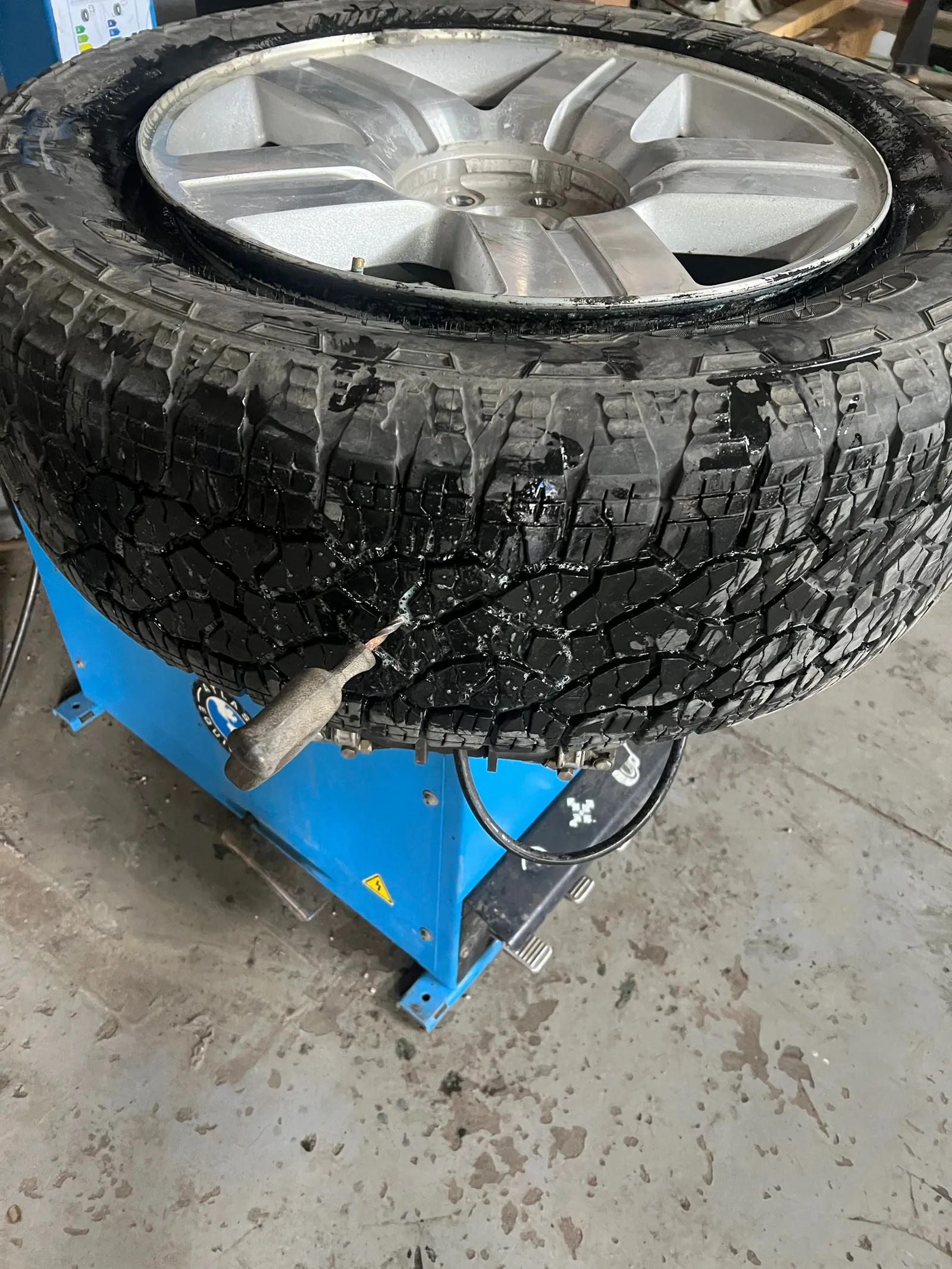
The Calgary tire repair information can help frame an enquiry, but repairability depends on assessment. The archive photograph accompanying this guide shows a wet tire and alloy wheel on service equipment with a tool at the tread; it is not evidence that a particular puncture was repairable or that any tire offered in your sale has passed inspection.
Use “unknown” as a precise answer
There are several kinds of unknown history. You might know the purchase date but not the kilometres driven on a seasonal set. You might have acquired the car with tires already fitted and no original invoice. You might know a set was stored indoors but not know how it was used before you obtained it. Record those uncertainties separately instead of collapsing them into “no issues.”
Do not estimate tire mileage by simply subtracting the car's odometer at purchase from its current reading when two sets alternated. That calculation describes vehicle travel, not necessarily use of either set. If you kept changeover odometer readings, provide the underlying entries and identify any gaps. An approximate total should remain labelled approximate. The buyer can then understand how the number was formed.
Age statements deserve similar care. A purchase date is not automatically a manufacturing date. A recently acquired used set may have an older history, and a stored tire is not made new by staying off the road. Preserve readable identification markings and let the relevant manufacturer guidance and professional assessment inform the next decision. Avoid offering a fixed remaining-life prediction.
A useful seller response might be: “I bought the vehicle with Set B already included. I have records for my ownership only, and I have not calculated its total distance.” That is more informative than a confident guess. It also tells the buyer which questions can be answered by documents and which require inspection or a conservative purchasing decision.
Decide what to assess before writing the listing
You do not need to solve every cosmetic detail before advertising, but unresolved tire safety concerns should not be hidden behind attractive photos. Make a short list of matters requiring assessment: repeated air loss, visible damage, unusual wear, a mismatched item or an extra set with uncertain application. Describe symptoms to the tire professional without deciding in advance what caused them.
Keep tire work separate from mechanical investigation. A pull or vibration can have more than one possible cause. Do not advertise that a balancing service has resolved an issue unless the outcome is actually established. KMJ handles tires and oil changes; any mechanical concerns should go to an appropriate specialist. A tire invoice is not a comprehensive vehicle safety certificate.
If assessment results arrive after the advertisement is posted, update the listing and tell anyone already considering the car. Do not leave the old wording active while relying on a later verbal explanation. A buyer who saved an earlier screenshot should receive a clear correction, particularly if the included goods or departure arrangement has changed.
For a tire-specific enquiry, use KMJ's tire-service contact page and explain that you are preparing a two-set vehicle handoff. Bring the actual inventory and the questions you need answered. That is more useful than asking for a general statement that the entire car is ready to sell.
Choose whether to repair, replace or describe a limitation
After assessment, decide what work you will authorize before the sale and what unresolved purchasing decision will remain with the buyer. Keep that choice transparent. If an extra set is not suitable for continued use, do not market it as an immediate seasonal solution merely because the wheels may still have a separate use. Describe the components and the finding accurately.
Where replacement is proposed, confirm the complete arrangement against vehicle and tire manufacturer requirements. Avoid buying one inexpensive tire solely to make the advertisement say “new tire.” A partial replacement involves the remaining set, not just the new item's price. USTMA recommends replacing all four for optimal performance and provides guidance for situations involving fewer replacements; the vehicle's specific requirements still matter.
You may decide to include an allowance in the negotiation rather than complete elective work. Do not imply that an allowance establishes safe use, pays for an exact future service or guarantees the buyer's preferred product is available. The financial discussion and the safe departure plan are separate decisions. Document each in ordinary language.
The guide to buying tires in Calgary can support a replacement enquiry. If both parties compare possible purchases, use confirmed specifications and written scope. Avoid turning an unverified online price into a claim about what the buyer will definitely spend after taking ownership.
Write an advertisement that matches the inventory
A good tire paragraph can be short because the detailed record exists elsewhere. State which set is installed, what additional items are included, whether the second set is mounted, and which condition records are available. If an assessment is pending, say so. Do not bury a material limitation in a photo caption while the main text promises a ready-to-use package.
Here is a fictional wording example: “Vehicle offered with Set A installed and four separate Set B tire-and-wheel assemblies. Item photographs and available service records can be reviewed. Set B's current condition and application require confirmation before use.” That is not a template for every sale; if your set has been assessed, replace the uncertainty with the actual dated finding rather than retaining vague language.
Avoid labels such as “brand new” for a used or previously installed set. If you know the purchase date or installation date, state it accurately and distinguish the two. Similarly, “balanced last year” describes an event, not proof that a set will require no attention when installed again. Specific history is more credible than a promise of future condition.
Keep your main advertisement and messages consistent. If you agree to exclude a set during negotiation, revise the inventory used for the final handoff. A friendly conversation is easy to remember differently. The purpose of the written description is to help both people see the same transaction, not to overwhelm a buyer with technical language.
Photograph evidence rather than polish
Take photographs in enough light to show the actual objects. Include an overview of each separate assembly, the relevant sidewall markings and any areas discussed in your condition notes. Do not use one good-looking tire to represent all four. Keep filenames or captions tied to the item labels so the buyer can connect a concern with the correct wheel.
Normal cleaning may make markings easier to read, but avoid staging that obscures the condition you are describing. A glossy surface is not evidence of tire health. If a feature cannot be photographed clearly, explain the limitation and leave room for an in-person assessment. Do not digitally remove blemishes, damage or identification marks from an evidentiary image.
Photograph accessories separately. A wheel-lock key beside its storage pouch and a labelled bag of relevant hardware are more useful than an indistinct image of the trunk. Do not publish private identification details unnecessarily. You can retain the fuller service record for a serious buyer while showing only the information needed to understand what is included.
If the buyer requests a very specific angle that you cannot safely obtain, decline the unsafe manoeuvre and propose inspection during appropriate service. No sales photograph is worth lifting a vehicle incorrectly or reaching into an unsafe position. The missing image should remain an acknowledged gap, not be replaced by a photograph of a different tire that looks similar.
Connect receipts to items without oversharing
Sort documents into purchase, installation, repair and assessment records. Then connect each record to Set A, Set B or a specific item only where the evidence supports it. An invoice for four tires does not necessarily identify the four currently present if a later replacement occurred. Preserve that distinction rather than arranging paperwork into a story that is cleaner than reality.
Provide useful information such as the service date, product specification, recorded odometer and work description. Protect unrelated personal details when sharing copies. Do not alter the substantive work record to make a past issue disappear. If a redaction makes a page difficult to interpret, explain what kind of information was removed and keep the original available for your own records.
Warranty coverage is a separate question from giving someone a receipt. Do not promise that a warranty transfers, that every claim will be accepted or that a service provider will reimburse the new owner. The applicable written terms and the provider's response determine that. You can tell the buyer where the product was obtained and which documents you have without making commitments on another business's behalf.
The tire questions and answers page is useful background for general service enquiries. Sale-specific promises should come from the actual agreement and confirmed terms. A thick folder of receipts is helpful history, but it does not replace a current condition assessment or approve a future installation.
Plan the viewing and test drive around actual condition
Make the tire inventory available before the viewing so the buyer knows whether the extra set is at the same location. If it is stored elsewhere, arrange a realistic way to inspect it. Asking the buyer to decide from old pictures while promising the set will appear later creates an avoidable uncertainty. At minimum, identify which items have and have not been physically reviewed.
For the vehicle's installed tires, follow the vehicle's recommended cold inflation pressures and appropriate inspection guidance. USTMA recommends regular gauge checks and notes that monitoring systems do not replace them. Do not inflate to the sidewall's maximum simply to make the tires appear prepared. If you do not know the correct specification, establish it from the vehicle documentation rather than guessing.
A test drive should not become an experiment to see whether a known problem goes away. If a tire appears damaged or a current symptom makes safe use uncertain, obtain appropriate guidance first. Tell the buyer about unresolved issues before any drive. A person unfamiliar with the car cannot reliably distinguish a new symptom from something you have stopped noticing.
Agree in advance whether a separate professional vehicle inspection will be arranged. Alberta's private-sale guidance recommends a safety inspection at a vehicle inspection facility. That broader process is distinct from the tire handoff described here. Neither a tidy spare set nor a completed tire service establishes the condition of the rest of the vehicle.
Keep the included accessories with the correct wheels
Different wheel sets may use different associated parts. Collect the wheel-lock key, relevant fasteners, centre caps and any available installation documentation without assuming that everything in the same drawer is interchangeable. Label the bags according to the documented set. If you are unsure which hardware belongs where, have the application checked rather than inviting the buyer to sort it out by appearance.
Do not provide an improvised fastener instruction based on memory. The proper hardware and installation specifications depend on the actual vehicle and wheel arrangement. A handwritten torque figure from an unidentified earlier vehicle should not travel with the set as if it were authoritative. Give the buyer the relevant manufacturer's documentation or identify the specification as unresolved.
Pressure-monitoring equipment should also be described carefully. If you know sensors are present from a service record, provide that record. Do not infer their presence or working condition solely from the valve's external appearance. Nor should a past absence of a dashboard warning become a guarantee that a separate set will work correctly after installation.
The wheel balancing service information explains one tire-and-wheel service, but balancing is not a substitute for confirming hardware, fitment or monitoring requirements. The buyer should receive a component inventory and any established installation information, not a collection of assumptions packaged as a complete approval.
Make the extra set's transport a real part of the sale
Four assemblies can occupy a surprising amount of space, and their combined weight belongs in the vehicle's loading plan. Before collection, decide who will transport them, in what vehicle and on which trip. Do not assume the buyer can fit them around passengers and luggage simply because they are part of the purchase.
Consult the transporting vehicle's load and cargo-restraint instructions. Tires and wheels should not be left free to move in the passenger area. A protective bag helps keep upholstery clean, but it is not automatically a restraint. Avoid treating a stack of tires as an extra seat, and do not obscure essential visibility or interfere with the driver's controls while trying to make everything fit.
If separate transport is needed, agree on timing and custody. Record who holds the set between vehicle collection and the later pickup, where it is kept, and which items remain to be delivered. A short inventory acknowledgment can prevent a later dispute over whether four loose tires or four complete wheels were waiting at the garage.
Where a tire-service visit is being considered as part of the plan, check KMJ's service areas and discuss the actual work and location. Do not assume a tire-service business also provides vehicle transport or delivery of sale goods. Those are separate arrangements unless explicitly confirmed by the relevant provider.
Handle a late change without confusing the buyer
Sometimes the buyer asks to collect the car on the other set. That request changes the handoff from moving goods to authorizing tire work. Confirm the set's condition and application, the work scope, who authorizes it and how the completed configuration will be documented. Do not agree to a rushed installation merely to preserve a convenient meeting time.
If a different set is installed, update the item record to show which tires are now on the vehicle and which are separate. Keep prior position notes as history rather than silently overwriting them. Any installation instructions or follow-up requirements supplied by the service provider should reach the buyer who will actually drive the car after the sale.
Weather may also change the collection plan. Decide based on the actual tires, current conditions and appropriate guidance, not a calendar assumption that a November pickup must be straightforward. Rescheduling, alternative transport or a suitable confirmed installation may be more practical than expecting the buyer to solve the problem at the roadside after payment.
For location-dependent work, the mobile tire service overview provides context for an enquiry. Confirm the job and site suitability directly; do not promise that every private-sale location or last-minute request can be accommodated. The revised plan should be agreed before anyone depends on it.
Compare offers without inventing the value of the second set
A buyer may value a documented usable set differently from an unidentified set needing assessment. That is a negotiation, not a reason to make unsupported claims about remaining life or replacement cost. Explain the included goods and available findings, then let the parties decide their own transaction terms.
If you compare replacement options, compare equivalent scope. Tires alone are not the same purchase as tires, wheels, associated hardware and confirmed installation. A listing for a different specification is not a sound basis for asserting the exact value of your used set. Availability and current prices also need confirmation; an old screenshot should not be presented as a current quote.
The budget versus premium tire comparison can help frame product-category questions without establishing resale value. Likewise, the Calgary tire catalogue is a starting point for product research, not proof that a particular item is currently available or that a buyer must assign it a certain value.
Be clear if an offer excludes the second set. List what remains in the sale, including whether the wheel-lock key or hardware is needed for the installed configuration. Do not retain an accessory required by the wheels staying on the car because it happened to be stored with the excluded set. Resolve that practical detail before the final collection appointment.
Keep the provincial paperwork separate but consistent
Alberta's private-sale guidance says to complete a standard bill of sale and directs buyers to the applicable registration and insurance steps. Follow the current provincial process for the vehicle itself. A tire inventory is supplementary information; it does not replace required documents, establish ownership by itself or settle a lien question.
Make sure your supplementary description does not contradict the transaction documents. If the additional set is included, use consistent quantities and descriptions wherever it is mentioned. If delivery will happen later, record that arrangement clearly. For legal questions about how to express conditions or obligations, obtain appropriate advice rather than treating a tire article as a contract template.
Both parties should retain the agreed version of the inventory. If you revise it, date the revision and make the change obvious. Do not leave several conflicting lists in a shared folder with no indication of which one reflects the final agreement. A simple final document is easier to use than a trail of messages containing untracked substitutions.
This discipline is useful even for a family transfer. People who trust each other can still forget which wheels were promised, whether a set was inspected or where the lock key went. Clear notes reduce the need to reconstruct those details months later, when the next seasonal installation brings the extra set back into use.
Walk through the handoff before the buyer leaves
At collection, compare the actual items with the agreed inventory. Identify the installed set, point out the separate goods and confirm the location of relevant accessories. Provide the condition records and any outstanding service instructions in a form the buyer can keep. Do not rely on a quick spoken explanation while everyone is busy moving keys and paperwork.
If a tire-related concern appears during collection, pause the departure plan and address it. A newly noticed low tire is not resolved by saying the paperwork is signed. Determine the appropriate assessment or transport arrangement rather than encouraging the buyer to drive and investigate later. Record any change to the agreed goods or timing.
When tire work has been arranged as part of the sale, confirm completion through the actual service documentation. Avoid telling the buyer that work was done merely because an appointment had been made. Scheduled, assessed and completed are different states. The buyer needs to know which state applies before relying on the vehicle.
Use online tire-service scheduling only after the required scope is understood. The final handoff should leave the new owner with a clear answer to four questions: what is on the car, what else is included, what is known about those items, and what still needs attention before use.
A worked example: two people, eight tires, one clear plan
Consider a fictional seller named Maya and a buyer named Ben. Maya's car has one seasonal set installed, while another set is stored at a relative's garage. Her original advertisement says only “two sets included.” Before the viewing, she checks the stored goods and discovers that they are four loose tires rather than the complete wheel assemblies she remembered.
Maya corrects the listing and tells Ben before he visits. She labels the stored items B1 through B4, copies their actual specifications and provides the purchase record she can find. She does not have complete distance records, so the inventory says that total kilometres are unknown. Ben can now evaluate the offer without assuming he is receiving eight wheels or a verified amount of remaining tread life.
During preparation, Maya also notices a recurring pressure concern on one installed tire. She arranges tire assessment rather than simply adding air for the test drive. The resulting findings determine the next step; this example does not assume a repairable puncture. Ben's broader vehicle inspection remains a separate process handled through an appropriate facility.
They agree on the final included goods, the confirmed vehicle configuration and a separate trip for the loose set because their collection-day cargo plan does not safely accommodate it. Their records identify what was handed over immediately and what remained for later pickup. Nothing about this process required Maya to predict a tire's future life or promise a service provider's availability. It required her to replace an ambiguous sales phrase with observable facts and agreed actions.
Your final seller checklist
Before advertising, count the tires and wheels separately, label the sets and items, and verify that your wording matches what is physically present. Identify the exact specifications you can read. Gather dated condition information and service records. Mark unknown history clearly, and arrange assessment for current concerns rather than writing around them.
Before the viewing, share the material limitations and explain where the extra set can be inspected. Separate tire condition from whole-vehicle condition. Keep proposed work distinct from completed work, and do not use the availability of a second set as evidence that either set is suitable for immediate use.
Before collection, agree on the final configuration, accessory inventory and transport plan. Update any changed description. Give the buyer relevant installation follow-up instructions and preserve the final records. If some goods are being collected later, record the remaining items and the arrangement instead of relying on memory.
A clear handoff does not need exaggerated claims about value, tread or winter performance. It needs enough reliable information that the new owner can make the next decision without starting from scratch. When both sets have an identity, a condition history with honest limits and a defined place in the transaction, “tires included” finally means something useful.
Sources and how they are used here
USTMA's replacement guidance supports checking replacement size, load index and speed rating against the relevant recommendations and considering the whole set when replacing fewer tires. USTMA's tire-care essentials support gauge-based pressure checks, use of vehicle specifications and attention to tread and visible condition. This article does not turn those general principles into a vehicle-specific approval, a universal pressure setting or a claim of remaining service life.
Alberta's private-seller vehicle guidance supports the distinction between tire preparation and the broader purchase process, including the recommended vehicle inspection and standard bill of sale. Consult the current provincial information and appropriate professionals for your own transaction. The inventory method, advertisement examples and Maya-and-Ben scenario are practical planning suggestions, not prescribed legal wording or accounts of an actual customer sale.