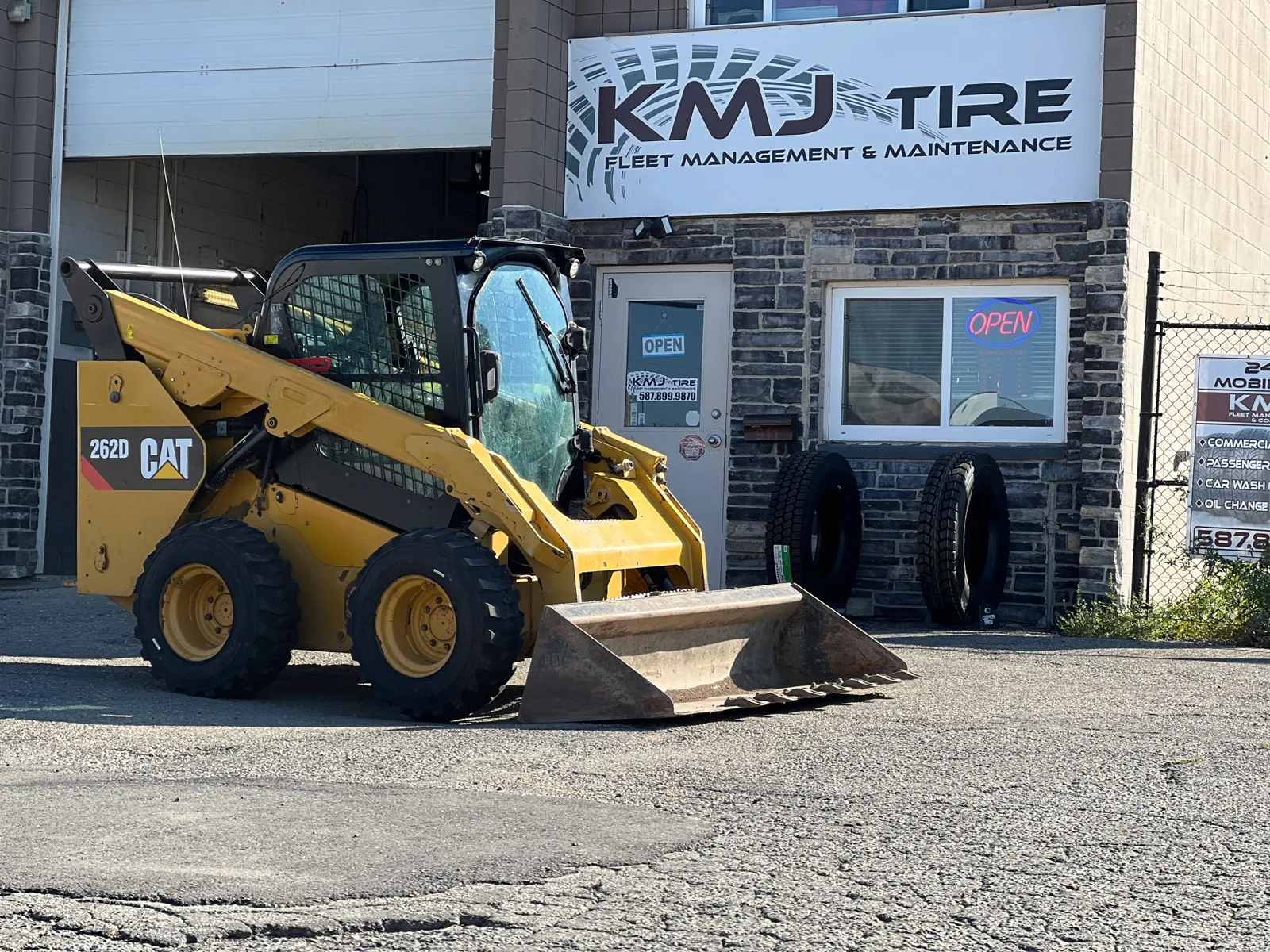
Should your skid-steer have deep-lug tires, a hard-surface tread, or an airless assembly? Start with where the machine actually spends its working hours, then confirm the equipment manufacturer's approved fitment. A tire that pulls well through loose ground is not automatically the best choice for repeated turns on concrete. A tire that cannot lose air still needs the correct capacity, clearance and working limits.
For a Calgary owner moving between landscaping, yard work and winter contracts, the useful question is not which tire looks toughest. It is which approved setup solves the most important problem without creating another one. That might mean reducing puncture interruptions, protecting a customer's finished surface, improving traction in loose material, or keeping one machine predictable across several operators.
This guide is about wheeled skid-steer tire decisions, not compact track loader undercarriage selection. It does not provide a universal inflation pressure, lifting procedure or conversion recipe. Those depend on the machine and the exact assembly. It does give you a way to document the job, compare suitable options and arrive at a tire assessment with information that changes the answer. KMJ's commercial tire services in Calgary are the relevant starting point for an equipment-tire inquiry; confirm the specific machine and service requirements before arranging work.
1. Describe the working surface before the tire
Write down the surfaces the machine touches during a normal week. Use ordinary descriptions: poured concrete with tight turns, broken asphalt with scattered metal, firm gravel, wet soil, irrigated turf, packed snow, or a mixture. Include the loading area and travel lanes, not just the place where the bucket spends most of its time. A landscaping machine can work in soil but still make hundreds of turns on a paved staging area.
Separate frequency from consequence. A short crossing over a finished courtyard may occupy very little time yet carry a large damage risk. A muddy entrance used twice a day may be the only place that stops production. A debris pocket near the scrap bin may account for most punctures even though the rest of the yard is clean. Percentages alone can hide the location that deserves attention first.
A simple work sheet can have four columns: surface, approximate working time, present problem and acceptable trade-off. Under present problem, record something observable such as repeated tread cuts, lost traction while pushing, visible scuffing during turns or recurring air loss. Avoid a diagnosis like weak tires unless an inspection supports it. Your notes should describe what happened, where it happened and whether the machine was loaded.
Also include the upcoming work, not only the last job. Buying for yesterday's demolition site makes little sense if the machine is moving to mostly pavement work for the next season. When comparing options through a Calgary tire buying guide, apply the same basic discipline used for road vehicles: describe the actual use before asking for a product recommendation. The equipment-specific approvals still come from the skid-steer manufacturer.
2. Build a machine identification sheet
The model name is helpful, but it is not the complete fitment record. Record the manufacturer, model, serial number and any relevant configuration shown in the equipment documentation. Photograph the identification plate without including unrelated personal or customer information. Have the operator's manual available, ideally the version that applies to that serial range, rather than relying on a search result for a similar-looking loader.
Photograph the markings on every installed tire. Include the complete size, manufacturer, product name, construction information and capacity-related markings. Record whether each assembly is pneumatic, filled, solid or another airless design. If a previous owner made the conversion and the paperwork is missing, identify that as an unknown. A tire with a valve does not, by itself, prove that the cavity still contains only air.
Inspect from a safe position with the machine secured according to its manual. You do not need to crawl under a loader, raise an attachment or disturb wheel fasteners to gather basic identification photographs. If markings are inaccessible, let the appropriate service professional obtain them. Make a four-position sketch so the photographs can be matched to left front, right front, left rear and right rear.
KMJ's explanation of tire sidewall information can help you recognize why an incomplete size description is a poor ordering instruction. However, do not treat a passenger-car sidewall example as an equipment fitment chart. The machine's approved sizes, wheel specifications and service documentation remain the reference. The goal of the sheet is to prevent assumptions, not to turn a photograph into an engineering approval.
3. Understand what steering asks of the tread
A skid-steer changes direction by operating its left and right sides differently. Turning therefore involves tire scrub rather than the same rolling motion as a conventionally steered car. On a high-grip hard surface, repeated tight turns can be demanding on the tread and on the surface underneath it. This is one reason the working environment belongs at the beginning of the tire conversation.
That does not mean a particular turning technique is suitable everywhere. Operating procedures, visibility, slope limits, attachment position and exclusion zones come from the equipment manual and the site's safety plan. Within those requirements, note whether a work area forces repeated pivots in one spot. Sometimes changing the material staging layout reduces unnecessary turning more effectively than changing to a more expensive tire.
Look at where the wear is appearing. Is it reasonably consistent around the tire, concentrated at certain tread edges, different on one side of the machine, or associated with a specific work route? Take photographs over time from the same position. A technician can use that record alongside an inspection; a single photograph after a long shift offers much less context.
Do not attempt to identify a drive-system fault from the tread alone. If the loader behaves abnormally, makes unfamiliar noises or shows a mechanical warning, refer those symptoms to an equipment specialist. Tire replacement should not be used to conceal an unresolved machine problem. Keep the tire assessment and the equipment assessment connected through good records, while respecting that they are different types of work.
4. Deep open tread and hard-surface tread solve different problems
Large spaces between tread elements can help a tire engage loose material and shed it as the tire rolls. More visually aggressive tread is therefore meaningful for some applications, but it is not a universal quality ranking. On predominantly paved work, a pattern designed around that surface may provide a more useful balance than a deep open pattern chosen mainly for its appearance.
A concrete manufacturer example is Michelin's X Tweel SSL 2 range. Its published product information distinguishes All Terrain and Hard Surface Traction versions. Michelin describes the AT design as deep, open tread for cleaning and traction, while the HST design uses extra-deep tread aimed at pavement tread life. These are descriptions of particular products, not proof that every tire labelled all-terrain or hard-surface performs identically.
The distinction also demonstrates why tread depth alone is an incomplete comparison. A deeper pattern is not automatically more suitable for soft ground, and a block pattern is not automatically intended for winter ice. Ask what the manufacturer says about the exact product's intended surface and operating envelope. If the recommendation is based only on how the tread looks, the selection process is missing important information.
Bring photographs of your work area alongside the tire photographs. A paved recycling yard, a clean warehouse apron and a gravel construction entrance are all hard-working environments, yet the hazards are different. Reviewing equipment and other tire categories available through KMJ can start the conversation, but current fitment and supply must be confirmed for the actual machine. A category page is not a reservation of a particular assembly.
5. Pneumatic tires: air pressure remains part of the system
A pneumatic tire carries its load through a structure that relies on inflation. Its correct operating pressure is not an arbitrary comfort adjustment. Use the instructions applicable to the loader and the exact tire, wheel, load and operating conditions. If the sources appear to disagree, resolve that with the equipment manufacturer and tire professional rather than choosing whichever number feels convenient.
Do not borrow a pressure from a pickup truck, a neighbour's skid-steer or another size fitted to a related model. Even within one equipment category, different configurations can have different requirements. The maximum marking on a sidewall is not automatically the loader's working instruction. Record the approved specification and where it came from so another operator does not have to guess at the next shift change.
Cold outdoor conditions can change a pneumatic tire's pressure compared with a warm indoor check. Establish a consistent pre-use inspection routine using the manufacturer's conditions and a suitable gauge. Do not deliberately lower pressure for traction unless the applicable manufacturer guidance specifically authorizes that adjustment. A softer-feeling tire can introduce another problem rather than solve the first one.
If an assembly is visibly damaged, has run severely low or has an unknown history, do not simply add air and resume work. Keep people clear and obtain professional assessment. Equipment tire inflation and wheel servicing can involve substantial stored energy. The general habits in KMJ's tire safety education support careful observation, but they do not replace the equipment-specific procedures or training needed to service these assemblies.
6. Filled, solid and airless are not interchangeable words
A filled pneumatic tire, a solid tire and a spoke-based airless assembly are different constructions. Avoid describing all three as solid when requesting a comparison. That shorthand can hide differences in mass, installation method, ride characteristics, wheel requirements and compatibility with other equipment. If you are unsure what is fitted, state that clearly and provide the markings and photographs.
Michelin describes its Tweel as a single unit replacing the tire and wheel assembly, with load carried through its spoke structure and no inflation pressure to maintain. That is a specific airless system, not an instruction to fill an ordinary tire or mount any airless product onto an existing wheel. The manufacturer's fitment guide and technical bulletins are part of the selection, not optional reading after purchase.
Removing the possibility of an air-loss flat does not remove wear, cuts, impact damage or inspection needs. Marketing language about reduced flat-related downtime should not be expanded into a promise that the machine can never stop because of a wheel or tire assembly. Ask how the exact product is inspected, what constitutes damage requiring removal, and which components can be serviced or replaced.
Any proposed construction change deserves an equipment compatibility check. Do not assume additional tire mass automatically improves stability or increases rated operating capacity. Those are machine-level questions. If the change affects approved configuration, attachments or operating limits, the equipment manufacturer or an appropriate specialist must resolve it. A tire quotation should identify those unanswered questions rather than treating them as invisible extras.
7. Read capacity together with speed and configuration
A capacity number is only useful with its conditions attached. Manufacturer tables may distinguish size, load, speed, wheel and application. Reading only the largest load figure creates an incomplete specification. For example, Michelin's skid-steer airless product table presents maximum load at a stated approximate speed. That speed qualification belongs with the number whenever the table is used.
This article deliberately does not prescribe a capacity for your loader. An unloaded machine's weight divided by four is not a complete loading analysis. Attachments, material in the bucket, position of the load and operating conditions affect what the assembly experiences. The equipment's own limits still apply even if a proposed tire has a higher published capacity than the tire it replaces.
Record the exact attachment used when a problem occurs. An operator who reports a harsh ride with an empty bucket is describing a different condition from one reporting poor performance while handling a permitted heavy load. Those observations can both be useful without either one justifying a pressure change or tire substitution. Keep measurements, specifications and impressions in separate fields on the work sheet.
For background on why ratings matter, KMJ's load-rating explanation is useful vocabulary. Equipment applications may use information that is not presented like a passenger-car load index, so take the next step: obtain the current technical data for the exact candidate and have it checked against the machine. Do not translate a familiar road-tire rule into an off-road approval.
8. Matching the four positions is more than matching the size
Two tires can carry the same nominal size while differing in product design, wear, construction or actual dimensions. A replacement plan should account for the set already on the machine, not just the damaged position. Record all four product names and their condition before asking whether one assembly can be replaced on its own.
The acceptable combination and any rolling-dimension limits are manufacturer-specific. There is no universal percentage or tread-depth difference in this guide. Ask the equipment specialist what the loader requires and have the tire professional compare the proposed replacement accordingly. If the answer depends on measurements that have not been taken, the plan is not ready merely because the sidewall size matches.
A used spare from another loader also needs identification. Its appearance, bolt pattern or ability to roll beside the machine does not prove correct load capacity, wheel offset or clearance. A complete assembly swap can introduce wheel differences that a tire-only discussion misses. Preserve any part numbers and documentation that came with the spare instead of discarding them after the initial purchase.
When comparing tire brands supplied through KMJ, distinguish brand familiarity from a verified equipment application. A familiar name may produce several very different ranges. The correct outcome could be a single suitable replacement, a broader matched-set plan, or a pause while machine specifications are confirmed. The answer should follow the evidence rather than a preference to replace the fewest or the most tires.
9. Punctures are a worksite problem as well as a tire problem
Create a small incident log before deciding that repeated flats require a construction change. Record the location, material involved if known, damaged area, time lost and inspection finding. Separate punctures from valve leaks, wheel-related leakage and damage associated with running low. Several air-loss incidents can have different causes, and one product change may not address all of them.
Walk the work area through the site's approved inspection process. A recurring pile of offcuts, exposed scrap at the bin edge or a route through fresh demolition debris may deserve correction independently of tire choice. Do not send someone into an active machine path to collect material while the loader is operating. Site housekeeping and traffic controls are responsibilities of the worksite, not features that can be purchased in a tire.
If there is an object embedded in a tire, do not pull it out merely to see how deep it goes. Secure the machine and obtain guidance. Removing the object can change the situation, and a surface photograph cannot show the complete internal condition. A request for tire repair assessment in Calgary should include that it is a skid-steer assembly, its construction and what happened.
Repairability depends on the product, injury, history and applicable repair policy. A passenger-tire puncture rule is not automatically the rule for every equipment tire, and a filled assembly may require a different service approach. Ask for an assessment before assuming a repair is possible. Equally, do not assume every air-loss event makes the entire set unusable; diagnosis should precede the replacement decision.
10. Finished pavement and turf change the decision
When the machine works on a customer's property, surface protection may matter as much as traction. Identify what must remain undamaged: a decorative driveway, new asphalt, an established lawn, a paved courtyard or a floor with specific contamination requirements. Photograph the condition before work through the customer's normal documentation process so existing marks are not confused with new ones.
A less aggressive-looking tread is not a guarantee against scuffing. Turning method, surface condition, machine loading and contamination all matter. Nor does a tread intended for traction on pavement establish that it is non-marking. If non-marking performance is required, request explicit product information and confirm the worksite's acceptance criteria rather than inferring it from colour or tread shape.
For turf, think about rutting, turning damage and the actual ground condition. A tire choice cannot make saturated ground behave like firm dry ground. The responsible decision may involve postponing work, changing access arrangements or using a different approved machine. Do not reduce pressure or improvise a wider fitment simply because the lawn looks vulnerable.
Owners who also run acreage equipment can use KMJ's farm tire service information to organize separate inquiries. Keep the skid-steer and tractor records distinct, even when they work on the same property. Sharing a surface does not make their tire requirements interchangeable. Surface protection should be a written requirement for each machine, not a vague promise that one tread style will solve everything.
11. Snow work needs its own application review
A loader that performs well in summer soil may behave differently on packed snow or icy pavement. Deep tread alone is not evidence of ice performance. Describe the winter surface precisely, including whether the machine is clearing fresh snow, pushing compacted accumulations or travelling over hard polished patches. The task and the surface can change through a single shift.
Do not apply passenger-vehicle winter tire labels, fitment shortcuts or pressure advice to skid-steer assemblies without equipment-specific support. A road-tire symbol has a defined context; it does not approve a loader conversion. Ask the equipment manufacturer and tire supplier what products and traction accessories are permitted for the exact machine and work. Operating restrictions and site controls remain necessary even with a suitable setup.
Chains, studs or other traction additions raise clearance and compatibility questions. Their suitability cannot be established by the presence of space around a stationary tire. Loaded movement, attachments, manufacturer restrictions and the surface being protected all belong in the review. Do not improvise a fastening method or assume that a product approved for another loader will be acceptable on yours.
Plan the tire assessment before a winter contract depends on the machine. If the loader is parked off-site, KMJ's service-area information for tire work helps frame the location inquiry. Confirm access and the exact service scope separately. This is preparation guidance, not a forecast, a statement of current local road conditions or a promise of immediate winter response.
12. Over-the-tire tracks introduce a second compatibility system
Over-the-tire tracks can look like a quick way to make a wheeled skid-steer act like a dedicated tracked machine. They are an additional system with their own approved applications and restrictions. Tire construction, dimensions, clearance and track requirements must be considered together. A component being physically installable is not the same as the combination being approved.
Camso's manufacturer guidance distinguishes steel and rubber over-the-tire solutions by application and surface. Its discussion describes rubber tracks in terms of flotation and reduced ground disturbance, while steel options address demanding traction applications. These descriptions should start a suitability conversation, not become a blanket assurance that any surface will remain unmarked or that any slope becomes workable.
One especially important detail in Camso's published FAQ is that it does not recommend using its over-the-tire tracks with foam-filled or solid tires, because of additional pressure on the track. This is a manufacturer-specific restriction worth checking before spending money on a tire conversion. It demonstrates how solving punctures in one part of the machine can conflict with a planned accessory.
Use current guidance for the exact track model and loader. If the wheeled machine's normal jobs consistently demand more flotation than approved tire or accessory options can provide, discuss equipment selection with the machinery dealer. Do not turn a tire-service visit into an undocumented conversion project. Hydraulic, drivetrain and other mechanical decisions belong with the appropriate equipment specialists, not within a tire-only recommendation.
13. Inspect wear without inventing a retirement number
Passenger-car tread rules are familiar, but they are not a universal retirement standard for every skid-steer tire. Find the manufacturer's wear and damage guidance for the particular product. Record measurements in consistent locations and units when the applicable procedure calls for them. A photograph can show changing appearance, while a suitable measurement can support a trend; neither replaces an assessment of damage.
Look for cuts, missing chunks, unusual deformation, exposed structural material, loose or damaged assembly components, and changes reported by the operator. Keep the machine secured during inspection, and do not put yourself between an attachment and the ground or beneath unsupported equipment. If inspecting a hidden area requires moving or lifting the machine, that task belongs in the proper service procedure.
An airless assembly has a different inspection focus from a pneumatic casing. Michelin's spoke-based design, for example, makes it clear why pressure checks are not relevant to that product, while its structure and hub still need attention under the manufacturer's instructions. Do not build a single check box labelled pressure OK and use it as the whole inspection for every construction type.
A useful condition record ends with a decision: continue under the applicable inspection schedule, obtain assessment before the next job, or keep the machine out of service until the concern is resolved. Avoid writing fine if the observer could not see the relevant area. An explicit unknown is more useful to the next person than a reassuring word that means only that no obvious problem was noticed.
14. Make a downtime comparison using your own records
A purchase price is one part of an equipment-tire decision. Other parts include fitting or assembly costs, planned service time, repair history, transport arrangements and interruptions to work. The benefit of a more suitable product should be tied to a problem you actually experience. Paying more for puncture resistance has a different value on a clean paved yard than in an environment with recurring sharp debris.
Use completed working hours, not just calendar months, when comparing your own history. Record which job types those hours represent. A machine that spent one period mostly idling or doing lighter work has not had the same exposure as one performing repeated loaded cycles. If the use changed, write that beside the tire record instead of presenting the difference as a product performance result.
A practical comparison can list current setup, proposed setup, verified fitment, known service requirements, documented interruptions and unresolved questions. Put actual quotations and your own operating records into it. Leave unknown service life blank rather than inserting a number from an unrelated machine. A claimed saving is not established until the assumptions and the time period are clear.
KMJ's discussion of budget versus premium tire choices is useful for thinking beyond the first price, but skid-steer economics must use equipment-specific evidence. No product in this guide is promised to last a particular number of hours, eliminate every interruption or lower your operating cost by a fixed amount. The honest comparison is narrower and more valuable: what problem could this approved option solve for your work?
15. Three hypothetical jobs, three different shortlists
Consider a landscaping contractor who spends most working time on loose soil but crosses finished paving to reach the rear of a property. The initial shortlist should favour approved products suited to that mixed use, with traction and surface protection treated as separate requirements. The access route may need a different operating plan even if the soil performance improves. An aggressive tread is not permission to pivot on the customer's courtyard.
Now consider a loader working on a mostly concrete yard, making many short turns while handling materials. A hard-surface application deserves explicit attention. The owner should compare the manufacturer's paved-surface offerings, gather wear history and inspect the turning layout. Choosing the deepest open lug available because the machine works hard would confuse duty intensity with surface type. A demanding job can still favour a pavement-oriented pattern.
A third owner works near demolition debris and has repeated documented punctures. An approved filled, solid or other airless option may deserve investigation, but only after identifying the current causes and the machine's compatibility requirements. If over-the-tire tracks are also part of the plan, those restrictions must be checked before selecting a construction. Housekeeping still matters, because avoiding air loss does not make structural damage harmless.
These are invented scenarios, not KMJ customer stories or product test results. Their purpose is to show how the question changes. The first owner needs a surface-sensitive access plan, the second needs a paved-work comparison, and the third needs a puncture and compatibility analysis. All three can ask about equipment tire planning within fleet management, but they should not receive an identical recommendation simply because each owns a skid-steer.
16. What to send with an equipment-tire inquiry
Prepare one concise message containing the model and serial information, current tire markings, construction type, affected positions and the job description. Add the location, whether the machine can remain safely parked, and any site access constraints. State whether the inquiry concerns wear, damage, traction, recurring air loss or a planned change of construction. Those are different starting points.
Attach clear photographs of the full machine, the relevant sidewall markings and the area of concern. Include a wider view that shows where the tire sits, not only an extreme close-up of a cut. Photograph the surface where the problem occurs if it is safe and permitted to do so. Explain anything the image cannot show, such as a symptom occurring only after a particular task.
Ask for the proposed product's exact designation, the reason it suits the application, what fitment information is still needed and what the service includes. Do not treat a general availability statement as confirmation that your exact size and construction have been reserved. If you are reviewing mobile tire service options in Calgary, equipment details and site conditions must be part of that assessment.
A good written inquiry might say: wheeled skid-steer, identification plate attached, current assembly markings attached, mainly paved yard work, repeated wear at specified positions, no proposed pressure adjustment, and request for an approved replacement comparison. It does not need a guessed diagnosis. Through KMJ's equipment tire inquiry contact page, ask which additional measurements or documents are needed before a firm service plan is made.
17. Prepare the service location without doing the service
A mobile visit needs a suitable work area, not simply an address. Describe the ground surface, slope, overhead or side clearance, site traffic and any restrictions on vehicle access. Tell the service provider if the machine is inside a controlled yard, behind a locked gate or at an active construction site. Access details should be confirmed before anyone travels.
The site's responsible person should arrange the required isolation and traffic control. The loader must be secured according to its operating and service documentation, with attachments and stored energy handled through the approved procedures. This article does not instruct owners to lift the machine, remove wheels, loosen fasteners or handle inflated assemblies. Those actions need the appropriate equipment, training and instructions.
Identify who can approve work and who is authorized to operate the machine if movement is necessary. If the regular operator will be absent, provide a proper handover rather than leaving an unfamiliar person to improvise. Make the manufacturer's documents and known modifications available. A service delay caused by missing approvals or inaccessible equipment is different from a parts delay and can often be prevented.
Once fitment, scope and location have been confirmed, use the agreed process to arrange a Calgary tire-service appointment. A general booking form does not by itself establish that every equipment procedure can be performed at every site. Keep the written confirmation specific to the loader and the requested tire work, including any transport or specialist arrangements that remain the owner's responsibility.
18. Keep an unexpected failure from becoming a second incident
If a tire or wheel concern develops during work, follow the machine and site's shutdown procedures and keep people away from the affected area. Do not continue loading just to finish a small remaining task. The decision is based on the condition and risk, not on how close the job is to completion. Inform the responsible supervisor or owner and identify the machine clearly as awaiting assessment.
Record what the operator observed before the stop: a sudden change in ride, visible air loss, an impact, a new noise or a damaged area noticed during inspection. Avoid resetting the story by adding air, pulling debris out or moving the machine repeatedly before advice is obtained. The original condition can be important to the person determining the next safe step.
Discuss recovery separately from tire repair. A loader stranded on unsuitable ground may need a specialist recovery plan before tire work is possible. Do not assume a mobile tire vehicle can also provide machine recovery, lifting arrangements or mechanical repairs. KMJ's emergency tire service information provides a route for describing the tire issue; the actual response and scope must be confirmed for the circumstances.
If the work affects customers or other crews, give them an operational update without making an unsupported completion promise. Say the machine is stopped pending assessment and identify the backup plan. That is more useful than predicting a repair duration before the assembly has been inspected. Preserve the findings afterward so a recurring failure can be studied instead of treated as a series of unrelated interruptions.
19. Review the first working period after replacement
Keep the installation record with the machine file. It should identify the installed product or assembly, positions, relevant specifications, service date and any follow-up instructions. If the manufacturer or service provider requires a particular inspection or fastener check, record the exact instruction and responsible person. Do not substitute a generic distance or hour interval found in an unrelated tire article.
Have the operator note how the machine behaves on the actual intended surfaces during normal permitted use. This is not an invitation to test traction limits or perform aggressive manoeuvres. It is an opportunity to notice changes, document concerns early and confirm that the selected setup addresses the original problem. If the work area changed at the same time, include that in the notes.
Track wear and interruptions over a comparable period. One quiet week is not proof of a lifetime saving, just as one incident may not establish that the product was unsuitable. Look for a pattern supported by the recorded application. If a concern emerges, provide the original selection sheet and the new observations together; they show what was expected and what actually happened.
The final check is whether the next operator can understand the setup without asking the previous operator to remember it. Approved inflation information for pneumatic tires, inspection guidance for other constructions, compatibility restrictions and unresolved issues should all be accessible. Good equipment tire management is a repeatable record of decisions, not a collection of disconnected receipts or a pressure number written on a dusty panel.
20. A short decision path to keep beside the file
Begin with the machine's identity and approved configuration. Next, describe the dominant surface and the most consequential exceptions. Identify the actual problem using inspection findings and work history. Compare only products whose load, speed, wheel and application requirements can be checked. Resolve accessory conflicts before committing to a construction change, particularly when over-the-tire tracks are involved.
Then confirm the condition of the remaining assemblies, the service location and who is responsible for any equipment-level questions. Request a clear written scope and retain the installation and follow-up information. If a required specification is missing, pause that choice while the information is obtained. Guessing is not made more reliable by choosing a heavier-looking tire or a familiar brand.
For the loader in your yard, the best next step may be as modest as four identification photographs and a week of surface notes. That small amount of evidence can turn a vague request for tougher tires into a useful comparison between suitable options. It can also reveal when the tire is not the only issue: a debris route, unsuitable access plan or unresolved equipment fault may need attention first.
Choose for the surface, verify for the machine and keep the result understandable to the people who use it. That approach leaves room for an appropriate pneumatic tire, a surface-specific tread or an approved airless system without pretending that one construction wins every job. It also keeps the service request focused: tires with the tire professional, and machine design or mechanical concerns with the relevant equipment specialist.
Primary references and the limits of this guide
The Michelin X Tweel SSL 2 product specifications support the distinction between its AT and HST tread designs, its single-unit airless construction and the need to read capacity with stated speed conditions. Its fitment guide and technical bulletins should be consulted for a specific installation. Mention here does not establish local inventory, pricing or suitability for your loader.
The Camso guidance on over-the-tire track selection explains application differences and its stated restriction concerning foam-filled or solid tires with its tracks. Check current documentation for the exact accessory before relying on older general product guidance. These references were reviewed for this article; the work sheets and hypothetical examples are practical planning aids, not manufacturer test data.