Can you keep a tire after a collision if it still holds air? Not on that evidence alone. Holding pressure answers one narrow question; it does not establish the condition of the tire's internal structure, the wheel or the rest of the vehicle. After a crash that may have involved a wheel, arrange appropriate professional assessment before treating that corner as ready for normal driving. A fresh tire is also not a whole-vehicle safety clearance.
This guide is about making the tire part of that process understandable. It explains how to preserve useful information, separate a puncture from impact damage, read a replacement recommendation and avoid losing important details as the vehicle moves between a collision facility and a tire service provider. It is not a roadside inspection procedure or a way to determine collision fault.
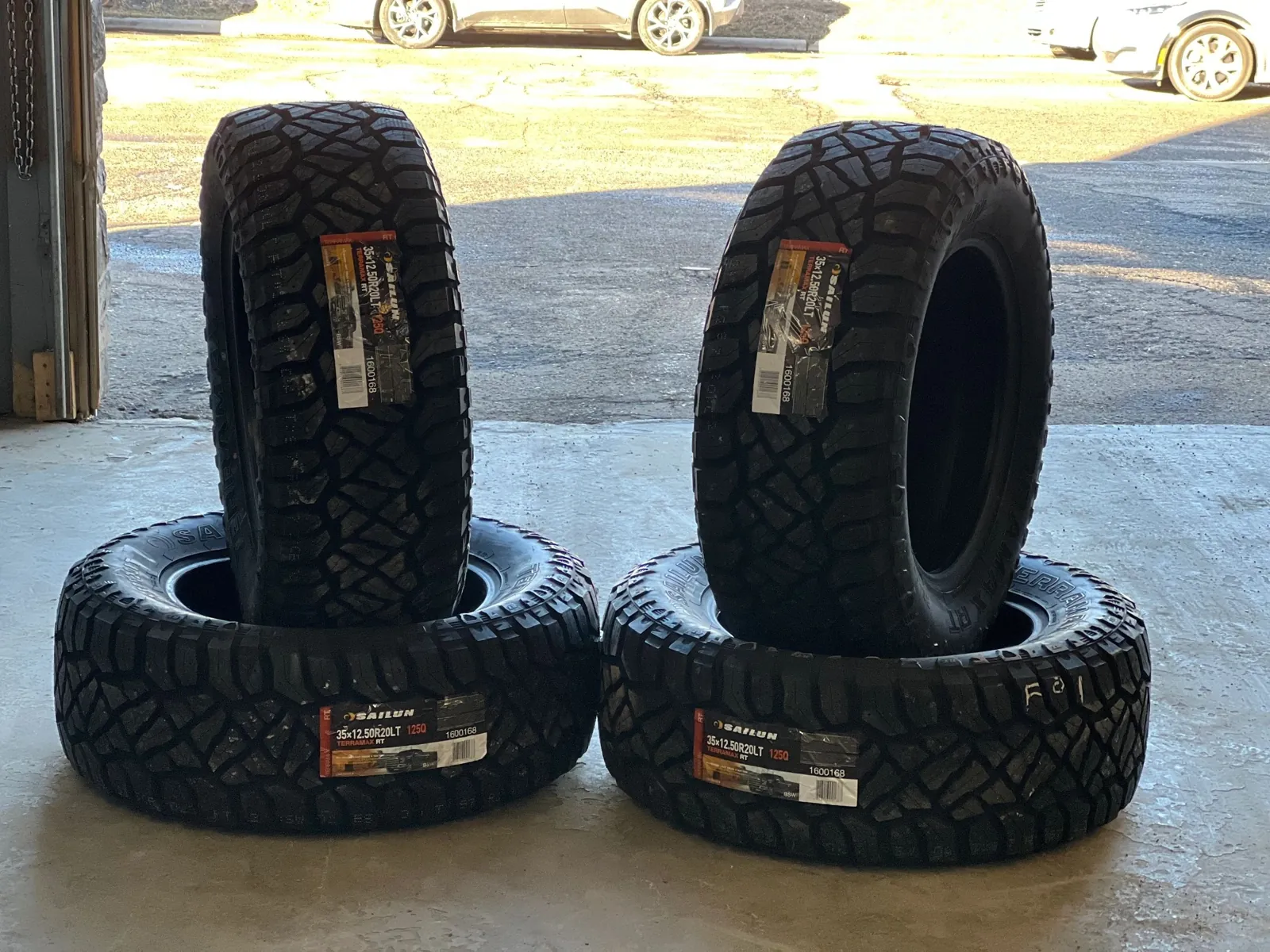
The photo shows labelled, unmounted replacement tires from KMJ's photo library. They are not tires from a collision, and the photo does not show damage inspection or recommend that particular tread for your vehicle. The point is the replacement decision: the correct answer comes from condition, fitment and manufacturer instructions, not from a tire looking substantial in a photograph.
Start with people and the scene, not the sidewall
At an active collision scene, protecting people and following emergency responders' instructions takes priority over collecting tire evidence. If there is an immediate danger or anyone needs urgent help, use emergency assistance. Do not step into a traffic lane, crawl beside an unstable vehicle or approach smoke to get a better photograph. A missing close-up is preferable to another person being injured.
This article does not tell you whether a damaged vehicle may be moved. That decision depends on the immediate situation and the people responsible for recovery. Tell the recovery operator about a visibly flat tire, a wheel that appears displaced, rubbing, fluid leakage or any other change you noticed. Describe the observation instead of saying that the tire is the only problem. You cannot establish that from outside the vehicle.
Once the vehicle is somewhere secure, distinguish three separate questions. Where can it remain safely? How will it reach the facility that will assess collision damage? What tire work, if any, will be needed after that assessment? Answering the last question first can lead to buying a replacement that does not resolve the reason the vehicle cannot be driven.
Someone may suggest adding air and seeing how it feels. That is not a substitute for assessment after a suspected impact injury. Do not deliberately reinflate a visibly damaged tire to test it, and do not drive a loop to see whether a bulge grows. Arrange recovery or qualified help when safety is uncertain. The inconvenience of changing transport plans is not evidence that the original plan remains suitable.
Build a timeline without guessing what caused the damage
A short factual timeline is more useful than a confident theory. Record when the collision happened, which part of the vehicle appeared to contact another object and what happened immediately afterward. If the vehicle rolled, was moved a short distance or was transported, include that information. If you do not know whether the tire lost pressure before or after the impact, write that uncertainty down explicitly.
For example: “Right front contacted the curb during the incident. I saw the tire looking low after stopping. The vehicle was then transported.” That is a useful account. “The curb broke the tire and nothing else” makes two conclusions that require evidence. The difference matters because later technicians need the sequence, not a diagnosis that becomes harder to correct as it gets repeated.
Separate what you personally observed from what another person told you. A passenger may remember a warning light; the recovery operator may have noticed a wheel scraping during loading. Preserve both observations with their sources. There is no need to force them into a single neat explanation before the vehicle is inspected. Different accounts sometimes describe different moments rather than an actual disagreement.
Older records can help establish a baseline. A tire-service invoice may show the installed model and position history. A recent pressure log may indicate what was measured before the incident. Neither proves the tire's condition at the moment of impact, but each can reduce uncertainty. Keep originals and make working copies. Do not change a date or fill a missing measurement from memory to make the file look complete.
Photograph identity and location before chasing close-ups
If it is safe and permitted at the secure location, begin with an overall view showing which vehicle corner you mean. Then take a view of the tire and wheel together, followed by closer views of visible marks. This creates a sequence that a person who was not there can understand. A close-up of black rubber alone may be impossible to place later.
Use position names consistently: left front, right front, left rear and right rear, viewed from the driver's seated orientation. Avoid “driver's tire” if there is a chance the file will be used with vehicles configured differently. If a tire has already been removed, ask the technician to preserve its original position in the service record. Do not assume that the location where a loose assembly is stored identifies where it came from.
Take readable sidewall photographs when practical. The brand, model, size, load index, speed symbol and special markings can matter when identifying an exact replacement. The full tire identification marking may not be visible on the outer side. Do not reach underneath or move a damaged vehicle just to obtain it. The facility can record inaccessible details during appropriate handling.
KMJ's explanation of tire sidewall markings for replacement selection can help you understand the information being requested. Use that knowledge to improve the record, not to interpret a photograph as a structural inspection. A date code identifies manufacturing timing; it does not say whether a tire survived an impact. A size code identifies dimensions and construction conventions; it does not prove compatibility with every wheel carrying the same diameter number.
Know what an exterior look cannot establish
A tire is more than its visible tread. Its structure, inner liner, bead areas and the surfaces hidden by the wheel all contribute to how it works. External inspection is useful for identifying concerns, but an attractive outer sidewall cannot establish that the unseen areas are undamaged. This is particularly important if the tire was pinched, struck or operated with very low pressure.
The U.S. Tire Manufacturers Association's tire repair guidance requires removal from the wheel for a complete inspection when assessing a puncture repair. That requirement illustrates why a photograph or a quick air check is not enough to approve a repair. It does not mean that every collision tire can be made acceptable by demounting it. Some findings mean removal from service, not repair.
Ask what was actually inspected and what remains unknown. “Looked at tire” could mean an exterior glance while the vehicle was parked. “Demounted and inspected inner liner, bead and injury area” describes a different scope. You are not asking for a preferred conclusion; you are asking for enough detail to understand how the recommendation was reached.
Nor does the absence of a visible cut settle the matter. A wheel can have a problem separate from its tire, and components behind the assembly can require their own assessment. Keep the tire report attached to the broader collision work rather than letting it stand in for that work. The right outcome is a connected set of findings with clear responsibilities, not a stack of reassuring phrases.
A pressure reading is information, not a clearance
Suppose a tire measures close to the vehicle's specified pressure after the incident. That tells you the pressure at the time and under the conditions of that measurement. It does not prove that the tire never lost air, never ran underinflated or has no internal injury. Record the reading if a qualified person obtains it, but do not expand its meaning.
Temperature and recent driving also affect interpretation. USTMA describes cold tires as those parked for at least three hours in its tire care essentials. A reading after movement or in a warm indoor space is not automatically comparable with an earlier outdoor cold reading. The service provider should apply the vehicle manufacturer's pressure instructions, not a value chosen from another vehicle or from the tire sidewall maximum.
A pressure warning that disappears after air is added does not close the collision question either. The warning system is not an impact-damage detector. If the sensor, valve or wheel was involved, the system may need appropriate tire-related attention, but a functioning display still cannot certify the wheel or the vehicle's structure. Ask which issue was addressed when someone says the warning is fixed.
After professional release, normal pressure maintenance resumes; it does not replace that release. Keep the recommended values with the vehicle's records and compare measurements under suitable conditions. For everyday habits once the incident work is finished, the Calgary tire care guide is a starting point. Persistent loss or a new warning needs follow-up, not a growing list of top-ups without explanation.
Separate a puncture repair from collision injury
A screw in the tread and a sidewall crushed between a wheel and a curb are not the same repair problem. Both may lead to air loss, but the shared symptom does not make the remedies interchangeable. If a tire has both a puncture and evidence of an impact, fixing the puncture does not automatically resolve the impact concern.
USTMA limits consideration of passenger and light-truck puncture repairs to the repairable tread area, with an injury no larger than 6 mm, and requires examination for other damage. Damage extending into the shoulder or belt-edge area is outside that guidance. Manufacturer restrictions also apply. Treat the dimensions as part of a professional procedure, not as permission to measure an exposed hole yourself and declare it repairable.
Its guidance calls for filling the injury with a rubber stem and sealing the inner liner with a patch; an outside-only plug is not an acceptable permanent repair under that procedure. A tire must come off the wheel so the technician can inspect it. A kit that stops air escaping for a while cannot turn a damaged sidewall or compromised tire structure into a sound tire.
When discussing puncture assessment and tire repair in Calgary, disclose the collision history before work begins. Do not present the job simply as “a slow leak” if the loss followed an impact. The history changes the questions that need answering. If sealant was added or a temporary repair was attempted, identify the product and what was done rather than leaving the technician to discover it unexpectedly.
Distinguish tire, wheel and mechanical responsibilities
The tire is the rubber assembly mounted on the wheel. The wheel supports and locates it, and the complete assembly connects to the vehicle through other components. A mark on one part does not tell you the condition of all the others. This sounds obvious until a repair conversation compresses everything into “the wheel is fixed.” Ask which component that statement refers to.
Wheel condition and suitability need their own qualified assessment. A tire that is acceptable on inspection does not make a damaged wheel acceptable. Conversely, replacing a wheel does not prove that a tire operated on it during the incident should be reused. The service record should identify what was retained, what was replaced and the basis for each decision.
Balancing is a tire-and-wheel service, not a correction for every post-impact symptom. A balance result cannot establish proper steering geometry or the condition of suspension components. If a vehicle pulls, behaves differently or has a persistent vibration after a collision, the appropriate mechanical or collision specialist needs to determine the cause. Do not ask the driver to identify the faulty component by where they feel the vibration.
KMJ provides tire services and oil changes only. Collision repair, alignment, suspension, steering, brake work and other mechanical assessments belong with appropriate specialists. The wheel balancing service information explains a tire-related service, not an all-purpose collision remedy. Keeping this boundary clear helps the owner arrange the correct work in the correct order and prevents a tire invoice from being mistaken for a complete vehicle inspection.
Identify the replacement before comparing its price
If replacement is recommended, obtain the exact description of the proposed tire. Brand and family name alone may not distinguish every version. Size, load index, speed rating, construction, winter category and any relevant original-equipment specification need to be considered against the vehicle manufacturer's requirements. The damaged tire's lettering is useful evidence, but an earlier owner may already have fitted something unsuitable.
Start with the vehicle placard and manual, then resolve any approved alternative fitment through reliable manufacturer information. USTMA's replacement tire guidance says replacement tires should have the size, load index and speed rating recommended by the vehicle or tire manufacturer and should not have lower load-carrying capacity than specified. Do not assume an upgrade in one number cancels a mismatch in another.
For readers trying to decode the load marking, understanding tire load index helps frame the conversation. It is not a shortcut for calculating a new pressure or approving a different construction. A professional needs the actual vehicle application. “It is a bigger tire” is not a load-capacity argument, and a tall tread block says nothing reliable about the required service description.
Only after the specification is clear should you compare proposals. KMJ's guide to buying replacement tires in Calgary can help organize those decisions. Ask each provider to name the exact product and the work included. A lower total for an unspecified tire cannot be fairly compared with an itemized proposal for the verified fitment and necessary tire services.
Why one damaged tire does not settle the quantity question
A collision may visibly damage one tire while creating a replacement decision involving more than one position. That does not automatically mean a complete set is required. It means the remaining tires and the vehicle's matching requirements must be part of the assessment. Their model, condition, tread depth and suitability need to be known rather than assumed.
USTMA recommends replacing all four together for optimum performance. Its guidance for replacing fewer explains the importance of the recommended specification and generally placing two new tires on the rear axle for stability on wet roads. That is general guidance, not permission to disregard a vehicle's specific restrictions or a staggered arrangement that cannot be moved front to rear.
All-wheel-drive systems can have manufacturer-specific matching requirements. Do not accept a universal tread-depth allowance copied from an online discussion about a different vehicle. Ask the provider to identify the applicable instruction and the actual measurements. If an exact tire is unavailable, the decision needs a documented alternative, not an assumption that a similar name or nominal size will behave identically.
There is a useful question that avoids both extremes: “What prevents one replacement from being suitable here, and what evidence supports the proposed quantity?” The answer might involve manufacturer matching limits, condition of the other tires or an incompatible product version. If the recommendation is four, understand why. If it is one, understand how the final set remains appropriate. Quantity is the result of the assessment, not the starting assumption.
Keep the seasonal set coherent during an autumn repair
A damaged winter tire can create a tempting shortcut: fit whatever is easy to obtain and deal with the mismatch later. That turns a repair delay into an equipment decision. First identify what seasonal set the vehicle is supposed to leave with and whether the proposed replacement belongs in that set. A temporary convenience should not quietly become the long-term arrangement.
Transport Canada recommends winter tires in sets of four to maintain control and stability in icy conditions. Its winter tire guidance also warns against mixing different tread patterns, construction and sizes outside the vehicle's appropriate fitment. A mountain-snowflake marking describes a snow-traction requirement; it does not make every tire carrying that symbol interchangeable.
For a dedicated cold-season set, look at winter tire options for Calgary vehicles after the fitment is established. If the vehicle previously used a year-round strategy, compare all-weather replacement tire choices with that actual strategy rather than silently changing one corner. Keep a distinction between restoring a coherent set and deciding to change the vehicle's entire seasonal plan.
Similarly, all-season tire selection in Calgary is a separate category discussion, not a guarantee of winter suitability. Repair completion dates can cross a seasonal change. Coordinate the final tire configuration explicitly, especially if a second set is stored elsewhere. Tell each provider whether those tires are loose or already mounted so nobody assumes an assembly is ready when it still requires mounting and assessment.
Read the estimate as a list of decisions
An estimate should let you see what is being proposed, not merely the final total. Identify the replacement tire, quantity and tire-related labour. Ask whether mounting, balancing, valve or sensor-related work and applicable disposal charges are included or separate. These are questions about the proposal, not assumptions that every item is always necessary or included at a particular price.
Keep uncertain work distinct from authorized work. A technician may need to demount a tire before determining whether it is eligible for repair. The initial authorization should make that scope understandable, including how you will be told about findings that change the plan. Do not interpret an inspection authorization as an unlimited replacement authorization, and do not demand a guaranteed repair outcome before the inside has been seen.
A budget-versus-premium tire comparison can help with genuine product choices, but fitment and safe condition come first. The budget discussion should occur among suitable alternatives. A cheaper tire with the wrong specification is not the lower-cost version of the same solution. Likewise, a more expensive product does not erase a mismatch with the remaining set.
Insurance coverage, deductibles, depreciation and claim decisions depend on the actual policy and claim handling. Ask the insurer or representative for written clarification rather than assuming a safety recommendation guarantees reimbursement. Keep the technical recommendation separate from the payment decision. If coverage is disputed, the appropriate response is to clarify the process and transport arrangements, not to use a rejected payment request as evidence that the tire is safe.
Preserve removed parts without creating a new hazard
Before parts are discarded, ask whether the insurer, repair facility or another authorized party needs photographs, identification or retention. Make that request early. It is much easier to agree on a plan before a damaged assembly has entered a disposal process. Do not promise someone an old tire after another party has already taken responsibility for preserving it.
A retention record can be simple: original vehicle position, tire identity, date removed, reason removed and the facility holding it. Attach the relevant photographs and report. If a part changes hands, record where it went. This is practical organization, not a claim that your notes establish legal fault or replace a formal evidence-handling procedure when one is required.
Do not handle a damaged inflated assembly merely because you want to keep it. Ask the service provider how it can be made safe and stored appropriately. Avoid placing a suspect tire back on a wheel or adding air to improve its appearance for photographs. Retaining a part does not mean returning it to service, and an item marked for disposal should not accidentally become a spare.
If you have a second seasonal set, label it separately from collision-related removed items. Similar-looking bags can cause confusion months later. Write “removed after incident, not cleared for use” where appropriate, based on the actual status, instead of a vague “old tires” label. When the authorized retention period is over, arrange proper tire disposal through the responsible provider rather than selling an unknown-condition tire as a usable bargain.
Coordinate the handoff between facilities
A vehicle may go first to a collision facility, then require tire work, and later return for other completion steps. The owner should not have to become a technician, but somebody needs to maintain a clear handoff. Identify who is coordinating the overall repair and how the tire provider will receive the relevant findings. Ask which stage must be completed before any road use.
Send a concise packet: vehicle identity, affected position, incident description, inspection findings, approved tire specification, work authorized and unresolved questions. Include the person's details who can approve changes. Avoid sending unrelated personal documents simply because they share a claim folder. The tire provider needs the information relevant to the tire task, not every private detail of the incident.
When considering mobile tire service in Calgary, confirm whether the proposed location and work are suitable. Mobile tire work does not replace collision recovery or make an unsafe vehicle ready to move. A secure, accessible site and permission to work there still matter. Do not promise the recovery operator that an assembly can be changed at a location before the service provider has accepted that plan.
Check KMJ's Calgary-area service coverage if the vehicle is stored outside your normal area, then verify the specific request. Coverage information is not a same-day arrival promise. Keep transport, access and timing arrangements in writing so a vehicle is not released into an unplanned gap between providers. The handoff should end with the next responsible person acknowledging what remains to be done.
Example: a winter tire cut during a curb impact
Consider an illustrative Calgary driver whose vehicle struck a curb during a collision. The right front tire has a visible cut and the winter set is partway through its service life. The driver wants one new tire because only one looks damaged. No price, tread measurement or repair outcome is assumed in this example.
The first decision is assessment and recovery, not product selection. The collision facility needs to determine the vehicle's broader condition. The tire provider needs the impact history and access to the affected tire and wheel. If the tire is unsuitable for service, the next step is to identify its exact specification and record the condition of the other three. The fact that the set was described as “winter tires” is not detailed enough.
Suppose the original model can be obtained. Availability still does not answer whether one replacement is suitable. The provider must resolve the vehicle's matching requirements and the remaining tires' condition. Alternatively, if the model is no longer available, the provider must explain which replacement arrangement produces a compatible final set. That may change the proposal, but the change should be traceable to the evidence.
The owner can make progress without arguing for a predetermined quantity: obtain the inspection result, the matching instruction and the itemized alternatives. If winter readiness requires work on the stored set as well, coordinate seasonal tire change services after the repair sequence is known. Do not use a seasonal swap to hide an unresolved collision concern simply because the damaged tire will no longer be on the vehicle.
Example: a pickup holds air but feels different
Now imagine a pickup that still has normal-looking tires after a side impact. The driver noticed a new vibration during the short movement to a secure place. It is tempting to assume a balancing weight fell off and request a quick balance. That is a hypothesis, not a finding, and it should be described as such.
The useful report names when the vibration began, whether it was present before the incident and what was observed during that already-completed movement. It does not require another test drive to create more data. The assessment must consider the tire and wheel as well as mechanical issues within the collision specialist's scope. A tire technician should receive the same history rather than a narrowed instruction that conceals the event.
If tire replacement eventually becomes necessary, the pickup's actual application matters. A large-looking replacement in the same nominal diameter is not enough. Load requirements, construction and the current set need review. The aggressive tread shown in this article's photo is an illustration of loose replacement products, not a recommendation for this hypothetical pickup or a claim of extra impact resistance.
Once the correct specification is established, searching Calgary tire options by fitment becomes useful. Until then, browsing can create false confidence in a product that has not been matched to the vehicle. The example's lesson is not “vibration means replace tires.” It is that a new symptom after an incident deserves the appropriate assessment before a familiar service is chosen as the answer.
At collection, ask what was completed and what remains
Collection is the moment to reconcile the plan with the actual work. Read the tire description on the invoice and compare it with the approved proposal. Confirm the installed positions, any manufacturer instructions supplied and any follow-up that belongs to the tire work. If the tire choice changed because of availability, that change should already have been discussed rather than discovered in the parking area.
Ask the coordinating collision facility about the broader release status. A tire invoice says what tire work was performed; it does not certify unrelated systems. If another assessment remains outstanding, clarify the transport arrangement rather than assuming that having four inflated tires means the vehicle can be driven home. Keep responsibilities explicit even when several providers have each finished their own assigned part.
Do not perform abrupt steering, hard braking or a high-speed run to test the repair yourself. If a concerning symptom appears after release, respond to the actual conditions, stop safely when appropriate and seek professional guidance. Record the symptom accurately without continuing to drive solely to collect better evidence. A phone video made by the driver is not worth the distraction or the added exposure.
Retain the final documents together: inspection findings, product details, invoice, relevant manufacturer requirements and any follow-up instructions. A future seasonal service can then distinguish the replacement tire from the rest of the set without reconstructing the event from memory. If you need a tire-service time after the repair plan is settled, use Calgary tire service scheduling and describe the authorized scope clearly.
What to do when two recommendations disagree
Two providers may reach different recommendations because they inspected different things or received different information. Before deciding that one must be wrong, compare the scope. Did both know about the collision? Did both see the tire off the wheel? Were they discussing the same tire position and the same product specification? A recommendation based on a telephone description is not equivalent to a written finding from a complete physical assessment.
Request the reason for the difference in plain language. One provider may be discussing puncture repair eligibility while another is discussing the condition of the wheel. Another disagreement may concern the remaining set rather than the visibly damaged tire. Ask each to identify the observation or manufacturer requirement that controls their recommendation. This changes the conversation from choosing the most reassuring answer to understanding the actual unresolved issue.
A second qualified assessment can be sensible when the explanation remains unclear. Arrange it without putting a suspect assembly back into use, and preserve the first report. Do not ask a second technician to confirm your preferred answer without disclosing the first findings. Their independence is useful only if they receive the relevant history. If additional handling could alter evidence needed for a claim, clarify the inspection plan with the responsible parties first.
Cost and turnaround time are real concerns, but they should be discussed separately from whether a tire is suitable for service. Ask about suitable alternatives, transport arrangements or the timing of a decision. A difficult schedule does not change the condition of the tire. Equally, an expensive proposal should still explain its technical basis. You are entitled to an understandable recommendation without treating the cheapest proposal as proof or the most expensive proposal as a guarantee.
The questions that prevent an incomplete handover
Here is a compact set of questions to use during the tire discussion. They are prompts for the person doing the work, not a checklist that lets an owner approve a damaged tire independently. Write the answers beside the relevant report so you do not have to remember several conversations while arranging transportation and the rest of the repair.
- What exact tire and original vehicle position does this finding concern, and how was that identity recorded?
- Was this an exterior observation, a demounted tire inspection or another procedure, and what limitations remain?
- Does the recommendation concern a repairable puncture, impact damage, previous underinflation, wear or a combination of findings?
- Has the wheel's condition been addressed separately, and who is responsible for any mechanical or collision-related concerns?
- If replacement is needed, what exact specification is proposed and which vehicle instructions determine the matching requirements?
- What measurements or condition findings from the other tires support the proposed replacement quantity and final positions?
- Which parts must be retained, who holds them, and when may they enter the normal disposal process?
- What work is completed, what is still outstanding, and who authorizes the vehicle's next movement or release?
You do not need to repeat every question to every provider. Direct each one to the party responsible for that part of the work. A tire provider can explain the tire assessment; the insurer can explain coverage; the collision facility can explain its overall repair process. Problems arise when one answer is stretched across all three subjects. A coverage approval is not a technical inspection, and a technical recommendation is not a promise about payment.
Before the final handover, look for unanswered questions rather than simply counting receipts. For example, an invoice for a new tire and another for transport may still leave the damaged wheel's assessment unresolved. Conversely, a clear report may explain why an undamaged tire was retained without any replacement invoice. Completion means the relevant decisions have evidence and an identified owner, not that every line in the folder involves a purchase.
A short file that answers the important questions
Your finished tire file does not need to be elaborate. It should answer which tire was involved, what was observed, who inspected it, what was concluded and what was done. Where the evidence is incomplete, preserve the uncertainty instead of replacing it with a confident sentence. That makes the record useful to the next professional who sees the vehicle.
Keep a one-page summary at the front. List the affected position and tire identity, the date of assessment, the decision to retain, repair or replace, and the supporting report location. Add the final set arrangement and any open follow-up. Store photographs in an order that preserves context. A folder full of unlabeled close-ups is less useful than a small collection tied to clear descriptions.
For tire-specific questions, KMJ's local Calgary tire service information is a place to start after the collision assessment responsibilities are established. Describe the incident honestly, even if the requested work sounds routine. No provider should have to infer the history from a scuffed wheel or discover halfway through a repair that the tire was driven flat after an impact.
The final decision is not based on whether the tire looks new, holds air or has enough visible tread. It comes from an appropriate assessment, a compatible final tire arrangement and completion of the vehicle's separate collision-related requirements. Keeping those pieces distinct makes the process easier to follow. It also lets you ask a precise question whenever a reassuring answer is missing the evidence that should support it.