Can better tires make a pickup suitable for a water tank in the bed? Not by themselves. Tires must be right for the vehicle and its actual loads, but they cannot increase the truck's rated payload or axle limits. Before filling a tank, establish whether the complete loaded combination is permitted, how that weight reaches the axles, and what tire specifications and cold pressures the manufacturer requires. A tank that physically fits between the wheel wells has not passed those checks.
For an acreage owner outside Calgary, a landscape operator moving clean water, or a household planning occasional water collection, the useful starting point is a load worksheet rather than a tire catalogue. Include people, the tank, its mounting equipment, hoses, tools and everything else that rides along. Then separate three decisions: whether the vehicle can carry the load, whether the tank and installation are suitable for transport, and whether the tires are suitable for that approved vehicle configuration.
This guide concerns ordinary water carried in a pickup bed. It does not approve tank installation, potable-water handling, chemical transport, commercial operating compliance or vehicle modifications. Those questions need their own qualified advice. The tire part becomes much clearer once the load plan is real. KMJ provides tire services and oil changes only. Tank engineering, mounting, suspension, brakes and other mechanical work belong with appropriate specialists.
Start with the truck you own, not a model advertisement
A manufacturer's advertised maximum payload describes a qualifying configuration, not every pickup with that model name. Cab style, drivetrain, installed equipment and other options can change the useful load available. A truck carrying a toolbox and a heavy canopy is also not in the same operating condition as an otherwise similar empty truck. Collect the actual vehicle labels and its correct owner's manual before drawing conclusions from a brochure.
Photograph the certification label and tire-and-loading information while the truck is parked safely. Record the model year and configuration alongside those photographs. Read the labels rather than assuming that one familiar number describes every limit. Gross vehicle weight rating, axle ratings, seating information, tire specifications and recommended inflation pressures answer different questions. If a label is missing or unreadable, get the information resolved through the manufacturer or an appropriate vehicle specialist.
Ford's published towing guide is useful for explaining the distinction between actual vehicle weight and rated limits, including axle limits. Its specific capacities apply to the configurations listed there, not to an unidentified Calgary pickup. That is the right way to use a manufacturer reference: learn the definitions, then return to the documentation for the exact vehicle being loaded.
When assembling tire details, the guide to reading tire sidewall information can help you record what is fitted. The tire sidewall is one part of the record, not a replacement for the vehicle's loading label.
Build an inventory before calculating the water allowance
Water is only one item in the bed. The empty tank has weight, and so do its approved supports, mounting hardware, pump, battery if fitted, hose reels and other accessories. A person can remember the large tank and still forget several smaller items that stay on the truck all season. Make the inventory while looking at the actual vehicle, rather than recreating it from memory at a desk.
Keep permanent additions separate from items that change between trips. A bed liner or fitted storage unit may stay in place; an extra passenger, generator or bag of supplies may not. Record both categories so that an empty-vehicle scale ticket can be interpreted later. A ticket taken before accessories were added is not a current baseline, even if the truck still looks similar in a photograph.
For preliminary planning, a litre of ordinary water weighs approximately one kilogram. This is a convenient approximation, not a substitute for an accurate loaded weight or a tank manufacturer's specifications. It also does not apply unchanged to every other liquid. Avoid converting a tank's volume into a supposedly exact safe payload when several other weights remain guesses.
A useful inventory has an item name, its known or estimated mass, and the source of that number. Mark estimates clearly. If the proposed load is close to a limit before unknowns are resolved, do not fill first and investigate afterwards. Reduce the proposed quantity or seek a different transport arrangement while the plan is still on paper.
A worked example: why tank capacity is not carrying capacity
Consider a hypothetical pickup with 900 kilograms of available occupant-and-cargo allowance under the applicable vehicle documentation. Suppose the occupants total 170 kilograms, the empty tank and its installation weigh 90 kilograms, and tools and hoses add another 60 kilograms. Those items consume 320 kilograms before water is added. The arithmetic leaves 580 kilograms, but that number is only an initial whole-vehicle screening result.
If the owner had planned to carry 750 litres of water, the approximate water mass alone would be 750 kilograms. Added to the other 320 kilograms, the proposed load becomes about 1,070 kilograms. That exceeds the illustrative 900-kilogram allowance. Stronger tires do not change that subtraction. Neither does driving slowly or limiting the trip to a nearby filling station.
Even a proposed 500-litre load would not automatically be approved. Its approximately 820-kilogram combined load might pass that first calculation, yet the rear axle could still exceed its rating, an individual tire could have inadequate capacity for its actual share, or the tank installation could be unsuitable. Each limit needs its own answer; one favourable total does not clear the others.
These numbers are teaching examples, not specifications for a particular truck. Use the worksheet to identify an obviously unsuitable plan before paying for equipment. Then verify the actual arrangement through the required manufacturer guidance, competent installation advice and appropriate weighing. The objective is a defensible carrying plan, not finding a generous interpretation of one attractive number.
Keep payload, axle capacity and tire capacity separate
Gross vehicle weight concerns the loaded truck as a whole. Axle weight concerns what rests on an individual axle. Tire capacity concerns the load a specified tire can carry under its applicable conditions. These limits interact, but they are not interchangeable. Adding the maximum numbers printed on four tires does not establish how much water the truck may carry.
Likewise, adding the front and rear axle ratings is not a way to increase the vehicle's gross rating. Manufacturer ratings can reflect different design constraints. Treat them as simultaneous boundaries. A plan must respect the whole vehicle, each axle, the fitted wheels and tires, and any other applicable equipment limits. The lowest relevant constraint may determine how much useful load remains.
A water tank placed in the bed can create a different distribution from passengers seated in the cab. The total added mass could be identical while the axle readings differ. That is why a load plan based only on total kilograms misses an important part of the tire decision. Obtain guidance on the intended tank position instead of improvising a location based on how the truck appears to sit.
For terminology, understanding tire load index is a helpful companion. A load index is not an instruction to ignore the truck's own capacity. Bring the actual ratings and measured loads to the tire discussion so that the answer addresses the vehicle in front of you, not a generic pickup category.
Plan weighing without driving an unverified overload
A scale can replace guesses with useful evidence, but it is not permission to drive a suspected overload to the scale. Begin with an unloaded or conservatively planned condition that is already appropriate for the vehicle. If the proposed tank arrangement cannot be assessed without creating an unsafe trip, involve the installer, transport provider or vehicle specialist before loading it.
Ask the weighing facility what information it can provide and how the vehicle should be positioned. A whole-truck weight and separate axle weights are more useful than a single total alone. Proper individual wheel-position weighing, where available and performed correctly, can help identify unequal side-to-side loads. Do not improvise by putting only part of the truck onto an unsuitable platform or by using unstable surfaces.
The record should describe the load state: occupants present, fuel condition, equipment carried, tank contents and any attached trailer. Without that context, the ticket is a number detached from the decision. Photograph the configuration when it is safe to do so and retain the ticket with the vehicle records. Keep all units consistent when comparing measurements with labels.
If the result exceeds a rating, the next action is to reduce or redesign the load arrangement under appropriate guidance. It is not to choose a pressure that makes the overloaded truck feel firmer. Weighing is a diagnostic step in planning, and an unfavourable result is valuable because it prevents an unsuitable configuration from becoming the normal routine.
Do not assume half the axle weight is on each tire
Dividing a rear axle reading by two gives an average for a single-rear-wheel pickup. It does not prove that the left and right tires carry equal loads. Equipment mounted on one side, an off-centre tank arrangement or other uneven cargo can create a difference. That matters when someone uses the average to claim that each tire is comfortably within its capacity.
Avoid inventing a percentage allowance for imbalance. The appropriate way to resolve uncertainty depends on the vehicle, equipment and available weighing method. A qualified installer or tire professional can explain what additional information is needed. If wheel-position weighing is recommended, have it done using suitable equipment and procedures rather than treating a casual driveway measurement as authoritative.
Also distinguish a parked measurement from what happens on the road. Braking, cornering and uneven surfaces change the forces involved in carrying a load. A static scale ticket is important evidence, but it does not certify the stability of a tank installation or the suitability of its restraints. Tire selection cannot replace that separate engineering and installation work.
If the truck has dual rear wheels, the discussion changes again. The relevant single or dual ratings, pairing requirements and manufacturer instructions must be considered. Do not apply a simple four-tire calculation to a six-tire truck. Identify the actual wheel arrangement at the start so that the right technical guidance is used throughout the assessment.
Treat the tank as transport equipment, not just a container
A container that holds water while stationary is not automatically suitable for travelling in a pickup. Obtain the tank manufacturer's written guidance for the intended mobile use and have the installation assessed by a qualified provider. Ask about support, restraint, permitted filling conditions and any operating restrictions. Do not assume that a cage, a familiar shape or a previous owner's account establishes suitability.
Water can move inside a partly filled tank. That makes the installation and operating instructions important even when the total mass seems modest. This guide does not prescribe a universal fill percentage, baffle design or restraint layout. Those details depend on the tank and vehicle arrangement. A blanket instruction to fill completely to reduce movement would be especially unhelpful if the full volume overloads the truck.
Keep tank questions distinct from tire questions when gathering quotes. The tire professional needs the approved configuration and actual load information. The installation specialist needs to assess the equipment and its attachment to the vehicle. Asking one person to approve work outside their scope creates a gap rather than a complete answer.
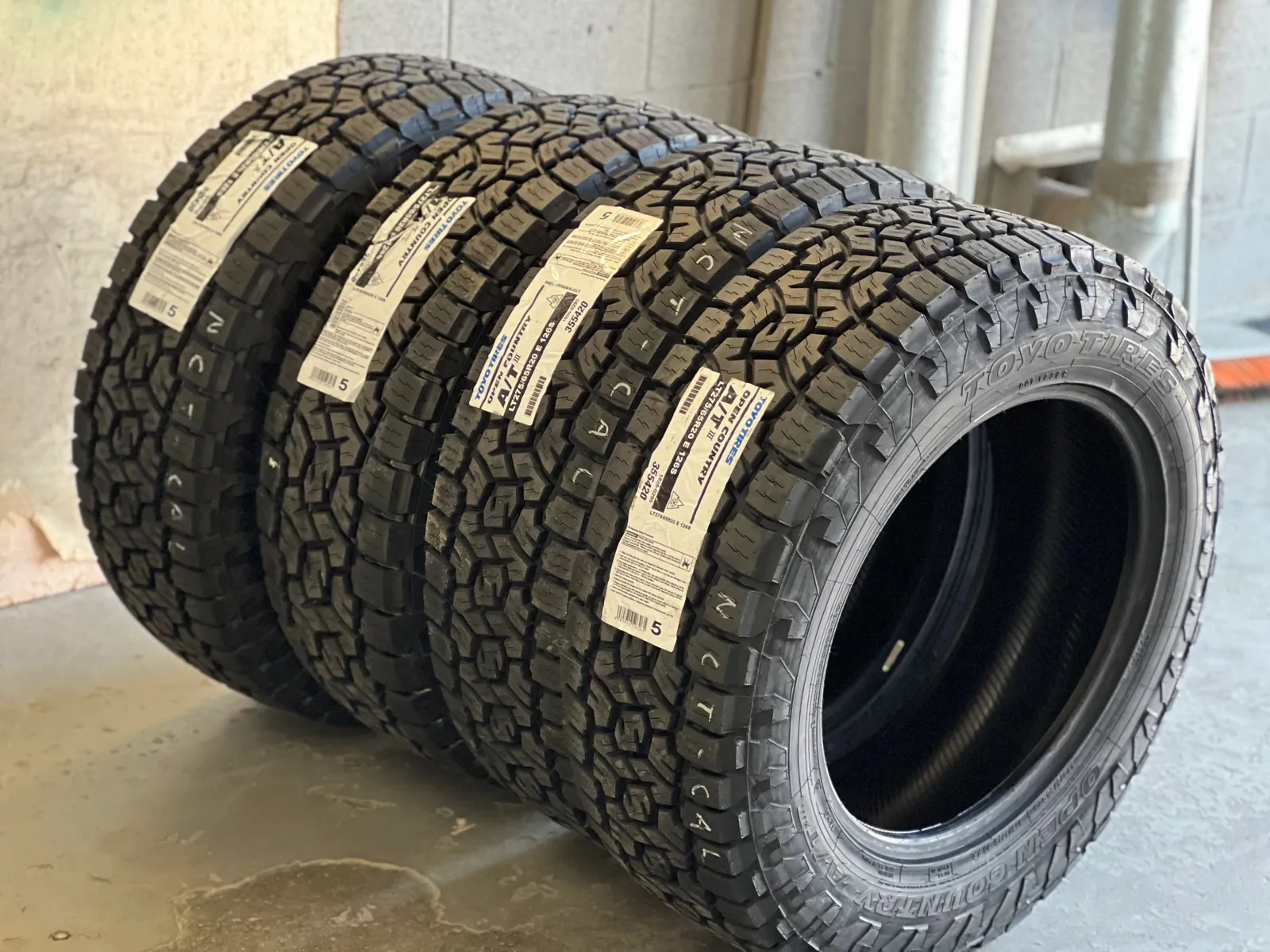
Nor should a tire photograph be treated as evidence of a tank system. The real KMJ image accompanying this article shows labelled Toyo tires standing indoors, with their tread visible. It illustrates tire selection only. It does not show a water-hauling truck, a load test, a tank installation or an endorsement of a particular tire for your proposed carrying arrangement.
Choose the tire specification before choosing the tread look
Large tread blocks can make a tire look ready for difficult work. That appearance does not establish its approved size, load-carrying capability, wheel compatibility or suitability for the truck. Start with the manufacturer's required tire specification, including the full size and service description. Compare exact product versions rather than relying on a model name that may cover several sizes and ratings.
USTMA's replacement guidance says replacement tires should meet the size, load index and speed-rating recommendations of the vehicle or tire manufacturer, and should not have less load-carrying capacity than originally specified. If someone proposes a different tire type or size, obtain the appropriate technical approval and inflation guidance. A conversion should not be settled by the observation that the tire fits inside the wheel opening.
Terms such as passenger, light truck and load range describe relevant differences, but none is a magic upgrade label. Do not assume that a tire with a more work-oriented designation can be installed at the old pressure and carry whatever the truck bed holds. The exact tire, wheel, vehicle and operating requirements still need to agree.
Use the Calgary tire selection pages to begin identifying options, then narrow them using the actual specification. Product browsing is not a statement of current availability or an approval for water hauling. A useful comparison starts with suitability and only then moves to tread characteristics, comfort and cost.
Pressure is a specification, not a response to appearance
A loaded tire may look different from an unloaded one, but appearance is not an accurate pressure gauge. Use the vehicle manufacturer's specified cold inflation pressures for the approved configuration and follow any applicable manufacturer instructions for load-related settings. Where a different approved tire specification is involved, have the required inflation information resolved professionally before carrying the planned load.
The maximum pressure information on a sidewall is not automatically the truck's everyday target. Equally, an internet pressure recommendation from a different pickup is not a substitute for the correct guidance. Do not increase pressure simply until the sidewalls look straight, and do not choose a lower pressure because the empty return trip feels harsh. Both decisions require the applicable specifications.
USTMA advises checking pressure with a gauge when tires are cold, describing that as having been parked for at least three hours. It also recommends checking before carrying heavy loads. Record readings before the truck is driven, together with the specified targets. Check all road tires and the spare as appropriate; a single accessible valve is not a sample of the whole vehicle.
The practical tire-care information provides a general starting point for regular checks. For a water-hauling setup, keep the actual approved pressure instructions with the load worksheet. If those instructions are missing, the plan remains incomplete even if the tank, truck and tires all appear tidy.
Use the gauge even when the dashboard looks normal
A tire-pressure monitoring system is a warning aid, not a substitute for checking the tires. Systems differ in how they detect pressure loss, what they display and when they warn. Consult the vehicle manual instead of assuming every dashboard operates alike. A display with no warning does not confirm that each tire is at the required cold pressure for the intended configuration.
This distinction matters when a truck alternates between ordinary errands and carrying a substantial permitted load. The driver may remember the last trip as uneventful and overlook a gradual leak since then. Measuring each tire before the next loaded journey provides current information. Record the actual readings rather than simply writing that the warning lamp was off.
If one tire repeatedly loses pressure, have the cause investigated before using the truck for the load. Repeated top-ups should not become the normal preparation routine. The issue may involve a puncture, valve, bead area or another condition requiring professional assessment. A gauge identifies the low reading; it does not diagnose why it occurred or prove that internal damage is absent.
Do not reset a warning merely to remove an inconvenient message before filling the tank. Follow the manual's procedure after the underlying condition has been addressed. Where the system itself needs diagnosis beyond tire-service scope, use an appropriate specialist. A quiet dashboard should be the consequence of a correctly resolved issue, not the goal that replaces resolution.
Inspect the tires before adding the load
An unloaded inspection gives you time to address problems without having a full tank waiting in the bed. Look for cuts, bulges, exposed material, abnormal wear and visible objects embedded in the tread. Inspect as much of each tire as can be seen safely from the ground. Do not crawl beneath an unsupported vehicle or position yourself where the truck could move.
Measure tread in several appropriate locations with a suitable gauge, avoiding wear bars as measuring points. Record the readings and any differences across the tread. A single attractive section does not describe the entire tire. A wear pattern can justify further professional assessment, but it does not by itself identify a mechanical cause or establish how long the tire can safely remain in service.
Age and history also deserve attention. Read the tire identification information, consult the tire and vehicle manufacturers' age-related guidance, and disclose previous damage or repairs. There is no universal promise that deep tread makes an older tire suitable for a demanding load. Similarly, a tire that has been driven underinflated may require internal inspection even when its outside looks presentable.
For a known puncture or pressure-loss concern, review the Calgary tire repair service information and describe the actual history. Do not assume repairability in advance. Tell the technician whether the truck was loaded, how far it moved after the warning and whether any temporary sealant was used.
Match the season as well as the load
A tire can meet a load requirement and still be a poor seasonal choice for the planned conditions. A November route may combine dry city pavement, shaded ice and snow-covered acreage access. Consider the actual trip and expected conditions rather than selecting a tread solely because the vehicle carries equipment. Carrying water does not turn an unsuitable seasonal tire into a suitable one.
Compare appropriate winter options using the winter tire information for Calgary, while preserving the vehicle's required size and service specification. If you are considering an all-weather alternative, the winter versus all-weather comparison helps frame the category discussion. No category label removes the need for correct fitment, adequate condition and sensible operating decisions.
An aggressive all-terrain pattern should not be treated as proof of winter suitability. Read the actual markings and manufacturer's intended-use information for the precise tire. The real conditions may make a different vehicle, postponed collection or delivered water the better practical choice. Those are planning alternatives, not failures to find a sufficiently tough-looking tire.
Where two seasonal sets are used, document both sets' specifications and pressure requirements. A winter changeover should not silently substitute a lower-capacity or otherwise unsuitable setup for the summer arrangement. Ask that the carrying use be included in the seasonal discussion so that a set selected for unloaded commuting is not assumed to cover an approved hauling configuration without review.
Separate gravel durability from permission to carry more
An acreage route may include loose stone, ruts or rough entrances. Those conditions can influence the choice among tires that already meet the vehicle's specifications. Explain the proportion of highway and gravel travel, the access surface and the kinds of damage previously observed. Useful detail is more valuable than saying the truck needs the strongest tire available.
Tread design and construction involve tradeoffs. The answer should address the actual route, not a belief that the most dramatic pattern is always best. Ask how the candidate tire is intended to be used and what limitations the manufacturer identifies. Avoid translating a marketing description into a guarantee against cuts, punctures or other damage.
A route change can also alter whether the trip is appropriate at all. A badly rutted or icy access lane is not resolved solely through a different tire. Assess the route before bringing the loaded vehicle into a difficult location. Do not experiment with lowering pressure on a heavily loaded truck for traction without specific approved guidance for that vehicle and use.
The tire-buying guide for Calgary drivers can help organise comparison questions. Keep load suitability, seasonal performance and surface suitability as separate headings in your notes. That prevents a strong answer in one category from hiding an unanswered question in another, especially when a truck has to perform several jobs in the same week.
Think through the empty return trip before departure
Water delivery changes the load state. The truck leaving the filling point may carry its planned quantity, while the vehicle returning home may contain only the tank and equipment. That difference should be anticipated in the operating plan rather than discovered as a reason to improvise pressure changes beside the road. Follow the manufacturer's applicable instructions for the approved setup in each condition.
Do not bleed air from warm tires simply to match a cold-pressure number after the loaded drive. Driving changes tire temperature and pressure. If an adjustment or check is required, follow the correct procedure and distinguish a warm reading from a cold one. Record the circumstances if you need advice, rather than reporting a number with no information about when it was measured.
The empty tank still has mass, and its restraints and fittings still need to remain suitable for travel. Removing the water does not remove every loading consideration. Keep hoses, caps and loose equipment secured according to their requirements. If the installation has shifted or another problem appears during unloading, resolve that before the return journey.
For repeated trips, create a short routine for each departure state rather than relying on memory. It might identify the approved configuration, intended contents, pressure-check record and condition observations. The routine should be simple enough to use consistently, without inventing a universal pressure schedule that conflicts with the vehicle or tire manufacturer's guidance.
Include passengers and last-minute equipment in every plan
A load calculation can be correct in the morning and wrong by the time the truck leaves. A second person joins the trip, a toolbox is added, or the driver decides to carry several extra containers. Each addition changes the loaded condition. Keep the worksheet tied to the real departure, not to the most convenient version of the trip.
Use actual known masses where practical and recognise uncertainty where they are unavailable. Do not make the calculation look precise by assigning confident numbers to things that have not been weighed. If a small change uses up the apparent remaining allowance, reduce the load or obtain better information before proceeding. A narrow mathematical result is not a reason to ignore uncounted items.
A passenger should not have to interpret a complex technical record. Give anyone involved in filling the tank a clear instruction about the approved plan and who can authorise changes. A container's upper volume marking should not become the default stopping point if the truck is permitted to carry less. The person operating the fill needs the same information as the driver.
Business use can introduce additional requirements beyond this tire discussion. Ask the appropriate authority or qualified adviser about the rules that apply to the vehicle and operation. This article does not decide whether a particular trip is commercial or exempt. Resolving that classification separately is better than assuming occasional use means there are no additional obligations.
Avoid turning a trailer into an unexamined solution
If the pickup cannot carry the planned tank, a trailer may seem like an immediate fix. It is a different configuration requiring its own assessment, not an automatic release from the truck's limits. Trailer tongue load or other imposed hitch load affects the tow vehicle, and the trailer itself has ratings, tire specifications, equipment requirements and loading restrictions.
The manufacturer towing guide explains why loaded vehicle and combination weights matter. Use the correct guide and manual for the actual truck, hitch and trailer. Do not take a maximum tow rating from an advertisement and subtract the tank weight to declare the whole arrangement suitable. Occupants, equipment, the trailer's own mass and the distribution of the load still count.
A purpose-built transport arrangement assessed by qualified people may be a better option, but tire advice alone cannot approve it. Keep the tank support, restraint, trailer condition, hitch suitability and any required braking system review with the relevant specialists. KMJ's role remains tires and oil changes, not designing or installing the transport system.
If trailer tires are part of the eventual plan, provide their exact identification and the trailer manufacturer's specifications when seeking tire advice. Avoid transferring assumptions from the pickup's tires to the trailer. A separate tire record for each vehicle helps prevent a familiar pressure or size from being copied into a configuration where it does not belong.
Make roadside decisions before a tire fails
A loaded water-hauling pickup is a poor place to discover that the spare is unsuitable or inaccessible. Check the spare's specification, condition, pressure requirements and the vehicle's restrictions before the trip. Locate the required tools and understand the manufacturer's procedure. Having a spare under the truck does not mean every roadside location or loaded condition is suitable for changing it yourself.
Plan how to obtain assistance if a tire loses pressure or suffers damage. Stop in a safe place as conditions allow, protect people from traffic and describe the vehicle and load accurately to the assistance provider. Do not continue on a damaged or flat tire merely because the destination is close. A repair decision requires an assessment of the tire's actual condition and use history.
The mobile tire service page explains a service option to discuss. Give the exact location, access conditions and vehicle details when seeking assistance. The page does not guarantee that every loaded pickup, roadside shoulder or rural access point can be serviced. Confirm suitability and availability directly for the circumstances.
If the truck needs recovery, disclose the tank, estimated contents and any known installation concerns. Do not instruct a provider to handle it as an ordinary empty pickup. Decisions about transferring water or moving the vehicle should be made with competent assistance and the relevant equipment requirements, not through a rushed attempt to lighten one corner for a jack.
Give the tire professional a useful information packet
Bring the vehicle's identification, clear label photographs, the exact fitted tire specifications and any current scale records. Add a simple description of the tank and equipment, the approved installation information and the intended route. Explain whether the truck alternates between loaded trips and everyday use. This lets the tire discussion begin with facts rather than a series of guesses.
Separate what is known from what still needs approval. For example, the tank may be selected but not installed, the axle weights may be unknown, or the current wheels may be aftermarket. State those gaps openly. A recommendation made conditional on further information is more useful than an unconditional answer based on incomplete assumptions.
When comparing budget and premium tire options, ask first which candidates meet the technical requirements. Then discuss differences relevant to the route and use. Do not allow price to determine whether a load specification is met, and do not assume a more expensive product increases the vehicle's rated capacity.
The tire-service questions page can help prepare the conversation. Write down the unresolved questions before making arrangements: approved tire specification, correct pressure guidance, condition of the existing set, spare suitability and whether additional vehicle information is needed. A concise packet saves time because each person can see which decision they are actually being asked to make.
Keep tire work and mechanical concerns on separate tracks
A new vibration, pulling sensation or unusual wear deserves attention, but it does not establish a single cause. Describe when it began, the speed or conditions involved and whether it occurs loaded, unloaded or both. Do not conduct risky test drives to produce a more detailed report. Existing observations are enough to begin a professional assessment.
Tire and wheel balancing may be relevant to some concerns; the wheel-balancing service information describes that tire-related work. It is not a promise that balancing will cure every vibration. Suspension, steering, brakes, structural changes and other mechanical issues need the appropriate specialists. A tire purchase should not be used to conceal a problem elsewhere in the vehicle.
Likewise, a truck that looks low at the rear is not diagnosed by appearance alone. Do not assume additional pressure or different tires will correct an inappropriate load or mechanical condition. Return to the ratings, measured weights and professional assessment. Any proposed suspension or vehicle modification must be evaluated outside the scope of ordinary tire selection.
This separation protects the usefulness of the advice. The tire professional can address the tire specification and condition; a qualified vehicle specialist can address mechanical suitability; the tank installer can address the equipment arrangement. A complete plan may require all three, with each conclusion documented clearly enough that it does not get mistaken for approval of the others' work.
Review the setup after changes, not only after problems
A previously assessed configuration can change quietly over time. The owner installs a canopy, replaces the tank with a larger model, adds a pump battery or changes to a different wheel set. Even if the water quantity stays the same, the original load worksheet may no longer describe the truck. Mark the record for review whenever equipment or tire specifications change.
Seasonal work is a natural opportunity to check those details. During seasonal tire-change planning, identify which set is being fitted and whether its documented specifications remain appropriate. Keep measurements and condition notes with the correct set so that information from summer tires is not accidentally attributed to winter tires stored elsewhere.
A change in route also matters. More highway distance, a steeper access road or a new winter schedule may affect the suitability discussion even when the permitted load is unchanged. Explain the new use rather than asking whether the tires are still good in the abstract. Tire condition and application are related but different questions.
Where work is needed, read the current tire appointment instructions after the relevant details are assembled. At the time of review, that page directs customers to arrange appointments directly rather than through online booking. Scheduling a service does not certify the vehicle's loading arrangement. If the truck should not be driven in its current condition, discuss that first instead of treating the appointment as a reason to make the trip anyway.
A practical departure worksheet and the decision to postpone
Keep the final departure record short enough to read beside the parked truck. Identify the vehicle, approved equipment arrangement, intended water quantity and occupants. Reference the current weight evidence, required tire specification and cold-pressure instructions. Add the date of the pressure check and any unresolved condition concerns. The supporting documents can be longer; the departure record should point to them clearly.
Before filling, confirm that the load plan still matches the truck. Before driving, confirm that the tires have been checked, the installation requirements have been satisfied and the route remains appropriate. These are separate decisions. A satisfactory tire inspection does not clear an uncertain tank mounting, and a proper installation does not make a damaged tire acceptable.
Postpone when an important answer is missing. That could mean a rating cannot be confirmed, a tire is losing pressure, the proposed quantity exceeds the calculated allowance, or the installation provider has not approved the arrangement. Reducing the water quantity may solve some weight problems, but it cannot be assumed to solve every tank, handling or tire concern.
For tire-specific questions, contact KMJ with the vehicle and load details. The useful end point is not the biggest tire or the fullest tank. It is a properly assessed vehicle carrying an appropriate load on suitable, correctly inflated tires, with a plan that still makes sense on the return trip.
Primary references and how to apply them
The USTMA Tire Care Essentials guidance supports regular gauge checks, checking before heavy loads, cold-pressure measurement and attention to damage and irregular wear. Its general advice should be used alongside the vehicle and tire manufacturers' instructions, not as a substitute for configuration-specific specifications.
The USTMA replacement-tire guidance explains why size, load index and speed-rating recommendations matter. The Ford 2025 towing guide, particularly its weight-limit explanations, illustrates the difference between actual loaded weights and ratings. Its model-specific numbers are not recommendations for other vehicles. Consult the correct current documentation for your truck, tank and installation before using any carrying plan.