Can a wheelchair-accessible van use the same replacement tires as an ordinary version of that van? Sometimes, but the base vehicle's name is not enough to answer. Start with the exact vehicle and conversion documents, identify the approved tire specification and inflation instructions, and resolve any disagreement with the conversion manufacturer or qualified mobility dealer before ordering. A catalogue match for an unmodified van is a starting point, not approval for the completed vehicle.
The practical goal is straightforward: keep the van usable for the person who depends on it without improvising around its tires, load limits or access equipment. That means planning more than a seasonal purchase. It includes who can check the pressures, where the passenger will wait during service, how a replacement wheel set is identified, and what happens if a flat prevents the usual trip home.
This guide is for owners, drivers and people assisting with a wheelchair-accessible passenger van in Calgary. It does not assume every conversion changes the tire specification, that every wheelchair user is a passenger, or that a particular person can transfer to another seat. Those facts belong to the individual vehicle and its user. The examples below are planning exercises, not accounts of KMJ customers or claims that a particular conversion has been inspected.
1. Identify two products, not just one vehicle badge
A converted van has an original vehicle identity and an adaptation identity. Record the vehicle year, make, model and identification number, then the conversion manufacturer, conversion model and identifying serial information where provided. Keep the conversion paperwork with the base vehicle's owner manual. If the van was bought used, incomplete paperwork is a reason to obtain the missing documents, not to assume the original brochure describes the finished vehicle.
The distinction matters because a replacement-parts search may recognize only the base vehicle. A product finder can return a tire size without considering changes associated with a particular conversion. That does not mean the result is wrong; it means the search has answered a narrower question. Tell the tire provider that the van is adapted before the search becomes an order, and supply the documents needed to check the result.
BraunAbility's current owner-manual lookup, for example, asks users to search by vehicle make, model and year. Its owner guidance also directs service and repair questions to its mobility-dealer network. That is useful evidence for treating conversion support as a specific responsibility. It is not a reason to apply BraunAbility instructions to another company's conversion or to declare all converted vans mechanically identical.
If a label is missing, unreadable or apparently inconsistent with a manual, photograph what remains and ask the responsible manufacturer for clarification. Do not select whichever number produces the cheapest tire or softest ride. A dated written answer tied to the correct vehicle is far more useful than an undated statement that someone once used a certain size successfully.
2. Build a tire record that a second person can use
A useful record fits on one page. Include the vehicle and conversion identities, the currently approved tire size and service description, the relevant inflation instructions and their source, and any wheel restrictions supplied by the manufacturers. Add the actual products installed at each position. Record the source document's edition or date so that a future reader can distinguish an old instruction from a current clarification.
Photographs help with transcription, especially where a sidewall or label is awkward to read. Take them from a safe accessible position without crawling beneath the van or entering traffic. A helper can photograph an inaccessible label while the owner decides which information to share. The record should make participation easier, not turn tire ownership into a physical-access test or require the driver to disclose unrelated medical information.
Use the guide to reading tire sidewall information to separate size markings from load and speed information. Copy the complete specification rather than only the wheel diameter. Two tires can fit the same diameter wheel while differing in dimensions, construction or capacity. A familiar brand name printed prominently on the sidewall does not replace the smaller technical markings beside it.
Keep a copy where another authorized driver can find it, with a backup outside the van. A phone photograph is convenient, but a dead battery should not erase the only reference during a breakdown. Avoid leaving sensitive personal records in a public service folder. Tire specifications, roadside instructions and the mobility provider's details are normally more useful to a tire technician than a passenger's medical history.
3. Resolve the approved specification before comparing products
Separate the approval question from the shopping question. First establish the tire and wheel requirements for the actual converted vehicle. Then compare eligible products for the routes, seasons and priorities that matter to the user. Reversing those steps invites a purchase that feels settled emotionally before anyone has checked whether it is suitable.
The service description is part of that first decision. Load index and speed rating should not disappear when a seller summarizes an offer as a tire size. Likewise, descriptions such as reinforced or extra load are not interchangeable instructions to install the highest number available. The correct replacement must satisfy the relevant vehicle, conversion and tire requirements as a complete combination.
For background, the tire load-index explanation helps show why a capacity number belongs in the discussion. It does not calculate the van's permitted payload or establish an inflation setting. Those are related but different questions. A tire's individual rating cannot be added to other ratings to create permission to exceed the completed vehicle's limits.
When requesting an estimate, ask the provider to state the exact product, size and service description in writing. If a substitute is proposed later, reopen the comparison rather than accepting that it is simply equivalent. A changed suffix, construction or specification deserves a documented check even when the tread name is unchanged. This is ordinary accuracy, not a demand that every owner become a tire engineer.
4. Count the actual people and equipment travelling
Passenger and equipment planning should describe a real trip. Include the driver, other occupants, the wheelchair or mobility device, carried aids, bags and routine supplies. Permanent conversion equipment is part of the completed vehicle, but the applicable capacity information must establish how that equipment is accounted for. Do not subtract its weight twice, and do not ignore it by using an unrelated base-model payload figure.
For illustration, imagine a family worksheet listing an occupant at 80 kilograms, a mobility device at 140 kilograms, an accompanying adult at 75 kilograms and luggage at 25 kilograms. Those selected items total 320 kilograms. That arithmetic describes only those items; it does not establish the vehicle's remaining allowance, distribute the load across its axles or account for everyone and everything else. The example numbers are not typical weights or recommended limits.
The next step is to compare the complete loading situation with the applicable vehicle and conversion limits using the manufacturer's instructions. If the guidance calls for a loaded weighing, arrange one with a suitable facility and the usual travel configuration. A total weight alone may not answer axle-loading questions. Ask the mobility specialist how to obtain meaningful measurements without disrupting safe passenger positioning or securement.
Changes in daily life can make an old calculation stale. A different power chair, additional companion or newly carried piece of equipment may alter the loading picture. Update the record before treating last year's tire decision as a permanent answer. If capacity is inadequate, stronger-looking tires are not a fix for the vehicle's rating; discuss a compliant solution with the appropriate vehicle or conversion specialist.
5. Use the right cold-pressure instruction
Find the inflation instructions that apply to the completed vehicle and its approved tires. If original and conversion information appear to conflict, get the conflict resolved rather than averaging the numbers. The maximum pressure information on a tire sidewall is not, by itself, the recommended everyday setting for the van. Neither a neighbour's minivan nor a forum post about another conversion supplies that missing instruction.
Check pressure in the cold condition defined by the applicable guidance, with a suitable gauge. Driving and temperature changes affect readings, so write down whether a measurement was taken before travel or after a journey. Comparing a cold morning reading with a warm arrival reading as if they were taken under identical conditions can send a well-meaning helper toward an unnecessary adjustment.
BraunAbility's maintenance guidance for accessible vehicles specifically includes checking tire pressure with a gauge and inspecting wear. The U.S. Tire Manufacturers Association also includes inflation in regular tire inspections, even for vehicles with pressure monitoring. Neither source provides one universal pressure for every converted van. The valuable habit is measurement against the correct vehicle-specific reference.
A more comfortable ride is not a justification for lowering pressure below the approved recommendation. If harshness is a major concern, explain the symptoms and current specification to the relevant providers. A tire assessment can address tire questions; conversion or mechanical concerns need the appropriate specialist. Do not use pressure changes to mask another problem, and do not assume a dashboard without a warning proves every tire is correctly set.
6. Make routine checks genuinely accessible
A maintenance plan needs a named person or service arrangement, not a vague instruction that someone should check the tires. Some owners can perform every check independently; others prefer assistance or cannot safely reach the valves. Establish who handles each task, how concerns are reported and where the last readings are recorded. The owner should retain control of decisions even when another person performs the physical inspection.
Consider the practical details before buying accessories. Can the user reach the gauge, read its display and operate its controls? Can the valves be accessed without an awkward transfer? Is there a suitable sheltered location? Ask a tire professional before fitting valve extensions or changing valve components; convenience equipment must remain appropriate for the wheel, valve and monitoring system.
The Be Tire Smart resource can support a shared checklist, but simplify the actual working sheet. A date, the applicable reference, measured readings, visible concerns and the next action are more usable than several pages of repeated general advice. Record a concern in plain language, such as a recurring loss at one position, rather than labelling it a failed sensor without evidence.
Set a realistic inspection rhythm following the manufacturer's requirements and general monthly tire-care guidance, with additional attention before demanding travel or after a concerning event. If a helper is unavailable, use the backup arrangement rather than silently skipping checks. The point is reliable coverage, not assigning blame to a person whose schedule or physical capabilities have changed.
7. Keep seasonal grip separate from ramp operation
Winter tire selection addresses the vehicle's contact with the road. Ramp operation, boarding surface conditions and wheelchair securement are separate matters. A capable winter tire does not make an icy boarding area safe, and clearing a ramp does not establish sufficient road traction. Plan both sides of the journey, including the destination where a familiar driveway layout may not be available.
When comparing winter tire options for Calgary, begin with products that satisfy the verified fitment requirements. Then discuss the actual driving pattern: local appointments, early starts, trips beyond the city or a route with limited alternatives. Do not promise that any tire makes a journey safe regardless of weather. The decision to postpone travel can remain the right one with new tires installed.
The distinction between winter and all-weather tires is useful when deciding whether seasonal sets are practical. Compare the particular products and conditions rather than treating category names as identical performance guarantees. A year-round arrangement may simplify storage, while a seasonal arrangement may better suit the use case. Either must start with the approved specification and a workable maintenance plan.
Also distinguish all-season and all-weather categories when reading an estimate. Similar wording can hide a different intended use. If a preferred product is not offered in a suitable specification, discuss another verified option rather than changing the vehicle's requirements to preserve a favourite tread name. Product selection should follow the van's needs, not the other way around.
8. Treat a second wheel set as a complete fitment project
A separate seasonal wheel set can make future changes more convenient, but it introduces another collection of parts to verify. Tire size alone does not approve a wheel. Relevant details can include wheel dimensions, capacity, mounting arrangement, clearance, fasteners and pressure-monitor compatibility. Obtain the requirements for the actual vehicle and conversion rather than assembling a set from a seller's statement that it came off something similar.
Do not change overall tire dimensions to alter boarding height or compensate for a ramp concern. Such a change reaches beyond a simple convenience adjustment. If access geometry or clearance is unsatisfactory, take that problem to the conversion specialist. Tire selection should not become an undocumented modification to a mobility system that someone relies on each day.
Label the second set with the vehicle identity and its verified specification, keeping any position restrictions in the service record. If the vehicle changes, repeat the approval process before transferring the wheels. Similar model names across years or two vans with different conversions do not establish interchangeability. The time saved by retaining a set is worthwhile only if the fit remains correct.
9. Write a service request that explains access needs
A clear request includes the tire task, the vehicle and conversion identity, the available documents, and relevant access requirements. For example: the van has a side-entry ramp, the driver requires an accessible waiting route, and no transfer to an ordinary replacement vehicle should be assumed. This gives the provider useful planning information without requiring a detailed account of the person's disability.
Ask whether the proposed service location can accommodate the vehicle and the person's needs before arrival. Accessible parking alone does not prove there is a workable route into the waiting area or enough space for the ramp. The person using the van is the best source of their access requirements. Let them describe what is necessary instead of substituting a generic idea of accessibility.
Use KMJ's tire-purchase planning information for the tire part of that conversation. Confirm the exact work that can be accepted and any coordination required with the conversion dealer. This guide does not claim KMJ is an authorized conversion service centre, that every adapted van can be accommodated, or that a particular waiting facility is suitable without checking.
Record the agreed arrangement with the estimate. If the schedule or location changes, reconfirm the access details rather than treating them as optional preferences attached to the original time. Good preparation avoids a situation where the tire work is technically straightforward but the passenger has nowhere appropriate to wait. A completed tire task is not the whole experience of getting the vehicle back into use.
10. Establish the lifting and equipment boundary
Before work begins, the technician needs the lifting and service instructions applicable to the converted vehicle. Changes beneath a van can make assumptions based solely on the unmodified model inappropriate. The owner should supply the conversion identity and documents, while the service provider determines whether its equipment and procedures are suitable. Nobody should improvise contact points from appearance or advice intended for a different vehicle.
This is not a do-it-yourself lifting guide. Do not crawl under the vehicle to identify parts, support it on mobility equipment or treat a ramp as a vehicle jack. Occupant arrangements during lifting and service must follow the applicable instructions and the provider's safe procedure. Arrange a suitable alternative place to wait rather than assuming a passenger can remain inside while work proceeds.
If the provider cannot establish the correct method, pause the tire work and obtain guidance from the conversion manufacturer or authorized mobility specialist. An inconvenient delay is preferable to an undocumented workaround. Record the unresolved question precisely: the required lifting points, a clearance issue or an equipment limitation. That makes the next conversation productive rather than a vague statement that converted vans are difficult.
KMJ's scope in this article is tire-related assistance, subject to confirming suitability for the vehicle and location. Ramp, lift, kneeling-system, restraint and other conversion work belongs with the appropriate mobility specialists. Mechanical concerns likewise require the relevant provider. Bringing the parties into the same plan is useful; blurring their responsibilities is not.
11. Decide whether mobile tire service fits the situation
Mobile service can remove some travel logistics, but it still requires a suitable site and the correct equipment and procedures. Discuss the actual address, parking surface, access space and vehicle configuration with the provider. A convenient location for boarding is not automatically a suitable work area, and an underground parking stall may impose constraints that are not obvious from a street address.
The mobile tire-service information is a starting point for asking about a specific job. Confirm whether the converted vehicle can be accepted, what access is required and where occupants will be during the work. Do not infer that a mobile service vehicle carries every tool or that a driveway visit avoids the need for conversion-specific instructions.
Keep the usable boarding route separate from hoses, loose wheels and the work area. The service provider must approve the setup, while the vehicle user explains their access requirements. If those needs cannot both be satisfied, choose another arrangement. No one should be expected to negotiate a blocked ramp path or improvise a transfer to preserve a convenient service time.
For a shared property, establish permission and any restrictions in advance. Tell the provider about gates, height limits or an access code through the agreed private channel. An alternate site should be considered before the day of service if the original plan is uncertain. This is a logistics decision, not a promise that every accessible van can receive mobile tire work wherever it is parked.
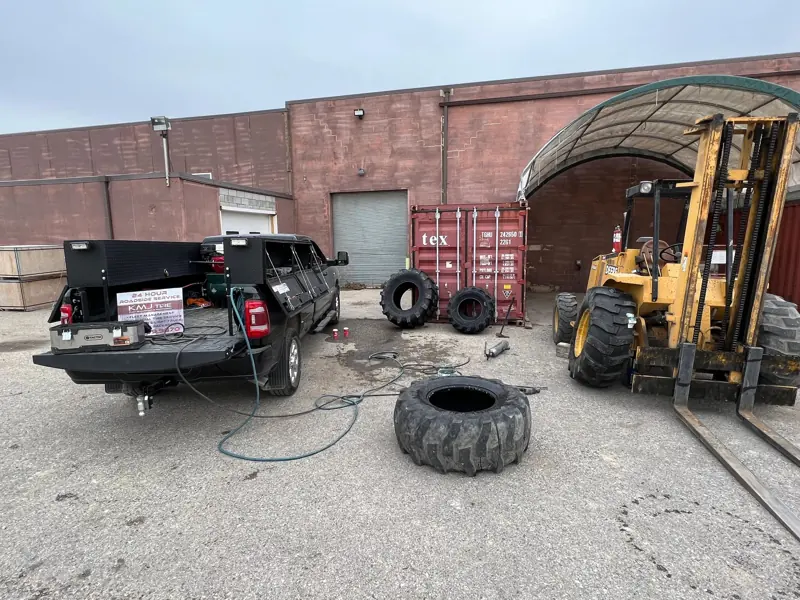
The hero photograph shows a KMJ-branded service pickup beside a red pickup at an outdoor work site, with an open equipment compartment and a hose on the ground. It illustrates mobile tire-service logistics only. It does not show an accessible van, an approved boarding arrangement or a completed repair. The pictured worksite is not being recommended as a suitable service location for the reader's vehicle.
12. Compare cost without losing the specification
A useful estimate is itemized around the actual approved work. Identify the exact tires, any wheels or hardware, monitoring requirements, installation tasks and applicable taxes or other charges. Ask which items are included and which depend on inspection. There is no meaningful cheapest option if two totals describe different products or omit work needed for the vehicle.
The budget-versus-premium tire comparison can help structure trade-offs after fitment is established. Prioritize evidence relevant to the use case: seasonal performance, expected usage, maintenance requirements and the manufacturer's terms. A lower-cost eligible product is not automatically unsuitable, and a more expensive product is not automatically approved for a conversion.
Consider the cost of the service arrangement as well as the tire purchase. Time away from the vehicle, accessible alternative transport and handling a stored set may matter to the household. Those practical costs vary by person and should not be invented as a universal figure. Discuss them openly so that a superficially inexpensive plan does not become difficult to use.
Keep promotional assumptions out of the comparison. Verify current pricing, availability and any terms directly when obtaining the estimate. A photograph of tires, a brand information page or an old invoice is not evidence of present stock or an active offer. The final choice should remain traceable to a specification and a current written proposal, not a remembered headline.
13. Ask precise questions about brand alternatives
Brand pages are useful places to begin a product discussion, not blanket approvals. For example, Michelin tire information in Calgary can help identify a manufacturer to investigate. The next question is which exact model, size and service description meet the van's requirements. A recommendation for one vehicle cannot be transferred merely because another driver likes the same brand.
Similarly, Toyo tire options should be compared at the product level. Ask what evidence supports the proposed tire for the intended seasons and loading situation. If a seller substitutes a different product due to availability, request the updated specification before accepting it. The fact that both products come from one manufacturer is not a substitute for comparison.
A third starting point is Falken tire information. Compare eligible alternatives with the same list of requirements rather than building a different standard around each brand. Keep comfort preferences distinct from minimum technical requirements. A quieter or softer-feeling tire still needs the right specification, and subjective impressions from another vehicle may not predict this van's ride.
There is no universally best brand for every accessible van. The useful result is a short list of verified candidates with clear reasons for the final choice. If only one option has been verified, say so instead of presenting a broad comparison that was never performed. If none has been verified, the decision remains open regardless of how attractive an advertised product appears.
14. Record wear and ride changes without guessing their cause
A new vibration, repeated pressure loss or uneven wear deserves attention. Note when it began, which conditions make it noticeable and any recent tire or vehicle work. A short factual description helps the appropriate provider investigate. Avoid diagnosing a conversion problem from a tire mark or declaring a tire defective solely because a passenger notices a change in comfort.
The USTMA guidance identifies changes such as increased air loss, noise and vibration as reasons to consult a tire professional promptly. It also emphasizes regular condition checks, including on vehicles that travel little. An accessible van used mainly for short essential trips may accumulate mileage slowly, but low mileage does not make age, pressure loss or damage irrelevant.
Wheel balancing information explains one tire-related service that may be relevant after assessment. Balancing is not a universal cure for every vibration and does not diagnose mobility-system or mechanical faults. Let the evidence determine the next step. If the concern falls outside tire work, preserve the observations for the appropriate specialist rather than cycling through unrelated tire changes.
Include the user's experience without making them prove it through unsafe testing. Nobody needs to drive faster, repeat a frightening manoeuvre or endure a painful journey to make a concern credible. If a tire appears damaged or the vehicle behaves abnormally, seek advice about safe movement. The method of getting help should fit the condition, not assume the van can be driven normally to a service location.
15. Plan for a puncture before the accessible trip starts
Find out what flat-tire equipment the actual converted van has. Do not rely on the base-model brochure to establish the presence or location of a spare, jack or mobility kit. Conversion documentation and a safe physical check should settle what is present and usable. Any spare must be suitable for the vehicle, and any temporary equipment carries its own instructions and limitations.
A flat-tire plan should also establish what the occupants will do. Identify a roadside-assistance route that can handle the vehicle and explain the accessibility needs when requesting help. A tow vehicle's ability to recover the van does not establish its ability to transport a wheelchair user. Ask about the passenger arrangement separately, including whether an accessible alternative vehicle must be arranged.
For an actual injury, tire repair assessment in Calgary is the relevant discussion, not an advance promise that every puncture is repairable. The tire needs appropriate assessment, with its history disclosed. Driving while severely underinflated or using a temporary product can affect the information the technician needs. Report what happened rather than omitting an inconvenient part of the journey.
Do not assign a roadside wheel change to a family member simply because the van contains tools. Location, traffic, instructions, physical capability and the converted vehicle's service requirements all matter. If there is no safe way to undertake the task, professional recovery is the plan. A prepared alternative is more valuable than equipment nobody can safely use when the situation occurs.
16. Protect the passenger plan during a breakdown
Keep a concise breakdown note with vehicle identification, conversion details, roadside-provider information and the user's essential access requirements. Explain whether a transfer can be assumed; often it cannot. State what the responder needs to know to arrange transport, without placing unnecessary medical details in a general vehicle folder. The user should help decide what information is shared and with whom.
Think through destination access as well as roadside departure. If the van is taken to a holding yard or service facility, can the user retrieve essential belongings and reach suitable transport safely? Will the mobility equipment remain with the person or the vehicle? Those questions cannot be solved by tire tread or an extra spare. They belong in the household's practical travel arrangements.
Weather and communication matter, but avoid a one-size-fits-all emergency kit list. Bring the items the individuals actually require, and preserve enough phone capacity to request assistance. If the situation involves immediate danger, use emergency services as appropriate. Do not remain in an unsafe location merely because the preferred recovery provider has been contacted or because abandoning a planned journey is inconvenient.
A practice conversation at home can reveal gaps without simulating a dangerous roadside stop. Ask who requests assistance, who explains the vehicle and who arranges the accessible onward journey. Then check the answers against the providers' actual services. A policy name or membership card should not be treated as proof that every transport need has been covered.
17. Store seasonal sets without blocking independence
A removed set should not occupy the ramp deployment area, a transfer space or an accessible route through a garage. Plan its storage location before service day. Tire-and-wheel assemblies can be heavy and awkward; avoid asking the user or helper to move them in ways that exceed their capability. Arrange suitable handling rather than allowing convenience to become a lifting injury.
USTMA recommends a clean, dry, cool, ventilated storage environment protected from damaging sunlight, heat, chemicals and ozone-producing equipment. Follow the product manufacturer's instructions for mounted or unmounted tires. Do not infer that a plastic bag makes an unsuitable outdoor area acceptable. Labels and records help preserve the set's identity, but they do not protect rubber from a poor environment.
When transporting loose assemblies, keep passenger spaces, restraint equipment and mobility access unobstructed. Ask about a suitable transport arrangement if the set cannot be carried safely with the normal occupants. Removing necessary mobility equipment or compromising securement to fit four wheels is not an acceptable storage solution. A separate collection arrangement may be the practical answer, subject to provider confirmation.
Before the set returns to use, have its condition and suitability reassessed. A stored set can have changed condition even though its tread has not accumulated road mileage. Retain the original specification record, but treat it as identification rather than a fresh condition report. The next installation should follow current instructions and the actual state of the tires and wheels.
18. Use a shared-vehicle handover that survives staff changes
For organizations operating accessible vans, the responsible driver may change from one day to the next. A durable handover should identify the vehicle, the current tire status, unresolved concerns and who has authority to arrange service. Avoid a system in which a verbal comment about a warning disappears at the end of a shift while the van remains available for the next trip.
The fleet tire-management information can start a discussion about tire-related support. It does not establish that KMJ manages passenger accessibility, conversion maintenance or every vehicle in an organization's fleet. Define the tire scope clearly and keep mobility-equipment responsibilities with the qualified provider. A combined schedule can be useful without combining unrelated technical approvals.
Use status words that mean something concrete. A measured pressure check is different from a visual walk-around; a reported concern is different from a completed assessment. Include the date and evidence for each action. If a vehicle has a restriction, make that restriction visible to the person assigning journeys instead of burying it in a maintenance invoice.
When a different wheelchair or passenger arrangement is introduced, review the loading and access assumptions through the appropriate process. A familiar route does not make a changed vehicle configuration irrelevant. The strongest handover is short enough to be used and specific enough to prevent someone from treating yesterday's arrangement as a permanent approval for every future journey.
19. Three decisions that look similar but are not
First, an owner wants a new winter set in the documented approved specification. The conversion paperwork is complete, loading has not changed and the provider confirms the service arrangement is suitable. The remaining work is product comparison, condition and component checks, installation under the applicable procedures, and a clear handover. There is no need to invent an exotic tire requirement simply because the van is accessible.
Second, a used accessible van arrives with two conflicting pressure references and no clear conversion identity. The owner wants to copy another van's settings. Here the problem is missing authoritative information, not a lack of tire brands. Recover the vehicle and conversion records and obtain the responsible manufacturer's clarification before choosing a setting or approving a different specification.
Third, a family introduces a substantially different mobility device and assumes the old loading worksheet still applies. The question is whether the real travel configuration remains within the completed vehicle's limits. Recheck the relevant weights and instructions with the appropriate specialist. Buying a tire with a larger capacity number does not answer that whole-vehicle question or change the permitted passenger arrangement.
Each example leads to a different next step because the missing fact is different. This is why a careful service request begins with the actual vehicle and the actual problem. A generic instruction to buy better tires is too vague to guide any of these situations, even though all three ultimately involve tires on an accessible van.
20. Finish with a handover the user can act on
After tire work, retain the exact product details, installed positions, pressure instructions and any required follow-up from the applicable vehicle, wheel or conversion guidance. Clarify what was completed and what was not. Tire installation does not certify a ramp, restraint system or other adaptation, and a conversion inspection does not replace an unresolved tire assessment.
Before the next planned journey, confirm that the agreed access arrangement is available and that any specialist restrictions have been resolved by the responsible provider. If the passenger or driver notices something different, document it promptly. Do not dismiss a concern because the paperwork is complete, and do not assume a new sound must be a tire problem without assessment.
For tire-specific assistance, discuss the accessible van's requirements with KMJ. Provide the vehicle and conversion information, the tire task and the practical access needs, then confirm whether the work can be accommodated. No current pricing, product availability or conversion-service capability is promised in this guide.
The most useful tire plan keeps three things connected without confusing them: an approved tire specification, a maintained vehicle and a workable journey for the person using it. Start with the right documents, make responsibilities explicit, and arrange the backup before it is needed. Independence is supported by a plan the user can rely on, not by shortcuts that leave someone else to solve an avoidable problem at the roadside.
Sources and how to apply them
Primary sources reviewed on October 25, 2026 include BraunAbility's owner-manual lookup and wheelchair-vehicle maintenance pages linked above, and the U.S. Tire Manufacturers Association tire-care guidance. BraunAbility supports the distinction between base-vehicle and mobility-product care, the need for configuration-aware service, and pressure and wear checks. Its instructions apply to its products; this article does not transplant a model-specific procedure or service interval onto another conversion.
USTMA supports regular inflation and condition inspections, attention to changes in air loss, noise or vibration, age considerations for low-mileage use and suitable tire storage. The planning worksheets, access questions and fictional examples here are practical organizational suggestions, not engineering approvals. The exact vehicle, conversion, wheel and tire manufacturers' current instructions govern the technical decisions. Obtain product-specific clarification when the available documents do not settle a question.