Can you buy tires online with confidence if the website says they fit your car? Yes, but treat that result as a shortlist, not the final approval. Before paying, match the exact vehicle, the wheels actually fitted to it, the complete tire specification and the installation arrangements. Then check the delivered tires against the order before anyone mounts them. A correct size in a search box is only one part of a correct purchase.
The awkward mistakes usually happen between those steps. A driver searches using a familiar vehicle name but selects the wrong trim. Someone orders tires for the original wheels while a different winter wheel set sits in the garage. A listing shows one attractive photograph beside several product variations, and the version in the basket is not the one the buyer compared. None of these requires carelessness. They happen because an online catalogue compresses a complicated fitment decision into a few menus.
This guide follows a purchase from the first search to the first drive. It is written for Calgary drivers buying ordinary passenger and light-truck tires, not for changing a vehicle's engineering or improvising a wheel conversion. The goal is to give you a small collection of reliable facts, a useful question list and clear stopping points. You should finish with a purchase you can explain, rather than a basket that merely looks plausible.
1. Build a vehicle record before opening product pages
Start beside the vehicle, not beside a search result. Record the year, manufacturer, model and exact trim as accurately as you can. Note whether the vehicle has a package that changes its wheels or brakes. If you cannot identify that package, say so. Guessing at a trim to make a menu accept your search does not resolve the uncertainty; it just hides it until later.
Photograph the tire-information placard and read the relevant section of the owner's manual. The placard is commonly around the driver's door opening, although the manual can direct you to the correct location. Keep the photograph readable and complete. A cropped picture containing only a pressure number loses the size and loading context that makes the label useful. Avoid sharing unrelated personal information from other documents when asking for help.
Next, record what is installed now. Read all four tires, because front and rear specifications may differ and previous owners may have made changes. Note the complete size, the service description after it, the brand and model. A photo of the sidewall is better than a hurried voice note when two similar letters are easy to confuse. Include the separate seasonal wheels if those are the ones receiving the purchase.
Your record now has three columns: what the vehicle specifies, what is fitted, and what you intend to use. Differences are questions to resolve, not invitations to choose whichever answer produces more results. KMJ's tire sidewall information guide can help you identify the markings. It cannot replace the vehicle-specific instruction, especially on a modified vehicle or a set whose history is unknown.
2. Decide which wheels the new tires must fit
A tire is purchased for a wheel as well as a vehicle. This becomes important when a Calgary household has a larger summer wheel set and a smaller, separately approved winter set. Searching by the vehicle's standard equipment may bring up the summer size even though the winter wheels are the ones waiting to be fitted. Write the intended wheel set at the top of the order notes.
The number after the construction letter in a common metric tire size identifies the nominal wheel diameter in inches. It is not the overall outside diameter of the tire. A listing that differs at that number is not a near enough alternative for the same wheel. Equally, matching that number alone does not establish suitability: wheel width and other fitment requirements still matter.
Do not infer wheel width from a photograph or from the tire that happens to be mounted. An existing assembly can itself be incorrect. If a seller proposes a different size, ask a qualified tire professional to check the tire manufacturer's approved rim-width information and the vehicle requirements. A generic calculator showing a similar overall diameter does not settle clearances, load capability or the suitability of that wheel.
There is a useful boundary here. Replacing a verified tire specification on a verified wheel set is a relatively contained purchase. Changing diameter, width, construction or the wheel package introduces additional questions. Move the second kind of purchase out of a quick checkout flow. Resolve it with proper fitment information before money, shipping and mounting make the decision harder to reverse.
3. Read the complete specification, not just the large numbers
The size string is the beginning of the product identity. The load index and speed rating matter too, along with construction and any other designation required for the application. USTMA's replacement tire guidance advises using the size, load index and speed-rating designation recommended by the vehicle or tire manufacturer. It also warns against reducing the originally specified size or load-carrying capacity.
A hypothetical example helps. Imagine two catalogue entries sharing the same size but displaying different service descriptions. They are not automatically interchangeable products simply because the biggest line of print matches. The higher-looking number does not answer every suitability question either. You need confirmation of the complete specification and the appropriate inflation requirements, not a rule that more of any marking must be better.
Passenger, light-truck, extra-load and other constructions need to be interpreted in their proper application. Avoid translating a description such as heavy duty into approval for your vehicle. Product categories are not a substitute for manufacturer information. If a proposed alternative changes the original construction or load system, have that change assessed rather than assuming the original placard pressure makes every alternative carry the same load.
Use the tire load-index explanation to understand what the seller is discussing, then ask for a direct answer about the actual product in your basket. A useful reply identifies the complete specification. An answer that merely says it fits most versions of your model has not closed the question you asked.
4. Make the season decision before sorting by price
A low displayed price is not a saving if it buys the wrong type of tire for the months you intend to drive. Define the job first. Is this a dedicated cold-season set, a warm-season replacement used alongside winter tires, or a year-round arrangement you are evaluating? Also distinguish normal city use from trips into places with different weather and tire requirements.
Marketing categories can be confusing because the words sound similar. Read the manufacturer's description for the exact model and specification, and identify the actual winter markings where relevant. Do not assume a photograph of a snowy road establishes a tire's qualification or performance. A product family can contain multiple variants, and a retailer's general category label may not explain every difference between them.
For a separate cold-season purchase, begin with winter tire options for Calgary. If you are considering a single year-round set, use the Calgary all-weather tire information to frame questions about that compromise. For another seasonal plan, the all-season tire selection page provides a different starting point. These are three decisions to examine, not three interchangeable names.
Keep weather suitability separate from size approval. A tire can have the correct dimensions yet be unsuitable for the season you are buying it for. Conversely, an appealing winter model still needs to meet the vehicle's fitment requirements. Resolve both before comparing convenience or delivery estimates. An online basket should reflect a decision already made, not become the place where an unresolved seasonal question gets settled accidentally.
5. Separate a model name from the exact item being sold
Online product pages often group related items under one heading. The photograph, review score and marketing description may belong to the model family, while a selector controls the actual size and version. After changing a selector, read the product details again. Do not assume that a feature shown before the change still describes the chosen item.
Look for a manufacturer part number or another precise product identifier that the seller can confirm. Save that identifier alongside the full written description. If the confirmation email contains only a shortened model name, ask for the missing detail before dispatch. This is especially useful when a manufacturer offers different versions that are easy to confuse in a small mobile screen.
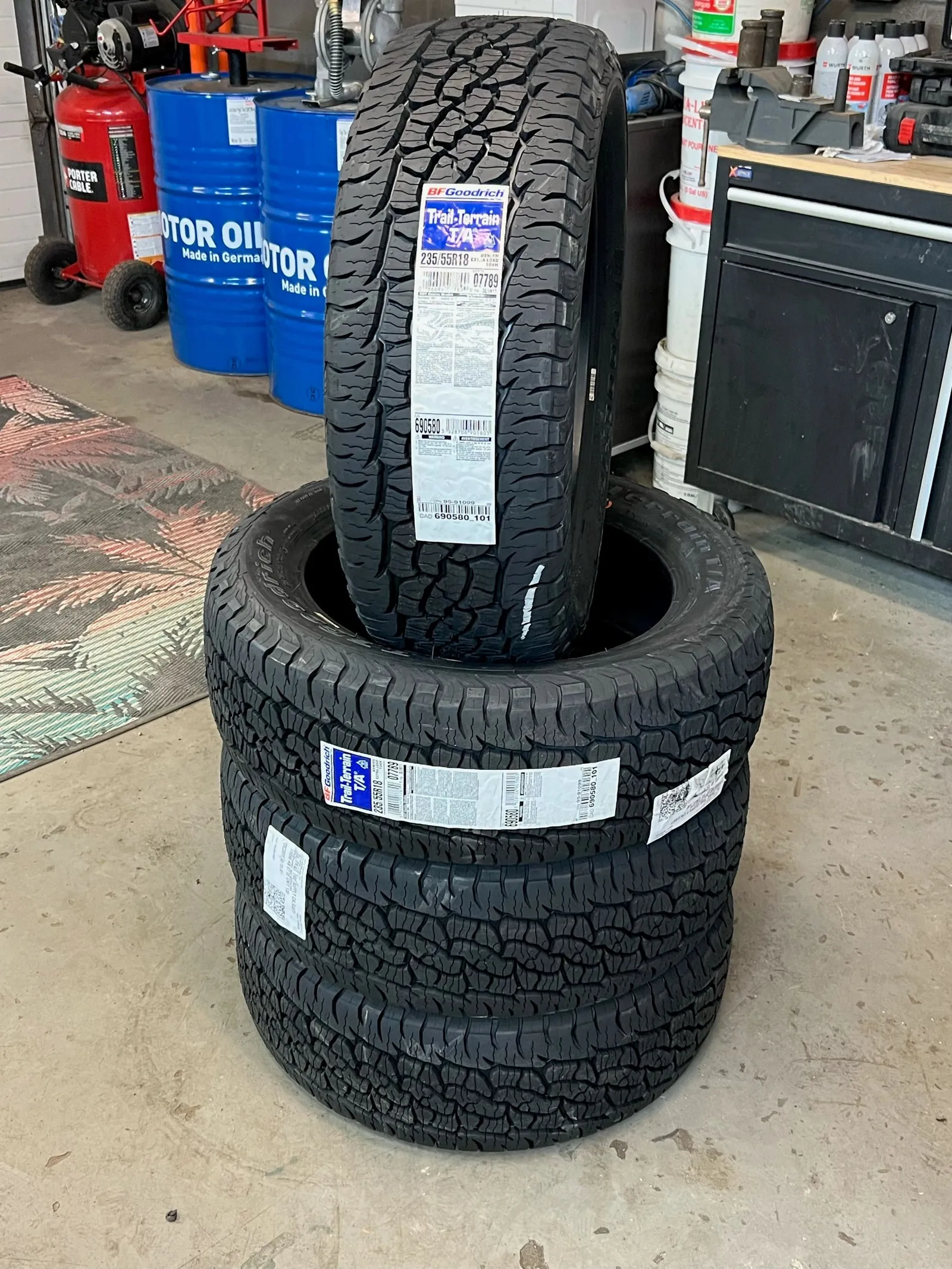
Treat a photograph as an illustration unless the seller specifically says it depicts the exact item. Tread appearance alone cannot establish size, load index, construction, manufacturing date or compatibility. The real KMJ photo accompanying this guide shows labelled tires in a work area; it illustrates why physical labels are useful at receiving time. It is not evidence of current inventory or a recommendation of that pictured specification for your vehicle.
Keep a screenshot or saved copy of the selected variant and the seller's written answer. A basket page can change after you leave it, and a shared link may reopen the default selection rather than your chosen size. When comparing the online tire selection for Calgary, write down what you selected instead of relying on a remembered picture or the browser's last view.
6. Verify the seller as carefully as the tire
The manufacturer of the tire, the operator of the website and the business taking payment may not be the same organization. Establish who is selling the goods and who is responsible if the shipment is wrong. A marketplace listing deserves particular attention because several sellers may offer similar-looking items through the same interface. A familiar platform name does not by itself identify the contracting seller.
Look for an accessible business identity, a working way to raise an order issue, and policies you can read before payment. Check that the product description, invoice currency, delivery destination and return address fit your understanding of the purchase. If anything is unclear, request the answer in writing. This is basic purchase documentation, not an accusation about the seller.
Be wary of using a search advertisement as proof that a business has a particular local location or service arrangement. Follow the information through to the actual business details. A site serving Canadian customers does not necessarily ship from Canada, and a Calgary search result does not establish local installation. Ask the practical questions directly rather than filling gaps with assumptions from the page design.
If local accountability matters to you, review KMJ's Calgary tire-business information as part of your comparison. Whatever seller you choose, keep the order confirmation, the written product specification and the relevant terms together. Good records are much more useful than remembering that the website looked professional when you paid.
7. Get installation acceptance before placing the order
Buying loose tires does not automatically include somewhere willing and able to mount them. Before paying an outside seller, ask your intended installer whether it accepts customer-supplied tires and whether the proposed product and wheel combination can be assessed. Policies differ, and the answer may depend on the condition, type and suitability of the equipment brought in.
Describe the work accurately. Loose tires to be mounted on wheels are different from complete wheel assemblies that only need a seasonal change. Existing pressure-monitoring sensors, valves and damaged wheels may affect what the visit involves. Ask what is included, what is inspected before work begins and what could require a revised estimate. Do not expect a checkout button on one business's website to commit another business to a particular service.
For a local comparison, seasonal tire-change information helps distinguish the type of visit, while the wheel-balancing service page explains another part of the tire-and-wheel work. Confirm the scope for your own purchase; a general service page is not a personalized quotation or a promise that externally purchased tires qualify for an advertised package.
If you prefer service at a suitable location, review mobile tire service in Calgary and the current tire-service area information. Confirm location suitability and scheduling directly. KMJ offers tire services, not brake, suspension or other mechanical repairs. Mechanical assessment belongs with the appropriate qualified provider.
8. Compare the finished purchase, not the first displayed price
Build a comparison with the same endpoint: the correct tires, delivered, accepted and installed for the intended vehicle. Record tire quantity, shipping, applicable taxes and fees, installation scope, and any separately priced components or services. Use actual written figures from the sellers and installers. This guide does not supply sample prices because made-up amounts can be mistaken for an offer.
Watch the unit being displayed. A product page may show a per-tire amount while a search snippet or promotional banner refers to a set or a package. The basket quantity and the total should agree with your plan. Where a front and rear pair differ, list both specifications separately rather than multiplying the first line by four and assuming that the remaining items are identical.
Include the cost of an unsuccessful purchase in your thinking without pretending you know its probability. Who pays return freight if you chose the wrong version? Does a cancellation after dispatch have different conditions? Is a mounting attempt treated as use under the seller's policy? Read the actual terms. An apparently small saving may not suit you if the downside is expensive to resolve or difficult to manage without another vehicle.
The Calgary tire-buying overview is a useful place to start a local comparison. Then compare written, current scopes rather than fragments from different offers. The goal is not to prove that online or local buying always wins. It is to compare equivalent outcomes and understand which business is responsible for each part.
9. Clarify date-code and storage questions without inventing a rule
Some buyers want a manufacturing-date commitment before paying. That is a reasonable question to put to the seller, but do not assume a listing for new tires promises manufacture in the current calendar year. Ask what information can be supplied for the actual items being dispatched and what policy applies if the delivered date range differs from an explicit agreement.
Manufacturing date is one piece of tire history, not a complete condition report or a universal expiry date. Storage conditions, time in service, damage and the tire and vehicle manufacturers' guidance also matter. Avoid using an arbitrary age limit copied from a discussion thread as if it were the instruction for every tire. Equally, do not use unused tread as proof that age and storage history are irrelevant.
If age is material to your decision, obtain the answer before ordering rather than negotiating only after delivery. A seller may be unable to promise an exact week or may offer a stated range. You can decide whether those terms meet your needs. Do not record an unanswered question as an agreement simply because no one objected to it in a message.
On arrival, photograph the identification markings that are accessible and match them to the records supplied. Ask a tire professional if you cannot locate or interpret them. Preserve labels until the product identity is confirmed. These photographs also make later warranty or recall questions easier to handle, but they do not establish that the tire has passed a professional condition inspection.
10. Read delivery promises as logistics, not fitment approval
Distinguish estimated dispatch, carrier pickup and estimated arrival. Those are different events. A seller's delivery estimate cannot guarantee road conditions, routing or the installer’s available time. Plan with enough room to inspect the order before installation and to resolve a wrong-item shipment without needing to drive on unsuitable tires in the meantime.
Ask how the tires will be identified and tracked. A set may arrive in separate parcels, so one delivery scan may not mean the entire order is present. Record the expected quantity and any tracking information provided. If part of the order arrives first, compare it with the confirmation but do not assume the remaining parcels contain the matching specification until you see them.
Arrange a delivery location where the goods can be received and kept secure. Think about how you will move them without blocking shared access or requiring someone to lift more than they can safely manage. If the shipment goes directly to an installer, obtain that business's permission first and use the receiving instructions it provides. Do not have tires sent to a business merely because you hope to use it later.
An urgent need does not make uncertain fitment acceptable. If a current tire is damaged, separate the immediate mobility problem from the new purchase. The Calgary tire-repair information explains where to begin asking about assessment, and tire emergency-service information can inform a separate request. Neither page promises that a particular damaged tire is repairable or that immediate assistance is available.
11. Treat fewer-than-four purchases as their own decision
Buying one tire can look like a simple way to solve one damaged tire. The existing set makes that decision more involved. Remaining tread, tire model, specification and the vehicle manufacturer's requirements all need attention. The fact that a retailer will sell a quantity of one does not mean a single replacement is suitable for every vehicle.
USTMA recommends replacing all four tires together for optimal performance. Its general guidance also addresses replacing fewer than four and explains why two new tires are normally placed on the rear axle. That advice should not be used to bypass a vehicle-specific requirement, an approved staggered arrangement or restrictions on acceptable differences among tires. Ask for application-specific guidance rather than trying to derive a complete installation plan from a general paragraph.
For an all-wheel-drive vehicle in particular, obtain the manufacturer's instructions about tire matching before assuming a new tire can join three worn ones. Do not invent a universal allowable tread-depth difference. Different vehicles can have different requirements, and the information needed includes the measured condition of the actual remaining tires, not simply the model's reputation.
If a product is discontinued, a similar-looking successor is not automatically the same tire. Tell the seller and installer exactly which tire remains on the vehicle and why you are replacing only part of the set. Resolve whether the intended combination is acceptable before committing to a scarce item, a special order or a product whose return conditions make changes difficult.
12. Separate tire purchases from complete wheel packages
A complete tire-and-wheel package adds another fitment project. Wheel diameter and bolt count are not enough to establish compatibility. The package supplier needs to verify the required wheel dimensions, mounting arrangement, clearances, load capability and hardware for the actual vehicle. Pressure-monitoring compatibility may also need attention where the vehicle uses that equipment.
Ask whether the package is supplied assembled and balanced, what hardware is included, and what still has to be done on the vehicle. Do not assume that existing fasteners are suitable for another wheel design. A photograph of a similar car wearing the same wheels does not answer whether its brakes, trim or modifications match yours.
This guide does not provide a do-it-yourself wheel-conversion formula. There is no single percentage of diameter change that automatically approves every other aspect of a replacement package. A calculator can help compare dimensions, but the manufacturer and competent fitment assessment must resolve the real application. Make the seller identify exactly what it has verified rather than accepting an unspecified fitment guarantee at face value.
When you only need tires for your current approved wheels, keep that scope clear. A search result that bundles wheels can make an alternative look simpler than it is, especially if the original tire size has fewer results. Changing the whole assembly to avoid a difficult search is not necessarily cheaper, faster or appropriate. Evaluate it as a separate proposal with its own written specification.
13. Know what warranties and return terms actually cover
Separate a manufacturer's tire warranty from a seller's return policy and any optional protection product. They answer different questions. A manufacturing-defect warranty is not the same as permission to return an incorrectly chosen size. A treadwear provision does not establish suitability for your route, and a road-hazard product can contain conditions and exclusions that you need to read for yourself.
Before payment, find out which documentation would be needed to make a claim and where the assessment would occur. Ask whether the product is supplied through the intended market and whether the applicable warranty is valid for your purchase and use. Do not assume that a familiar brand name means every cross-border listing carries identical terms in Canada.
Read the return conditions for unmounted and mounted tires, the time period, authorization procedure and responsibility for freight. Save the policy version that applies to your order. If the seller gives you a special written agreement about fitment or date range, keep it with the confirmation. A conversation with one business does not automatically amend another business's terms.
Be equally clear about installation workmanship. The seller of the tire and the installer may have separate responsibilities, and neither should be assumed to cover the other's work without an agreement. Ask who investigates a vibration, air loss or suspected product issue after installation. You want a practical route for getting help, not a collection of documents that each directs you somewhere else.
14. Audit the basket immediately before paying
Pause on the final order summary and read it as if someone else assembled it. Check the selected vehicle, the exact product variant, the full specification, the quantity and the delivery address. If there are two different axle specifications, verify which quantity belongs to each. A copied item, a browser reset or a changed selector can alter the basket without changing the headline you remember.
Match the product identifier in the summary to the one the seller confirmed. Recheck the return policy and the installation arrangements if you changed anything during the comparison. A different size or construction can change the suitability and receiving requirements even if the brand and model remain the same. Do not carry approval from the first proposal over to a revised order without confirmation.
Keep the distinction between a question and an answer visible. For example, a note saying please confirm fitment is not itself fitment confirmation. If a material question remains unresolved, leave the purchase incomplete until it is answered. This is especially important when stock status or a delivery estimate makes you feel rushed. Convenience does not supply missing technical evidence.
Save the completed order confirmation in a place you can access at delivery. If the confirmation differs from the basket you approved, raise it promptly and ask the seller how to correct it before dispatch. You are much better positioned with a precise discrepancy, such as a different service description, than with a general statement that the order does not look right.
15. Inspect the delivered goods before mounting
Count the tires and compare every item with the order. Read the brand, model, full size and service description on the physical tires, not only the shipping label. Labels can be attached to the wrong parcel, and a correct first tire does not prove the other three match. Keep the order record beside you while inspecting rather than relying on memory.
Look for obvious shipping damage or irregularities and photograph anything concerning before the packaging is discarded. Do not attempt to repair a damaged bead, reshape a visibly damaged tire or make an uncertain item acceptable by mounting it. Preserve the item and ask the seller and a tire professional how to proceed. An installation attempt can complicate both the condition assessment and the return process.
Document discrepancies with neutral, specific language. State what was ordered, what the sidewall shows and which item is affected. Include readable photographs and the order identifier through the seller's appropriate channel. This lets the business investigate efficiently without you needing to diagnose why the error occurred. Avoid removing labels until the product identity and next step are clear.
Keep a receiving checklist: quantity complete; each specification matches; physical condition concerns recorded; date-code agreement checked if applicable; installer accepts the actual items. A tick beside these points is not a substitute for professional inspection. It is a way to ensure you do not miss a straightforward mismatch before the tires become mounted assemblies and the transaction is harder to unwind.
16. Three purchase scenarios that show where to stop
Consider a driver with two approved wheel sets. The vehicle selector returns the original larger-wheel size, and the driver adds four tires to the basket. Before payment, the vehicle record shows that the tires are actually intended for the smaller winter wheels. The right response is to stop and verify the specification for those wheels, not to assume that the vehicle-based search overrules the physical wheel set.
In a second example, a crossover loses one tire to damage. An online seller has the same model name, but the remaining tires have substantial wear. The important unanswered question is not just whether the listing exists. It is whether that one replacement can be used with the existing set under the vehicle manufacturer's requirements. The driver needs measured condition and appropriate guidance before ordering a single item.
A third buyer compares two websites. One shows a tire-only amount and a delivery estimate; the other describes a fitted package. The first appears lower until the buyer separates quantity, freight, taxes, installation and return responsibilities. There is still no automatic winner. The useful result is that both proposals can now be compared at the same endpoint, and the buyer understands who handles a mismatch or an after-installation concern.
These are illustrative situations, not customer stories or claims about particular products. Each has a different stopping point: wheel identity, set compatibility or purchase scope. That is the value of working through the sequence. You do not need to become a tire engineer. You need to recognize which unanswered question prevents an otherwise attractive listing from becoming a sound order.
17. Send one clear fitment question instead of five vague messages
A concise request can carry a surprising amount of useful information. Start with the vehicle identity and the intended wheel set. Add the placard specification, the current full tire markings and the exact listing identifier. State whether you are replacing all four tires or only part of the set. Mention any known wheel changes rather than assuming they will be visible from the model name.
Then ask a bounded question: is this exact product suitable for this vehicle on these wheels, and what information is still needed to establish that? If you are also asking about installation, separate that request from product suitability. Ask whether customer-supplied tires are accepted and what the proposed work includes. A business can answer one part while still needing information for the other.
Do not paste a huge collection of unrelated screenshots without explaining which one represents the intended purchase. Number the useful photographs and identify what each shows. A readable placard image, the relevant sidewall and the selected product details usually communicate more clearly than a stream of marketing pages. If a professional requests additional measurements or inspection, let that requirement guide the next step.
Record the reply in the same folder as the order. If the seller changes the product, make the change explicit and obtain a new answer where necessary. A clear information trail reduces crossed wires between buyer, seller and installer. It also means another household member can receive the delivery or discuss the visit without having to reconstruct the entire purchase from memory.
A reusable order sheet for a shared household
A small order sheet is useful when one person researches, another pays and someone else takes the vehicle for installation. Begin with a clear version date and identify who owns the final decision. Record the intended vehicle and wheel set in plain language, such as the approved winter wheels stored at home. Do not rely on a nickname that only the person doing the research understands.
Create a product line for each distinct specification. Include the manufacturer, model, full size, service description, quantity and seller-confirmed product identifier. Leave a separate space for any required feature or designation that has been verified. If something is unknown, write unknown rather than leaving a blank that another person might interpret as not applicable. This makes uncertainty visible without encouraging someone to guess.
Under that, list the evidence supporting the selection. Identify the placard photograph, the relevant manual section and the written response about the proposed fitment. These are references to keep with the record, not instructions to post private vehicle information publicly. If a vehicle modification is relevant, note what changed and who will assess its effect. Do not let a routine order sheet become a substitute for that assessment.
Add a logistics line containing the seller, expected quantity of parcels, delivery destination and intended installation provider. Mark installation acceptance separately from the requested date. A requested date is not a confirmed time, and a confirmed time does not establish that tires arriving late can still be fitted then. This distinction prevents a family member from assuming the entire plan is settled because one message mentions a day.
Use a final exceptions box for anything that could change the decision. Examples include an unanswered date-code request, a revised product identifier, a pending assessment of the existing wheels or a requirement to inspect the remaining tires before replacing only one. Assign the next action to a person. An unresolved exception with an owner is manageable; an unresolved exception hidden in an old text thread is easy to miss.
At receiving time, the person accepting the shipment can use this sheet to check the actual items. They should record discrepancies, not authorize an unassessed substitution just to finish the task. After installation, add the invoice reference and file the sheet with the maintenance records. The document has now followed the product from selection to use without requiring everyone in the household to repeat the research.
This approach is especially helpful if you order from a phone during a busy week. Product tabs may close, search results may rearrange themselves and a shared link may show another variant. The order sheet preserves the decision independently of the website interface. It is short enough to use, specific enough to check and clear about which questions still need a real answer.
18. Finish with a documented handover and a sensible first drive
At installation, make the order details and any relevant manufacturer instructions available. Ask the installer to flag a mismatch or condition concern before proceeding. Confirm what was fitted and retain the invoice or service record. If something differs from the approved plan, get a clear explanation rather than assuming a last-minute substitution is equivalent.
Afterward, follow the vehicle and wheel manufacturers' applicable instructions and any documented follow-up advice from the installer. Pressure settings should come from the appropriate vehicle guidance for the approved fitment, not an arbitrary number copied from a tire sidewall. USTMA's tire-care essentials emphasizes regular gauge checks, including before long trips, and explains that pressure-monitoring systems do not replace routine checks.
Notice a new vibration, unusual noise, steering change, visible damage or warning indication rather than dismissing it as the normal result of new tires. Stop where safe if the symptoms suggest an immediate problem and seek appropriate assistance. Tire-related assessment belongs with a tire professional; suspected mechanical faults need the right mechanical specialist. Do not continue a risky drive merely because the tires were bought recently.
For ongoing ownership, the Be Tire Smart maintenance information and Calgary tire education articles offer useful reading. Keep your vehicle record, product specification, confirmation, receiving photos and installation documentation together. Buying online works best when every step describes the same actual tires on the same actual vehicle. The successful checkout is not the finish line; a verified, suitable installation is.