You are replacing your car, but the winter wheels in the garage still have useful tread. It seems wasteful to buy another complete set. Can the old assemblies move to the new vehicle, or should they go with the car you are selling?
Possibly, but the answer requires two separate approvals: the tires must suit the new vehicle, and the wheels must suit it too. A matching bolt count, a familiar tire size, or the fact that both cars come from the same brand is not enough. Sensors, hardware, clearance, load capability, condition, and the new vehicle's approved winter configuration can change the result. Establish compatibility before promising the set to either car.
This guide helps Calgary owners organize that decision. It follows the handover from the first vehicle shortlist through inspection, budgeting, installation, and the final paperwork. It is not a universal fitment chart or a procedure for adapting incompatible wheels. Where an exact dimension or operating limit is needed, use the vehicle, wheel, and tire manufacturer's information for the actual products involved.
Separate the assets before deciding what to keep
A winter assembly contains several things that can have different futures: the tire, the wheel, the valve or sensor arrangement, and the required mounting hardware. Treating them as one indivisible "set" can hide useful options or create false confidence. The tires may be suitable while the wheels are not, or the reverse.
Start with an inventory of what you actually own. Are there four complete assemblies, four loose tires, a matching spare, or a mixture? Are all four tires the same version and size? Do the wheels share a part number, or is the set intentionally staggered? Are there separate nuts, bolts, locks, or rings stored in a bag?
Record those items before the vehicle sale becomes urgent. A set that disappears into the back of the outgoing car cannot be assessed later. Equally, retaining the wrong hardware while selling the wheels can leave the next owner with an incomplete package. Clear identification helps both sides of the transaction.
The first practical task is therefore not measuring bolt holes in the driveway. It is collecting the invoice, sidewall photos, wheel identification, sensor information if available, and the old vehicle details. The tire sidewall guide helps decode the tire portion. Wheel information may be stamped or cast in locations that are best documented when a professional has the assembly safely removed.
Make the new vehicle specific enough to assess
"A newer SUV" is not a fitment. Neither is a model name without its model year, trim, or relevant equipment package. Variants can have different wheel and tire requirements, including clearance differences that matter to a winter package.
Before asking whether the old set transfers, identify the exact vehicle being considered. If you have not bought it yet, say that the assessment is preliminary. A change in the final trim or wheel package may require the question to be checked again. Do not turn an answer for one candidate into permission for a different car purchased a week later.
Obtain the tire information label and the relevant owner's-manual guidance for the new vehicle. If the manufacturer publishes an approved winter package, that can provide a useful reference. An online photo of another owner's car wearing similar wheels is not equivalent evidence.
For an illustrative example, a family shortlists two versions of the same crossover. The winter assemblies appear promising for one, but the other has different equipment. The useful outcome is a separate compatibility conclusion for each candidate, not a general statement that the wheels fit that model. If keeping the winter set affects the purchase budget, make that uncertainty visible before signing the vehicle deal. It is easier to plan around an unresolved question than to absorb a surprise after delivery.
Compare the tire specification before the wheel appearance
The tire must meet the new vehicle's approved requirements for dimensions, load capacity, speed description, and intended use. USTMA's replacement guidance emphasizes the recommended size, load index, and speed designation and warns against reducing the specified load-carrying capacity. A tire that worked on the old car has not automatically earned approval for a different one.
Write the existing tire specification beside the new vehicle requirement. Keep the load index and any additional load designation visible; do not compare only the large size numbers. If the new vehicle is heavier or has different axle requirements, that difference may matter even when the tire dimensions look familiar.
The load-index explanation is useful background, but it is not a complete inflation or fitment calculation. The appropriate pressure and capacity relationship must be established from the relevant manufacturer guidance, especially if an alternative size is proposed.
If the dimensions differ from the original new-car package, ask whether the existing tires match an approved alternate winter fitment. Do not assume that a smaller winter wheel is always acceptable or that a similar outside diameter settles the question. A professional comparison should identify the approved configuration and its limits, not merely show that two numbers are close on a calculator.
The wheel has its own identity and limits
A tire size tells you the rim diameter it fits, but not every dimension or characteristic of the wheel. Wheel width, mounting geometry, capacity, centre fit, and clearance can all be relevant. The wheel's exact part number is often a better starting point than a visual description such as black steel or five-spoke alloy.
Ask the wheel manufacturer or a qualified fitment provider to confirm the application for the new vehicle. If the wheel is original equipment from the old car, the old vehicle's identity and the wheel part number can help trace it. If it is aftermarket, locate the original invoice and any supplied application documentation.
Do not assume that a wheel is suitable merely because it can be placed over the studs or bolted loosely to the hub. Static attachment does not establish correct seating, clearance through movement, or adequate capacity. A fitment decision must account for the vehicle's operation, not just a photograph while parked.
This is where retaining a wheel set can become less economical than expected. If an approval cannot be established, the appropriate option may be new compatible wheels with reusable tires, or an entirely different set. The tire buying guide can help structure the comparison, but it should not be used to justify adapting an unidentified wheel to save a purchase.
Bolt pattern is a filter, not the finish line
Owners often begin with bolt pattern because it is easy to discuss and easy to find in listings. It is an important compatibility field, but it is only one field. Matching it does not establish the correct centre fit, offset, wheel width, hardware seating, or clearance.
Likewise, the number of fasteners alone tells you very little. Two wheels with the same number of holes may have different mounting dimensions. A seller's statement that both cars use five bolts is not a meaningful approval. Preserve the complete specification and have it verified.
Do not use an adapter, spacer, or different fastener as an assumed cure for an otherwise incompatible set. Those changes create another engineered configuration with its own requirements. This guide is about transferring an approved package, not inventing an adaptation through trial and error.
A useful response from a provider explains which checks are complete and which remain open. For example, the mounting pattern may match, but wheel identification or clearance evidence may still be missing. That is progress without a final yes. Keeping an unresolved item visible prevents a partial match from becoming a blanket recommendation. The right question is not "Can it bolt on?" but "Is this exact assembly approved and suitable for this exact vehicle?"
Clearance includes the version of the car you actually bought
Wheel clearance is not reliably assessed from diameter alone. The shape inside the wheel matters, and vehicle equipment can vary. A wheel that clears one version may not clear another with different components. Do not extend a fitment answer across trims without checking the relevant differences.
The tire also needs appropriate space throughout normal steering and suspension movement. A parked car with straight wheels cannot demonstrate every operating condition. Clearance must be established through reliable application information and professional assessment, not a drive around the block waiting to hear rubbing.
If the current winter package was already an alternate fitment on the old car, keep the original approval evidence. It may explain what was changed, but it does not transfer that approval to the new car. The new vehicle starts a new compatibility question.
A last-minute purchase can make this frustrating. The old wheels are ready, the forecast may be changing, and the new car is arriving soon. Nevertheless, a deadline cannot create clearance. Make a temporary transport plan if the final configuration is unresolved. The winter tire selection page is a place to explore suitable winter options, not a reason to assume that the existing set must be made to work.
Hardware should travel with the correct wheel specification
Wheel nuts or bolts are not interchangeable simply because a wrench fits them. The required thread, seat design, length or engagement, and related details must match the wheel and vehicle application. The old hardware may belong to the old vehicle even if another part of the winter set can be reused.
Keep separate hardware bags clearly labelled until compatibility is established. Include any locking key, but do not assume the key's presence proves that the fasteners themselves are right for the new car. If the set's history is unclear, ask for the hardware to be identified rather than mixed from whatever is in the garage.
The tightening specification and procedure also come from the relevant vehicle and wheel guidance. Do not carry over a remembered torque value from the old car. Do not add lubricants or alter threads based on a general tip without the applicable instructions; the specified condition of the joint matters.
During the handover, ask the installer to document the hardware used and any follow-up instruction. This is particularly valuable when the wheels are aftermarket or the package differs from the new car's original setup. The owner does not need to perform the installation to keep a complete record. Good records make the next seasonal swap less dependent on memory and reduce the chance that an old bag of fasteners is used simply because it was nearby.
Sensors can make a physically suitable set incomplete
Some tire pressure monitoring systems use sensors associated with the wheels; others infer pressure changes through vehicle systems. The new car's system may differ from the old one's. A sensor working on the outgoing vehicle does not prove compatibility with the replacement vehicle.
Ask which system the new car uses and what the approved winter setup requires. If sensors are needed, identify whether the existing units are compatible and serviceable, whether programming or learning is required, and what parts are appropriate. The answer should be based on the actual vehicle and sensor specification.
Do not accept a permanently illuminated warning as an ordinary feature of winter wheels. Nor should you assume that clearing or resetting a warning proves correct sensor operation. The system needs to function as intended after the approved installation procedure.
Continental's TPMS overview explains the broad distinction between direct and indirect systems. Model-specific procedures still come from the vehicle and equipment guidance. Build any necessary sensor work into the transfer estimate before declaring the old set the inexpensive choice. A wheel package that physically fits but leaves a required monitoring function unresolved is not a finished handover.
Useful tread does not answer the condition question
You may remember the winter set as nearly new because it has been driven only a few months each year. Calendar age, storage history, damage, and actual tread measurements still matter. Low seasonal mileage is not the same as a current inspection.
Measure and record the condition of all four tires rather than inspecting the easiest one. Uneven wear or a past one-tire replacement can leave a set less uniform than memory suggests. Any cuts, bulges, exposed material, persistent leaks, or known impact history should be disclosed for assessment.
Transport Canada's winter guidance says tires worn close to 4 mm tread depth should not be used on snow-covered roads. That is a winter-performance consideration, not a promise that every tire above that measurement is suitable. The tire's overall condition and the new vehicle's requirements remain relevant.
If a tire has a puncture or previous repair, ask whether it remains eligible for service under the applicable guidance. The Calgary tire-repair information explains the service category. A repair history does not automatically condemn a tire, but an unknown or improper repair should not be ignored because the wheel transfer looks convenient. Condition and fitment are separate gates, and both need an answer.
The old set may be good but wrong for the new arrangement
Some vehicles have different approved front and rear sizes or other set-matching requirements. If the new car uses a staggered arrangement, a square set from the old car is not automatically an approved winter alternative. The reverse transfer can be equally unsuitable. Verify the specific approved setup.
All-wheel-drive requirements also deserve attention. The relationship between tire sizes, versions, and remaining tread may matter to the drivetrain. Use the new vehicle manufacturer's limits rather than a universal rule about allowable tread difference or outside diameter.
Continental's guidance on mixing tires notes that some factory combinations are specific to the vehicle and require following manufacturer recommendations. That is why a matching set of four is not always defined simply as four identical dimensions. The approved configuration is the reference.
If only part of the existing set can be reused, ask for the resulting complete arrangement to be described. Keeping two tires and adding two others may or may not be appropriate; it cannot be decided from the desire to retain half the investment. A coherent winter package needs suitable specifications and condition across the vehicle, not just individually usable components sitting in the garage.
Keep four possible outcomes on the table
A proper assessment does not have only two answers. One possibility is that the complete existing assemblies are suitable, subject to condition and the required installation checks. Another is that the tires can be retained but need approved wheels or sensors for the new car.
A third possibility is that the wheels are suitable but the tires are not, because of specification, wear, condition, or the intended use. The fourth is that neither component should transfer. Describing these outcomes separately prevents an early all-or-nothing assumption from obscuring the practical choice.
Ask for each realistic option to include the work needed to produce a complete, approved setup. Tire dismounting and remounting, balancing, valves or sensors, hardware, and inspection can affect the total. Do not compare the price of a loose tire with the price of an installed complete package as though they represent the same result.
The complete tire selection information can help explore replacement categories if part of the old set is unsuitable. Actual products, availability, and fitment still need confirmation. Retaining a component is worthwhile when it contributes to the right finished package, not merely because it avoids throwing away something that once worked on another vehicle.
Calculate the decision with categories, not invented savings
Write a simple comparison with actual estimates. For keeping the assemblies, include any inspection, sensor, hardware, installation, and balancing work required. For reusing tires on different wheels, include the complete wheel-related work. For replacing the whole package, include the same categories so the comparison is fair.
Then consider the remaining useful service of the retained components. This cannot be reduced to tread depth alone, but condition and age may influence whether spending on transfer work is worthwhile. A professional assessment can help identify which components are likely to need near-term attention without promising a guaranteed lifespan.
Also consider what happens to the outgoing vehicle. If its buyer expects a winter set, retaining it may change that agreement. If the set is sold separately, there may be time, storage, and transaction effort involved. These are real decision factors even though this guide assigns them no dollar value.
The budget-versus-premium tire discussion can help you think about priorities, but avoid reducing the transfer decision to brand tiers. The relevant question is the cost and suitability of each complete plan. A previously expensive set can be wrong for the new car; a sensible new package can be better value than adapting an unsuitable old one.
Decide what the vehicle sale actually includes
Before listing or trading the old car, write down whether its winter wheels are included. Do not advertise them as part of the sale while simultaneously planning to keep them if they fit the replacement. Resolve the condition before the transaction, or state the arrangement clearly and accurately.
If the set is included, provide its identification and known condition without claiming it is suitable for every related model. If it is retained, make sure the old vehicle still has the proper equipment required for its agreed handover. Do not leave a buyer with a missing lock key or hardware that belongs to the wheels supplied.
Keep documents relevant to the retained set, but separate personal information that the buyer does not need. A copy of the tire specification and service history can be useful without handing over unrelated records. The aim is a clean transfer of equipment and facts, not a pile of unexplained bags and receipts.
This step often prevents more frustration than a complicated fitment calculation. Everyone knows which items move, which stay, and what has or has not been verified. When the replacement vehicle is delayed, a clear agreement also avoids pressure to install the winter wheels on whichever car happens to be available that day without completing the compatibility checks.
Timing matters when the cars change hands in autumn
A Calgary vehicle handover can occur while temperatures and road conditions are changing. Plan the sequence early enough that the approved winter setup is ready when needed. Do not assume the old wheels can be installed immediately on delivery day merely because they are already assembled.
Ask when the final vehicle specification will be known, when the old assemblies can be inspected, and when the required parts and service can be confirmed. Keep those as separate milestones. A preliminary fitment answer before purchase is useful, but the actual delivered vehicle should still be checked against it.
The seasonal tire-change service information helps distinguish a wheel swap from work that requires tires to be mounted on different wheels. Explain which operation your plan involves. An appointment intended for a simple swap may not describe the work needed after a partial transfer decision.
Have a fallback if the package is not ready. That could mean adjusting travel, retaining another suitable vehicle for a short period, or arranging an approved complete setup. This guide cannot promise service timing or availability. It can help you avoid creating urgency through an assumption that fitment, condition, parts, and installation will all resolve at once after the new car arrives.
Winter purpose should survive a change in driving habits
The new car may also change how you use a vehicle. A city commuter could become the family's mountain-trip car. A small car could be replaced by a heavier vehicle carrying more passengers. The existing winter set needs to satisfy the new application, not simply preserve the old spending decision.
Review the actual winter use alongside the fitment check. Dedicated winter tires, all-weather products, and all-season products are different categories with different intended strengths. An apparently convenient transfer should not erase the seasonal reason for owning the set.
The all-weather tire comparison and all-season tire information can help you understand those categories. They do not approve a specific set for a particular car. Use the manufacturer's requirements and the conditions you expect to encounter when deciding what belongs on the replacement vehicle.
If the old winter tires are studded, keep that fact in the assessment. Confirm product condition and the rules relevant to your travel rather than assuming that a previous routine still covers the new one. The tire-studding information is a starting point for that conversation. Studs, like an OE code or a familiar brand, do not solve an incompatible wheel or an inadequate load specification.
The inflation instruction belongs to the new vehicle
Even when the assemblies transfer successfully, the old car's pressure setting does not automatically transfer with them. The new vehicle's approved inflation guidance must be established for the actual fitment and loading conditions. Do not simply retain whatever is already in the tires after storage.
USTMA identifies the vehicle label or owner's manual as the reference for recommended pressure and advises checking when tires are cold. An alternative approved size may require more specific guidance. Ask the provider to document the appropriate instruction rather than deriving it from the sidewall maximum or the old vehicle's sticker.
Calgary's changing temperatures make the timing of measurements relevant. A reading after driving or in a warm indoor space is not directly interchangeable with a cold outdoor reading. Use the prescribed cold-check procedure and a suitable gauge, and keep the units clear.
The Be Tire Smart resources can help establish a routine, but the number itself must be correct for the new car. Once the set is installed, update the winter-set record with that instruction and its source. This small administrative step prevents a familiar pressure value from being reused year after year after the vehicle it belonged to has gone.
Prepare the assemblies for inspection, not for concealment
Make the set accessible and provide the history you know. A clean enough sidewall to read is useful; heavy cosmetic dressing that hides the surface is not. Do not attempt to repair, grind, paint over, or conceal a questionable area before asking for an assessment.
Explain prior impacts, leaks, repairs, storage conditions, and any recurring vibration. If you do not know the history, say so. The provider can then distinguish a documented fact from something that still needs inspection. A statement that the wheels were fine last winter does not answer what happened during storage or whether they suit the new car.
If access to the wheels requires moving heavy assemblies or reaching an awkward storage area, arrange help appropriate to the task. You do not need to lift a vehicle or dismantle a wheel to prepare a useful information package. Photographs, invoices, and accessible labels are enough to begin the discussion.
For service planning, the KMJ mobile tire-service page and service-area information describe relevant options. Confirm whether the location and specific transfer work are suitable. Mobile service is not a promise that every fitment investigation or equipment need can be resolved in any driveway, parking space, or roadside location.
A worked example where the complete set can transfer
Consider a hypothetical owner replacing one car with a verified compatible version. The old winter tires meet the new vehicle's approved winter specification. The wheel part numbers have been checked for the exact application, the hardware is correct, and the monitoring-system requirements are resolved. Inspection finds the components suitable for continued service.
In that case, retaining the complete assemblies may be a straightforward option. The installation still includes the proper pressure setting, mounting procedure, and any required sensor learning or verification. The owner receives the documented configuration rather than merely a statement that the wheels fit.
Notice what made the conclusion possible. It was not that the vehicles looked alike, or that the old car had driven well. It was the combination of exact identities, application evidence, and current condition. Each piece answered a different question.
After installation, the owner keeps the updated specification and follow-up instructions with the new vehicle's records. The old vehicle's winter notes are retained only as history. That prevents the previous pressure, hardware assumption, or service description from quietly becoming the new car's default. This example is an explanation of a decision process, not a recommendation for any named model or an assurance that a similar-looking transfer will have the same result.
A second example where the tires and wheels split up
Imagine another owner whose tires satisfy an approved winter specification for the new vehicle, but whose wheels do not have the required application approval. The initial reaction may be that the entire set is useless. That is not necessarily the only outcome.
A qualified provider can assess whether the tires remain serviceable and can be mounted on appropriate new wheels within their approved rim requirements. The estimate would include the suitable wheels, required hardware or sensors, mounting, and the relevant balancing work. The old wheels then have a separate future rather than being forced onto the new car.
The wheel-balancing service details are relevant to that remounting plan, but balancing does not correct incompatible dimensions or an unsuitable wheel. It is one part of finishing an appropriate assembly, not a way to make a wrong assembly acceptable.
The owner should compare that complete option with replacing the set, using actual estimates and the inspected condition of the retained tires. If the tires are close to retirement for winter use, transfer labour may not be worthwhile. If they have suitable condition and specification, reuse may be sensible. The answer comes from the complete plan, not from treating the original package as either entirely valuable or entirely disposable.
A third example where keeping the set is the wrong economy
A family moves from a smaller car to a vehicle with different approved dimensions and higher load requirements. Their winter set is in good cosmetic condition, and the wheel bolt count appears similar. They hope a simple hardware change will make it work.
The appropriate assessment finds that the existing components do not form a suitable approved package for the replacement vehicle. That result should end the transfer plan unless a properly engineered and documented alternative is established through the relevant manufacturers. It should not trigger a search for shortcuts around the mismatch.
The family can then decide whether to include the set with the old car or sell it accurately for an application that a future buyer must verify. They select an appropriate winter setup for the new vehicle using the actual requirements. No money is saved by retaining a component that undermines the suitability of the whole arrangement.
This example also highlights an emotional trap: the recent purchase price of the old set can make replacement feel wasteful. That cost is already incurred. The next decision concerns the safest suitable use of the equipment now, not proving the earlier purchase was permanent. A clear compatibility report helps separate disappointment from technical uncertainty and lets the owner choose the next step without repeatedly asking the same wheels to become something they are not.
What to request on the completed work record
Ask the record to identify the installed tire specifications, wheel identity where relevant, and any new sensors or hardware. Keep the source of the approved pressure instruction and any follow-up requirement. If the package differs from the new vehicle's original setup, preserve the evidence supporting that configuration.
Also record which old components were not transferred. This prevents an extra bag of hardware or a spare wheel from later being mistaken for part of the approved new package. If anything remains unresolved, it should be stated as unresolved rather than disappearing from the invoice.
When arranging the work through the online booking information, explain that this is a cross-vehicle winter-set assessment or transfer, not merely a routine seasonal swap. A clear description helps the provider understand the scope before the vehicle arrives. Confirm the final arrangement in the actual service exchange.
The local KMJ business information provides background on the tire-service provider, but no general business page can approve your individual set. The useful proof is the vehicle-specific assessment and completed work record. Keep that proof with the new vehicle so the next seasonal visit begins from established facts.
The first week should not be an experiment
After an approved transfer, follow the installer and vehicle manufacturer's instructions for checks and any required fastener follow-up. Verify that the pressure monitoring system operates as intended. Pay attention during ordinary driving without deliberately testing the limits of the new arrangement.
If you notice rubbing, strong vibration, a warning, or a substantial unexpected handling change, stop in a safe place as appropriate and arrange assessment. Do not assume that transferred wheels need time to become compatible. Fitment is established before service, not by waiting for a problem to wear away.
Describe the symptom and the conditions in which you noticed it. The cause may involve tire or wheel work, or it may require an appropriate automotive specialist. Avoid deciding from the driver's seat that every new feeling must be a balance issue or a normal difference between cars.
Keep the old and new service records available for the follow-up. They can show what changed and what was verified. The objective is a stable, suitable winter setup whose operation matches the approved plan. A successful transfer should simplify ownership after the handover, not leave the driver conducting an informal fitment trial through the first Calgary snowfall.
Research, photograph, and a one-page decision summary
The general replacement principles in this guide come from USTMA's replacement guidance, Continental's tire-size, mixing, and pressure-monitoring explanations, and Transport Canada's winter-tire guidance. Market-specific examples in global manufacturer pages are not treated as Canadian legal rules. Exact dimensions, load requirements, pressures, and hardware instructions must be verified for the actual new vehicle and components.
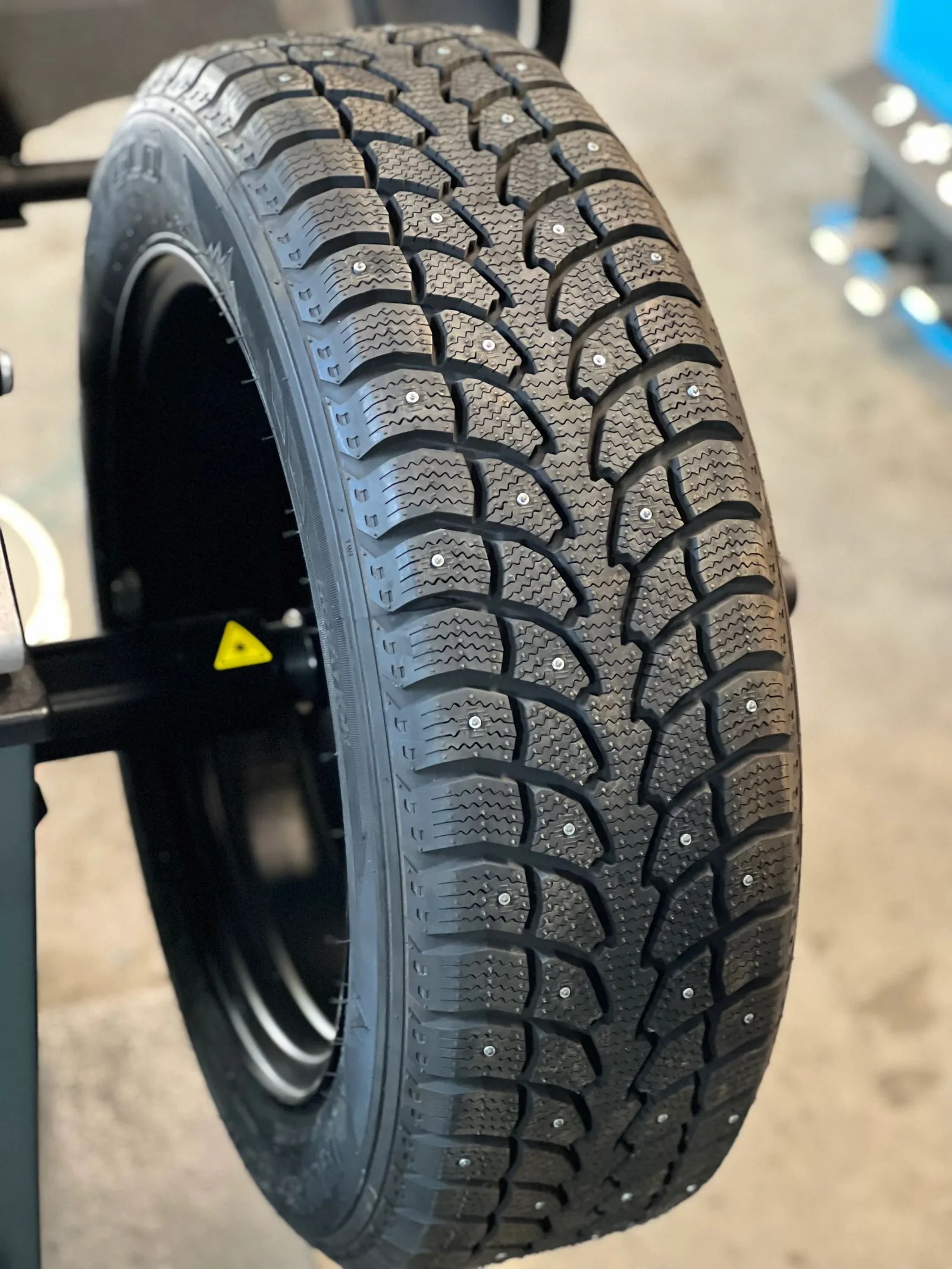
The photograph is from KMJ's existing GoDaddy library. It shows a studded tire mounted on a black wheel at service equipment, with tread grooves and sipes visible. It illustrates a complete winter assembly. It does not establish the pictured product's fitment, current availability, condition for another vehicle, or suitability for the car you are buying.
For your own one-page summary, write the new vehicle identity, the old tire and wheel identities, the compatibility evidence, the condition findings, and the complete costed options. Finish with the selected outcome: whole assemblies retained, only tires retained, only wheels retained, or a new set required. Keep unknowns visible until they are resolved.
The KMJ tire article library provides more background for individual tire questions. The transfer decision itself remains specific: useful old equipment can be worth keeping, but only when it forms the right complete package for the new car. Verify first, agree what changes hands second, and install after the plan is complete.