Which tires belong on a compact tractor that mows grass, moves gravel and clears an acreage driveway? Start with the tractor's approved tire-and-wheel combinations, then choose among those combinations for the work you actually do. The biggest-looking lugs are not automatically the best choice. Neither is the smoothest turf pattern. A useful decision accounts for the surface, attachment, load, speed and consequences of getting stuck or damaging the ground.
That answer is less exciting than naming one perfect tire, but it saves an expensive mistake. A small tractor can spend a summer carrying a mower and an autumn carrying a loader. Its appearance barely changes while the demands at its tires change substantially. The right conversation begins with those jobs, not a photograph of an attractive tread.
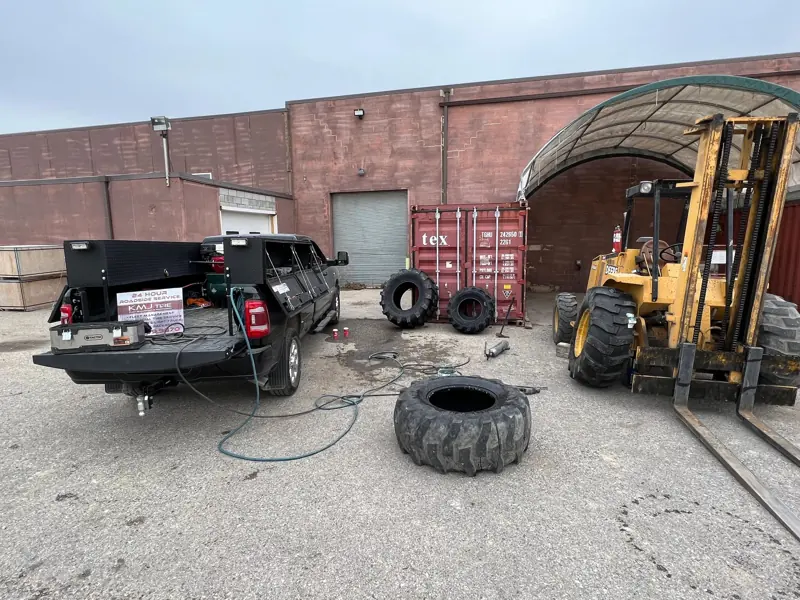
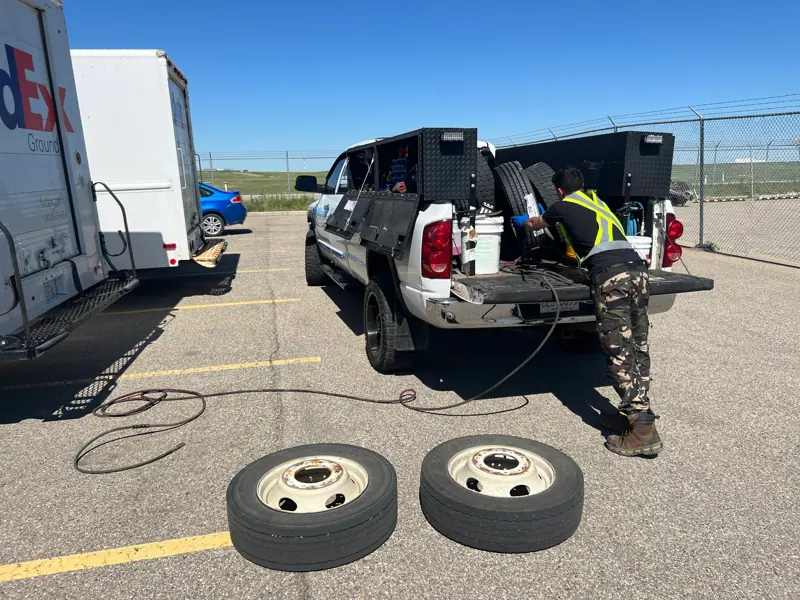
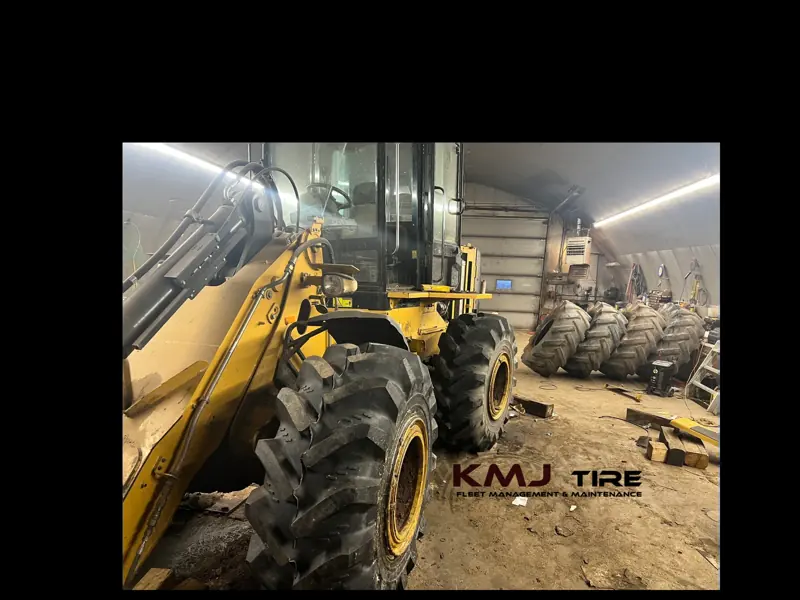
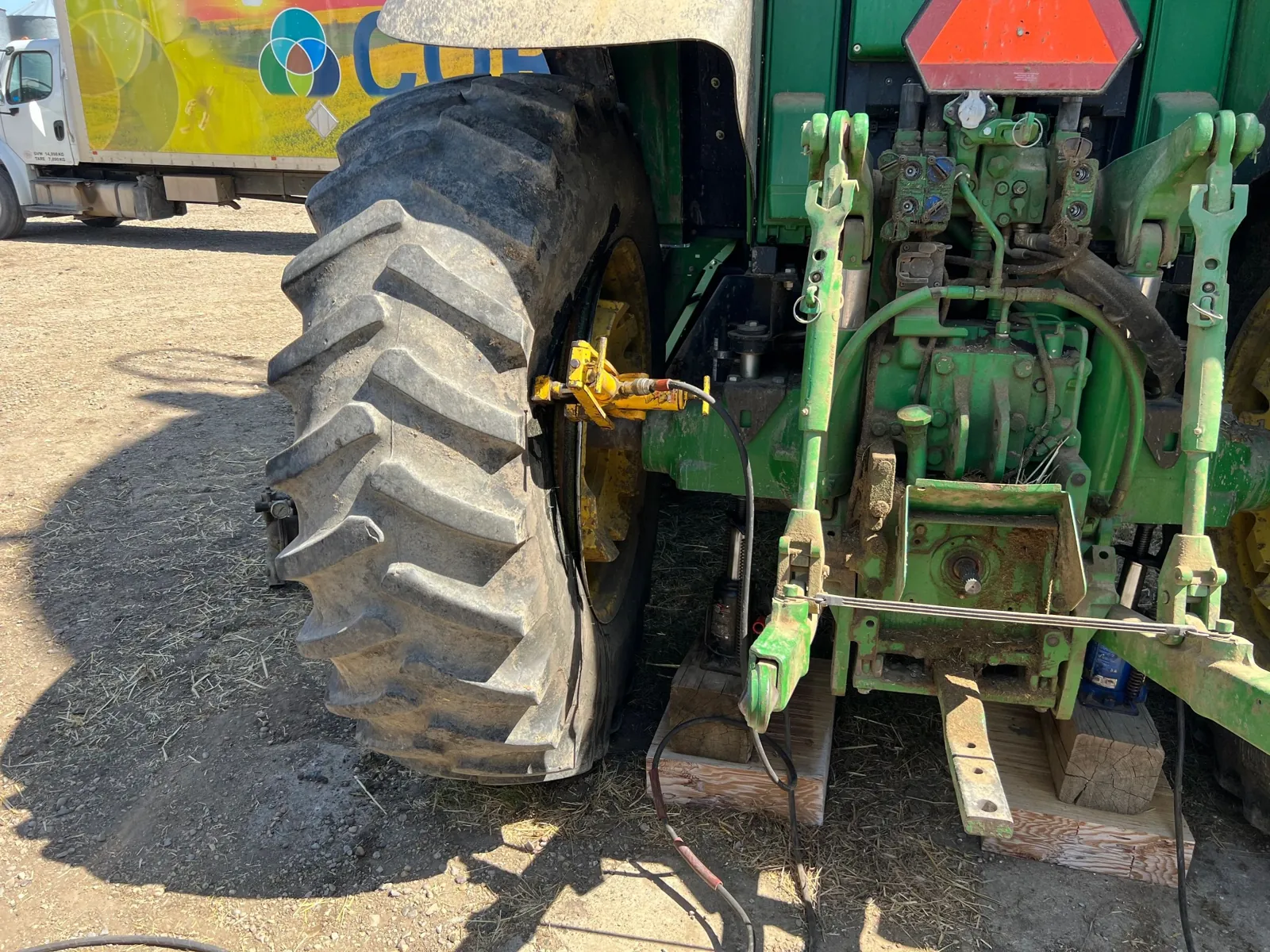
This guide is for owners around Calgary who want to prepare a sound tire decision, not perform agricultural tire mounting themselves. It explains what information to collect, how to compare alternatives and where the machine manufacturer's instructions must take over. The real KMJ-library photograph shows a tractor rear tire with tire-service equipment attached. It illustrates equipment tire work; it does not identify your compact tractor's fitment or demonstrate a procedure to copy.
Describe a working week before choosing a pattern
Write down what the tractor does during a normal working week. Be specific about the surface under the tires: maintained lawn, loose garden soil, firm gravel, wet access lane or paved yard. Then add the less frequent jobs that have serious consequences. Moving a heavy attachment twice a season may matter more to suitability than several hours of light mowing.
A short description might read: mostly mowing relatively level grass, some gravel distribution with a front loader, occasional movement between buildings, and driveway snow removal. That description reveals competing priorities immediately. Protecting grass, transmitting pulling force through soil and supporting loader work are not identical tasks. A tread recommendation that addresses only one of them has not answered the owner's actual question.
Separate inconvenience from a stop condition. A tire that leaves an objectionable mark on ornamental turf presents a different issue from a tire with insufficient load capability. You can sometimes change the route or wait for the lawn to dry. You cannot solve an inadequate rating by deciding that the load will be carried carefully. Ratings and machine approvals are filters applied before preference.
Use the farm tire service information to frame a discussion about the equipment and its work. Include the tractor model and attachment details with that description. Do not assume that a provider knows your property, has the required replacement immediately available or can approve an alternative solely from the machine's horsepower.
Identify the machine beyond the badge on the hood
A family name on a hood can cover different models, production years and configurations. Record the exact model and serial information from the identification plate, using the manufacturer's instructions to locate it. Keep those details in your own maintenance record. For a public inquiry, you usually do not need to post an entire identification plate where everyone can see it.
Establish whether the machine has driven front wheels and which factory tire options were offered for its configuration. Find its actual operator's manual rather than a similar-looking manual discovered through an image search. A manual for a related model may describe a different axle, wheel or tire combination. Similar paint and sheet metal are not evidence of interchangeability.
Used equipment needs a second question: does the current configuration match the approved one? A previous owner may have changed tires, wheels or attachments. The sidewall tells you what is fitted now, but it cannot prove that the choice was correct. If the manual and installed sizes disagree, resolve that difference with the equipment manufacturer or an appropriately qualified equipment specialist before ordering replacements.
Make a small identification folder containing the manual reference, clear tire photographs and any prior tire invoices. The tire sidewall identification guide is useful background for reading markings, but an agricultural tire can use a different size format from a passenger-car tire. Copy the entire marking instead of translating it into a familiar format yourself.
Read all four tires, not just the easiest rear sidewall
Walk around the parked, secured machine in a safe location and record each tire position. Use left and right from the operator's normal seated perspective. A front tire may carry a very different size and specification from a rear tire. Photograph both front positions and both rear positions rather than assuming that the other side is identical.
Capture the brand, product name, complete size, construction marking and any load or service information you can read without putting yourself beneath equipment. If mud obscures the writing, clean only accessible surfaces safely. An unreadable mark belongs in the record as unreadable; a guessed digit can lead to the wrong tire or wheel discussion.
Also record what you do not know. You may be unable to establish whether a tube is installed, whether liquid ballast is present or which wheel specification is fitted. Those are legitimate unknowns for a professional assessment. Do not depress a valve simply to investigate the contents, and do not loosen components to improve a photograph.
A four-position list can expose a mismatch before money changes hands. It can also prevent a supplier from quoting two rear tires when the real issue is a single front assembly. General load-rating information explains why capacity matters; the agricultural product's own technical data must supply the values and operating conditions for your particular equipment.
Agricultural lugs answer a soil-traction question
An agricultural lug pattern is intended to engage the working surface, not merely look rugged. In Titan's current agricultural range, the manufacturer describes products with open lug designs, cleanout features and traction intended for soil conditions. Those descriptions support comparing products by their intended application. They do not mean that every lug tire performs equally on every surface.
Think about the job where pulling force matters. Drawing an approved implement through suitable soil is different from crossing a finished lawn to reach a shed. A pattern that makes sense in the working area may leave unwanted disturbance along the access route, particularly when the ground is soft or the operator turns sharply. Your route to the job is part of the tire decision.
Do not use tread aggressiveness as permission to work terrain the tractor is not approved to handle. A machine that can generate traction can still face stability, attachment or operating limits. Better ability to move forward does not establish safe operation on a slope, near an edge or with a raised load. The tractor manual remains the authority for those issues.
When comparing lug options, ask what the exact product is designed to do and what trade-off accompanies that design. Request the applicable specifications instead of accepting a category nickname as the whole explanation. Product names and tread classifications organize the search, but they are not substitutes for a matched, approved tire-and-wheel configuration.
Turf-oriented tires put ground disturbance in the foreground
For a tractor used mainly on established lawn, protecting the surface can be a major requirement. Manufacturer descriptions of turf-oriented products commonly emphasize contact area and reduced disturbance. Titan, for example, identifies shoulder design as a turf-damage consideration on its Multi Trac C/S product. That is a product-specific design statement, not a guarantee that a tractor cannot mark grass.
The rest of the machine still matters. A loaded tractor, repeated passes, a tight turn and wet ground can change the result even with a turf-oriented pattern. If the lawn is being damaged, record when and where it happens. A rut on a wet travel lane and a scuffed patch at a turning point may call for different changes in how the work is organized.
Consider whether the task can wait, whether a broader turn is practical and whether the route can avoid a vulnerable area. Those are planning questions, not instructions to defeat the tractor's safety rules. Never remove required ballast or change approved pressures simply to make a footprint appear gentler. Protecting grass cannot come at the expense of the machine's operating requirements.
A useful comparison describes an outcome: less disturbance during approved mowing work on this surface. An unhelpful comparison asks which tire is softest without defining load or pressure. Keep the reasoning tied to the task, and ask whether the proposed tread is available in an approved combination for the machine before comparing appearance or advertised comfort.
Industrial and hybrid choices still need a specific job
Many compact tractors divide their time between property maintenance and material handling. Some manufacturers therefore offer tread choices intended to span different surfaces. Titan describes its Trac Loader II for compact and utility tractors used in light construction applications. Kubota describes the Goodyear R14 option on its BX series as combining elements of agricultural, turf and industrial treads.
These examples explain why the choice is not limited to a simple lawn-versus-field argument. They do not establish that either named product is approved for your tractor, offered in your size or available from KMJ. A manufacturer page for one machine family cannot approve a conversion on another. Treat it as an explanation of design intent, then verify the actual application.
A mixed-purpose tread also does not erase compromises. Ask which job receives priority when conditions are poor. If mowing is overwhelmingly the main activity, occasional gravel work may not justify changing the whole configuration. If loader work dominates, an attractive lawn result may be secondary to the approved tire specification for that work.
The tire brand overview can help organize a brand discussion, but brand familiarity is only the beginning. A company's passenger tires and its agricultural products are separate fitment questions. Request an exact product and specification, not a promise that any tire from a familiar brand will suit the acreage tractor.
A loader changes the information needed for tire selection
The tractor's empty weight is not the whole tire-loading story. Attachments, carried material, the operator and approved ballast all belong in the working configuration. A front loader is especially important to disclose. The load supported by an axle is not established by dividing the tractor's total weight into four equal pieces.
Bring the loader and attachment model information into the conversation. A bucket and a set of forks do not describe the same use simply because both attach at the front. Nor does a loader's advertised lifting figure automatically become a tire capacity allowance. Machine, attachment, wheel and tire limits must each be respected under the manufacturer's operating instructions.
Do not raise a load for the purpose of experimenting with tire deflection or photographing an apparent capacity. If actual weight information is required, ask the equipment specialist how to obtain it safely in the relevant configuration. The tire decision should use suitable measurements and manufacturer data, not a homemade test that creates a new hazard.
The main site's commercial tire-service overview provides another entry point for equipment-related tire questions. Describe the tractor accurately rather than presenting it as a road-going truck. KMJ's role here is tire service; hydraulic, loader, axle and other mechanical concerns need the appropriate equipment specialist.
Ballast is a machine instruction, not a tire-store shortcut
Ballast and tire capacity are related topics, but they are not interchangeable. Kubota's BX page explicitly discusses the importance of proper ballast for loader operation. That does not supply a ballast recipe for every tractor. The type, quantity, location and approved configuration must come from the instructions for the particular machine and attachment.
A tire that can support a stated load does not make an otherwise unsuitable loader setup safe. Similarly, adding weight cannot increase a tire's approved capacity. Keep the questions separate: what does the equipment manufacturer require for the operation, and can the approved tire-and-wheel arrangement support the resulting working conditions?
Tell the tire provider if you know the tires contain liquid ballast or if you suspect they might. Preserve any record identifying the material and prior service. Do not guess that a fluid is harmless or that it has the same handling requirements as plain water. Its identity can affect how the assembly must be serviced and how any leak is managed.
This is not a do-it-yourself filling guide. Agricultural tire assemblies can be extremely heavy, and the correct handling procedure depends on the equipment and contents. If a valve is leaking or fluid appears around a wheel, secure the machine safely and describe the observation. Keep people and animals away from an unidentified spill while qualified help determines the appropriate response.
Pressure depends on the exact product and operating case
There is no universal acreage-tractor pressure that this guide can responsibly give you. Michelin's current MULTIBIB technical page states that inflation must be appropriate for load per tire, travel speed and the work being done. Its tables separate sizes and operating conditions. That is why copying a neighbour's gauge reading is not a specification.
Find the guidance for the installed tire and the tractor's approved configuration. If the two sets of instructions appear inconsistent, ask for clarification rather than selecting whichever number seems convenient. A tire sidewall limit, an equipment recommendation and a load-inflation table may serve different purposes. The professional helping you should be able to explain which information governs the proposed use.
Record pressure in clearly identified units and under the measurement conditions required by the relevant instructions. An isolated number without units or context is easy to misread. Note whether the tractor had been working and whether the measurement was taken before operation. Use suitable equipment and follow the procedure appropriate to the assembly, including any ballast considerations.
The tire-care education page offers general maintenance context. For a tractor, do not import a car's pressure setting or a road-tire rule of thumb. A sensible record says which specification was used, who confirmed it and which operating configuration it covers. That is more useful than remembering that the tires looked firm.
Read a load table without inventing a setting
A technical table is a relationship between conditions, not a menu of interchangeable numbers. Start by confirming the exact product and size, then identify the units, load basis and speed or work category. A row for one application cannot be borrowed because it produces the pressure you hoped to use. Any footnotes are part of the specification.
Michelin's MULTIBIB page is a useful example because it shows both technical dimensions and pressure/load information. It distinguishes recommended and approved wheels, lists a loaded radius and presents different speed rows. You do not need to use that tire to understand the lesson: several dimensions of the decision exist, and a nominal size alone does not capture them.
For an illustrative paperwork exercise, imagine that an owner has two documents: a tractor manual naming an approved tire combination and a supplier sheet for a candidate replacement. The owner should match the exact size and construction, confirm wheel compatibility, identify the relevant work and load requirements, and ask the supplier to explain any unresolved differences. No pressure number needs to be invented to make this exercise useful.
Keep a copy of the specific table or manufacturer reference used at the time of selection. Technical information can be revised, and an invoice containing only a broad size may not explain the original decision. If the work later changes, revisit the configuration instead of treating the old note as approval for every future attachment.
Front and rear compatibility is more than outside diameter
On a tractor with driven front wheels, the relationship between the front and rear tire arrangements needs machine-specific approval. Do not assume that two tires are compatible simply because their nominal diameters look close in an online calculator. The equipment manufacturer may specify particular combinations and limits that a generic calculator does not know.
Rolling behaviour is not fully described by measuring an unloaded tire with a tape. Product construction, loaded dimensions and manufacturer specifications matter. The right question is whether the complete front-and-rear combination is approved for the exact tractor configuration. Ask the equipment specialist to identify the supporting documentation if the proposal differs from the original arrangement.
Replacing one badly worn tire also deserves more thought than finding a matching number on its sidewall. Explain the condition and identity of the remaining tires. Do not assume that one replacement always requires four, but do not assume that a single substitution is automatically acceptable either. The answer needs the machine's requirements and the actual state of the set.
The guide to buying tires in Calgary can help structure a purchasing conversation. For agricultural equipment, add the front/rear pairing question explicitly. A written quote should identify what is being supplied and what compatibility remains to be confirmed, rather than hiding an unresolved fitment issue behind the phrase standard size.
Changing tread families can involve more than rubber
An owner may want to switch from a lug-oriented arrangement to a turf-oriented one after moving to a different property. That can be a reasonable question to investigate. It is not permission to mount whichever tire has the desired pattern on the existing wheels. The approved tire-and-wheel package must be established first.
Ask whether the proposed alternative requires different wheels and whether all relevant front and rear components are included. Confirm clearances and the machine manufacturer's approval through the appropriate specialist. A wheel that accepts a tire is not necessarily the correct wheel for the tractor, and an assembly that physically clears at rest is not proof of suitability in operation.
Also consider the attachments and work that originally drove the tire choice. If the tractor will still perform loader tasks, changing its primary use to mowing does not remove those requirements. Explain the full use case so that an alternative is evaluated honestly rather than against an artificially easy version of the job.
Keep the old and proposed specifications side by side in your record. Mark every difference as confirmed, not applicable or unresolved. This simple comparison makes a conversation easier to follow and prevents an attractive tread photograph from becoming the deciding evidence. Do not proceed with a conversion while a load, wheel or drivetrain compatibility question remains unanswered.
Snow clearing is a separate operating problem
A tractor with deep lugs can still encounter difficult conditions on a packed or icy driveway. Tread appearance alone does not establish winter suitability, and an agricultural pattern is not the same product category as a passenger-vehicle winter tire. Define the actual task: clearing fresh snow, working on a packed travel lane or moving material in a yard.
Follow the tractor and attachment instructions for snow work. If traction aids are being considered, confirm whether the machine permits them, which exact devices are suitable and what clearance and operating restrictions apply. Do not assume that chains fitting around a tire are approved near every fender, hose or component. This guide does not prescribe a chain, stud or homemade traction modification.
Think through what happens if the task cannot be completed safely. Waiting, using another properly equipped machine or arranging an appropriate service may be the sensible plan. A remote acreage driveway does not become a test course for discovering a tire's limits. Keep people clear of the operating area and follow the equipment's instructions rather than improvising a recovery technique.
For the road vehicle used to reach the acreage, the Calgary winter-tire information addresses a different selection problem. Keep those two records separate. A pickup's winter specification cannot be transferred to a tractor, and an agricultural tire recommendation does not answer the pickup's winter-road needs.
Low hours do not provide a complete condition history
A tractor can accumulate relatively few operating hours while spending years exposed to weather or sitting between jobs. Hour readings help describe use, but they do not establish tire condition by themselves. Nor does deep remaining tread prove that the entire assembly is suitable. The inspection needs to consider the actual tire, wheel and service history.
Look only from accessible, safe positions with the machine secured according to its instructions. Record visible cuts, bulges, unusual cracking, exposed structure, leaks or changes in appearance. Do not crawl beneath an attachment or move an unstable assembly to complete the inspection. An area you cannot safely see should be left for the qualified person doing the assessment.
Take photographs that show the location as well as the close detail. A tight image of a mark is more useful when accompanied by a wider view identifying the tire position. Avoid applying dressings or trying to hide a defect before inspection. The goal is to preserve the evidence, not make the tire look newer.
If a condition raises doubt about safe operation, stop using the machine until the appropriate assessment establishes what comes next. The tire-repair information is a starting point for a repairability discussion, not a promise that an agricultural casing can be repaired. Product rules, damage location and actual examination govern the answer.
A slow leak needs a history, not repeated top-ups alone
When a tire repeatedly loses pressure, record when the change was noticed and whether the machine was operated in that condition. Include any recent impact, puncture, service or valve concern. That history can be important even if the tire looks normal in a photograph. A successful top-up does not identify the cause or establish that the casing escaped damage.
Do not pull out an embedded object or apply an unknown sealant just to see what happens. Inform the provider about any substance already added. If liquid ballast may be involved, mention that before the visit so the service can be planned with the right information. Concealing a previous intervention makes the assessment harder rather than simpler.
Different tire constructions and applications can have different repair rules. A passenger-tire repair limit quoted online is not automatically the decision rule for an agricultural tire. Ask whether the proposed procedure is permitted for the exact product and condition, and whether the assembly needs further examination before repairability can be decided.
If the machine is stranded, establish a safe waiting arrangement and describe its position accurately. The emergency tire-service information explains the service context, but it is not a guaranteed response time or confirmation of equipment coverage. Provide the location, access limitations and known tire details so the provider can confirm what help is possible.
Prepare the site without starting the tire work
A useful service request describes the access route as well as the tire. Note gates, narrow lanes, soft areas, overhead restrictions and whether a service vehicle can approach safely. Send clear location instructions through the agreed channel. An acreage address alone may not identify which building or yard contains the tractor.
Where safely possible and consistent with the operator's manual, have the machine parked and secured on a suitable surface before the visit. Do not drive a damaged or unsafe tire merely to make access more convenient. If it cannot be moved safely, tell the provider and let the situation determine the plan. Convenience should not turn a manageable service issue into further damage.
Keep bystanders, children and animals out of the work area. Leave attachment support, lifting, wheel handling, deflation and mounting to appropriately trained personnel with the necessary equipment. The photograph accompanying this article is context, not a complete depiction of every precaution needed for a service procedure.
Read the mobile tire-service overview and check the listed service areas before assuming a particular acreage can be served. Confirm the machine, location and scope directly. A map boundary or general service description does not establish a current opening, travel charge or ability to complete an unusual equipment job on the spot.
Compare quotes on a like-for-like basis
Two quotes can contain the same nominal tire size while covering different products or work. Ask for the exact manufacturer and product, the complete specification and the number of assemblies included. Clarify whether the proposal concerns loose tires, mounted replacements or an approved wheel-and-tire change. Unclear scope makes price comparison misleading.
Ask which related items or services have been included and which require assessment first. Depending on the actual assembly, questions about tubes, valves, wheel condition or existing ballast may need answers before the total scope is known. Do not assume that every quote includes the same handling or site work. Let the provider explain what applies rather than requesting unnecessary items from a generic checklist.
The budget-versus-premium tire guide offers a general way to think about value. For the tractor, prioritize approved fitment and suitability before comparing acquisition cost. A cheaper tire that does not meet the machine's requirements is not a lower-cost version of the same solution; it is an unsuitable proposal.
Keep road-vehicle shopping separate from agricultural selection. The main tire shopping page may help with other vehicles on the property, but an online passenger-size search is not proof of tractor availability. Ask for a verified equipment quote and lead time without treating a catalogue image as a stock commitment.
Worked example: mowing dominates, gravel work is occasional
Imagine an acreage owner whose tractor mainly cuts established grass. A few weekends each year involve moving gravel with an approved loader arrangement. This is an illustrative planning case, not a customer story or a recommendation for a particular machine. The owner is considering a more aggressive tread because the gravel task felt difficult last season.
The first useful step is to describe the difficulty. Was it a tire traction problem, unsuitable ground, an operating issue or a question about the equipment setup? A tire purchase should not be used to guess at a mechanical or attachment concern. An equipment specialist can resolve those questions while the tire provider identifies the installed specifications and condition.
Next, the owner gathers the approved tire options and documents the loader configuration. Among approved choices, the comparison considers lawn disturbance during the dominant task and suitability for the occasional material-handling work. If the alternative needs different wheels, that becomes part of the scope instead of an unpleasant discovery after ordering rubber.
Finally, the owner changes what can be changed operationally without departing from manufacturer instructions: scheduling suitable work when the ground supports it, planning access and avoiding unnecessary passes over vulnerable turf. The outcome might be an approved new tread choice or retaining a suitable existing one. The useful result is an explained decision, not a predetermined sale.
Worked example: a used tractor arrives with missing records
A second owner buys a used compact tractor with a mower and loader. The seller says the tires have always been fine, but provides no specification record. That statement is background, not technical approval. The new owner begins with the exact machine identification and the correct operator's manual, then documents all four installed tires.
Suppose one sidewall is unreadable and the rear assemblies may contain ballast. Those unknowns should stay visible in the inquiry. Guessing the size from a similar tractor or assuming the ballast is a particular fluid can send the service discussion in the wrong direction. Clear photos and a professional assessment are better next steps than creating a tidy but unreliable inventory.
The owner then asks the equipment specialist to confirm the current front/rear combination and attachment requirements. Any mechanical concerns go to that specialist. The tire provider can address the tire findings and proposed replacement scope once the compatibility questions are understood. KMJ offers tire services and oil changes; this article does not imply tractor mechanical repair or a particular equipment oil-service capability.
A useful final record distinguishes verified facts from pending work. It might list a confirmed model, an identified rear product, a front marking still needing inspection and a ballast question awaiting confirmation. That record is already progress. Buying a replacement before those issues are resolved would create an appearance of speed without establishing the correct solution.
Keep a record that survives the next attachment change
Create one page for the machine and a separate section for each meaningful configuration. Record tire positions, exact products, the approved wheel arrangement and the source of the operating guidance. Attach invoices and inspection findings. If another household member uses the tractor, make sure they can find the instructions without searching through a phone full of photographs.
When an attachment or use changes, note it. The tire arrangement may remain suitable, but the change deserves review against the machine and product instructions. A pressure or ballast note established for one case should not silently become a universal setting. Write down what the advice covers and who supplied it, including any restrictions that matter to the next operator.
For a property business with several machines, fleet tire-management information can help start a discussion about organized records. Keep equipment-specific details distinct instead of placing every machine under one generic service interval. A tractor's work history, a delivery vehicle's kilometres and a trailer's loading pattern do not mean the same thing.
Use a simple status field: suitable under the documented configuration, awaiting assessment, or not to be used pending resolution. Do not let an ambiguous note such as checked become permission to operate when the underlying finding was unresolved. The point of the record is to make the next decision easier and more accurate, not merely to accumulate receipts.
The questions to settle before placing an order
Before ordering, you should be able to explain the machine, its principal jobs and the approved combination being proposed. The tire provider should know about the loader, any suspected ballast and the condition of the other positions. You should understand whether wheels or additional assessment are involved and which specifications support the choice.
Ask for unresolved issues in plain language. Is the remaining question about product availability, machine approval, wheel compatibility, actual load or repairability? Those are different tasks with different owners. A clear answer makes it possible to progress without pretending everything is settled. If an equipment specialist must approve a change, get that answer before treating the tire quote as a complete plan.
For a direct discussion, use the KMJ tire inquiry page with the model, tire photographs, work description and location. The service questions page is useful background, but your particular tractor still needs an individual fitment and scope check. No price, stock status or arrival time is promised by this guide.
The best compact-tractor tire is the approved choice that suits the actual work with understood compromises. Start there, preserve the specifications and avoid making the tire solve a problem that belongs to the machine, attachment or operating plan. That approach is more useful than choosing the boldest tread in a photograph, and it remains useful when the acreage's jobs change next season.
Manufacturer references and the limits of this guide
The Titan agricultural tire range explains application-specific tread design, including soil-traction, turf-oriented and loader-related products. Those descriptions were used to explain how design intent differs. Manufacturer marketing claims are not treated here as a measured comparison on a Calgary property or proof of suitability for an unidentified machine.
The Michelin MULTIBIB technical page supplies a concrete example of size-specific wheel information and load, speed and pressure relationships. None of its numerical settings is prescribed to readers. The correct values require the exact installed product and operating case, with the tractor manufacturer's requirements also satisfied.
The Kubota BX series information provides the manufacturer example of a hybrid tread option and discusses ballast in the context of loader work. It is not a Canadian inventory listing, a KMJ offer or approval for a different tractor. Consult the operator's manual for your exact machine and the relevant tire manufacturer's current technical instructions before making a change.