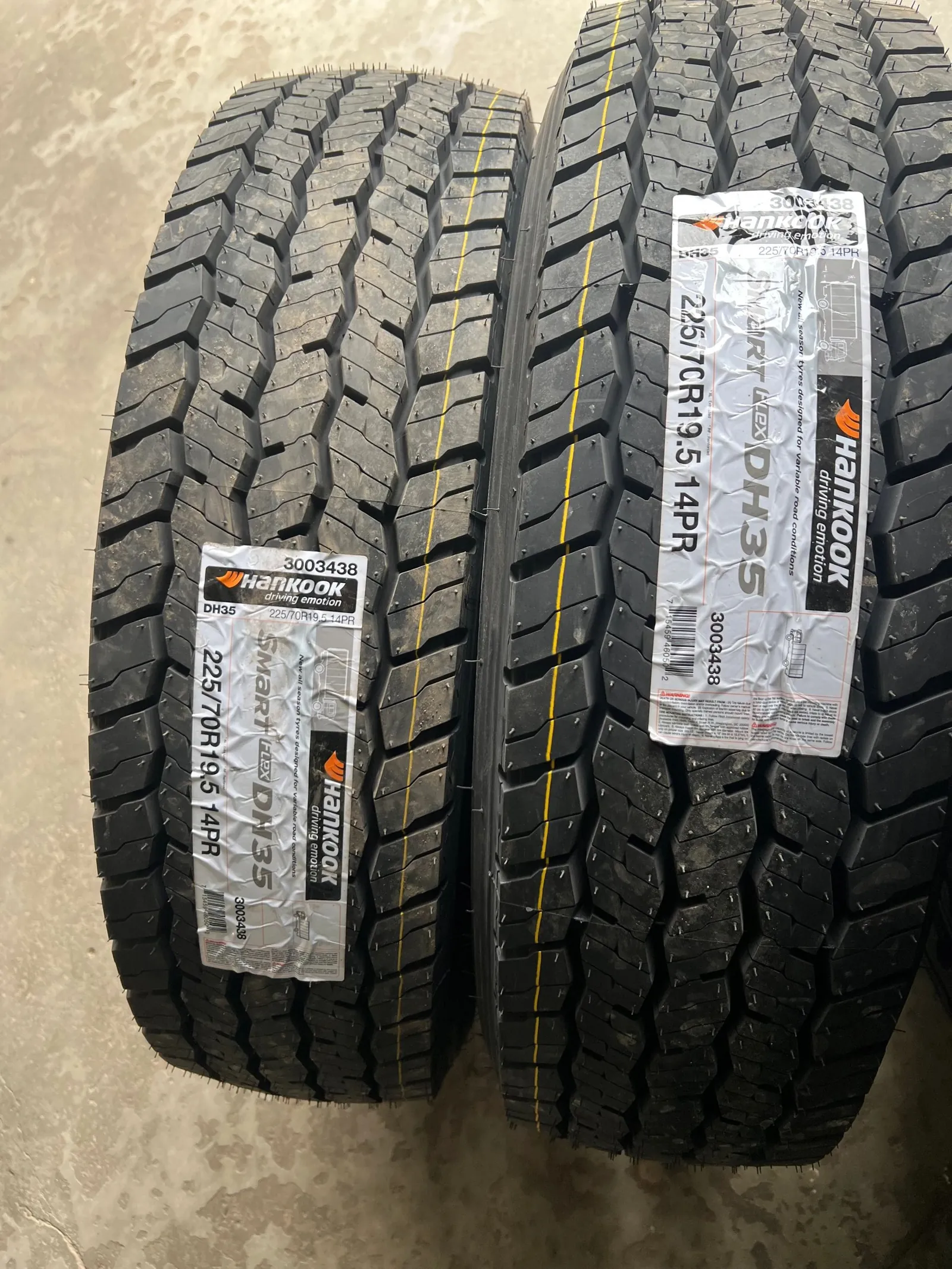
Can you replace one rear tire on a dually pickup and leave the tire beside it alone? Sometimes a single replacement is possible, but the printed size is not enough to make that decision. The tire professional needs to assess the proposed tire against its partner, the rest of the truck's fitment requirements, and the history of the failure. If one tire ran flat, the apparently healthy tire beside it deserves attention too. Two tires sharing a wheel position are a working pair, not a road tire and a spare.
That is the useful starting point for a Calgary owner whose truck spends weekdays carrying tools and weekends towing. A dual-rear-wheel pickup has two front tires and four rear tires, with an inner and outer tire on each rear side. The extra tires add maintenance positions that are easy to overlook. They do not remove the need to follow the truck's load ratings, check every tire's pressure, or stop when a tire is damaged.
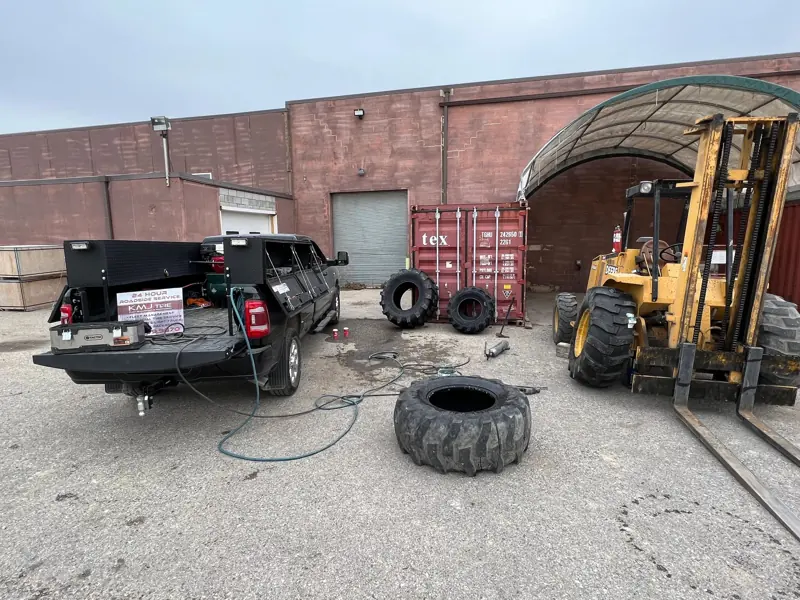
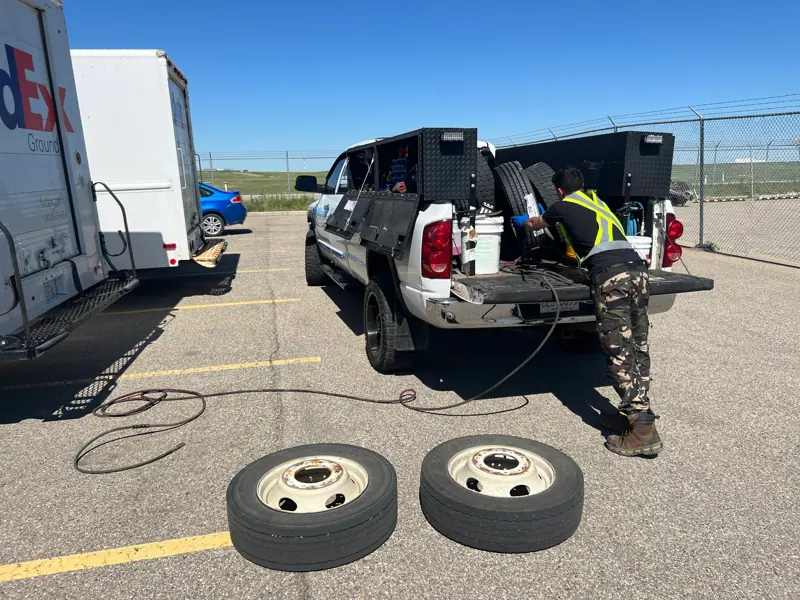
This guide focuses on managing those paired rear positions: identifying them, checking access, arranging a replacement, and keeping a record that survives the next rotation. It is not a fitting chart or a roadside wheel-removal procedure. Your truck manual, tire manufacturer's application data and actual wheel specifications decide the technical limits. The photograph shows two labelled commercial tires from the KMJ library. It illustrates comparing tire identities and tread, not an approved pickup fitment, a measured match or current inventory.
Start with a six-position map, not a four-tire habit
Give every road tire an unambiguous name. Left front and right front are straightforward. At the rear, use left inner, left outer, right inner and right outer. Define left and right from the driver's seated position facing forward. That small convention prevents an observer standing behind the truck from reversing the labels. Record the spare separately instead of squeezing it into the same six entries.
On a piece of paper, draw the truck as a rectangle with its front marked. Put two circles at each rear corner. A phone note works equally well if everyone who uses the vehicle understands the abbreviations. For each position, leave room for the tire model, complete size, service description, pressure reading and tread observations. Do not assume the concealed sidewall says the same thing as the visible one simply because the truck came with a matching-looking set.
The map is particularly useful when a tire has already been replaced. A receipt saying “one rear tire” cannot reliably tell the next person which casing is newer after a later rotation. Tie the invoice to a position and, where accessible, identifying markings. If the identification requires moving heavy wheels or reaching beneath the truck, leave that work to the service provider. A blank marked “not yet verified” is better than a confident guess.
Owners building a new maintenance routine can use KMJ's practical tire-care information for the basics, then add the two extra rear positions to every check. The goal is not elaborate paperwork. It is making sure that the tire you cannot easily see still receives a real measurement and an inspection.
Separate single and dual load information
“Single” and “dual” describe how a tire is used at an axle end. A normal pickup with one tire on the left rear and one on the right rear uses single rear positions. Having two tires somewhere on the axle does not make that a dual installation. On a dually, two tires sit beside each other at each rear axle end, which is why the applicable dual-load information matters.
Some light-truck service descriptions carry two load-index numbers. Other markings express maximum single and dual loads in words and numbers. Read the whole marking rather than lifting the larger figure into a calculation. The corresponding tire data must match the exact product, size and application. A load range letter by itself is not a complete statement of what the tire can carry at a particular pressure.
Michelin's truck service manual distinguishes single and dual usage and directs readers to application-specific load and inflation information. That supports the distinction; it does not authorize copying a commercial truck's pressure into a pickup. The tire load-index explanation can help you prepare the questions, but the final specification belongs with the vehicle and tire documents used for your own truck.
When someone gives you a replacement recommendation, ask them to write the complete service description and confirm the dual application explicitly. If a catalogue only shows the single-use load, ask for the missing data instead of trying to derive it. The useful answer is a documented compatible fitment, not an impressive-looking capacity number.
The truck's ratings still govern the job
Four rear tires do not mean the rear axle may carry any load their combined sidewall markings suggest. The truck has limits for the vehicle as a whole and for its axles. Wheels and other components also have limits. A higher-capacity replacement tire does not increase the manufacturer's vehicle rating. Tire selection must fit inside the complete vehicle's approved operating envelope.
This matters when the pickup changes roles. A toolbox, auxiliary equipment, passengers, cargo and trailer load can change what the truck actually carries. A truck that felt comfortable on an empty trip may be a different loading problem with equipment aboard. Use the owner's loading instructions and appropriate weighing information rather than treating a level-looking body as proof that everything is within limits.
An axle weight is useful, but it does not prove equal loading at the left and right sides. Dividing the rear axle total by four creates an average; it does not measure each tire's actual operating condition. Where wheel-position information is needed, arrange a suitable weighing method with a qualified provider. Do not improvise by parking partly off an ordinary scale or guessing from how far each tire appears to bulge.
Bring the loading description to the tire discussion. “Usually empty, occasionally towing this trailer with these tools aboard” is more helpful than “heavy duty.” KMJ's commercial tire-service information is a starting point for discussing the tire work and vehicle requirements. Confirm the exact truck and service scope; a commercial-services page is not a promise that any load or modification is suitable.
Same printed size does not finish the matching check
Two tires can have the same nominal size without being an acceptable working pair in their present condition. Product design, actual dimensions, wear and inflation all matter. A substantially worn tire next to a new one raises a different question from two equally worn tires of the same model. The answer needs the applicable manufacturer's matching criteria and real measurements.
Michelin's service manual explains that mismatched duals can share load unevenly and contribute to rapid or irregular wear and casing failure. It also describes measuring tire circumference as part of dual assessment. Those are reasons to ask for a proper match check, not instructions to adopt one measurement allowance for every brand and pickup. Different applications and manufacturers can have their own requirements.
A tread-depth reading is useful evidence but is not automatically a complete circumference comparison. Nor does matching the visible tread pattern prove that the two casings are identical. Photograph the model name, full size and markings when safely accessible, and provide the installation history if you have it. Let the professional decide what measurements are required before approving the pairing.
When browsing tire options available through KMJ, narrow the discussion to the exact truck specification before comparing tread appearance. If the original product is unavailable, the replacement decision may involve more than one tire. That is not an automatic rule to buy six; it is a reason to find out what combination can actually meet the requirements.
Spacing is a fitment requirement, not a visual preference
The gap between adjacent rear tires has a job. Tires deflect under load, and the paired arrangement needs adequate clearance. Michelin identifies dual spacing as important both for avoiding rubbing and for airflow. Its manual also documents casing damage from contacting dual sidewalls. A pair that looks separate while the truck is empty is not, by that observation alone, approved for its loaded use.
Minimum dual spacing is a defined dimension in the relevant tire data, not simply a universal amount of daylight between the closest sidewalls. Tire dimensions, wheel width and wheel geometry are part of the question. A wider replacement tire or a wheel change can therefore affect more than fender appearance. Ask the installer to check the required spacing with the actual components being proposed.
Do not solve a tight gap by adding an unapproved spacer or altering hardware. That can introduce new fitment and fastening problems while leaving the original question unanswered. Any change to wheels, offsets or the vehicle arrangement needs appropriate manufacturer support and competent assessment. This guide does not supply a spacer thickness or approve a modification.
At an ordinary walk-around, visible contact, rub marks or trapped material between the tires deserves attention before the truck goes back to work. Keep hands and tools out of places where they could become trapped. Removing a lodged object is not proof that the sidewalls escaped damage. Report what you saw and arrange an assessment of the affected pair, including surfaces that are difficult to inspect from outside.
Make inner valves genuinely accessible
A pressure routine fails if it reaches only the easy valves. The inner rear tires need individual pressure measurements with suitable equipment. Ask the service provider to demonstrate how your truck's valve arrangement is intended to be checked. A gauge or air chuck that works well on a passenger car may not reach or seat correctly on this wheel layout.
Do the demonstration while the vehicle is safely parked, with the engine off and the area clear. There should be no need to crawl under an unsupported truck or force a hand into a narrow gap. If trim or a wheel cover prevents straightforward access, identify the correct access method. Do not bend a valve stem to make an unsuitable tool fit.
Valve extensions and other access hardware need to be appropriate for the assembly and installed correctly. They are not automatically good or bad based on their appearance. Ask what components are fitted, how they are supported where required, and how leakage will be checked. A newly accessible valve is useful only if the arrangement remains sound in service.
Keep the gauge and any required access tool together. If a second driver cannot identify which valve serves which tire, the routine is not finished. KMJ's tire-service questions page can help frame a discussion, but bring photographs of the actual wheels. “Can I measure each inner tire with this tool?” is a much more concrete request than “Are my valves okay?”
Check cold pressures without inventing a loaded-truck rule
Use the truck's placard and owner's instructions as the starting point, together with any application-specific guidance required for the approved tire setup. Do not use the tire sidewall maximum as a default target for every position. Front and rear requirements can differ, and a value from another dually is not evidence for yours.
USTMA advises checking pressure with a gauge at least monthly, when the tires are cold, and before long trips, heavy loads or towing. Its cold-check guidance describes a vehicle parked for at least three hours. Follow your applicable manufacturer's instructions if they define the procedure more specifically. A cold measurement is about the tire's operating state, not whether the Calgary air feels cold to your hand.
Record the actual reading before adjustment when practical. That lets you distinguish an isolated low tire from a general temperature-related change across the set. If one inner rear repeatedly loses pressure while its partner does not, treat that as a problem to investigate. Repeated topping up without finding the cause leaves the important question unresolved.
Never deliberately leave one tire lower to soften the ride or to compensate for a size mismatch. Michelin's dual guidance calls for equal inflation between adjacent duals at the recommended pressures. Obtain the correct settings for your application; do not use inflation as an improvised method of making unsuitable tires behave like a matched pair. Normal pressure growth after driving is also not a reason to bleed a warm tire down to its cold target.
Know what the pressure display actually monitors
A dashboard pressure display can be helpful, but establish what it covers on the specific truck. Do all six road tires have monitored positions? Does the screen identify inner and outer tires separately? Is the spare included? Does the owner manual describe a learning procedure or conditions before readings update? The answers vary, and the presence of a tire icon does not settle them.
Do not assume that a missing warning means every tire is properly inflated. USTMA explicitly treats pressure monitoring as a supplement rather than a substitute for gauge checks. A warning system has operating rules and thresholds; your maintenance target comes from the appropriate specification. A number on a screen also needs to be associated with the correct physical position before it becomes useful evidence.
After tire service, ask whether any sensor work or position relearning was needed and completed. If the displayed position seems inconsistent with a direct measurement, report the discrepancy. Do not decide that the hidden tire is fine because the visible outer tire looks normal. Keep the map and the readings available so the person investigating has observations rather than a guessed sensor diagnosis.
Owners coordinating multiple trucks can incorporate that distinction into fleet tire-management planning. The fleet record should say whether pressures were measured with a gauge, read from the vehicle, or not checked. Those are three different levels of information. A tick beside “dashboard clear” should not silently become “all six measured.”
Treat a flat inner tire as a disabled tire, not redundancy
An outer tire may make a flat inner tire less obvious at a glance. That does not make continued travel acceptable. The remaining tire can be forced to carry an unintended share of the load. The failed casing may also have sustained damage that cannot be judged while it remains mounted. Do not plan to finish the route simply because the truck still sits upright.
If a pressure warning, handling change or inspection suggests a flat, stop in a safe place as soon as conditions allow and arrange appropriate help. The safe location and recovery method depend on traffic, ground conditions, the truck's load and any attached trailer. This is not the setting for experimenting with wheel removal beside moving traffic.
Tell the responding provider that the truck has dual rear wheels, identify the affected position if known, and describe the cargo and trailer. Report whether it was driven after pressure loss and how far, if you actually know. An honest “duration unknown” is useful; “only a little” is not a reliable inspection history. Both members of the pair may need assessment following the event.
Use the Calgary tire-repair assessment information to understand the service conversation, not as a promise of repairability. A puncture visible in the tread does not settle whether the casing survived low-pressure operation. The professional must inspect and apply the manufacturer's repair rules. Restoring air alone is not a return-to-service decision.
Inspect the hidden surfaces without taking unsafe shortcuts
A walk-around should include more than the outside rear sidewalls. Look at the tread you can safely see, the accessible sidewall areas, the space between paired tires and the valve arrangements. Note cuts, bulges, exposed material, irregular wear or objects trapped between the tires. Do not pull out a suspected puncturing object simply to see what happens.
You will not see every surface during a driveway check. State that limitation. The inner sidewalls and areas concealed by the assembly may require professional access. A phone photograph through a gap can document an observation, but it cannot replace an internal inspection or certify the whole tire. Keep clothing, fingers and loose equipment away from pinch points.
After gravel or construction-site use, pay particular attention to material caught between the rear tires. Michelin's damage guidance includes sidewall damage caused by an object wedged in a dual assembly. If something is lodged, avoid turning it into a do-it-yourself prying job around a loaded wheel. Arrange removal and assessment using a suitable method.
Track recurring observations rather than repeatedly describing them from memory. A mark that appears at the same position after cleaning, or a tire that keeps losing pressure, gives the service provider a useful starting point. If the evidence points to a mechanical issue, that assessment belongs with a qualified mechanical specialist. KMJ's scope is tires and oil changes, not suspension, brake or drivetrain repair.
Measure tread by position and retain the lowest useful readings
A single tread reading for “the rear tires” hides too much. Record each casing separately and take measurements in the appropriate main grooves at several locations. Follow the tire manufacturer's method and avoid measuring on a wear indicator. An average can conceal a worn area that matters to the replacement decision. Note unevenness rather than compressing everything into one reassuring number.
Keep the unit consistent. If one record uses millimetres and the next uses fractions of an inch, label them clearly rather than comparing the bare numbers. Use a suitable tread-depth gauge and repeat an unexpected reading to check your technique. Access must remain safe; a reading that requires an unsafe reach should wait for proper service access.
The purpose here is twofold. Tread condition helps determine whether a tire remains suitable for its use, and differences within a pair help flag a matching question. Neither purpose is fulfilled by saying that both tires “still have lots of tread.” The tire professional may need additional dimension checks before making a pairing decision.
KMJ's sidewall-information guide helps connect those measurements to the exact tire identity. Keep model, size, position and reading together. A photograph of a gauge with no position recorded can become almost useless a month later, especially when two rear tires have the same visible tread design and have since moved.
Build the one-tire replacement decision in the right order
First establish why the tire needs replacement. A road puncture, a sidewall injury, a mismatch and unexplained recurring wear are not interchangeable problems. If the cause remains unresolved, a new tire can enter the same unsuitable conditions. Share the relevant operating history before asking for the cheapest replacement that fits the wheel.
Next identify the exact original specification and the proposed product. Then assess its compatibility with the adjacent tire and the other requirements of the vehicle. The inspection should consider condition and measurements, not just the catalogue description. If a single replacement cannot meet the matching requirements, ask what wider replacement arrangement would, and why.
Finally obtain a position-specific installation plan. Which tire goes where? What happens to a serviceable tire that is moved? Will the spare still be appropriate? What pressures and follow-up checks apply? The explanation should make sense on your six-position map. It should not rely on the owner remembering a hurried discussion at collection.
For planning a tire purchase in Calgary, compare proposals only after the fitment and replacement scope are clear. One quote for a single tire and another for a pair are not automatically competing prices for the same job. Ask whether the difference comes from measured condition, product availability or a specific manufacturer requirement. Do not assume either proposal is correct merely because it costs more or less.
Do not import a passenger-car replacement shortcut
Advice written for four-tire passenger vehicles often discusses fitting the newer pair to the rear axle. That general advice is not a complete installation plan for six road tires and paired rear assemblies. It does not answer whether a particular new casing matches the worn tire beside it, whether the wheel position is suitable, or whether the truck has additional drivetrain requirements.
USTMA's replacement page is useful for its direction to follow the vehicle or tire manufacturer's size, load-index and speed-rating recommendations. Its fewer-than-four discussion needs to be read in context rather than stretched into an instruction for every dually. A professional plan should account for the complete configuration instead of applying a slogan.
The same caution applies to advice from another owner whose truck appears identical. Model year, chassis configuration, wheels and prior changes can matter. Even if the two trucks left the factory alike, their current tire wear and operating history may differ. Your neighbour's successful single replacement is not a measurement of your remaining partner tire.
A sound recommendation can be explained without a dramatic claim. It should identify the applicable specification, the measured concern and the proposed solution. If those pieces are missing, request clarification before authorizing installation. The aim is not automatically replacing the maximum number of tires; it is avoiding an unsupported combination while retaining genuinely suitable components where the rules allow.
Make rotation a documented six-tire procedure
Do not sketch a passenger-car rotation pattern and add two extra arrows. Dual-wheel trucks can have vehicle-specific rotation instructions, wheel-position restrictions and differences between inner and outer wheel arrangements. Directional tire requirements may introduce further constraints. Consult the exact truck manual and confirm the actual wheels before deciding which assemblies can move.
A cosmetic difference does not tell the whole story. An outer polished wheel and an inner wheel may not be interchangeable in the way an owner expects. The relevant questions include approved positions, mounting details, tire orientation and access to the valves. If moving a tire requires demounting rather than simply moving a complete wheel assembly, that should be explicit in the service plan.
Record the old and new positions after rotation. Recheck the prescribed pressure for the destination position and confirm any sensor-position procedure. Keep the partner relationship visible in the record; a tire that was once paired with a particular casing may no longer be beside it. That matters when reviewing later wear or a single replacement request.
Ask about wheel balancing for the truck's assemblies where appropriate, but do not confuse balancing with approval of a mismatched pair or correction of mechanical wear. If an uneven pattern needs a mechanical assessment, arrange that separately. Moving the tire can redistribute wear; it does not prove that the underlying cause has disappeared.
Choose winter capability for the complete configuration
A dually's extra rear tires do not turn an unsuitable tread compound or worn tire into a winter solution. Steering, braking and directional control involve the whole vehicle. Plan winter use around the manufacturer's approved fitment and the conditions you actually expect, rather than selecting a rear tread solely because it looks aggressive.
When discussing winter tires for Calgary pickups, keep load capability and dual suitability on the same page as cold-weather traction. The exact required size and service description may narrow the available choices. A tire described as winter capable in one size is not proof that every version fits your truck, and a familiar model name does not establish current availability.
The winter-versus-all-weather comparison can help organize the category discussion. Avoid treating category language as a waiver of fitment requirements. Ask how the proposed set suits the truck's operating season and whether you need to change travel plans when conditions exceed the equipment and driver's reasonable limits.
Plan seasonal changes before the truck is committed to a loaded departure. If using a second wheel set, check its full compatibility rather than transferring last year's assumptions. Record both seasonal sets by individual position and condition. A storage label saying “rear pair” is ambiguous when there are two rear pairs, and it becomes less helpful still after a rotation.
Include the spare in the pairing conversation
A full-size spare is not necessarily an unrestricted substitute for any of the six road positions. Confirm the truck manufacturer's instructions, the tire specification, wheel compatibility and any temporary-use restrictions. If the road tires have changed since the truck was supplied, the original spare needs another look rather than automatic acceptance.
Condition matters even when a spare has very little tread wear. Check its pressure and inspect it according to the applicable guidance. Find out whether the current tire and wheel arrangement allows it to be used at the affected position, or whether a different recovery procedure is required. Do this while parked at home, not after discovering an inner rear failure in poor weather.
A spare's compatibility with the neighbouring tire is part of the dual-wheel question. Do not assume that “full size” proves matching circumference or meets the manufacturer's pairing requirements. The service provider should know the spare's identity and the condition of the current set when explaining the emergency plan.
Access also deserves a practical check. Cargo, trailer equipment or a seized carrier can make an otherwise useful spare unavailable. Follow the owner's procedure for checking access safely, without crawling beneath an unsupported vehicle. If the spare cannot be retrieved or the necessary equipment is unsuitable, arrange a recovery plan that does not depend on a roadside wheel change by the driver.
Prepare the service location and the load description
Tell the tire provider the pickup's year, model and dual-rear-wheel configuration when arranging work. Include relevant modifications, the tire size, whether a trailer is attached and whether substantial cargo remains aboard. A provider cannot judge equipment and access requirements from “pickup tire change” alone. Photographs can help, provided they are taken safely and show the whole arrangement.
For mobile tire service in Calgary, confirm that the work site, surface, clearance and vehicle setup are acceptable before assuming the visit can proceed. A narrow alley, steep driveway or busy loading area may change the plan. The provider makes the working-area assessment; an owner should not move supports or create an improvised lifting area to make the job fit.
Keep children, pets and bystanders away from the work area. Move loose cargo only in a safe, planned manner, and explain any unloading limits before the visit. Do not ask a tire technician to resolve a load-control, trailer-coupling or structural issue as an informal extra. Those concerns may need the appropriate specialist or a different location.
When considering seasonal tire-change arrangements, specify whether the tires are loose or already mounted on approved wheels. Six assemblies require a different transport and handling plan from four passenger-car wheels. Confirm what needs to arrive with the truck, what will be returned and how the removed set will be identified.
Compare a written scope instead of a headline price
An itemized proposal should identify the exact tires, the number being replaced, positions, necessary tire-service components and the work included. If the recommendation depends on inspecting the partner tire first, the quote should say so. Ask what happens if inspection shows that the original scope cannot produce an acceptable matched arrangement.
The budget-versus-premium tire guide is useful after unsuitable choices have been removed. A lower price is not a bargain if the product lacks the required specification. Equally, a higher-priced tire does not excuse an incompatible wheel or an overloaded truck. Compare acceptable solutions to the actual problem, not product labels alone.
Warranty discussions need the same precision. Keep the receipt, installation details and maintenance records, and read the terms for the actual product and application. Do not assume a mileage promise, commercial-use coverage or road-hazard benefit applies because another driver received it. Operating conditions and documented maintenance can affect what a manufacturer will consider.
If an estimate changes after inspection, ask for the new finding and revised scope in plain language. “The remaining inner tire does not meet this pairing requirement” is actionable when backed by the relevant measurement and criterion. “Duallys always need everything” is not a substitute for explaining this truck's condition. The owner should be able to understand what was retained, replaced or referred elsewhere.
A worked example: one puncture, three separate decisions
Imagine a contractor finds the left inner rear tire low after returning from a work site. The outer tire looks normal. The truck was carrying equipment, but nobody knows exactly when the pressure began falling. This is an illustrative scenario, not a KMJ customer account or a diagnosis of a particular vehicle.
Decision one is whether to drive. The owner should not rely on the outer tire as permission to finish another loaded trip. The useful next step is a safe stop and an appropriate assessment or recovery arrangement. Record the position, pressure if safely measured, load and unknown operating duration. Avoid inventing a reassuring distance simply because the last part of the journey felt normal.
Decision two concerns the failed casing. A visible puncture may explain the air loss, but professional inspection determines whether repair is permitted and whether low-pressure operation caused additional damage. The adjacent tire's condition also needs consideration because it may have carried extra load. These are inspection questions before they become purchasing questions.
Decision three is the replacement arrangement if repair is ruled out. The available new tire must be checked against the partner and truck requirements. Perhaps a compatible single replacement is possible; perhaps a pair or another documented arrangement is needed. The result should include positions, pressures, the spare implications and the evidence behind the scope. Keeping these decisions separate prevents a quick price enquiry from skipping the work that makes the repair plan meaningful.
Another example: the attractive wider-tire change
Consider a second owner who wants a wider tread for appearance and gravel-road use. An online size calculator suggests a similar overall diameter. That calculation addresses one geometric comparison; it does not approve the dual-wheel installation. Wheel width, load specification, spacing and the vehicle manufacturer's requirements remain unresolved.
The owner should bring the proposed tire's complete data and the actual wheel information to a competent fitment review. The existing gap cannot simply be reduced by the nominal width difference and declared acceptable. Published dimensions depend on the specified measuring conditions, and the manufacturer's minimum dual-spacing requirement must be checked for the real assembly.
If the proposal needs unapproved spacers or a pressure adjustment to avoid contact, stop the selection process and resolve the incompatibility. Do not treat a short unloaded test drive as validation. A truck can encounter a different condition when loaded, turning, travelling over uneven surfaces or operating for an extended period. Manufacturer approval and proper assessment come before those experiments.
The useful outcome may be staying with an approved size and selecting a suitable tread within it. That still gives the owner a meaningful product choice without turning a tire purchase into an unsupported modification. Appearance is a preference; the ability of the full assembly to meet its requirements is a condition of proceeding.
Keep a record that the next driver can use
A compact dually record can fit on one page. Put the truck identity, current tire specification and source of the pressure instructions at the top. Under that, keep six position entries plus the spare. Add the date, odometer, whether the readings were cold, and any unresolved observations. Separate an owner's visual check from a professional inspection so the record does not imply work that never happened.
After service, attach the invoice and the updated position map. Include instructions for any wheel-fastener follow-up supplied by the vehicle or wheel manufacturer and installer. Do not turn a commonly quoted distance or torque number into a universal requirement. The actual hardware and manufacturer procedure govern the check, and it should be performed with appropriate equipment.
If another person uses the truck, show them the inner-valve access method and the location of the spare information. Explain the stop-and-report rule for a low or damaged tire and who arranges recovery. Shared responsibility works better when someone is explicitly responsible for each check; “we all look at it” can leave the hidden inner tires unattended.
For a tire-service enquiry, discuss your dually's requirements with KMJ using that record and clear photographs. KMJ handles tires and oil changes. Mechanical concerns need the appropriate specialist. No pressure setting, replacement quantity or service availability is promised by this guide; those answers require the actual vehicle and proposed work.
Sources and the practical takeaway
The USTMA tire-care essentials support gauge checks, cold-pressure practice, attention before heavy loading and the need to use vehicle instructions. Its replacement guidance supports matching the manufacturer's recommended specification. Its passenger-vehicle examples are not used here as a six-position installation chart.
The Michelin commercial technical-document library provides the Truck Tire Service Manual. Its discussions of single and dual load information, dual matching, spacing and damage between paired tires inform this article. Commercial-manual examples explain the engineering concerns; they do not replace pickup-specific fitment data or establish universal pressure and mismatch limits.
For the owner, the takeaway is simple enough to use on the next check: identify all six positions, measure every tire, keep each rear pair's condition visible in the record, and ask for a documented matching decision before replacement. The hidden tire is not optional maintenance, and the visible tire beside it is not an emergency spare. Looking after the pair means looking after both.