You reach your car on the second underground level, put your bag down, and notice one tire sitting almost on its rim. Can you drive it up the ramp so someone can help? Do not make that your default plan. A visibly flat tire needs an assessment before the car moves. The short distance to daylight does not tell you whether the tire can carry the vehicle, and adding a steep ramp, tight turns and other traffic makes the decision more complicated.
Start by keeping people out of the driving lane, leaving the vehicle parked if its location is safe, and contacting assistance with the vehicle details and the parkade access information. A suitable spare, an approved temporary mobility procedure, professional tire service or specialist vehicle recovery might be the answer. Which option works depends on the tire, the vehicle and the building. There is no universal instruction to inflate it and drive outside.
This guide is about organizing that recovery, not diagnosing a tire from a photograph or teaching vehicle lifting. It covers the information a Calgary driver can gather without crawling beneath a car, the questions to ask before dispatch, and how to move from a parked problem to an inspected tire. KMJ provides tire services and oil changes. Building access, specialist towing and mechanical problems require the appropriate people; this article does not promise that a KMJ service vehicle can enter every garage.
1. Separate the people problem from the tire problem
First decide whether anyone is in immediate danger. A car securely parked in its own stall is a different situation from a vehicle stopped across a blind ramp. If there is smoke, fire, a strong unusual smell, an injured person or another immediate threat, follow the building's emergency procedures and contact emergency services as appropriate. Tire troubleshooting can wait. Do not remain in a hazardous area because you are trying to save a repairable tire.
For an ordinary flat in a stall, bring children, passengers and pets to a suitable safe waiting location. An adjacent empty stall is not automatically a waiting area: another driver can enter it. Avoid having someone stand behind the car as an improvised lookout while you repeatedly move it. If the vehicle is obstructing traffic, tell building security or management where it is and ask them to manage access rather than directing cars yourself from a blind corner.
A driver often feels pressure to clear the space quickly. That pressure is understandable, especially when somebody is waiting at the gate. But the person waiting cannot assess the tire's internal condition from their driver's seat. Say that the vehicle has a tire problem and that you are arranging assistance. A brief, clear explanation helps prevent the rushed choice of driving a flat tire just to stop an awkward conversation.
Keep the immediate decision small: secure people, identify the location, and arrange informed help. You do not need to choose a replacement tire while standing beside the car. The Calgary emergency tire-service information is a starting point for discussing tire assistance, not confirmation that a particular underground recovery is feasible or that help is already dispatched.
2. Record what you can see without moving the vehicle
From a safe standing position, note which tire is affected and how it looks. Use a position description such as driver's-side rear rather than only left or right, which can be misunderstood over a call. Describe a tire as visibly flat, apparently low, damaged or uncertain. Those words are observations. Calling it a slow puncture before anyone tests it turns a guess into a diagnosis.
A few useful photographs are better than a long video taken while walking in traffic. Capture the whole vehicle in its stall, the affected wheel from the side, the accessible tread area and any obvious cut or foreign object. Do not reach into an unseen gap, pull a screw out, or roll the vehicle to expose something hidden. If the area is too dark, unsafe or confined, report that limitation instead of trying harder to obtain the picture.
Include the time you first noticed the problem and whether you drove on the tire after a warning appeared. If you remember a curb impact on arrival, say so. If somebody else drove the car last, ask them rather than supplying a reassuring answer on their behalf. A tire that lost pressure while parked and a tire driven while severely underinflated may need different consideration even when their outward appearance is similar.
The tire-sidewall reading guide can help you find the size and identifying markings that are visible. Photograph the lettering rather than copying it from memory. An image of the affected tire is more useful than an old online order that might refer to the vehicle's previous seasonal set. Leave anything on the hidden sidewall for a technician to inspect safely.
3. Build an access description before requesting dispatch
An address is not enough for underground service. Give the street entrance used by vehicles, the building name if there is one, the parking level and the stall number. Some buildings have separate resident and visitor entrances with different routes. A navigation app may direct assistance to the lobby while the vehicle entrance is around the block. Mention that difference at the start of the call.
Find the posted clearance information without walking into the path of traffic. Read it exactly, including units. Do not estimate the height from your own vehicle or say that a pickup should fit because you have seen one inside. Service equipment, roof-mounted items, ramps and overhead features can affect access. The operator needs to decide whether their particular vehicle and working arrangement are suitable.
Describe the route beyond the first gate: another overhead door, a sharp turn at the bottom of the ramp, a narrow aisle, a speed hump or a low beam near the stall. You are not being asked to survey the structure or guarantee clearance. You are giving the service provider reasons to verify the route before entering. If you only know the entrance height, clearly distinguish that from the lowest clearance along the entire route.
Also tell them whether the car is nose-in, backed-in or parked against a wall, and which side has the flat. A flat next to a concrete pillar may create a different working-space issue from the same flat beside an empty aisle. Ask about mobile tire service in Calgary using these details. Confirm the actual service plan and location; mobile service does not mean every job can be performed wherever a car happens to stop.
4. Involve the building without turning access into a repair promise
Contact the person responsible for the parkade: security, the concierge, a property manager or the parking operator. Explain that assistance may need access and that the vehicle should not be moved casually. Ask about entry arrangements, permitted work areas, restrictions on service vehicles and how traffic will be managed if a lane has to be occupied. Building permission and technical suitability are separate checks.
If a gate requires a fob, decide who will meet the operator. Do not assume a delivery entrance is available for vehicle service, and do not prop open a secure door without authorization. A visitor pass, loading-zone reservation or escort may be necessary under that property's rules. Obtain the actual instructions rather than borrowing procedures from another building where you once lived.
Tell the building if you cannot stay with the vehicle. There may be a time limit on visitor parking or a concern about an unattended car in a shared area. Document whom you contacted and what was agreed. That record can prevent a later misunderstanding, but it is not a substitute for making sure the service provider can reach the car and has a way to contact you.
Avoid asking a concierge to approve a jack location, tow configuration or tire repair. Those are not access decisions. Their useful role is coordinating the property, not accepting technical responsibility for the vehicle. Likewise, a tire technician's willingness to inspect the car does not override building rules. Put the two parties in contact when necessary so the driver is not improvising instructions between them.
5. Understand why a short drive can still matter
A tire supports load through its construction and inflation pressure. With inadequate pressure, the tire can flex excessively and sustain internal damage. The USTMA tire-care guidance explains that underinflation creates excessive heat and stress and can cause internal damage. The fact that a proposed trip is only from a stall to an exit does not establish that it is harmless.
The parkade route may also involve steering while the tire is heavily deformed, climbing a ramp or stopping in a busy entrance. You cannot convert those conditions into an approved driving distance by looking at the tire. A tire that still holds some air is not automatically suitable for the trip, and a quiet ride is not proof that damage is absent. Avoid using the absence of noise as a clearance test.
There can be situations where immediate personal safety requires a different decision. Those should be handled according to the actual emergency and professional direction, not treated as a general permission to drive flat. For a parked car with no immediate hazard, waiting for an appropriate recovery plan is usually the practical way to avoid turning a tire issue into a more difficult vehicle movement.
Tell the professional exactly how far you already drove, if known, and what you observed. Approximate honestly: from the entry gate to the stall is useful information even if you do not know the metres. Do not shorten the story because you worry it will affect repair eligibility. The purpose of the history is to support a safe inspection, not to judge the driver.
6. Pressure readings answer one question, not every question
If you can safely reach the valve and have a suitable gauge, a pressure reading can help describe the situation. Record the reading and units, the tire position and whether the vehicle has recently been driven. Follow the vehicle's pressure label and owner's manual for its specified cold inflation pressures. The maximum figure on a tire sidewall is not a substitute for the vehicle's recommended setting.
An underground garage can be warmer than the outdoor air, and recent driving can warm the tire. That context matters when interpreting a measurement. It does not mean a single visibly flat tire should be dismissed as an ordinary temperature change. If several tires read low, share all the readings rather than inventing a common cause. A professional can help distinguish an inflation adjustment from an air-loss problem requiring investigation.
Do not keep adding air to a damaged tire simply to see whether you can make it look normal. A tire with visible damage, a bead problem or a history of being driven flat requires assessment. Inflation does not undo internal injury. If you cannot tell whether the tire is safe to inflate, stop and explain that uncertainty to the service provider.
The practical tire-care advice from KMJ is useful for normal pressure and condition habits. In a recovery call, however, the most important facts are the measured condition and the history, not a promise that the pressure stayed up for a few minutes. A brief observation in a stationary garage does not establish suitability for a loaded road journey.
7. Check whether a spare actually solves this situation
Before telling assistance that you have a spare, check the vehicle's equipment list and the storage location described in the owner's manual. Some cars have a temporary spare, some a full-size assembly, and some a mobility kit instead. A wheel-shaped compartment beneath the cargo floor does not prove that a usable spare is present. Vehicles bought used may also be missing equipment that originally came with them.
When accessible without lifting the car or putting yourself at risk, confirm what is there. A spare may need its own pressure check, condition assessment and manufacturer-specific use restrictions. An unused tire is not automatically a healthy tire: USTMA notes that age can matter particularly for full-size spares because ordinary tread wear may not reveal the need for replacement. Follow the relevant tire manufacturer's service-life guidance.
A temporary spare is a temporary mobility tool, not a promise that every planned journey can continue. Read the speed, distance, placement and operating restrictions in your vehicle's instructions and on the spare. Restrictions vary, so this guide does not supply a universal limit. Tell the operator if the spare cannot be accessed because of cargo, a locked compartment or an unfamiliar lowering mechanism.
The safe place to fit that spare is another decision. A sloping ramp, wet floor, narrow stall or active traffic lane may make a change unsuitable even when the spare itself is usable. A spare in the trunk does not make the location safe for do-it-yourself lifting. Let the professional assess working space and equipment rather than moving the car onto a different surface on your own.
8. Treat a mobility kit as a model-specific procedure
A compressor and sealant bottle can look like a simple alternative to a spare. They are not a universal puncture cure. The vehicle and kit instructions specify what damage the system is intended for, how it is used, and when it must not be used. Read those instructions before operating it. If the instructions are missing, unreadable or inconsistent with the tire's condition, ask for assistance rather than experimenting.
Check the kit's condition and any expiry information. Do not substitute an unrelated aerosol or assume that a bottle from another vehicle is suitable. If the car has already been driven on a flat tire, tell the professional before considering sealant. A temporary system cannot establish that the tire's internal structure remains sound. Visible sidewall injury also cannot be reclassified as a tread puncture just because sealant is available.
If a kit has already been used, retain its packaging or photograph its label. Tell the receiving tire technician which product was used and when. That information supports the inspection and handling of the wheel assembly. Do not conceal it because the warning light has gone out or because the tire seems to be holding pressure. A successful temporary inflation step is not the same as a completed permanent repair.
You can use the KMJ tire-service questions page to prepare for a conversation, but the kit's own instructions and the assessment of the actual tire govern the temporary procedure. The sensible question is whether the kit is appropriate here, not whether somebody online has used something similar on another car.
9. Run-flat lettering is not blanket permission to leave
A vehicle owner's memory that the car came with run-flat tires may no longer match what is installed. A previous owner, a seasonal change or a replacement purchase may have changed the tire type. Identify the actual tire model and markings and consult the manufacturer's instructions. Do not infer run-flat capability from a premium brand, a low-profile sidewall or the absence of a spare.
Even a confirmed run-flat tire has operating conditions and restrictions. The permitted response to pressure loss depends on the relevant tire and vehicle guidance and the circumstances. This article deliberately gives no generic speed or distance allowance. A driver who applies the wrong limit can misunderstand what the tire was designed to do. If the condition is unclear, seek professional direction before moving.
Repair eligibility is also a separate issue. USTMA explains that some manufacturers have repair restrictions for run-flat and other tires. The fact that a tire was designed for limited operation following pressure loss does not establish that it can subsequently be repaired. Disclose the warning history, any movement after the warning and any unusual noise or handling.
Photographs of the model name and the complete accessible size markings help the conversation. Do not crawl under the car to find hidden lettering. If the outside markings are incomplete, say so and let a technician resolve it. A careful unknown is better than a confident but incorrect identification that sends the recovery plan down the wrong path.
10. Know what an underground tire appointment can and cannot promise
A mobile tire provider needs to assess both the tire task and the working location. Access for a person carrying a gauge is different from access for the equipment needed to remove, inspect, repair or replace a tire. Ask what can actually be done at the vehicle, what might require taking a wheel assembly elsewhere, and what would happen if the tire is not repairable.
A useful conversation includes contingency planning. If the operator arrives and cannot work safely in the stall, who makes the next call? If a replacement is required, how will fitment and availability be confirmed? If the vehicle needs specialist recovery, is that a separate arrangement? These questions are about the sequence of work, not a request for anyone to guarantee an outcome before inspection.
Use KMJ's contact options for tire assistance to communicate the access description and ask about feasibility. Do not assume that submitting an online request means an operator is on the way or has accepted the clearance constraints. For an immobilized vehicle, obtain a direct confirmation of the plan and the agreed contact method.
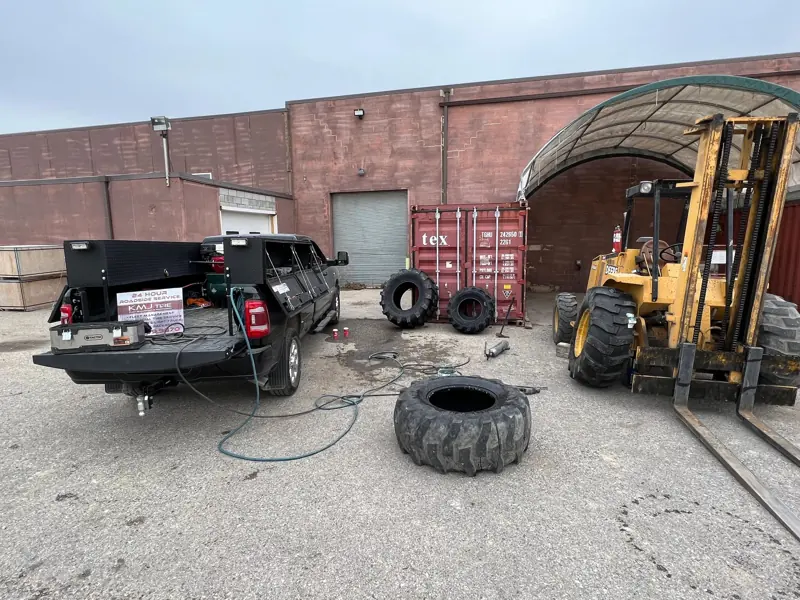
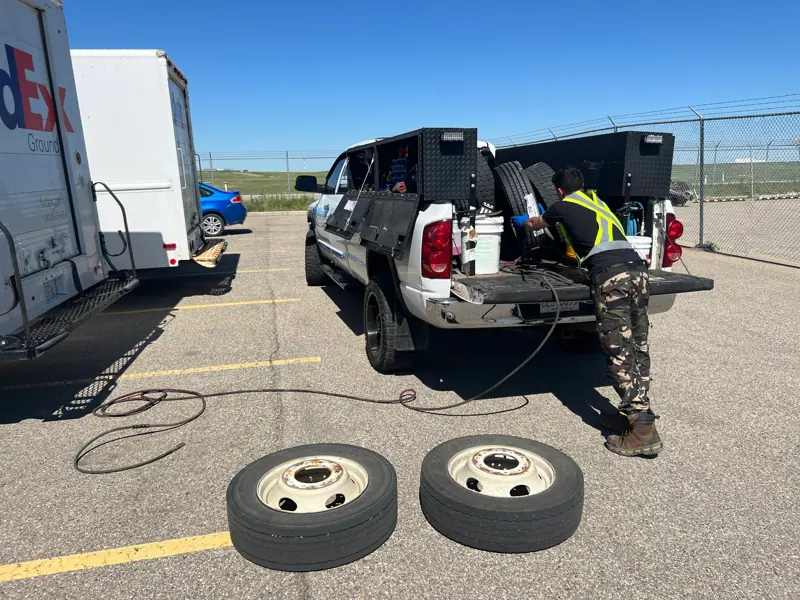
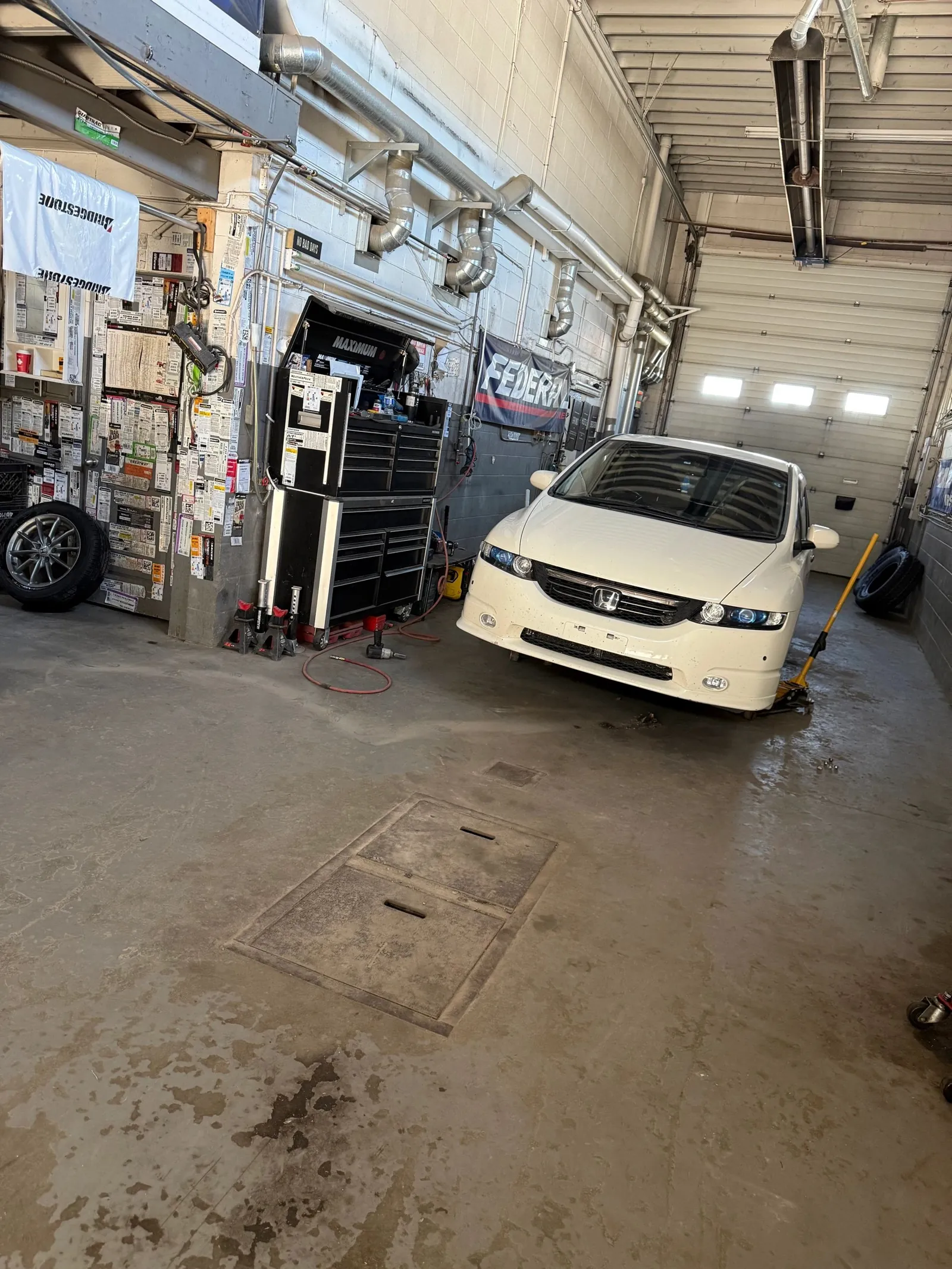
The photograph accompanying this guide shows a white Honda in a KMJ service bay, with workshop equipment and loose wheel assemblies nearby. It illustrates tire-service context. It does not show work inside an underground parkade, prove access to your building, or demonstrate a finished repair. Photographs are useful for explaining context, but actual dispatch decisions need current vehicle and site information.
11. Leave lifting and wheel removal to a suitable setup
A vehicle jack is not a general-purpose solution to a cramped location. The correct lifting points, equipment, support method and ground conditions depend on the vehicle and the task. Read the owner's manual and involve a qualified operator when the situation is uncertain. Do not improvise a lifting point from something that merely looks solid beneath the car.
Clear working space matters around the vehicle as well as underneath it. A pillar may prevent safe tool movement, a nearby car may leave too little room, and passing traffic may expose the worker to contact. These constraints are reasons to change the work plan, not instructions for the driver to squeeze into the gap. Do not put any part of your body beneath a vehicle supported only by a jack.
Have the wheel-lock key available if the vehicle uses locking wheel fasteners. Look in the normal storage locations before assistance arrives, but do not force an unfamiliar tool onto the fastener. Tell the provider if the key is missing. An accurate description at booking can avoid a visit that cannot complete the intended task with the equipment brought.
Vehicle-specific procedures may include additional steps for suspension systems, lifting modes or wheel attachment. Those belong to the correct manual and trained operator, not a general parkade article. If the problem turns out to involve mechanical damage, arrange the appropriate mechanical specialist. KMJ's role here is tire service, not suspension, brake or drivetrain work.
12. Arrange specialist recovery when the car cannot be serviced there
Sometimes the practical answer is to move the vehicle using specialist recovery equipment. That is a different service from a tire inspection. Give the recovery operator the exact vehicle model, year, drivetrain information and any relevant modifications, plus the garage route and clearance details. The operator should determine the suitable method using the vehicle manufacturer's transport requirements.
Do not ask a friend to drag the car with a rope or push it around a blind turn to meet a larger truck. A disabled vehicle in a constrained garage can create risks for people, other vehicles and the building. Electric vehicles, all-wheel-drive vehicles and other configurations may have particular transport restrictions. No universal tow arrangement is appropriate for every vehicle covered by this guide.
Ask who will coordinate the transition between underground retrieval and onward transport if more than one stage is required. Confirm the destination before the vehicle leaves and tell the receiving shop what condition to expect. If a wheel has been removed or a temporary assembly installed, that should be communicated too. A clear handoff reduces the chance that the next person assumes the car is ready to drive normally.
There is also a cost and authorization conversation. Request the scope of the proposed service, what is included, and what would require another approval. This article does not quote rates or promise coverage through a roadside plan. Contact the plan administrator if you have coverage, and distinguish their authorization from the recovery operator's assessment of the actual site.
13. Why the tire must be inspected before a permanent repair
Seeing a nail in the tread does not prove that removing it and sealing the outside will make the tire serviceable. The USTMA passenger and light-truck puncture-repair procedures require removal of the tire from the wheel for a complete inspection. That is how damage that cannot be judged from the parked vehicle can be considered.
The same guidance limits repair to the appropriate tread area and a puncture injury no larger than 6 mm, while excluding injuries extending into the shoulder or belt-edge area. Those criteria are not a self-service checklist that guarantees repair. The tire's condition, previous repairs, manufacturer policy and service history also matter. A small visible object can conceal a different injury path inside the tire.
USTMA describes filling the injury with a rubber stem and sealing the innerliner with a patch, often through a combination repair unit. It rejects outside-in and on-the-wheel repairs as the permanent repair procedure. An external plug that appears to stop a leak does not replace the required internal examination. Ask the professional what inspection and repair procedure is proposed.
Discuss professional tire repair in Calgary without assuming the result in advance. A technician may find that a tire is repairable, or that replacement is necessary. The recovery plan should allow for either outcome. Preserving the option of a proper inspection is another reason not to drive a visibly flat tire simply because the shop is nearby.
14. If replacement is needed, separate urgency from fitment
Being unable to leave the garage makes any available tire sound appealing. Still, the replacement has to suit the vehicle and the remaining tires. Confirm the complete size, load index, speed rating, tire type and any vehicle-specific requirements. The tire load-index explanation helps explain one part of the specification, but matching one number alone is not a fitment decision.
The other tires also need consideration. Wear differences, axle placement and manufacturer requirements may affect whether replacing one tire is appropriate. Some vehicles have particular matching requirements, especially across a driven system. Do not rely on a generic rule that a single tire can always be replaced or that every puncture requires four new tires. Ask for the reasoning tied to the actual vehicle and measurements.
You can browse replacement tires for Calgary vehicles once the specification is confirmed. An online listing does not establish that a tire is available for your immediate recovery, nor does it confirm suitability for the existing set. Obtain confirmation before arranging transport or assuming that the car will return to normal use the same day.
Price is part of the decision, but compare equivalent specifications and the work included. The budget-versus-premium tire guide can help frame that conversation. Ask about the trade-offs relevant to your driving, not simply which product has the lowest displayed amount. Keep the immediate recovery decision separate from an unplanned upgrade to a different wheel or tire size.
15. Account for the road outside, not just the garage floor
A warm, dry garage can make an emergency spare or replacement seem less consequential than it will be outside. Before the car returns to the road, consider the actual outdoor conditions and the limitations of any temporary arrangement. A clear concrete aisle does not tell you what traction will be available on the exit ramp, the street or the rest of your route.
If the vehicle normally uses a winter set, identify which set is currently installed and whether the proposed replacement belongs with it. Review winter tire options for Calgary driving as part of a properly specified replacement discussion. Do not let the need to escape the garage become the reason to mix unsuitable tires without professional and manufacturer guidance.
Some drivers discover the flat during a planned seasonal swap. That can be a convenient time to inspect the removed set, but it does not make an unexplained pressure loss disappear. Tell the shop which tire lost pressure and what happened before the change. Otherwise the damaged assembly may be stored and become the same surprise next season. The seasonal tire-change service information explains the service context, while the affected tire still needs its own assessment.
For a longer-term purchase, the comparison of winter and all-weather tires addresses a different question from emergency recovery. You can make that seasonal choice after the immediate vehicle problem is controlled. There is no need to redesign your entire tire strategy while the building manager is waiting for an access confirmation.
16. A worked example: flat beside a pillar, no usable spare
Imagine a driver finding a visibly flat rear tire beside a pillar on the lower level of a condominium garage. The car is fully inside its assigned stall, so it is not blocking traffic. The driver has no confirmed usable spare and remembers a warning light on the previous trip. This is an illustrative scenario, not a KMJ customer story or a claim about a particular building.
The first useful action is to leave the car parked and move passengers to a safe place. The driver photographs the accessible sidewall, notes the wheel position and records the warning history. They contact the property manager for the entry process and read the posted clearance. They also explain that the pillar limits access on the affected side rather than assuming a technician can work around it.
The tire provider now has enough information to discuss feasibility. If safe work at the stall is possible, the agreed plan might involve assessment and an appropriate tire-service procedure. If not, the driver needs specialist recovery planning. Neither party has to pretend that the tire is repairable before inspection, and nobody needs to drive the flat vehicle around the pillar just to improve the photograph.
The important result is not a predetermined repair. It is a decision based on three established facts: the vehicle can remain safely parked, the working space is constrained, and the tire may have been driven underinflated. Those facts influence the plan more than the driver's hope that the screw they can see is the whole problem.
17. A second example: low-pressure warning at an office garage
Consider a different driver who sees a pressure warning after returning to a car parked at work. None of the tires appears visibly flat, and the driver has a gauge and safe access to the valves. They record the readings, the tire positions and the vehicle's recommended cold pressures, while noting that the garage is warmer than outside. Again, this is a hypothetical decision example, not a reported customer outcome.
Those observations support a more useful call than saying the dashboard must be wrong. A professional can discuss the readings, the warning behaviour and whether there is evidence of ongoing loss or damage. The driver should not treat a reset button as a repair. Nor should they assume that a warning appearing in cold weather explains every pressure difference, particularly if one tire differs substantially from the others.
If the appropriate advice is to correct inflation and monitor a tire, the driver should understand the conditions of that advice and what would require stopping again. If there is a damaged area, uncertainty about prior flat operation, or pressure that will not hold, further assessment is needed. This guide does not supply a remote clearance to drive based on an unspecified reading.
The distinction between the two examples is important. A visibly flat tire beside a pillar calls for a different starting plan from an accessible vehicle with a pressure warning and no obvious deformation. Both deserve accurate information. Neither benefits from declaring every warning an emergency or dismissing every garage discovery as a temperature effect.
18. Make the service handoff easy to understand
Before the appointment, gather the vehicle key, wheel-lock key if applicable, owner's manual access, tire photographs and any relevant recent service records. If another person will meet the operator, send them the same concise summary. Avoid a chain where one person tells the concierge, the concierge tells a coworker, and the coworker tells the technician that the car just needs air.
A useful handoff sentence might be: the passenger-side front tire was visibly flat when found this morning, the car has not been moved since, and the stall is beside a wall on level two. Add the exact access instructions separately. If you do not know whether the tire was driven low yesterday, include that uncertainty rather than leaving the technician to infer a clean history.
After the work, ask what was found, what was done and whether any restrictions remain. If the tire was replaced, record the new tire's details. If a temporary arrangement remains, understand its limits and the next required service. A payment receipt and an appointment completion message are not substitutes for knowing whether the car is ready for normal driving.
When the vehicle is mobile and the immediate problem is resolved, book any remaining tire service with a clear description of the previous work. If there is a new vibration, do not assume that another inflation adjustment will solve it. Wheel-balancing service in Calgary addresses a particular tire-and-wheel issue, but new symptoms need assessment rather than a predetermined service order.
19. Prepare a small parkade recovery note before the next flat
The easiest information to collect is often the information you gather when nothing is wrong. Save the garage's vehicle entrance, the parking level, the property contact and the approved visitor-access process in a private note. If you record a clearance sign, include when you checked it and avoid presenting it as a guarantee that every part of the route has the same clearance.
Keep the vehicle's equipment information with that note: spare or mobility kit, the location of the wheel-lock key, and a link or saved copy of the correct owner's manual. Review it when you change vehicles or wheel sets. A note inherited from a previous car can be worse than no note if it confidently describes equipment the new car does not have.
A working flashlight and a pressure gauge can make ordinary observations easier. They do not turn an unsafe work area into a safe one or replace professional equipment. Store tools where they are accessible without unloading cargo into a driving lane. Keep emergency contacts available somewhere other than a phone that may have no signal or battery underground.
Do not publish gate codes, fob details or a complete home parking location in a public tire forum. Share necessary access information directly with the confirmed provider and property representative. Preparing for recovery is about reducing uncertainty for the people doing the work, not making building access details widely available.
20. Your one-call checklist
If you need help now, work through this list from a safe place. It is designed to organize the conversation, not to authorize driving, lifting or repair.
- People and surroundings: say whether anyone is at risk, whether the car blocks traffic, and whether building security has been contacted.
- Vehicle identity: provide the year, make, model and relevant drivetrain or modification information without guessing about transport requirements.
- Tire condition: identify the affected position, describe visible deformation or damage, and report any measured pressure with its units.
- History: explain warnings, impacts, prior inflation attempts, sealant use and any driving after pressure loss.
- Equipment: confirm whether there is a spare or kit, whether it is accessible, and whether the wheel-lock key is available.
- Access: give the vehicle entrance, level, stall, posted clearance, known route constraints and the authorized entry process.
- Working room: mention pillars, walls, adjacent vehicles, slopes and active traffic near the affected wheel.
- Next step: confirm who is assessing feasibility, who is actually dispatched, and what happens if the tire cannot be serviced at the stall.
You do not need an answer for every item before calling. Say which facts are unknown. A provider can tell you which missing detail matters most, and you can gather it safely or arrange for someone qualified to assess it. The checklist is a way to avoid unnecessary confusion, not a reason to delay assistance while trying to complete a perfect form.
The central idea is simple: solve the access and movement question before assuming the repair. A flat in a Calgary parkade is not only a tire problem; it is a tire problem in a specific working environment. Accurate observations, the correct vehicle instructions and a confirmed service plan give the people helping you a much better starting point than a rushed drive to the exit.
Sources and scope
The technical repair discussion follows USTMA's passenger and light-truck puncture-repair guidance, including internal inspection, tread-area limits and manufacturer-specific restrictions. Pressure and inspection principles come from its tire-care essentials and tire-care safety guidance. These sources were reviewed for this article; they do not inspect your vehicle or establish whether a particular tire is serviceable.
Parkade access examples and call checklists are practical planning suggestions, not universal building rules or technical recovery instructions. Follow your property manager's access requirements, your vehicle and tire manufacturers' instructions, and the assessment of the appropriate service professional. KMJ's business scope is tires and oil changes; specialist vehicle recovery and mechanical work belong with providers qualified for those tasks.