Can a tire that sat in floodwater be dried out and put back into service? Do not assume so. Michelin's published truck tire service manual says tires exposed to storm or floodwater for a substantial amount of time need to be discarded, including unmounted inventory and tires already installed on vehicles. A clean-looking sidewall, deep tread or successful pressure check does not cancel that instruction. For a different tire manufacturer or an uncertain exposure, obtain the applicable guidance before reuse.
The practical challenge is often less obvious than a submerged vehicle. A seasonal set may have been sitting on a garage floor. New tires may have been stored in a flooded business unit. A contractor's truck may have remained in a yard while nobody could reach it. When the water is gone, all three can look easier to recover than they really are.
This guide explains how to preserve the right evidence, keep uncertain tires out of circulation, speak with a tire professional and plan a replacement if required. It is about recovery after prolonged or uncertain exposure, not how to drive through standing water. Ordinary rain and routine tire washing are not the same event as a tire left in floodwater. Nor is this article reporting a current Calgary flood or road condition.
Start with the scene's safety and the condition of the whole vehicle or building. Do not enter floodwater, an unsafe structure or a contaminated area to take tire photographs. Emergency authorities, property professionals and qualified vehicle specialists handle those broader risks. Tire work is only one part of a recovery. KMJ's scope here is tires and oil changes, not flood-restoration work or mechanical clearance of a damaged vehicle.
1. Separate three questions that often get mixed together
The first question is whether you can safely access the property or vehicle. The second is whether a particular tire remains suitable for service. The third is who will pay for the resulting work. They are connected administratively, but an answer to one does not settle the others. An insurer can request photographs without making the site safe, and a pressure reading cannot establish insurance coverage.
Keep those decisions in separate places in your notes. Under site access, record the responsible authority or professional and any restrictions. Under tire condition, record the manufacturer's guidance and the tire professional's findings. Under the claim, record the reference number and instructions for preserving evidence. That prevents a payment conversation from being mistaken for a technical release.
A useful starting message is “four stored tires may have been submerged; exposure duration is uncertain; they have not been reused.” It gives the service provider the relevant issue without claiming the tires are either salvageable or definitely beyond use before the product and event are understood. It also tells the next person not to treat the set as ordinary seasonal inventory.
For a commercial vehicle, Calgary commercial tire service information can help identify the appropriate service discussion. Confirm the exact vehicle, tire type and location first. A general service category does not establish that a provider can enter a restricted site or handle every specialized assembly. Site clearance and tire assessment remain distinct decisions.
2. Describe the exposure instead of assigning a vague label
“Got wet” covers far too much. It could mean rain on a parked car, water across the floor under an upright tire, or a set left under contaminated floodwater for days. The first description tells a tire professional almost nothing about the event. Preserve the actual observations and let the applicable guidance determine their significance.
Record when the tires were last known to be dry, when water was first observed, when it receded and whether the duration is known or estimated. Note the highest observed water level relative to the tires. If the only evidence is a water mark after the event, say that; do not turn the mark into a precise timeline. Include whether the tires were loose, bagged, mounted on wheels or installed on a vehicle.
The nature of the water matters to the recovery discussion too. Report visible oil, fuel, sewage or other suspected contamination without claiming a chemical identification you cannot support. Use the property incident report if one exists. Do not smell, taste or handle flood residue to decide what it contains. Unknown contamination is useful information, not an embarrassing gap to fill with a guess.
A clear record might read: “Set was on the floor before access was restricted; lower shelves were submerged; exact start time unknown; bags contained water when viewed after clearance.” That description is much more actionable than “probably only damp.” It does not decide the outcome, but it preserves the facts needed for an honest decision.
3. Know exactly what the manufacturer says
The Michelin Truck Tire Service Manual currently linked from Michelin's commercial resources includes a short flood-damage section on printed page 60. It states that tires exposed to water from hurricanes, storms or floods for a substantial amount of time need to be discarded and not put into service. It explicitly includes new unmounted inventory as well as tires mounted and installed on vehicles.
The manual explains that prolonged moisture exposure can have a degenerative chemical effect on rubber and lead to potential failure later in the tire's life. That is why the decision is not simply whether the tire appears dry today. The concern can outlast the visible water, and an attractive exterior is not proof that exposure had no effect.
The wording does not supply a universal hour-by-hour salvage threshold. Do not invent one, and do not use this article to declare an overnight exposure acceptable or a shorter exposure automatically disqualifying. When the event does not clearly fit the instruction, give Michelin the facts for the actual Michelin product. For another brand, obtain that manufacturer's applicable advice rather than silently transferring a truck-manual rule to every product.
When discussing Michelin tire replacement options in Calgary, identify the exact model and use. A product sales page is not a flood-damage assessment or a warranty promise. Keep the manufacturer's written response with the event record so the reason for replacement or further assessment remains clear after the initial conversation.
4. Do not confuse rain use with prolonged immersion
Road tires are used outdoors and encounter rain. That does not mean every form and duration of water exposure is equivalent. Routine wet-road use, ordinary cleaning and extended flood immersion involve different histories. A useful recovery decision begins by describing the event accurately instead of arguing that tires are either completely waterproof or inherently ruined by any moisture.
For example, a car parked outside during rain has a different exposure story from an unmounted seasonal set left in a flooded basement. A third case is a vehicle driven into deep water whose duration and contamination are unknown. The tires may not be the most urgent problem in that third case, and the whole vehicle needs appropriate assessment before anyone plans a normal drive.
This guide does not define a safe water depth to drive through. Nor does a tire's tread depth establish whether a flooded road can be crossed. Hidden current, road damage and vehicle-system risks are separate from tire grip. After an incident, explain whether the vehicle was driven, recovered or left stationary; do not use its ability to move as evidence of fitness for service.
The distinction matters when asking for advice. “It rained while the truck was parked” and “the truck remained in floodwater until recovery” should not be placed in the same category without explanation. Accurate language avoids both unnecessary assumptions and premature reassurance. If you do not know which description fits, preserve the uncertainty and ask the manufacturer what evidence it needs.
5. Identify each tire before the set is separated
A recovery can move quickly once a building is cleared. Tires may be shifted by property staff, a restoration crew, a vehicle recovery operator or several family members. Before identities become mixed, create an inventory from a safe, permitted location. Give each tire or assembly an identifier and associate it with its owner, vehicle or storage record.
Capture the complete tire size, manufacturer, model, service description and readable identification markings. The tire sidewall identification guide can help explain the markings, but do not move heavy assemblies or reach into an unsafe pile to find a hidden code. Mark an unreadable field as missing and let the appropriate professional obtain it later.
Include a wider photograph that shows which tire the close-up belongs to. If there are eight similar wheels from two household vehicles, a filename such as “tire closeup” will not be enough when a claim assessor asks about one set. A simple sequence such as set A, tire 1 through 4 can preserve the connection without exposing private vehicle details publicly.
Do not assume that a pair of identical-looking tires had identical exposure. One could have been on a higher shelf or moved before the water rose. Equally, do not claim that the higher tire remained dry unless there is evidence. The inventory should distinguish known location, observed condition and uncertain history. That is more useful than grouping everything under a convenient but unsupported verdict.
6. Loose unmounted tires are not protected by being unused
A new tire can have full tread, intact labels and no road wear, yet still require disposal under applicable flood guidance. Michelin's instruction explicitly includes unmounted inventory. The important fact is the exposure, not whether somebody has already driven on the tire. Newness is not a substitute for a suitable storage history.
For a loose tire, record how it was positioned and what is known about water entering its interior. Do not assume standing a tire upright or tipping it later proves it was unaffected. Draining visible water changes the current appearance; it does not reconstruct the duration, contamination or effect of the event. A dry interior after cleanup cannot tell the whole story.
Keep labels and purchase records if they can be preserved safely. A receipt helps establish product identity and ownership, but it does not establish serviceability. Likewise, a seller's statement that the tires were never mounted answers a different question from whether they were stored in an affected area. Both facts may be true while reuse remains inappropriate.
If a new set must be replaced, planning a tire purchase in Calgary begins with the vehicle's approved fitment, not necessarily an exact repeat of an earlier order. Confirm that the original order was correct, then evaluate current suitable options. Availability, price and lead time must be confirmed for the specific product; this guide does not claim any inventory or promotion.
7. Mounted wheel sets still need an exposure history
A tire installed on a wheel can look more protected than a loose tire because the assembly retains pressure. Do not turn that observation into a flood-clearance test. Michelin's flood instruction also includes mounted tires. The presence of air does not prove that prolonged exposure has had no effect on the tire's materials or suitability.
Keep the tire decision separate from the wheel decision. A wheel, valve and monitoring sensor may need their own assessment under applicable manufacturer guidance. Replacing a tire does not automatically mean every other component must be discarded, and retaining a wheel does not approve the tire. Avoid a single “whole set good” entry when the components have different findings.
A seasonal assembly may also have identification and fitment requirements that were never properly documented. Record the vehicle it belongs to, the wheel markings if accessible, and any previous service notes. Do not assume that a usable-looking replacement wheel from another set is interchangeable. Wheel diameter alone does not establish fitment, load rating or mounting compatibility.
If wheel balancing is needed after tire replacement, treat it as part of the approved tire-and-wheel service, not a test that certifies flood recovery. A balanced assembly can still have an unresolved suitability issue. The sequence should be condition and compatibility decisions first, then the required installation work, with the findings retained in the record.
8. Vehicle-mounted tires are only one part of recovery
A vehicle that stood in floodwater may have electrical, braking, bearing, fluid, structural or other concerns beyond the tires. Those systems need the appropriate qualified assessment. KMJ tire work must not be represented as a complete flood-vehicle inspection, and an oil change alone is not a general restoration plan for a water-exposed vehicle.
Do not start or drive the vehicle merely to make tire access easier. Follow the recovery instructions from the appropriate vehicle professional, manufacturer and site authorities. Tell a tire provider if the vehicle cannot be moved under its own power or has not been released for movement. That changes the service plan and avoids an unsafe assumption about arrival at a tire location.
For an electric or hybrid vehicle, follow the vehicle manufacturer's specific incident guidance and qualified recovery advice. Tire identification does not require experimenting with charging or operating the vehicle. The article does not provide high-voltage recovery procedures; those are outside tire-service scope and depend on the actual vehicle and exposure.
A useful handoff says which decisions have been completed and which remain open. For example: property access permitted, vehicle movement arranged by recovery provider, tire exposure review pending. That is more informative than “ready for tires” if nobody knows whether the vehicle can safely be moved. Clear boundaries keep the tire work coordinated with the rest of the recovery without claiming authority over unrelated systems.
9. A passing pressure check does not answer the flood question
Pressure checks are important in normal tire maintenance, but they have a limited purpose. A tire that retains pressure at the moment of measurement has demonstrated that particular observation. It has not demonstrated that prolonged water or chemical exposure caused no damage, or that the manufacturer's discard instruction can be ignored.
The same applies to a short drive without vibration, an intact label or a deep tread reading. Each may describe something real, but none is a universal flood-recovery test. Do not build a list of reassuring observations and treat their quantity as a substitute for the applicable technical guidance. Several answers to the wrong question do not become an answer to the right one.
If there was also pressure loss or the tire was driven low during the incident, preserve that separate history. Underinflation, overload and impact can require their own assessment. Do not reinflate a suspect damaged commercial assembly as an informal experiment to see whether it “comes back.” Tire and wheel servicing, particularly after questionable operation, belongs with trained personnel using the proper procedures.
The general tire safety guidance for Calgary drivers remains useful for ordinary checks on serviceable tires. Flood exposure adds another decision layer; it does not replace those checks, and those checks do not erase it. Make the question explicit when speaking with the provider so a routine pressure service is not mistaken for a condition assessment after immersion.
10. Fuel or oil contamination deserves a separate note
Floodwater can carry substances that were not present in clean rainwater. If fuel or oil contamination is suspected, document that separately and follow the scene's contamination controls. The Michelin truck manual describes petroleum-related tire damage including swelling, blistering and a spongy condition, and directs disposal when the described conditions are present.
Those descriptions are for understanding why the history matters, not for inviting an owner to perform a hands-on chemical test. Do not sniff a tire closely, probe softened rubber or handle contaminated residue without the appropriate professional controls. A tire professional and the relevant cleanup specialists can determine what observations can safely be made and what handling is necessary.
Do not interpret the absence of a smell or obvious swelling as an all-clear. You may not know what was in the water, how long contact lasted or which parts were exposed. Manufacturer advice should be based on the actual known event, not a casual comparison with an unaffected tire. “No visible swelling observed from a distance” is a description, not a declaration of fitness.
Avoid adding more chemicals to make the set look normal. Solvents, fuel-based cleaners and aggressive treatments can create additional problems or obscure the original condition. USTMA's storage advice specifically warns about exposure to petroleum products and other damaging substances. Preserve the evidence and obtain guidance before cleanup, rather than trying to remove every visible trace before the assessment begins.
11. Keep uncertain tires out of the usable pile
The most immediate organizational risk is accidental reuse. A tire can be moved out of a flooded area, cleaned by someone else and placed among normal inventory. Weeks later, another person may see good tread and assume it was retained deliberately. Prevent that by clearly identifying the set as awaiting an exposure decision.
Use a visible status label linked to the inventory record. “Flood exposure review pending; do not install” communicates more than a coloured sticker nobody remembers. Keep the label on the set or its designated storage location without using a method that damages the tire. If physical segregation is restricted by contamination or handling requirements, coordinate the arrangement with the responsible professionals.
Restrict who can change the status. A property cleanup employee should not inadvertently release tires for road use by marking the cleanup task complete. A claims administrator should not turn payment approval into technical approval. The tire disposition should identify the relevant manufacturer instruction or professional finding and the person responsible for recording it.
For a business, fleet tire management planning can include this exceptional-event process alongside normal tire records. A small operation can achieve the same clarity with a binder and a separate marked area. The essential feature is traceability: anyone encountering the tire should be able to discover why it is there and whether reuse has actually been approved.
12. Photograph evidence without turning it into a diagnosis
A useful photo set includes the overall location, the set's identifier, product markings and observable water or contamination evidence. Take pictures only after access is permitted and from safe positions. Include a reference to the event date in the record rather than relying entirely on a phone's automatic timestamps, which can be changed or lost when files are shared.
Keep original files where practical. Cropped copies are useful for highlighting markings, but the wider image preserves context. Do not enhance or edit a photograph in a way that changes apparent damage. If you annotate an image, keep it as a separate copy and label the annotation as your observation, not a manufacturer's conclusion.
Photographs cannot establish every internal condition, and they cannot necessarily prove an exact immersion duration. Say what each image shows and what it cannot resolve. A water line in a building may support an exposure account, but it does not prove where a movable set was located throughout the event. Link photos to witness notes and other records rather than asking the image to carry more meaning than it can.
When sending material for a tire-service discussion, avoid unnecessary personal information. Crop unrelated paperwork or vehicle details from shared copies while retaining original claim evidence privately. The service provider needs product identity, exposure facts and access information, not a public album of the property loss. Good documentation is specific and proportionate.
13. Ask the manufacturer a question it can actually answer
Prepare the tire identity and event summary before contacting the manufacturer. Include whether the tires were new or used, mounted or unmounted, stationary or driven, and what is known about duration and contamination. Attach safe, relevant photographs and state any missing facts openly. A broad question such as “are flooded tires okay?” is much harder to answer usefully.
Ask which published guidance applies to the exact product and exposure. If the answer refers to an inspection, clarify who should perform it and what decision it can support. If the guidance calls for disposal, do not search for a cosmetic test to override it. Retain the response with the inventory identifiers so it cannot later be applied to the wrong set.
For another brand, Toyo tire information in Calgary or Falken tire selection information may help start a product discussion, but the flood-exposure answer must come from the applicable technical guidance. A local brand listing is not a statement that every product shares Michelin's manual wording or that a particular set can be recovered.
Request a written case reference or written summary when available. If advice arrives verbally, record the date, product discussed, facts supplied and the response accurately. Avoid embellishing “needs more information” into “probably fine.” The value of a manufacturer conversation is the answer to the actual documented scenario, not a reassuring phrase separated from its conditions.
14. Preserve claim evidence without delaying safe containment
Insurance and warranty questions are different. A flood-related property or vehicle claim depends on the policy and event; a tire warranty has its own terms and exclusions. Do not assume one covers what the other does not, and do not promise reimbursement based on this article. Ask the relevant provider what evidence it needs and whether it must see the tires before disposal.
At the same time, follow urgent site and contamination requirements. If authorities or cleanup professionals require material to be moved or handled in a particular way, coordinate evidence preservation around those instructions. Document why access, storage or retention was limited. Claim paperwork should not become a reason to keep contaminated items in an unsafe household location.
Keep the original purchase information, exposure record, manufacturer guidance, assessment findings and replacement estimate together. A quote should identify exact products and services, rather than simply saying “four tires.” If wheels, valves or monitoring parts need separate decisions, have them itemized so the claim record does not blur tire replacement with unrelated component work.
Make a disposal record when the final disposition is known. It can include the tire identifiers, date, recipient and the handling arrangement, subject to the requirements of the claim and receiving facility. This closes the loop between the items assessed and the items removed. It also helps prevent an uncertain set from reappearing as a supposedly usable spare later.
15. Do not sell the problem to the next owner
A tire rejected under applicable exposure guidance should not return to road use through a private sale, donation or a different description. “Lots of tread,” “never mounted” and “holds air” do not resolve the reason it was removed from service. Changing the owner does not change the exposure history.
If the decision is still pending, keep the status pending rather than listing the set with a vague disclaimer. A buyer may not understand the limits of a visual inspection or may assume that a discounted price merely reflects cosmetic staining. The ethical and practical solution is to settle the serviceability question before treating the tire as a usable product.
Be equally cautious when buying replacement used tires after a regional water event. Ask about storage and ownership history, request identifying information and use an appropriate professional assessment. A clean tire without a reliable history is not automatically a bargain. That does not mean every used tire in the area was flooded; it means the relevant history should not be replaced by a general assumption.
A budget-versus-premium tire decision should compare suitable products, not a known acceptable option against an unresolved exposure risk. A lower purchase price cannot compensate for missing serviceability evidence. There may be several legitimate price points for the vehicle, but each candidate still needs the correct fitment, ratings and condition.
16. Rebuild the replacement specification from the vehicle
When replacement is required, identify the vehicle's approved tire size and service requirements again. The old set can help establish what was previously installed, but it is not proof that the prior choice was correct. Check the placard, owner's manual and any applicable upfitter information. A seasonal set may differ from the original wheel size under a documented approved fitment.
Confirm load and speed requirements along with construction and application. The load-index explanation for tire selection helps interpret one part of the specification, but it does not replace vehicle approval or a complete tire data sheet. Commercial, light-truck and passenger applications should not be treated as interchangeable because a nominal dimension looks similar.
If only part of a set was affected, the proposed replacement still needs to meet the vehicle's requirements for matching tires. That can involve the axle arrangement, drivetrain, tread differences and product specifications. Do not assume an unaffected tire must automatically be discarded, but do not demand a one-tire solution before fitment and matching have been assessed.
List the proposed final arrangement on the estimate. The owner should know which existing components are retained, which are replaced and why. This is especially useful when a claim covers only identified damage while the vehicle's fitting requirements affect the replacement plan. A clear technical explanation is easier to discuss than an unexplained change from one tire to several.
17. Keep seasonal choices separate from recovery decisions
A flood-exposure decision tells you whether the old tires can remain in service. It does not automatically tell you which seasonal category to purchase next. That second decision should consider the vehicle's approved fitment, normal routes, use schedule and the weather conditions it must reasonably handle. Avoid letting the urgency of a property cleanup settle a long-term tire choice by default.
For a passenger or light-truck vehicle, winter tire options for Calgary driving can begin the seasonal discussion. Confirm the exact product and suitability before arranging installation. No category label guarantees availability in a particular size or suitability for every load and vehicle configuration.
If comparing one-set and seasonal-set approaches, the winter versus all-weather tire guide and all-season versus all-weather comparison offer background. Use those distinctions to ask better questions, not to approve a product without checking its full specification. Commercial equipment may need a different product-level discussion from the household vehicle parked beside it.
Where a suitable studdable winter product is being considered, Calgary tire studding information is a separate selection resource. Studding does not restore an exposed or rejected tire. It is relevant only to an appropriate eligible replacement product and the intended travel rules. Recovery work should not become a reason to modify a questionable old set in hopes of gaining another season.
18. Arrange transport without spreading the exposure
Before moving affected tires, tell the receiving provider what happened and whether contamination is suspected. Do not load wet or contaminated assemblies into a passenger compartment as though they were an ordinary clean seasonal set. The appropriate handling and containment depend on the incident and should be arranged with the responsible cleanup or service professionals.
Heavy wheel assemblies also create a handling problem independent of the flood. Do not lift beyond your capability, stack unstable loads or place people beneath unsupported equipment. If safe movement is not practical, explain that before arranging service. The objective is a suitable plan for the actual location, not a promise to deliver a set that nobody can safely retrieve.
Mobile tire service in Calgary may be worth discussing once site access and suitability are established. Confirm whether the exact vehicle or assemblies can be handled, whether the location is appropriate and what must be completed beforehand. A tire provider is not automatically a contamination cleanup service, and a mobile visit cannot override a restricted site.
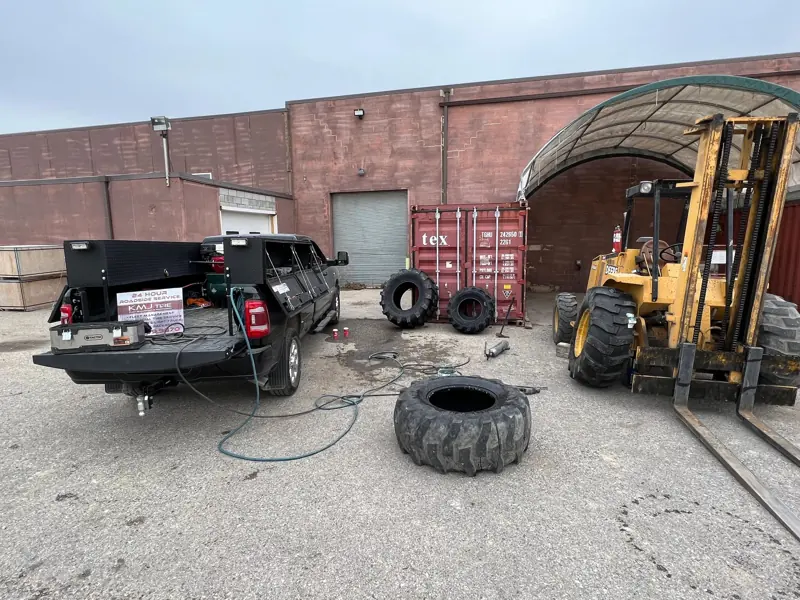
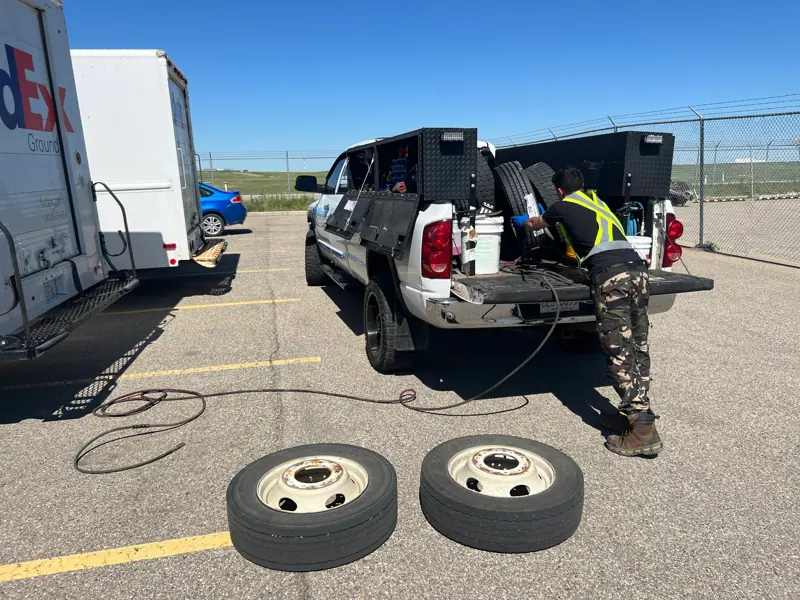
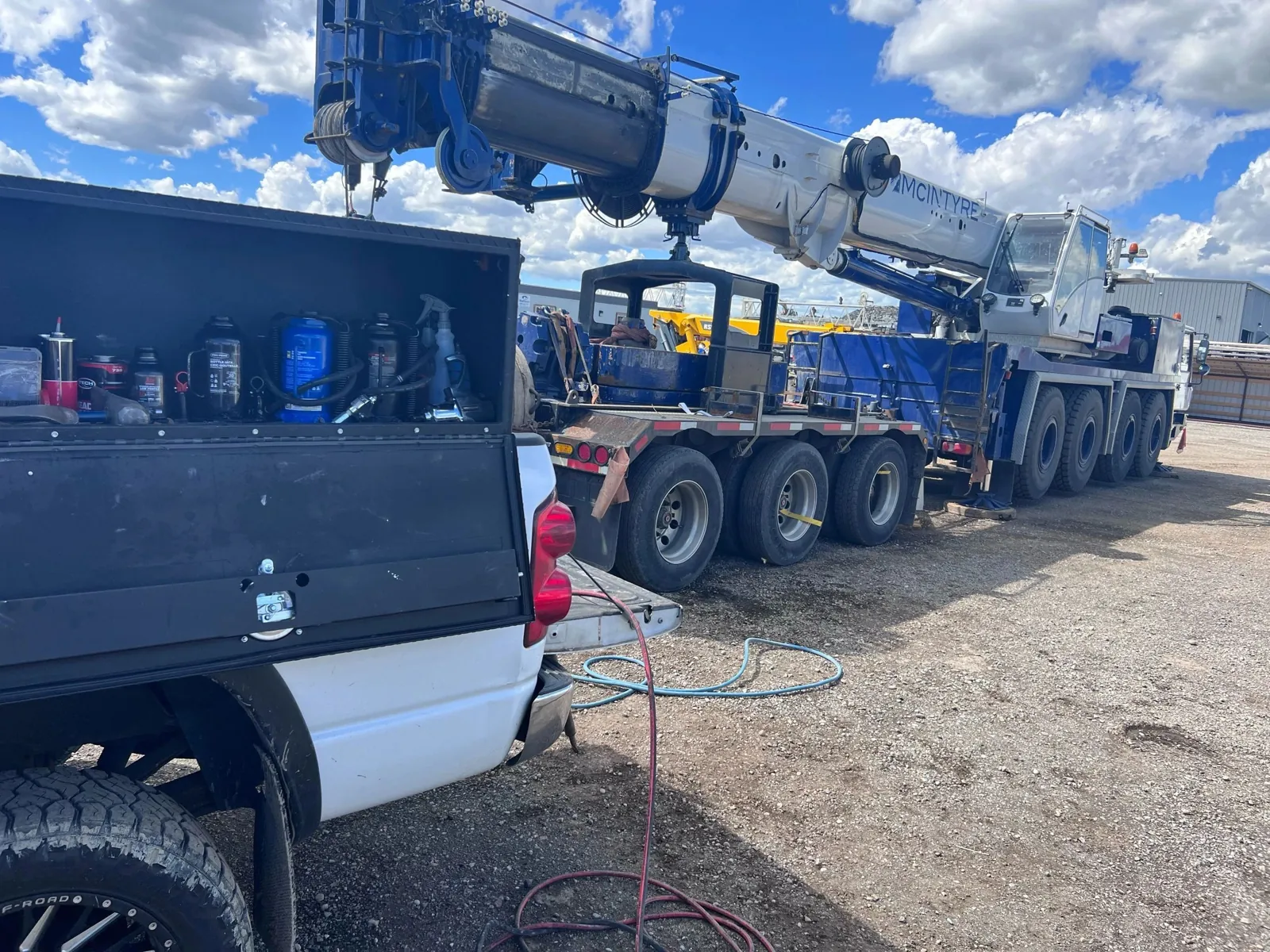
The hero photograph in this article shows a KMJ service pickup with its equipment compartment open beside a crane truck in a gravel yard. It illustrates a real tire-service setting only. It is not a flood-recovery photograph and does not establish that the pictured equipment, people or location were exposed to water. That distinction matters: an illustrative service image should never become invented evidence of an incident.
19. Treat repair, replacement and vehicle clearance separately
A puncture repair addresses a specific injury under an appropriate repair procedure. It does not reverse prolonged moisture exposure or chemical damage. A tire that requires disposal under applicable flood guidance does not become suitable because it can be patched, balanced or inflated. Make the exposure history part of the request before any routine repair decision is made.
The Calgary tire repair assessment page is a starting point for discussing an actual tire injury, not a promise to repair flood effects. If a tire also has a puncture, the professional needs both histories. Leaving out the flood event can produce an answer to the wrong problem even when the repair assessment itself is otherwise competent.
Replacement of affected tires likewise does not release the entire vehicle for normal use. Keep any mechanical, electrical or other specialist restrictions visible in the vehicle record. The person collecting it should understand exactly what the tire provider completed and what remains outside that work. A tire invoice should not be used as a substitute for another specialist's clearance.
At handover, retain the exact replacement products, installed positions, inflation instructions and any follow-up required by the applicable vehicle or wheel guidance. If monitoring equipment or retained wheels required separate work, include that record as well. The outcome should be a clear tire-service record connected to, but not confused with, the broader recovery file.
20. Reset storage only after the space is suitable
Before bringing replacement tires into the same storage area, address the original exposure problem through the appropriate property professionals. A new set should not be placed back into a damp, contaminated or uncleared location simply because the old set has been removed. Tire replacement and restoration of a suitable storage environment are separate tasks.
USTMA recommends clean, dry, cool, well-ventilated tire storage protected from sunlight, chemicals and damaging environmental exposure. It also cautions against keeping tires near ozone-generating equipment. Use the tire manufacturer's storage guidance for the product and whether it is mounted. A storage bag is not a substitute for a suitable location or a reliable flood barrier.
Consider how future water problems would be noticed. Keep product and ownership records somewhere other than solely inside the affected area. Photograph a seasonal set when it enters storage and maintain a list of where each set belongs. If a building has known water-entry concerns, discuss appropriate property measures rather than improvising a tire shelf that cannot support the load safely.
Do not invent a universal storage height or promise that one rack design prevents every event. The useful improvement is a suitable environment, stable approved storage, accessible records and a response plan. If another incident occurs, those measures make it easier to identify affected items and prevent accidental reuse, even when the event itself cannot be prevented.
21. Three recovery examples without invented thresholds
First, a homeowner finds bagged seasonal tires after water entered a garage. The bags now contain moisture, but nobody knows when it entered or how high the water rose. The correct record includes those uncertainties. The owner should not infer a safe exposure duration from the day the bags were opened, and should not treat drying them as a completed suitability assessment.
Second, a business has new unmounted commercial tires on a low storage level during a documented prolonged flood. Michelin's published guidance explicitly addresses new inventory as well as vehicle-mounted tires for the products within its scope. Full tread and an unused label are not exceptions. The business should preserve identifiers, follow the applicable disposition guidance and prevent the tires returning to saleable inventory.
Third, a vehicle is recovered after standing in water, and a tire looks normal. The owner wants to drive to a tire provider. That plan must first fit the vehicle-recovery instructions and the broader condition assessment. A tire's appearance does not answer whether the vehicle can be operated, and a tire-service destination is not an automatic authorization to drive there.
These examples are decision exercises, not reports of local customers or current events. Their purpose is to show where a missing fact belongs. None supplies a magic number of hours, a cleaning recipe or a visual test that overrides manufacturer guidance. The most useful answer sometimes is a documented restriction and a concrete next step, rather than premature certainty.
22. A short handoff checklist for the next person
Write a one-page summary that another person can understand without hearing the whole story. Include the set identifiers and owner, exact products where readable, exposure timeline with uncertainties, mounted or unmounted status, known or suspected contamination and any movement after the event. Attach the photographs and relevant property or recovery records rather than repeating them from memory.
Next, list the decisions in order: access status, manufacturer guidance obtained, tire disposition, wheel or sensor assessment, replacement specification and outstanding vehicle-specialist work. Put the evidence beside each completed decision. “Spoke to someone” is not as useful as a dated case reference and a summary of the precise facts that person considered.
Finally, identify what happens next and who is responsible. That could be obtaining manufacturer clarification, arranging safe transport, retaining items for a claim or documenting disposal. Make clear which tires must not be installed. The checklist is successful when it prevents the next person from mistaking a clean-looking set or a paid invoice for evidence that every question has been resolved.
For tire-specific help, discuss an exposure assessment or replacement with KMJ using that summary. Confirm the service scope and suitable next step for the actual product and location. The aim is not to dramatize a wet tire or reassure away a real exposure; it is to make a defensible decision and preserve the reason for it.
Sources and the limits of this guide
The primary technical reference is the Michelin commercial resource library, accessed October 24, 2026. Its currently linked 2023 Truck Tire Service Manual, printed page 60, contains the flood-damage and diesel-fuel-contamination guidance described here. The flood instruction includes prolonged exposure and both new unmounted inventory and mounted tires. It does not give this article a universal time threshold or authority to approve another manufacturer's product.
The U.S. Tire Manufacturers Association tire-care guidance, also accessed October 24, provides the storage and general condition-assessment background. Manufacturer, vehicle and component instructions for the actual equipment take precedence over a general explanation. Insurance coverage, building access, contaminated-material handling and whole-vehicle recovery require the appropriate separate authorities or professionals. No cleaning method, inspection shortcut or business capability beyond the stated tire-service scope is implied.