Your food truck spends much of its working day standing still. Why should its tires need a different plan from the van that delivers your ingredients? Because the kitchen travels too. Refrigeration, counters, cooking equipment, water and supplies can remain on the vehicle when sales are slow and the odometer barely moves. Tire decisions need to reflect that real operating configuration, not an empty-van assumption or the number of kilometres driven yesterday.
The practical answer is to establish the completed vehicle's approved tire requirements and actual loaded condition, keep pressure and condition checks tied to that configuration, and make a deliberate check before the truck leaves a serving location. Do not invent an inflation pressure by dividing total weight by the number of tires. Do not assume that fitting a higher-rated tire increases the vehicle's permitted weight. Get missing specifications resolved by the vehicle or conversion manufacturer and a qualified tire professional.
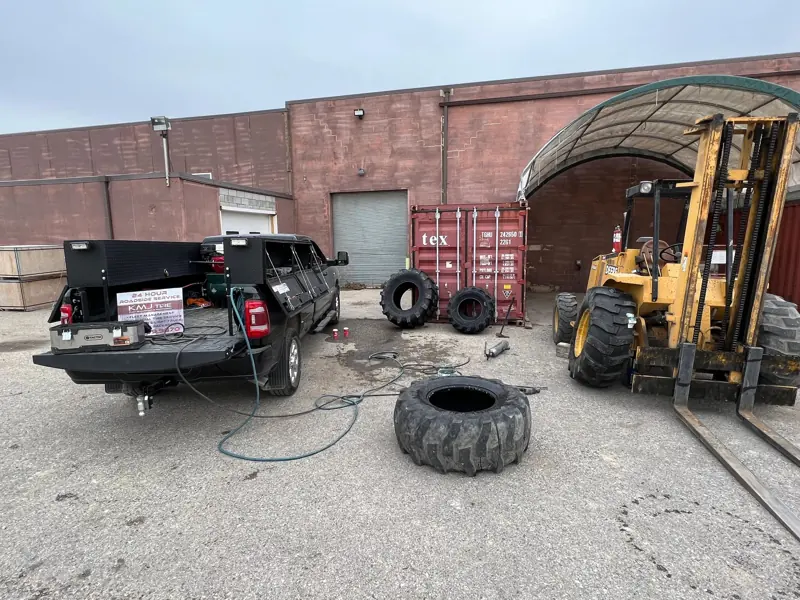
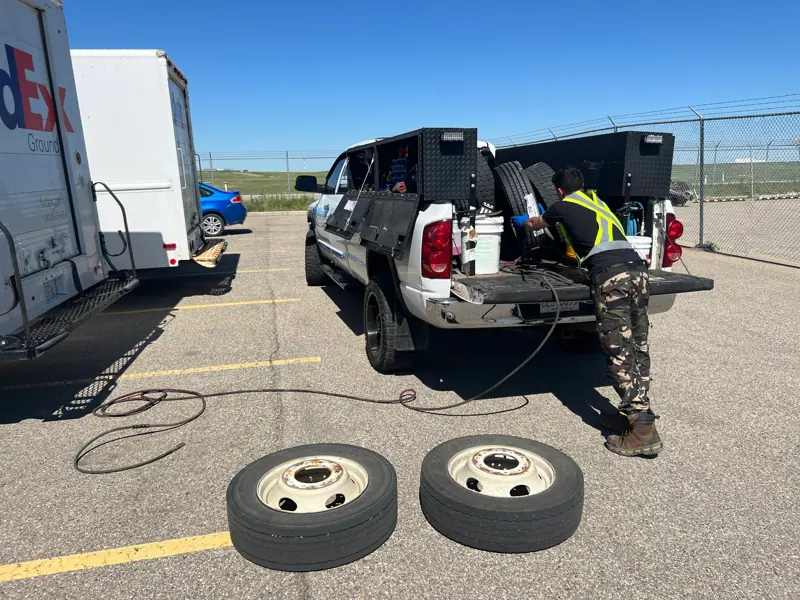
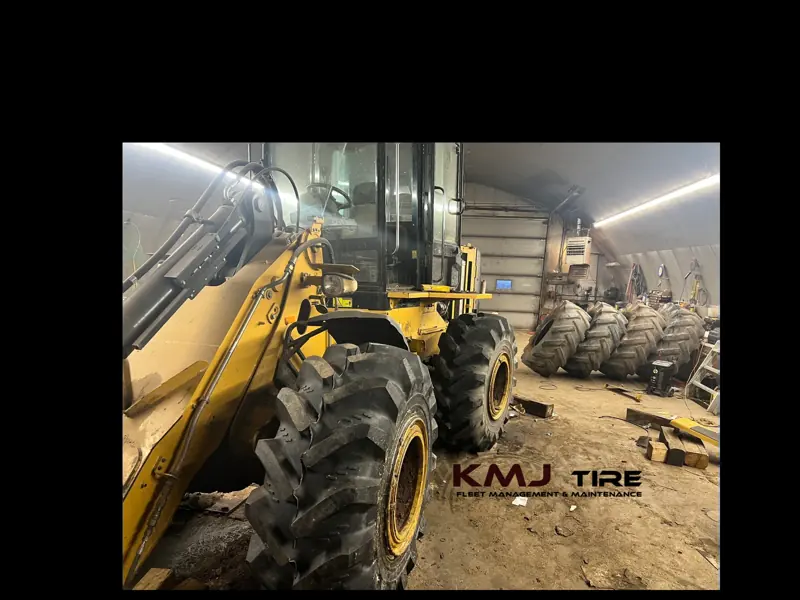
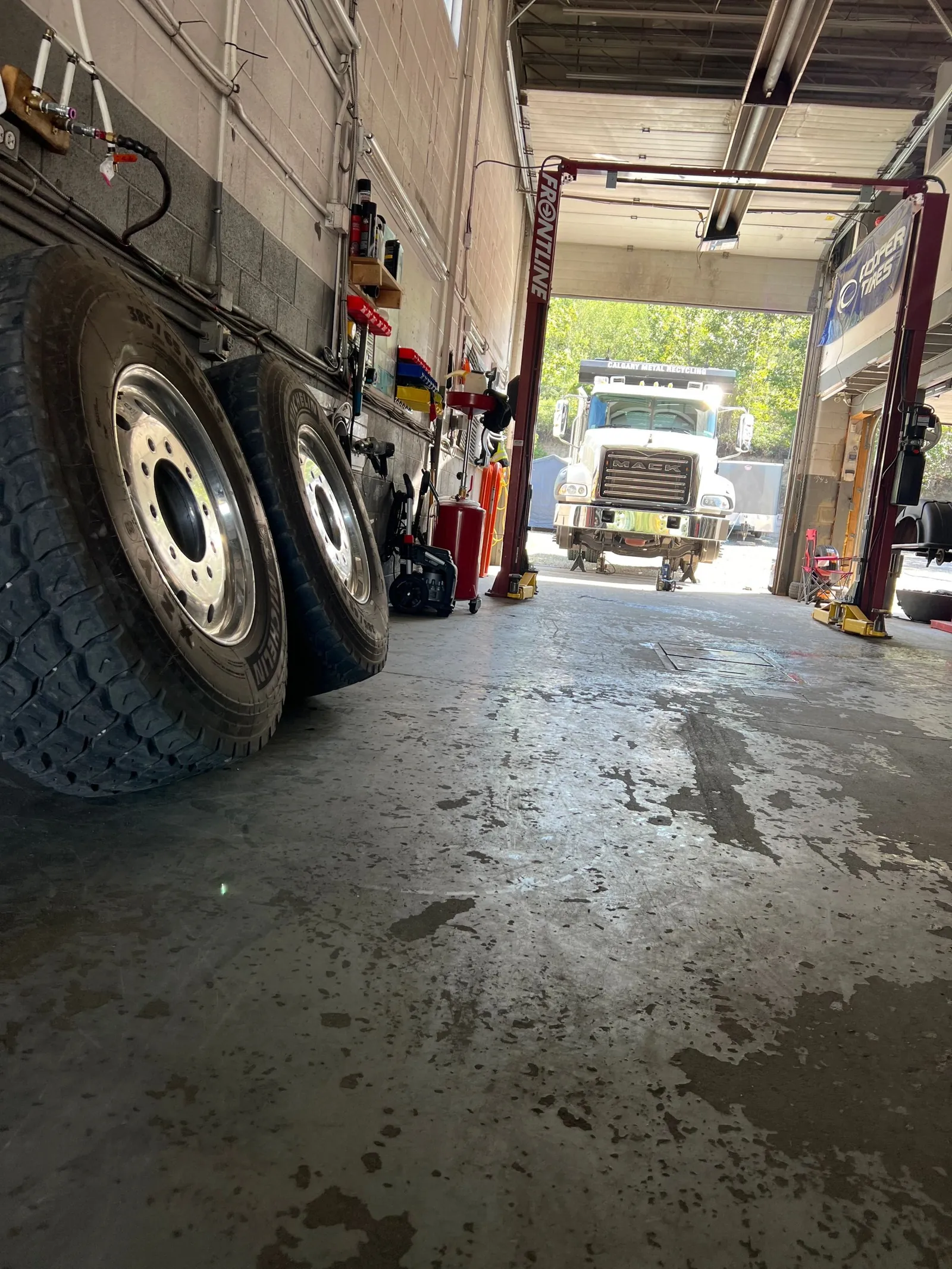
This guide follows one operating day, from the preparation yard to the serving pitch and back, then explains the records and seasonal decisions behind it. The examples are hypothetical and contain no claimed Calgary permit rules, tire prices or equipment weights. The real KMJ-library photo shows commercial tire assemblies in a service setting; it does not depict a food truck inspection. KMJ's scope here is tire service, not kitchen conversion, electrical, gas, plumbing or other mechanical work.
1. Identify the vehicle underneath the kitchen
Begin with the vehicle identity and the conversion documentation. A step van, cutaway chassis, bus conversion, light-duty van and towed concession trailer are not interchangeable tire applications. This article focuses on self-propelled food trucks. A trailer needs its own manufacturer-approved tire and loading plan rather than a copy of the towing vehicle's specifications.
Gather the owner's manual, certification and tire labels, conversion records and any subsequent approved changes. Keep clear photographs of the labels and note which organization issued each one. A later-stage manufacturer may have supplied information relevant to the completed vehicle. If documents disagree, ask the responsible manufacturer or qualified conversion specialist to reconcile them before selecting tires or setting a new pressure policy.
The tires currently fitted are evidence of what is installed, not proof of what belongs there. A second-hand truck can arrive with a plausible-looking size chosen by a previous operator. Read all positions, including any spare, and compare the full specification with the approved information. If the vehicle has dual rear wheels, do not assume a front-tire marking describes the entire setup.
Use the tire sidewall information guide to organize what you photograph. Record the brand, model, size, service description and construction markings without shortening away letters you do not recognize. The useful outcome is a verified baseline for this completed vehicle. Until that exists, a price comparison between attractive tire options is premature: you have not yet established the specification those options must satisfy.
2. Separate permanent kitchen weight from daily supplies
A conventional delivery van may unload most of its cargo. A food truck often carries substantial installed equipment all the time. Make an equipment inventory that distinguishes permanent fixtures from removable stock and variable fluids. This is an organizational tool, not a substitute for weighing the completed vehicle. Estimates from product brochures can miss brackets, cabinetry, wiring, repairs and later additions.
Think through several realistic states: departure with supplies, a serving period with staff and equipment, and the return journey with remaining stock and waste. Clean-water and wastewater quantities can change, and their locations may differ. That does not automatically make the return trip lighter at every axle. Identify the configurations that could matter and obtain actual measurements and professional guidance where needed.
Do not treat axle ratings as interchangeable portions of one total allowance. A vehicle can be within its overall permitted weight while a particular axle is overloaded. Tire and wheel capacity also remain separate constraints. The tire load-index explanation provides background, but it does not calculate a legal or safe payload for your truck.
For the operating record, describe the configuration in ordinary language: installed kitchen unchanged, specified water state, normal ingredient load and the people or equipment included in the assessment. Avoid a vague label such as “fully loaded” if nobody can reproduce it. When tomorrow's supply order or a new appliance changes that description, you have a clear reason to review the baseline instead of assuming the old numbers still apply.
3. Obtain useful loaded measurements
Arrange weighing through an appropriate facility or qualified provider and explain the type of vehicle and information you need. You want measurements that can be compared meaningfully with the applicable limits and tire guidance. A single total weight may not reveal an axle or side-to-side concentration that matters on a vehicle with a kitchen running along one wall.
Ask the tire professional or vehicle manufacturer what measurement detail is required for the application. Do not improvise a wheel-position weighing method or drive partly off a platform without the facility's approved procedure. An unreliable measurement can look precise while producing the wrong conclusion. Keep the original ticket and a note of how the vehicle was configured at the time.
The interpretation should account for the relevant vehicle, axle, wheel and tire limits, together with the manufacturer's inflation guidance. If the numbers reveal a problem, resolve the loading or approved configuration first. Adding air, changing tire size or buying a tougher-looking tread is not a substitute for correcting an overloaded or improperly configured vehicle.
Consider a hypothetical coffee truck whose heavy equipment is mostly on one side. Its owner initially knows only the total weight. The next useful step is not to split that number equally across four tires. It is to obtain the measurement and specification detail needed to evaluate the actual loading. The business benefit is a decision grounded in the truck that exists, rather than in an imaginary evenly loaded van.
4. Keep inflation tied to approved guidance
Start with the applicable vehicle and tire instructions for the completed configuration. For an ordinary placarded setup, the specified cold pressure is the starting point; some commercial applications require additional load-and-inflation interpretation by a qualified professional. Do not substitute the maximum marking on a sidewall for a complete operating-pressure recommendation.
USTMA's tire-care essentials emphasize correct inflation, loading and inspection. The useful food-truck application is consistency: identify the correct target, check under the specified cold conditions and record deviations. A pressure reading after a highway run or beside operating equipment is not directly comparable with an early-morning cold reading without considering the conditions.
Do not bleed a warm tire down to a cold target simply because the gauge reads higher after driving. If an unexpected reading appears, investigate the timing, equipment and tire condition rather than inventing a new normal. Persistent loss needs assessment even if repeated topping-up keeps the truck apparently ready for service.
Give staff a written reference for each relevant position or axle, including units and where the approved value came from. A number remembered from another truck is not a specification. If a replacement vehicle arrives or the kitchen configuration changes, verify the reference rather than carrying the old pressure instruction forward. The practical tire-care resource can support staff education, while vehicle-specific decisions remain with the appropriate manufacturer guidance and qualified tire expertise.
5. Distinguish a pre-departure check from kitchen opening
Opening the business and releasing the vehicle are different decisions. The person checking refrigeration, supplies and payment equipment may not be the person who drives. Make the tire check a distinct part of vehicle release so it cannot vanish inside a general “ready to open” message.
Before departure, look for obvious damage, a visibly low tire, objects lodged in the tread, abnormal wheel condition and anything obstructing access. Check pressure as specified, using suitable equipment and safe access. Record a problem rather than assuming the next staff member will notice it. If the truck has duals or hard-to-reach valves, establish a professional-approved method rather than treating the inaccessible position as exempt.
A tire that needs repair assessment should not be declared fit for the route because the serving event has already been advertised. The customer schedule does not diagnose a leak or determine repairability. Calgary tire repair information can help frame the assessment request, but the physical tire and its operating history determine what can be done.
Keep the release record short enough to use: date, truck identity, checker, relevant measurements, observed concern and the person responsible for resolving it. “No new issue observed” describes a check; “guaranteed safe all day” overstates it. The record is a starting condition and accountability tool, not a promise that road debris or an unrelated failure cannot occur after departure.
6. Give dual rear tires their own procedure
If the food truck uses dual rear tires, both tires at each assembly need attention. An outer tire that looks inflated does not prove that its inner companion is properly inflated. Do not assume the outer tire can safely carry the intended combined load if the inner tire loses pressure. A visibly compromised dual assembly needs appropriate assessment before the vehicle is used.
Correct matching, clearance, inflation and service procedures are application-specific. Ask the tire provider to verify the relevant requirements rather than applying a passenger-car rule. Record inner and outer positions separately, so a pressure history or repair note cannot drift between two tires that are difficult to distinguish in a rushed conversation.
Access hardware deserves its own check. If extensions or other valve arrangements are fitted, identify them and have their suitability and condition reviewed by a qualified provider. Do not add an improvised extension solely to make a daily check easier. The measurement process must reach the tire accurately without introducing a new leak or unsupported hardware arrangement.
Train staff to report uncertainty explicitly. “Inner rear valve inaccessible with our current equipment” is actionable; a copied pressure value is not. Resolve that access problem before the log becomes a series of invented numbers. Where service is required, communicate the dual configuration when discussing commercial tire help through the local Calgary tire business, and confirm the specific vehicle and task can be handled.
7. Choose the route with the loaded truck in mind
The route that suits a staff member's car may not suit the food truck's dimensions, weight or operating constraints. Tire planning is only one part of vehicle routing, but it benefits from knowing the actual access conditions. Identify tight entrances, damaged pavement, abrupt surface transitions and places where a driver might feel pressured to mount a curb.
Do not turn a delivery instruction into permission to use a surface or access route that the vehicle should not use. Confirm site access with the organizer or property operator and verify applicable vehicle restrictions through the responsible authority. This guide does not establish permits, parking rights or legal access for any Calgary location.
When an entrance looks unsuitable, stop in a safe place and resolve it before committing the truck. Driving farther onto a questionable surface can leave fewer options for turning or recovery. Schedule slack helps because it gives the driver time to make a controlled decision instead of treating a late arrival as a reason to rush a tight turn.
A useful route note describes the actual constraint: narrow approach, raised edge, uncertain surface or restricted clearance. “Difficult entrance” is less helpful to a relief driver. Save a verified alternative where one exists, but review it when construction or site arrangements change. Tires can be selected for an intended duty, yet no tread design authorizes careless curb contact, overloading or use of an unsuitable access route.
8. Inspect the pitch before positioning the vehicle
Walk the serving location where it is safe and permitted to do so. Look for sharp debris, broken surfaces, drainage problems and objects that could contact a tire as the truck is positioned. Consider the exit route as well as the arrival path. A space that is easy to enter before the event may become constrained once other vendors, barriers and customers arrive.
Position the truck according to the vehicle, conversion and site instructions. Do not improvise levelling, supporting or stabilizing methods using loose scraps, improvised ramps or objects under tires. If the kitchen requires a particular operating position or support arrangement, that is a conversion-system question for the responsible manufacturer or specialist, not a tire-pressure adjustment.
Keep the tire area visible and accessible where the site arrangement allows. Avoid burying a wheel behind loose supplies or placing waste containers where leakage and debris can reach the tire. Good housekeeping makes later inspection easier and reduces the chance that a new problem stays hidden until departure.
Think ahead to assistance. A roadside or mobile provider needs a safe working area, not simply enough room for the truck to stand. If a tire problem occurs at this pitch, could the vehicle be approached without exposing workers or customers to danger? Note the answer before the event is busy. That question does not guarantee service there, but it can reveal a location problem while you still have time to choose an approved alternative.
9. Keep kitchen hazards away from the tire area
A food truck brings heat sources, cleaning products, fluids and waste handling into a vehicle environment. The correct clearances and equipment layout must come from the conversion and equipment instructions. Do not route a hot exhaust, discharge, cable or hose near a tire because the space happens to be convenient. Tire protection is one reason to respect the approved installation, not a substitute for fire, electrical or gas safety requirements.
If a spill reaches a tire, identify the substance and obtain appropriate cleaning and assessment advice from the tire manufacturer or qualified provider. Do not assume every kitchen cleaner is suitable for rubber, and do not coat the sidewall with an unapproved chemical to hide a stain. A clean surface helps inspection; aggressive treatment can obscure or create a problem.
Avoid using tires as shelves, supports or attachment points for temporary serving equipment. The tire area should remain part of the vehicle, not become a convenient storage nook. Where a cable or hose must cross the operating space, follow the responsible equipment and site guidance so it does not create a new access or movement hazard.
An equipment modification that changes heat exposure or clearances needs professional review. KMJ does not perform food-truck conversion, gas installation or electrical work. A tire provider can assess tire condition and discuss approved tire requirements, while the relevant specialist handles the source of an equipment-layout problem. Solving only the damaged tire without correcting the cause can leave the same exposure in place.
10. Use the serving period to observe, not to improvise repairs
During a serving shift, staff may notice a tire looking different, hear an air leak or see an object close to the tread. Establish a simple reporting route so the observation reaches the person responsible for vehicle movement. A note buried in a general sales chat can be missed when the driver returns at closing time.
Do not remove an embedded object or attempt an improvised repair while customers are being served. The tire's construction, damage location, pressure-loss history and condition need proper assessment. If a tire has been run low or flat, include that fact when seeking help. A small visible hole does not reveal everything that may have happened internally.
Keep food-service decisions separate from vehicle-release decisions. The business might be able to remain stationary under its site and operating rules while the vehicle is not ready to drive, or it might need to close for other reasons. Those are situation-specific decisions. Do not let a running kitchen create an assumption that the truck can safely depart.
Make the issue visible in the closeout plan: which tire, what was observed, when it began and who has been contacted. If the driver changes during the shift, hand over the concern directly. A physical reminder at the driver's controls can support communication where appropriate, but it should not replace a clear record or the responsible person's decision about the next safe action.
11. Make the return to the road a second release point
Closing the serving window is not the same as preparing the vehicle to move. The truck may have been stationary for hours while the surrounding site changed. Walk the departure path, check the tire area and verify that serving equipment, cables, hoses and other temporary items have been handled according to their instructions. Keep people clear of the movement area.
Look again at any tire concern recorded during the shift. A note that says “check later” needs an outcome before departure, not another promise to review it tomorrow. If the truck was moved around the site by someone else, ask about curb contact, unusual feel or warnings rather than assuming that a low-speed repositioning could not matter.
The return load may differ from the morning configuration. Waste, remaining ingredients and transferred supplies can change distribution even when sales reduced some stock. Keep heavier items in their approved secured locations and follow the vehicle and conversion loading instructions. Do not use an open space beside a wheel arch as an unreviewed solution to a crowded closing routine.
A hypothetical operator notices the rear of the truck looks different after equipment was shifted to clear the serving aisle. That visual impression does not measure axle load or diagnose a tire, but it is a reason to check the change before driving. The second release point catches these differences. It turns the return journey into a deliberate vehicle decision instead of the automatic last step after the cash drawer is closed.
12. Decide on mobile service from the site, not the marketing label
Mobile service can reduce the need to move a truck with a tire problem, but the location still has to support safe work. A crowded festival pitch, sloped shoulder or narrow lane may not. Describe the actual vehicle and access conditions when asking for help: approximate vehicle type, tire configuration, ground surface, clearance, customer activity and any equipment that limits approach.
Review Calgary mobile tire-service information, then confirm the proposed job and site with the provider. A service-area listing is not a promise that every task can be completed in every parking space. The provider may need more information or may determine that a different service arrangement is appropriate.
The KMJ service-area page is useful for location questions, while emergency tire-assistance information helps identify the route for a time-sensitive inquiry. Neither link guarantees availability, response time or permission to continue driving. If separate vehicle transport is required, arrange it through the appropriate provider with the truck's configuration and restrictions disclosed.
Do not move the truck simply to make the job more convenient without first resolving whether that movement is safe. Explain a known flat, suspected damage or manufacturer's restriction before discussing a relocation. A good assistance request includes both the tire problem and the operational setting. “Food truck with an inner rear tire issue at a crowded event” provides a very different starting point from “need one tire changed.”
13. Describe symptoms without deciding the cause yourself
If the driver feels vibration, pulling or a new noise, write down when it appears. Is it present immediately, only at a certain speed, after a long parked period or after a known impact? Note the surface and load configuration. These details help a qualified provider decide what assessment is needed without turning the operator into a remote diagnostician.
Do not assume every vibration is a balance problem or every pull is a tire-pressure issue. Tire condition, wheel condition and mechanical causes can produce overlapping symptoms. Wheel-balancing information explains one tire-service subject, but it is not proof that balancing is the correct remedy for an individual truck.
Keep the food-service timeline in the report. An observation after equipment was installed or after a tire replacement is useful context, not automatic proof of causation. Record the change accurately and let the appropriate specialist evaluate the relationship. Avoid repeatedly driving a suspect vehicle to generate more symptom data when a safety concern already justifies stopping and seeking help.
Where the assessment points beyond tires, use a qualified mechanical or conversion specialist. KMJ's involvement in tire service does not mean it provides suspension, steering or drivetrain repairs. A clear referral boundary improves the record: tire findings belong in the tire work order, and other findings belong with the provider responsible for them. That prevents an incomplete tire-only visit from being mistaken for a complete resolution of the vehicle's behaviour.
14. Choose tread for the actual operating duty
Start tire selection with approved fitment and capacity, then discuss the surfaces and duty cycle. A food truck that travels mostly on paved city roads and stands on paved sites has a different pattern from one regularly entering appropriate unpaved event grounds. Aggressive appearance alone does not establish suitability for either application.
Describe route speed, typical distance, seasonal operation, loading and access surfaces to the tire provider. Ask about the manufacturer's intended use for the proposed model. A tire that seems attractive for one muddy entrance may introduce other compromises or may not be available in the required specification. Solve occasional site-access problems through route and location planning as well as tire selection.
The Calgary tire-buying guide can help structure the discussion, and the replacement-tire catalogue is a starting point for options. Confirm current suitability, availability and price directly; this article claims none of them. Have the proposal identify the complete product specification rather than only a brand and a set price.
Keep the reason for the final selection in the vehicle file. “Approved specification for this configuration, chosen for these routes and seasons” is useful when a future puncture forces a replacement decision. “Looked heavy-duty” is not. The record should also explain any matching or axle-position requirements provided by the vehicle and tire manufacturers, so the next buyer does not unknowingly substitute a product that disrupts the intended setup.
15. Make winter operation a vehicle-wide decision
If the food truck operates through Calgary winter, plan for the route and serving site as well as the tires. Cold conditions, snow, slush and icy access can affect the ability to arrive, position the vehicle and leave. Tire choice contributes to traction, but it does not erase weight limits, steep-site problems or unsafe conditions around the serving area.
Transport Canada's winter-tire guidance explains the benefits of winter tires and recommends them in sets of four for the vehicles addressed by that guidance. A commercial or dual-wheel food-truck application needs its own approved fitment and matching advice. Do not turn a passenger-vehicle recommendation into an unsupported prescription for a different chassis.
For initial category education, compare the pages on Calgary winter tires, all-weather tire selection and all-season tire options. Then establish which approved products actually suit the truck. A category name is not enough: the specific tire, vehicle requirements and operating conditions still need review.
Build a cancellation or relocation decision into the event plan. No tire purchase obligates the driver to accept an unsuitable route or site. If the serving location cannot be used safely under the conditions, resolve that with the organizer rather than relying on the tires to compensate. Keep customer commitments separate from the driver's responsibility to make a sound movement decision. The plan is strongest when that boundary exists before the weather creates pressure to ignore it.
16. Schedule changeovers around operating configurations
A seasonal changeover is a useful time to review the baseline. Has equipment been added, the truck changed hands or the route mix shifted? Are the stored tires still appropriate for the current configuration? Do not reinstall a set simply because the bags carry the truck's name from last year.
Before arranging seasonal tire-change service, identify whether the task involves complete wheel assemblies or tires that must be mounted on the existing wheels. Confirm the actual truck, tire dimensions and access needs with the provider. Service feasibility and duration should be verified, not borrowed from a passenger-car experience.
Ask for condition findings on the removed set and record any unresolved issue before storage. A tire with a noted leak or damage concern should not disappear into a bag labelled “summer” and return months later as if the problem never happened. Tie the finding to a specific tire identifier or durable label, not only to the axle position it occupied that day.
Plan the work so the vehicle can remain unavailable if the inspection reveals something unexpected. That is a business-continuity choice, not a prediction that delays will occur. A spare operating day, a verified alternate transport arrangement for supplies or a realistic event schedule can reduce the temptation to approve an unsuitable tire decision merely to keep the next booking. The maintenance plan should allow the evidence to determine the outcome.
17. Treat the off-season as a different operating state
Some food trucks work year-round; others sit for extended periods. Low winter mileage does not eliminate the need to care for the tires. Follow the vehicle and tire manufacturers' storage guidance and keep the vehicle in an appropriate location. Record tire condition and approved inflation information before the parked period begins.
Do not improvise support stands, lifting points or ways of taking load off the tires. A converted truck may have configuration-specific requirements, and support arrangements need proper equipment and instructions. If a manufacturer recommends a storage procedure you cannot carry out safely, seek qualified help rather than creating a homemade version.
Keep stored loose seasonal tires identified, protected as recommended and separate from kitchen chemicals or other unsuitable materials. Retain condition notes with the set. If equipment is changed while the truck is parked, review how that affects the vehicle's loaded baseline before the next operating season. The passage of a few quiet months does not preserve the old configuration automatically.
Before returning to the road, inspect and check according to the applicable guidance. Do not dismiss a new vibration as inevitable after storage without considering its severity, persistence and other warning signs. A professional assessment may be needed. The truck's first movement of the season deserves its own release decision, especially if it is going straight from a storage yard to a public event where stopping to investigate will be more difficult.
18. Keep a small tire file that answers real questions
The best record system is one the operator can maintain. Store the vehicle identity, approved tire information, loading assessment, tire identifiers, service history and current unresolved issues together. You do not need to record every ordinary movement of the truck, but you do need to know which specification and configuration the maintenance plan relies on.
Separate observations, measurements and decisions. A photograph of a tire is an observation record. A pressure reading has units, timing and a particular position. A decision to release the vehicle has a responsible person and a reason. Combining them into a single unchecked “okay” box makes the file shorter but much less informative.
Use simple change triggers: new appliance, relocated tank, additional equipment, different wheel setup, replacement tire or a new pattern of operation. When one occurs, identify which parts of the baseline need review. Not every change requires the same work, but each should be considered rather than disappearing inside a general renovation budget.
For background education, the KMJ tire article library can help staff understand terms used in service discussions. It should not become a replacement for the truck's actual specifications. Put vehicle-specific instructions at the front of the file and general reading behind them. A relief driver needs to find the correct pressure reference and unresolved concern quickly, without interpreting an entire collection of articles before leaving the yard.
19. Budget for decisions, not just a set of tires
Tire spending is easier to plan when you separate inspection, approved replacement, installation requirements and downtime. Do not build the budget around an advertised passenger-car set price if the truck requires a different construction, size or service arrangement. Request an itemized, verified proposal for the actual vehicle and clarify what is included.
A cheaper-looking option can be unsuitable if it does not meet the approved specification. Conversely, the most expensive product is not automatically the right one for the duty. Compare like-for-like options and ask what evidence supports the recommendation. Avoid invented kilometre promises; wear and service life depend on use, loading, maintenance, condition and the product's actual terms.
Plan a reserve for an unexpected damaged tire without assuming every puncture can be repaired. The choice between repair and replacement requires assessment. USTMA's replacement-tire guidance reinforces the need for appropriate replacement decisions, while the specific truck and remaining tire setup determine the practical plan.
Downtime planning should also address the business operation honestly. If a tire problem prevents safe movement, moving ingredients or rescheduling a service commitment may be necessary. Those are business arrangements to establish in advance, not reasons to lower the vehicle-release standard. A realistic contingency can make the safer decision easier when staff, customers and an event organizer are all waiting for an answer.
20. Work through a complete operating-day example
Imagine a Calgary lunch truck with a permanent kitchen, a regular preparation yard and a weekly outdoor serving location. The owner has a verified specification file and a documented loaded assessment for its normal configuration. Before the day begins, the driver checks the relevant tire pressures and condition, confirms that the equipment arrangement has not changed and reviews the site's access note.
On arrival, the approved pitch contains loose debris near the planned rear-wheel position. The operator resolves that with the site organizer before positioning the truck rather than driving over it. During service, a staff member hears a possible air leak and records the position and time. The vehicle is marked as needing assessment before movement; the issue does not disappear because food service continues.
The operator describes the truck, tire configuration and site constraints to a qualified provider. The provider determines the appropriate assessment and service arrangement. No one promises that a visible object can simply be pulled out or that the truck can drive a few kilometres on the affected tire. After the issue is resolved, the owner retains the work record and follows the supplied instructions before releasing the vehicle.
Back at the yard, the tire file is updated and the next driver receives a concise handover. If the event exposed an access problem or a gap in the reporting process, that gets corrected too. The lesson is not that every day needs a long checklist. It is that the right information must reach the right person at three moments: before departure, when a problem appears, and before the next movement.
21. The one-page plan to keep in the cab
Put the verified vehicle identity, tire specification reference and operating-pressure instructions at the top. Add the approved loaded-configuration description and the person who can resolve a specification question. Keep personal or sensitive business information elsewhere; the cab sheet needs actionable vehicle information, not the full financial or customer file.
Next, list the release checks and the reporting route. Include how to identify each tire position, what observations need escalation and where current unresolved issues are recorded. A relief driver should be able to understand the process without guessing which rear tire a previous note meant. Where access requires special equipment or professional help, say so explicitly instead of leaving an impossible check on the form.
Finally, record the assistance process and service information that has actually been verified for the vehicle. Keep site access and movement restrictions visible. Recheck the sheet after a vehicle modification, a change in responsibilities or a service finding that alters the plan. Date the review so an old laminated instruction cannot quietly outlive the configuration it describes.
A food truck's tires support a working kitchen before they carry it down the road. Treat the completed vehicle, its changing loads and its long stationary periods as part of one operating system. Establish the real requirements, measure what matters, protect the tire area while serving and deliberately release the truck for each journey. That is a practical plan a small Calgary business can use without turning tire selection into guesswork or stretching a tire provider's role beyond the work it actually performs.