Can a horse trailer be ready for the road because its tires still have deep tread? No. Before loading the horses, you need a matched, approved tire specification, sound tire and wheel condition, verified cold inflation, and a realistic understanding of the loaded trailer. You also need a plan for a tire problem that does not leave you inventing an animal-handling solution beside traffic.
That last point changes the whole preparation process. An empty utility trailer can sometimes wait quietly while you sort out an unexpected delay. A loaded horse trailer brings animal welfare, experienced handling, ventilation and a suitable place to stand into the decision. The practical answer is to resolve tire uncertainties at the yard, while the horses are still somewhere secure, rather than after the ramp has gone up.
This guide follows that sequence: identify the trailer, establish its load, assess its tires, prepare the tow vehicle, and make a clear departure decision. It is not a horse-handling course or a substitute for the instructions supplied with your particular trailer. A two-horse bumper-pull, a slant-load gooseneck and a trailer with living quarters do not share one loading diagram or one inflation number.
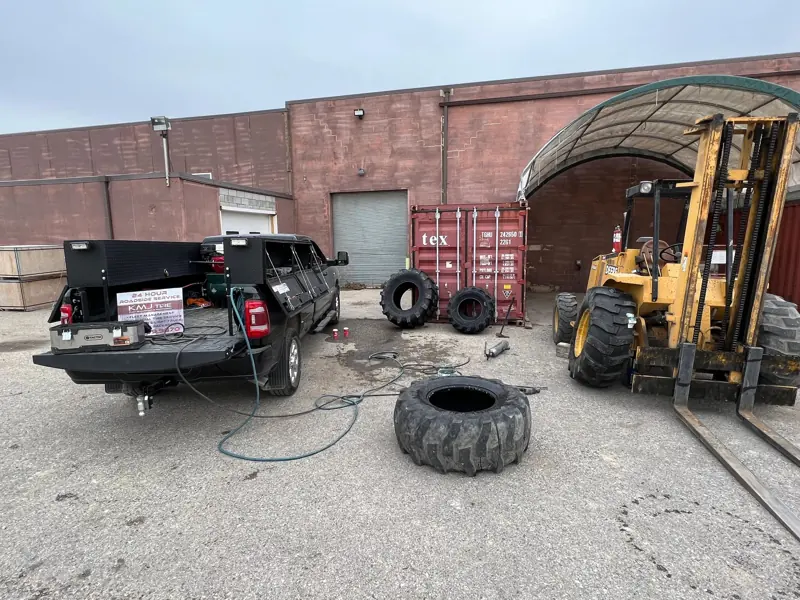
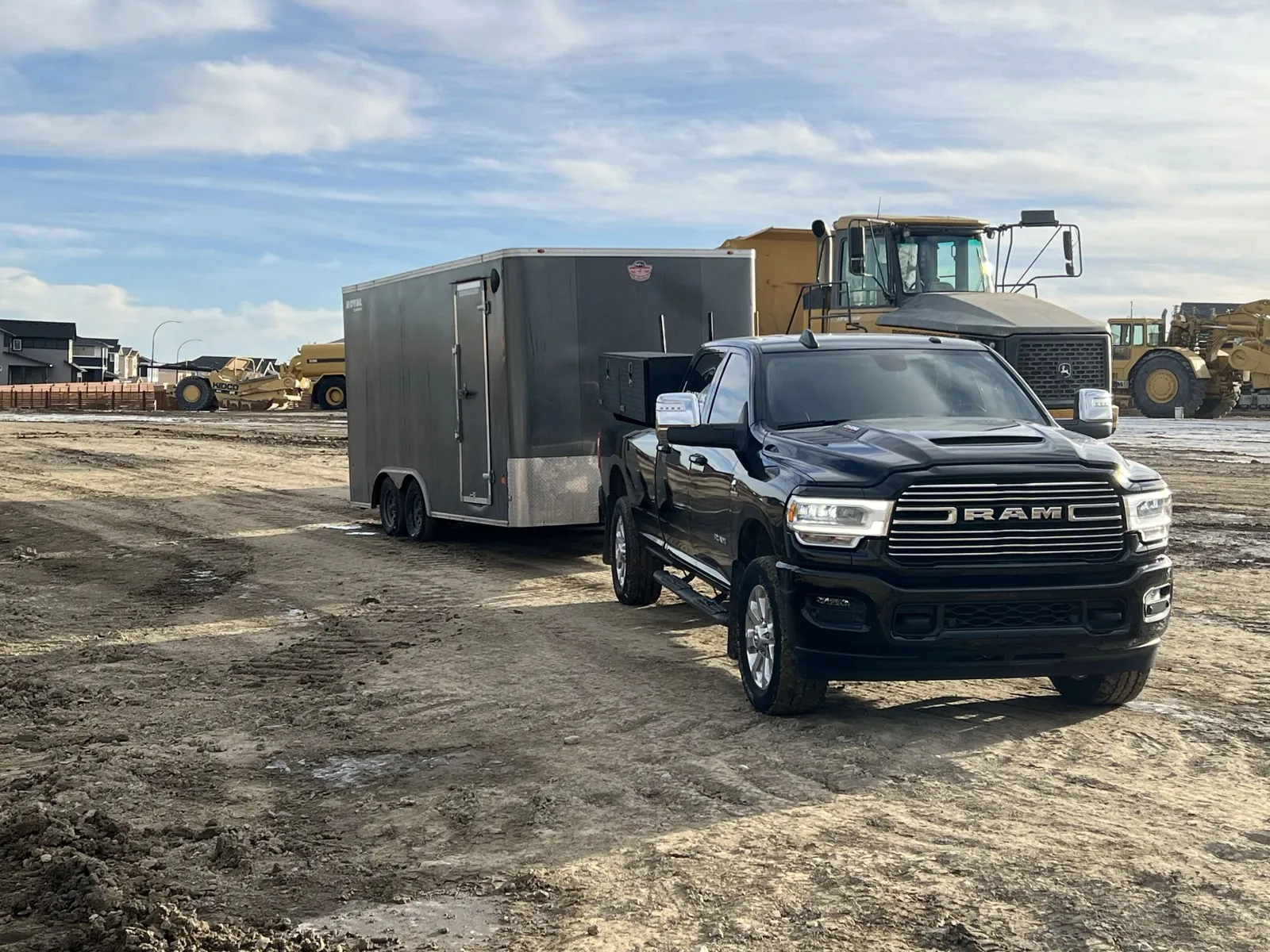
The photograph shows a real pickup and enclosed equipment trailer from KMJ's photo library. It illustrates a towing combination, not a horse trailer, and does not establish a horse-hauling service or a particular tire fitment. The tire principles below are grounded in manufacturer guidance, with horse-specific planning examples clearly separated from actual customer stories.
1. Make the tire decision before the loading decision
Picture an ordinary departure morning: tack is packed, a second person is waiting at the arena, and one trailer tire looks slightly softer than the others. This is exactly the wrong moment to let the schedule answer a technical question. The appointment time does not tell you whether the tire has lost pressure, whether the gauge is accurate or whether the casing has been damaged by earlier low-pressure travel.
Build a short pause into your routine before any horse approaches the ramp. Walk around the empty trailer in a place where you can see the tires, read the labels and use a gauge without standing in traffic. If the trailer is parked in mud or deep grass, move it only if its condition allows safe movement; otherwise arrange assessment where it sits. Do not load animals merely to make the trailer easier to reposition later.
A useful departure note has three possible answers: ready on the evidence available, waiting for a specific check, or not travelling until a defect is resolved. The middle answer matters. A missing specification is not the same as a failed tire, but it still needs an answer before you make a load-dependent decision. Write down the actual missing information instead of rounding uncertainty up to approval.
For basic inspection habits between trips, KMJ's tire safety and maintenance guidance provides a starting point. A horse trailer still needs its own manufacturer instructions layered on top. Do not transplant the maintenance interval from your daily commuter, especially when the trailer spends long periods parked and then carries a substantial load on occasional journeys.
2. Identify the trailer you own, not the one in a forum
Start with the certification label, identification number and the correct owner manual. Photograph the label while it is readable. Record the trailer model, axle ratings, gross vehicle weight rating and original tire information. Keep those images somewhere you can reach without crawling around the trailer while it is attached to a truck or surrounded by activity.
A forum post about a similar-looking trailer may describe different axles, a different wheel size or an optional living-quarters conversion. Even two trailers advertised for the same number of horses can have different empty weights and equipment. The number of stalls is not a tire specification, a cargo allowance or a statement about how much weight belongs on each axle.
Replacement wheels and previous-owner modifications deserve particular attention. A placard describes an approved configuration, but it does not prove that the wheels currently fitted still match that configuration. If the installed tire size differs from the label, find the documented approval for the change. An old invoice that simply repeats the installed size is evidence of a purchase, not necessarily of an engineering decision.
Use tire sidewall identification help to understand the information you are collecting. Preserve the entire size and service description rather than only the rim diameter. When you ask a professional to reconcile a mismatch, send the label photograph and sidewall photographs together. That is much more useful than saying the trailer takes a common size and asking whether something close will fit.
3. Count horses, water and tack as separate loads
The ready-to-travel load includes more than the horses. Water, hay, saddles, feed, mats, tools, portable fencing, spare equipment and personal gear all contribute. Some equipment may already be included in a recorded empty weight; some may have been added later. Establish what the figure actually includes before subtracting it from a rating.
Consider a planning example, not a recommendation for any trailer. Suppose an owner has a documented empty weight and then adds two horses, several containers of water and a large tack trunk. The useful calculation lists each addition individually. It does not assume that two horses must fit within the available capacity simply because two stalls exist. Nor does it treat a partly filled water tank as weightless because it is not full.
Unknown animal weights should remain identified as estimates until a suitable weighing method resolves them. A guessed total with a generous-looking margin can conceal several smaller errors. If both horse estimates are low and the empty-trailer figure excludes added cabinetry, the errors reinforce one another. Be especially careful when borrowing someone else's loading notes, because their gear and their horses may be different.
The purpose of the list is to decide what needs measurement and what can be left behind. Do not reduce necessary animal-care supplies indiscriminately to solve an overweight combination. A different trailer, a different tow vehicle or a revised travel arrangement may be the correct answer. Tire selection cannot repair a capacity problem elsewhere in the combination, even when a replacement tire has a higher advertised rating.
4. Understand what a scale ticket can and cannot prove
A total combination weight is useful, but it is not the whole picture. You need to know how the load is distributed between the tow vehicle and trailer, between trailer axles and, where the situation requires it, between wheel positions. Ask the scale operator and trailer manufacturer which weighing method will answer your particular question safely.
The Featherlite enclosed-trailer manual discusses empty weight, axle, wheel, hitch or kingpin and total weights as separate measurements. It also warns that uneven side-to-side loading can overload a tire. The important lesson is not to create your own weighing manoeuvre. It is to choose a method that produces the missing information without putting a trailer partly on an unsuitable surface or asking animals to tolerate unnecessary handling.
Dividing a total by the number of tires produces an average. It does not prove that every tire carries that average. A heavy tack compartment on one side, water placement and the occupied stalls can make that distinction important. Likewise, a combined axle figure does not automatically establish that both axles are equally loaded under the actual hitch setup.
Keep the scale ticket with a written description of the configuration: which horses travelled, where they were placed under the approved loading instructions, water level, gear and tow vehicle. A ticket without its configuration becomes less useful the next time you change the load. KMJ's explanation of tire load ratings can help with terminology, but the trailer's ratings and the tire maker's application data remain the controlling limits.
5. Follow the approved stall arrangement
Horse placement is not an opportunity to improvise a better-looking tire load. Follow the instructions for the actual trailer layout. A loading direction appropriate to one design may be wrong for another, and the horse's ability to load and travel safely also needs experienced judgement. Ask the trailer manufacturer or a qualified horse-transport professional when the manual does not clearly answer the situation.
For example, the Featherlite manual contains a specific forward-most-stall instruction for its horse-loading procedure. That is a manufacturer instruction in a particular manual, not a universal rule that this article applies to every trailer. A reader with another make should find the equivalent guidance for that product rather than copying a sentence out of context.
Tack and supplies need planned locations as well. Adding a heavy chest to an unused stall may change the weight distribution and introduce a restraint problem. The fact that there is floor space does not establish that a cargo item belongs there. Secure equipment only in the manner and locations approved for the trailer, without obstructing animal space, ventilation or access needed for safe handling.
This is where the tire plan meets the rest of trailer preparation. If the tires appear suitable but a divider, floor, hitch component or restraint arrangement needs attention, the combination is not ready. KMJ's role in this guide is tires; structural repairs, towing-system work and animal-handling decisions belong with the appropriate specialists. A tire visit should not be mistaken for a complete horse-trailer safety certification.
6. Select the tire specification before comparing products
A familiar size does not make two tires interchangeable. Construction, service type, load capability, operating limits and wheel compatibility must be checked together. Trailer-approved applications can involve different tire designations; do not decide that every horse trailer needs the same prefix or that a pickup tire is automatically a stronger substitute.
Begin with the trailer maker's approved specification and the tire manufacturer's current data for the exact product. Preserve letters such as ST or LT where they are present, as well as the complete numerical size and rating information. If a different specification is proposed, request a documented fitment assessment that includes the wheel and the trailer, not just a salesperson's description of a tire as heavy duty.
A higher tire capacity does not increase the axle rating or the gross rating of the trailer. It also does not establish that the existing wheel and valve support a different pressure requirement. Changing one component can create a mismatch even when its individual specification appears better. Keep the approval chain together instead of comparing isolated sidewall numbers.
When researching options, the KMJ tire brand directory is a place to begin a product conversation, not a promise that a particular trailer tire is available. Ask about the exact model and fitment. Do not choose by logo alone, and do not interpret a general passenger-tire category page as approval for carrying horses on that product.
7. Measure cold pressure without guessing a universal number
The correct pressure is not supplied by a neighbour's trailer or by this article. Use the trailer placard and manufacturer instructions for the approved tire configuration, resolving any replacement-tire differences with qualified advice. The maximum marking on a sidewall is information about the tire; it is not a reason to ignore the trailer's instructions or component limits.
Cold means the tires have not been warmed by normal travel and are at the surrounding temperature under the manufacturer's checking conditions. Plan the check before the road journey. A trailer that has just come back from another yard is not automatically cold because the air outside feels chilly. Record that circumstance instead of treating a warm measurement as the morning baseline.
Use a suitable gauge with enough range for the application and a clear unit display. Keep pounds per square inch and kilopascals distinct. Read every trailer position and the spare, then record the results. A quick visual comparison is poor evidence because a tire's shape also depends on its construction and the load at that moment.
Featherlite's tire-safety section calls for cold-pressure checks at least weekly, while its pre-tow guidance also requires proper pressure before towing. Those are not competing instructions: routine maintenance does not remove the departure check. A tire that repeatedly needs air deserves investigation, even if you can restore the target pressure before every journey. Refilling it is an action; finding and resolving the cause is a different action.
8. Inspect the whole assembly, including the hidden side
Look at the tread face, both shoulders, accessible sidewalls, valve and wheel. Roll the trailer only under safe, controlled conditions if that is needed to expose another portion of tread; do not reach beneath an unsupported trailer. A flashlight and a clear inspection area are more useful than trying to judge a muddy inner sidewall from several metres away.
Cuts, bulges, exposed cord, severe cracking and suspicious deformation are not problems to test with a loaded drive. Featherlite's manual explicitly treats visible tire defects as reasons for replacement before towing, and unusual wear as a reason for professional diagnosis. Let a qualified person assess uncertain findings before loading rather than hoping that deep tread cancels out a sidewall concern.
A wheel can also be part of an air-loss problem. Damage, corrosion, valve condition and fitment all matter, but an owner should not identify the cause from the location of a wet mark alone. Cleaning enough to inspect is sensible; aggressive probing, improvised sealants or disassembly without the correct equipment are not substitutes for an assessment.
For an actual puncture question, review Calgary tire repair assessment options. A repair decision depends on the specific tire, injury and history, including whether it was driven underinflated. Do not promise yourself a repair because the object looks small from outside. The inspection may reveal damage that was not visible while the tire remained mounted and loaded.
9. Separate low mileage from known condition
Horse trailers can accumulate relatively few kilometres while their tires continue to age. That makes tread depth an incomplete replacement guide. Service history, storage exposure, inflation history, impacts and manufacturer service-life guidance still matter. A tire can have a deep pattern and an uncertain internal condition at the same time.
Record the manufacturing date information and installation history for each tire. The last four digits of the date portion of a modern DOT tire identification number indicate the manufacturing week and year. That is not an installation date, a warranty start date or a guarantee of remaining life. If you cannot read the full marking safely, ask for it to be recorded during service.
Avoid a universal birthday rule. The U.S. Tire Manufacturers Association recommends following the tire manufacturer's service-life guidance and emphasizes that a stated age recommendation does not guarantee a minimum safe life. Featherlite's general manual also discusses age and professional inspection, but its broad discussion should not replace the current instructions for the exact tire you use.
A newly purchased used trailer deserves a baseline review even if the seller says it rarely travelled. Ask for invoices, pressure-loss history and any previous roadside events. Missing records are not proof that a tire is defective, but they are not proof of good treatment either. KMJ's guide to buying tires in Calgary can help frame replacement questions without treating the original selling story as a technical inspection.
10. Make the spare usable before it is needed
A spare contributes only if its tire and wheel are suitable, its pressure is correct, and it can actually be accessed. Check its identification and condition rather than assuming it matches because the previous owner carried it. A wheel that looks similar can still have incompatible mounting details or a different rating.
Inspect the carrier and the method used to secure the assembly. Rusted hardware, an inaccessible lock or a missing key can turn a straightforward service request into a much longer delay. This is a good task to resolve at the yard, with the trailer safely supported as required, not at the edge of a highway with animals waiting inside.
Do not assume that a tandem-axle trailer can continue loaded after one tire fails. Losing support at one position changes the situation for the remaining tires and components. The presence of another wheel nearby is not an emergency load approval. Stop safely and obtain advice appropriate to the actual failure and location.
The emergency plan should identify who can assist with the trailer and who can assist with the horses. Those may be different people. A tire-service provider is not automatically an animal transporter, and an experienced horse handler does not automatically have the equipment for safe wheel work. Check KMJ's emergency tire-service information in advance, while keeping coverage, access and availability as questions to confirm rather than assumptions.
11. Prepare the pickup as part of the combination
A sound trailer does not compensate for an unsuitable tow vehicle. The truck's ratings, hitch arrangement, axle loads, passengers and cargo all matter. Tire capacity is one part of that assessment. A toolbox, passengers, fuel and equipment can affect what remains available for trailer-imposed load, especially when comparing an empty-truck specification with the truck as it actually travels.
Inspect the tow vehicle's tires on their own terms. Use its approved sizes and cold-pressure instructions, and confirm that any aftermarket changes have been properly assessed. Do not copy the trailer's inflation number to the truck or the truck's number to the trailer. Separate gauges are not necessarily required, but separate specifications and records are.
Seasonal traction choices also belong to the pickup's application. Calgary-area trips can cross different road conditions, but a winter tire on the tow vehicle does not erase trailer limitations or make a marginal departure sensible. If you are comparing winter tire options for a Calgary tow vehicle, identify the truck, approved ratings and towing use before choosing a product.
The right preparation includes the route and a willingness to postpone. This is not a promise that a particular tire category makes every weather condition manageable. It is an acknowledgement that the entire combination, the driver, the horses and the conditions must fit the plan. Ask the relevant towing and trailer specialists about issues outside tire selection instead of trying to solve everything through a new set of rubber.
12. Leave time for questions after replacement work
Replacement is not finished merely because new tread is visible. Confirm what was installed, what pressure was set, whether the spare was checked and what follow-up the wheel and trailer manufacturers require. Keep the invoice together with the specifications so the next person does not need to infer the setup from photographs.
Wheel-fastener follow-up is particularly important on trailers. Requirements vary with the wheel, hardware and trailer instructions, so use the actual procedure rather than a memorized distance from a passenger-car conversation. Featherlite's manual includes staged early rechecks after wheel mounting; that detail reinforces the need to read your own instructions, not to apply one generic recheck to every trailer.
Ask how to handle the follow-up before loading animals for a long journey. If it requires a return visit or a qualified check along the route, arrange that while there is still time. Do not let a departing competition schedule become the reason an instruction is skipped. Nor should an owner improvise torque values or use an impact tool as a substitute for a calibrated measurement.
KMJ's online tire-service booking page can start the scheduling process, but describe the trailer and requested work first so the fitment and access can be confirmed. A general reservation is not confirmation that every specialized application can be handled in every location. Accurate details reduce the chance of arriving with horses aboard for work that needs an empty trailer or a different service arrangement.
13. Choose a service location that works for the animals too
A flat, accessible yard and a narrow roadside shoulder are not equivalent places to work. Tell the provider whether the trailer is empty or loaded, what surface it is on, how much space surrounds it and whether the truck can remain connected. Let the professional determine the required setup rather than moving equipment or animals into a guessed position.
When possible, have tire work completed before loading. If a problem appears with horses already aboard, involve the appropriate people in deciding whether and where unloading is safe. Never assume that unloading beside moving traffic is automatically safer than waiting for coordinated assistance. That decision depends on the location, the animals, the trailer condition and the available trained help.
For yard-based assistance, mobile tire service around Calgary is a relevant option to discuss. The page does not establish that any particular horse-trailer job, ground condition or emergency can be accepted. Explain the actual situation and obtain confirmation of scope. A truthful description is more useful than simply requesting a quick tire change.
Location details matter outside the city as well. Provide the correct rural address, access instructions and a way to identify the entrance without sharing unnecessary personal information publicly. Review KMJ's tire-service area information before assuming a farm or arena is covered. Keep a backup provider and an animal-transport contingency in the travel plan where appropriate.
14. Know what to observe during a safe stop
Once underway, make checks at suitable stopping places in accordance with the trailer manufacturer's guidance. A planned stop gives you a chance to notice a visibly low tire, fresh damage, unusual odour or a change in the way the combination behaves. It is also an opportunity for the animal-care checks recommended by the people responsible for the horses.
Do not turn a quick stop into an unsafe roadside inspection. Avoid reaching behind hot components, crawling beneath the trailer or putting yourself between traffic and the wheels. If there is smoke, obvious damage or a serious handling change, treat that as a reason to stop and obtain appropriate assistance, not as an invitation to complete a longer drive to see whether it improves.
A warm pressure reading should not be casually reduced to the cold target. Normal operation changes temperature and pressure, while a leak or an overload can also create a problem. Record what you observe and consult the correct instructions rather than bleeding air merely because the displayed number is higher than the morning reading.
Temperature tools and pressure monitors can add information, but they do not replace a correct setup or an inspection. An infrared reading depends on where and how it is taken; one external surface reading cannot certify the condition inside a tire. A monitoring system also needs correct sensors, settings and a response plan. The useful question is what action a changed reading requires, not whether a screen looks reassuring.
15. Use a two-person handover when someone else hauls
Borrowing a trailer or handing it to another driver changes the information problem. The next person may not know that one tire was losing air, that a wheel was recently removed or that the spare carrier needs a particular key. Put these details in a written handover instead of relying on a conversation during loading.
Include the approved tire specification, current cold-pressure records, last known service work, spare details and any unresolved issue. Keep tire positions consistent: left front trailer, left rear trailer, right front trailer and right rear trailer, for example. A note saying the back tire was low is ambiguous when two people picture the trailer from different ends.
The driver should also know the actual travel configuration and the contingency contacts. A person who normally hauls one horse should not assume that a different two-horse load with extra gear is equivalent. If the setup changes, the previous weight record may no longer answer today's capacity question. This is especially important for shared trailers used by several owners across a busy season.
For a business managing several towing combinations, fleet tire record and service planning can support consistent maintenance discussions. It is not a substitute for carrier obligations, horse-transport competence or the applicable trailer requirements. The practical benefit is simpler: the next driver can see what was checked, what changed and what still needs attention before accepting the equipment.
16. Work through three realistic departure decisions
First, imagine a trailer that has stood at an acreage for several weeks. The tread looks good, but one cold-pressure reading is substantially below the others and below its specified target. The owner restores pressure and wants to leave. The unresolved issue is the cause and history of the loss. Arrange assessment before loading; do not treat the fresh gauge reading as proof that no internal damage occurred during earlier use.
Second, consider an owner replacing the original tires with a higher-rated product. The proposed tire fits the nominal diameter, but its pressure requirement and wheel compatibility have not been reconciled. The answer is not automatically yes or automatically no. The missing step is a complete fitment review. Obtain that review, keep the documentation and remember that the trailer's gross and axle ratings have not increased.
Third, a rider changes from a solo lesson trip to an overnight outing with a second horse, water and additional gear. Yesterday's satisfactory empty-trailer check still tells you something about condition, but it does not establish today's loading. Revisit the load list and the approved stall arrangement, then obtain the measurements required to confirm that the combination remains within its limits.
These are planning examples, not customer testimonials. Their value is in separating different kinds of evidence: an inspection, a specification check and a weight assessment answer different questions. If cost is part of a replacement decision, comparing budget and premium tire choices should come after identifying suitable products. An attractive price cannot make an unapproved tire appropriate, and a higher price does not eliminate the need for verification.
17. Keep a small record that earns its place in the cab
A useful record does not have to be elaborate. Keep the trailer identity, specification photographs, current tire positions, manufacturing dates, service invoices and weight tickets together. Add a one-page departure sheet with the date, driver, load configuration and readings. The record should make the next decision easier, not become a substitute for looking at the equipment.
Separate observations from conclusions. “Left rear measured below target before loading” is an observation. “Valve leak confirmed and repaired by the service provider” is a conclusion supported by a specific service result. “Probably just the weather” is an explanation that still needs evidence. Writing those categories clearly prevents an unresolved concern from disappearing into a reassuring sentence.
Include the disposition of each issue. Was the tire replaced, professionally cleared for continued use, removed for assessment or still awaiting a decision? Attach the relevant document instead of marking the entire trailer fixed. A tire repair does not resolve an unrelated floor or hitch issue. Likewise, an animal-transport plan does not establish the mechanical condition of the trailer.
KMJ's answers to common tire-service questions can help prepare the information for a conversation. When a trailer requirement is not covered there, use the manufacturer and the appropriate specialist. The goal is not to collect a large folder of general advice. It is to have a short, reliable set of facts about the combination you are actually about to tow.
18. Finish with a clear go, wait or change-the-plan decision
Before loading, ask whether the tire and wheel specification is confirmed, the condition is acceptable, cold pressures are correct and the planned load has been assessed against the relevant limits. Confirm that the spare and assistance plan are usable. Then check that the other trailer and horse-preparation requirements have been handled by the people qualified to address them.
If something remains unresolved, name it precisely. “Waiting for the replacement wheel rating” is actionable. “Trailer seems okay” is not. A precise unresolved item lets you decide whether a service visit, a manufacturer answer, a different combination or postponement is required. It also prevents several people from assuming someone else has already dealt with the concern.
For tire help, contact KMJ with your trailer specifications, photographs and the actual service question. Confirm the application and requested work rather than assuming a general tire-service description covers every trailer. KMJ provides tire service. Trailer structure, brakes, bearings, hitch work and animal-handling decisions require the appropriate specialists.
The best departure is not the one where nobody noticed a problem. It is the one where the important questions were answered before the horses were loaded. A calm, documented decision at the yard gives you more options than a hurried guess on the road, and it keeps the tire discussion connected to the load that makes this journey different.
19. Review the trip before putting the trailer away
Return-day notes are easy to skip when the horses are settled and everyone wants to unpack. Yet this is when the details are still clear. Record any road impact, pressure warning, unusual smell, vibration or service interruption. Note whether the trailer carried the same load on the return leg. A changed water level or equipment load can help explain why the configuration differed, without proving the cause of a tire symptom.
Do not erase a concern because the final kilometres were uneventful. An intermittent warning or a tire that needed an unplanned top-up still belongs on the maintenance list. If you used the spare, mark its new position and record the condition of the removed assembly. Otherwise, the next departure may begin with a spare carrier holding a tire that everyone assumes is usable even though it was removed after a failure.
Once tires are cold under the relevant checking conditions, establish a new recorded baseline if the trip revealed a pressure concern. That measurement is not a clearance to travel; it is useful information for the professional reviewing the problem. Include the earlier reading, the timing of any air addition and whether the tire was operated below the specified pressure. Do not make up an exact distance if you do not know it.
Unpacking also gives you an opportunity to compare the planned load with what actually travelled. Perhaps another person added a feed bin or moved equipment into a different compartment. Update the list before those changes become invisible habits. A good load record reflects the normal real-world configuration, not a carefully stripped version created only for a scale visit.
For storage, consult both the trailer and tire instructions. The requirements for tires supporting a parked trailer can differ from advice for loose seasonal car tires. Do not lift the trailer or remove assemblies simply because you read that unloading tires is helpful; the support points, equipment and procedure must be appropriate. Protecting the trailer from unauthorized use while a wheel is removed is also part of the service arrangement.
Choose a parking location that allows future inspection and avoids leaving a wheel buried in mud or against a sharp object. Keep access to the identification labels and valves practical. If a cover is used, follow the relevant guidance and do not assume it eliminates pressure checks or age-related considerations. Storage protection cannot reverse existing casing damage.
Finally, assign the next action to a person and a date appropriate to the manufacturer's maintenance schedule. A note saying “check sometime before spring” is easy for everyone to forget. A specific unresolved tire assessment should stay visibly unresolved until the assessment happens. This closes the loop between the journey you just completed and the one you will eventually plan, without pretending that a parked trailer maintains itself.
Sources and how to apply them
The Featherlite owner-manual library currently links its enclosed-trailer manual covering tire safety, weight distribution, horse loading and pre-tow checks. The linked file includes older revision dates within the document; its presence in the current library does not make every paragraph a new specification. Use the manual supplied for your particular trailer and obtain manufacturer clarification when equipment or instructions differ.
The USTMA tire-care and safety guidance supports regular inspection, pressure checks, attention to spares, manufacturer-specific service-life guidance and professional assessment of changes such as air loss or vibration. It provides general tire principles, not a Canadian horse-transport authorization or a model-specific trailer setup. No numerical inflation pressure, payload allowance or universal retirement age is prescribed in this guide.