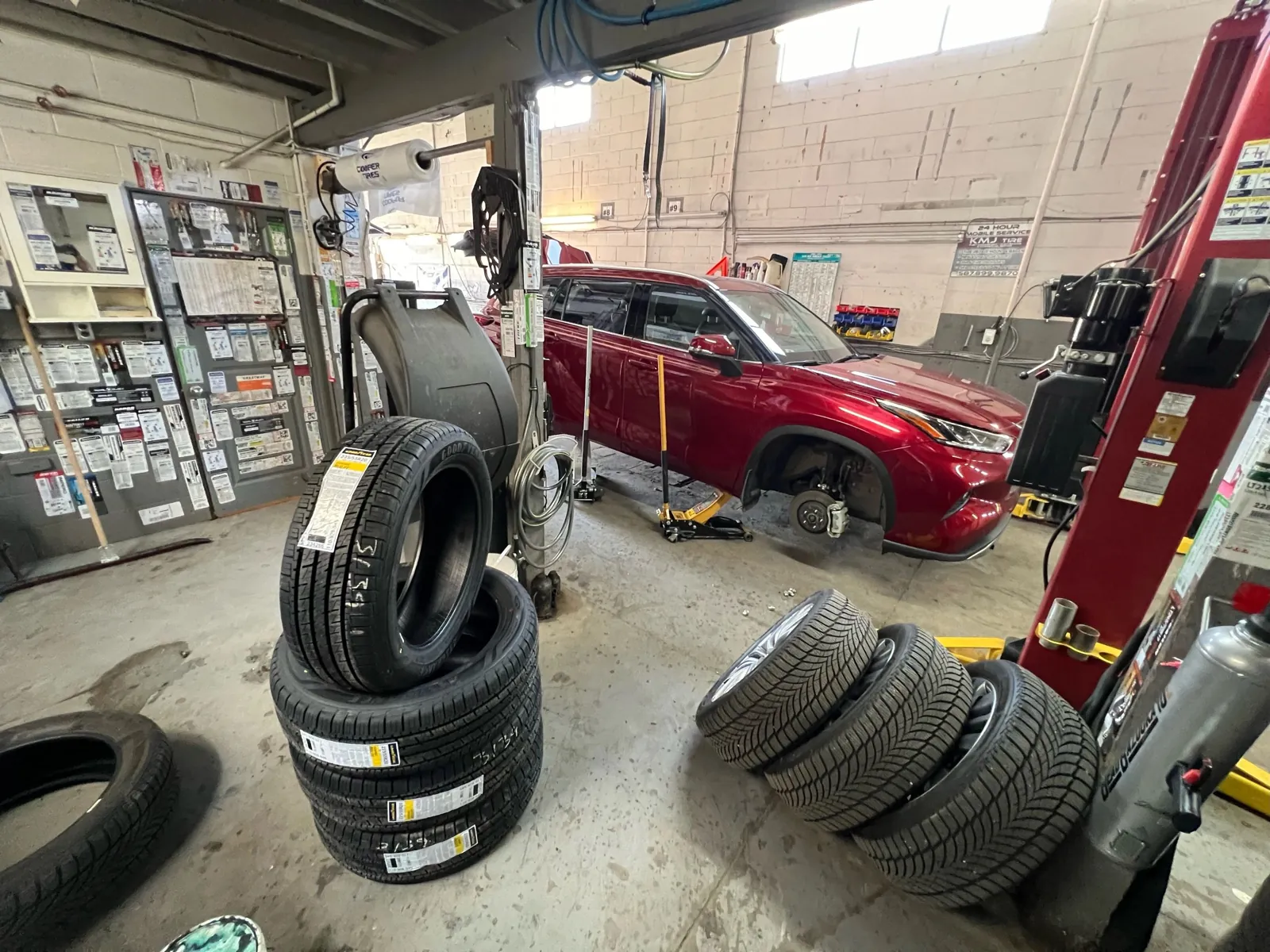
Your lease ends soon, the winter wheels are on the vehicle, and the original tires are somewhere in storage. Do you need to buy a new set before returning the keys? Not necessarily. First obtain the return rules for your actual lease, identify every tire and wheel you plan to return, and arrange the required condition assessment. Then address documented deficiencies with a replacement plan that is safe for the vehicle and acceptable to the lessor. Buying four tires before those questions are answered can solve the wrong problem.
A lease-return decision has two separate tests. The vehicle must remain suitable for the driving you still need to do, and the returned equipment must satisfy the applicable agreement. Passing one test does not automatically pass the other. A serviceable winter set may be unsuitable for a particular return date or wheel requirement. A tire above a contractual tread threshold may still need professional attention because of damage. Keep roadworthiness and contract acceptance on separate lines of your notes.
This guide is for Calgary drivers returning ordinary passenger cars, SUVs and light trucks. It explains a practical sequence, not a universal lease inspection standard. The examples are hypothetical. Your finance provider's current Canadian instructions, your signed agreement and the vehicle manufacturer's requirements control the actual decision. KMJ can help with tire questions and tire service; the lessor or its appointed inspector decides lease acceptance. Mechanical concerns belong with an appropriate mechanical specialist.
Start with the company that owns the agreement
A dealership name on a key tag is not enough to identify the return rules. Find the finance provider named on your lease and confirm which Canadian return guide applies to your account. A manufacturer's public guide can be a useful starting point, but agreements, products and procedures differ. A friend who returned another brand's vehicle without a tire charge is describing their experience, not establishing a rule for yours.
Locate the maturity date, return arrangements, excess-wear information and any relevant protection product. Keep those documents together. If a document uses unfamiliar wording, ask the provider to explain it in writing before choosing a replacement. Useful questions are precise: Does this agreement require original wheels? What tire matching is required? Is there a seasonal restriction? What evidence is needed after correcting an inspection item? You want answers tied to your agreement rather than a general assurance that tires are usually fine.
Be clear about who can approve an exception. A service adviser, salesperson and finance representative may have different responsibilities. If someone says an alternate wheel set is acceptable, ask whether that statement is an authorized decision for your return and how it will appear in the record. Written clarification prevents a rushed discussion at the parking lot from becoming the only evidence of what was agreed.
The tire business can explain the fitted equipment without interpreting the lease on the finance provider's behalf. KMJ's local Calgary tire service information helps establish the tire-service side of the process. Keep any request for contractual acceptance directed to the organization responsible for that decision.
Read a real return standard without turning it into a universal rule
One current example shows why assumptions are risky. On its Canadian lease-end page, GM Financial lists tread depth greater than 3 mm at the shallowest point, including the spare, in its acceptable category. It also describes manufacturer-recommended tire guidelines, matching type and brand on each axle, and original manufacturer wheels. Those details are not interchangeable with a casual statement that the tires still have tread.
The same public page says winter or snow tires are acceptable for returns from November 1 through April 15, provided the other stated requirements are met. It lists studded tires among items needing attention. This is a specific provider's published guidance, checked for this article on October 19, 2026. It is not permission to apply those dates or measurements to a different lease, nor a guarantee that any particular GM vehicle will pass inspection.
Read the wording literally. Greater than a threshold is different from equal to it. At the shallowest point is different from an average across the four tires. Original wheels is a separate issue from tire size. A seasonal allowance does not erase damage or matching requirements. Ask how the rules apply to your vehicle if the public summary leaves anything unresolved.
The broader lesson is to extract the actual conditions into a short checklist. Do not copy a number from an online discussion and spend money around it. The GM Financial Canadian lease-end guidance is a useful worked example because it shows several independent requirements in one place; your own return standard remains the one to follow.
Choose the inspection date before choosing the replacement date
An early assessment gives you room to investigate, compare appropriate tires and arrange any permitted correction. Waiting until the last drive can leave you choosing between an unverified purchase and accepting an unexplained charge. Ask the provider when inspection can occur, who performs it, where it may take place and whether it is optional or required for your agreement.
Ford Credit Canada's public lease-end page describes a self-assessment before its third-party final inspection and says an inspection can be scheduled within 90 days of lease end. GM Financial describes a complimentary, optional pre-return inspection. These examples illustrate different processes; they do not mean every driver receives the same timing or service. Use your provider's instructions to build your own calendar.
Work backward from the confirmed return date. Leave time to retrieve the seasonal set, obtain an assessment, ask for clarification and carry out an approved correction. Also allow for the kilometres you expect to drive between assessment and return. An inspection is a record of condition at a particular time, not a promise that further wear or damage cannot affect the final result.
If the vehicle will be unavailable during your preferred inspection window, resolve the logistics early. For example, a work trip may make it more sensible to inspect before departure and review any new issue afterward. Do not change a return date or assume a grace period based on tire scheduling alone. The finance provider must confirm any change to the agreement or return arrangements.
Inventory what came with the vehicle and what you own separately
Make two lists: equipment associated with the leased vehicle and equipment you acquired separately. Include the fitted tires, original wheels, seasonal wheels, wheel covers or centre caps where applicable, the spare or mobility equipment, and any wheel-lock key. The point is not to decide ownership by memory. It is to identify what needs documentary clarification before the return.
A winter package may have been purchased separately, included in a negotiated deal, financed through another arrangement or described in the lease paperwork. Those situations can produce different expectations. An invoice can help show what was supplied, but the relevant agreement still determines what must be returned. Do not sell, transfer or discard a set until you know whether it is required.
Check physical quantities as well as paperwork. Four bags in the garage are not proof of four usable original assemblies. Open them where it is safe to do so, identify each item and check that accessories have not been separated. If the tires are stored by another business, request the inventory and retrieval procedure. Allow time for that business to locate the set instead of assuming immediate access.
For two-set households, use clear labels that identify the vehicle and season without exposing personal information unnecessarily. KMJ's seasonal tire changeover information can help you distinguish a mounted-wheel changeover from remounting loose tires. That difference affects the work required, but neither service determines which set the lessor wants back.
Record each wheel position rather than describing the set as good
A useful record has one entry for each fitted position. Write down the tire brand, model, full size, service description, visible condition and any measured tread readings. Add a separate entry for the spare if the vehicle has one. If the car uses different approved front and rear sizes, preserve that distinction. A single size written at the top of the page can hide a staggered setup.
Photograph the sidewall and tread in adequate light. Take an overview that shows which assembly is being recorded, then close views of markings or a concern. Avoid claiming that a photograph proves the entire tire is sound. Inner sidewalls, internal construction and areas blocked by the vehicle may not be visible. Never crawl beneath an unsupported vehicle or lift it merely to complete a return checklist.
Use consistent position labels, such as left front and right rear, and state that left and right are viewed from the seated driving position. If the assemblies move later, update the record. Otherwise an old photograph can be mistakenly associated with the wrong corner during a discussion about wear. Good records should make a correction easier to follow, not create a second mystery.
KMJ's tire sidewall identification guide is useful when translating the markings into a clear request. Send the whole specification and vehicle identity rather than a cropped picture of the brand name. The more exact the identification, the less likely you are to compare products that only appear equivalent.
Measure tread as evidence, not as a prediction of acceptance
A tread gauge is more informative than a distant photograph or a statement that the wear bars are not showing. Record the unit and the location of each reading. Check suitable major grooves in several places across the tread and around the circumference, following the gauge instructions. Do not mistake a raised wear indicator for the groove floor. If you are unsure how to obtain a representative measurement, have a tire professional do it.
Keep the individual readings instead of averaging them into one reassuring number. Consider a hypothetical tire with readings of 4.5, 3.8 and 2.9 mm at the inspected points. An average above 3 mm does not meet a rule requiring more than 3 mm at the shallowest point. This example explains the arithmetic, not a pass or fail for your lease. Your provider's method and criteria govern its assessment.
Measurement uncertainty matters near a threshold. A rounded display, debris in a groove, an angled gauge or a different measurement location can affect the result. Do not plan to return a tire exactly at a limit while expecting every reading to round favourably. Ask the inspector which measurement created the concern and whether another assessment is appropriate if your record differs.
Tread depth also does not describe every part of tire condition. Cuts, bulges, uneven wear or a history of running underinflated can require attention independently. The practical tire-care guidance on the main site can help organize routine checks. A return measurement is one piece of evidence, not a complete safety certificate.
Separate a shallow shoulder from a mechanical diagnosis
Suppose the centre grooves appear healthy but one shoulder is much more worn. That observation deserves attention, but it does not tell you precisely which component or operating condition caused it. Driving history, inflation, vehicle setup and mechanical condition can all be relevant. A photograph cannot reliably decide the cause. Record what is visible and seek the appropriate assessment instead of naming a fault yourself.
Replacing a tire without addressing an unresolved cause can allow the new tire to develop similar wear. This matters even near lease end because the vehicle still has to be driven safely. If the tire professional identifies a concern outside tire service, coordinate with a qualified mechanical specialist. KMJ's role in this guide does not include performing steering, suspension, brake or alignment work.
Ask for distinct findings. One line should describe tire condition and replacement needs; another should identify any recommended mechanical referral. That separation keeps the tire invoice understandable and prevents a broad phrase such as front-end problem from becoming an unsupported diagnosis. It also gives the finance provider clearer evidence if the return assessment raises a related question.
Do not use wheel balancing as a catch-all solution for uneven wear or pulling. KMJ's wheel balancing service details explain a tire-and-wheel service, not a promise to correct every vibration or vehicle fault. Describe the symptom accurately and let the relevant professional determine the scope before authorizing work.
Confirm the replacement specification before comparing brands
The return guide may describe matching or originality, while the vehicle manufacturer specifies the approved fitment. Both need to be satisfied. Begin with the vehicle's actual identity and manufacturer guidance, not only what is fitted today. A previous owner, driver or service event may have changed the tires. Existing equipment is evidence of what is present, not automatic proof of what is correct.
The U.S. Tire Manufacturers Association advises that replacements use the size, load index and speed-rating designation recommended by the vehicle or tire manufacturer. It cautions against reducing the originally specified size or load-carrying capacity. This technical guidance does not determine a Canadian lease charge; it helps establish a sound replacement starting point before the contractual conditions are added.
Ask whether the exact original tire model is required or whether an appropriate alternative is acceptable under the agreement. Do not assume either answer. If alternatives are allowed, they still need to satisfy vehicle requirements and any tire-matching rules. A familiar brand name does not make every product in its range equivalent, and the same size does not establish the same service description.
Use the tire load-index explanation to understand why capacity cannot be reduced simply to lower the bill. Then put the confirmed specification on every request for an estimate. You can compare suitable alternatives fairly only after each supplier is answering the same technical and contractual question.
Treat one-tire replacement as a vehicle-specific decision
A single damaged tire near the end of a lease creates an understandable temptation: replace only that corner and move on. Sometimes a limited replacement is possible, but the decision requires more than matching the numbers on the sidewall. Remaining tread, model compatibility, axle matching and the vehicle manufacturer's requirements all need consideration. Some drivetrains have specific limits that cannot be guessed from a general article.
USTMA recommends replacing all four tires together for optimal performance and provides guidance when fewer are replaced. Its replacement page also warns that a single replacement can affect the vehicle and treadwear. Those general principles are useful, but they are not a universal instruction to move tires around a staggered or otherwise restricted setup. Follow the applicable vehicle and tire guidance for the actual assemblies.
Give the tire professional the tread readings and identification of the remaining tires, plus the lessor's requirements. If the original model is unavailable, ask what combination is technically appropriate and whether the provider accepts it. Do not authorize a substitute based only on a claim that the inspector probably will not notice. The goal is a documented, suitable configuration, not a cosmetic resemblance.
KMJ's Calgary tire buying guidance can help frame that comparison. Request an explanation of why the proposed quantity is needed. A defensible recommendation should connect to condition, fitment, matching or manufacturer guidance rather than treating every lease return as an automatic four-tire sale.
Plan the seasonal set around the return date and the remaining drive
A Calgary return can land between seasonal needs. You may need winter capability for the remaining weeks but face a provider's rule about what equipment it accepts on the return date. Start by asking which set must be presented, whether a seasonal allowance applies and whether original wheels remain required. A winter-tire allowance and permission to return aftermarket wheels are not necessarily the same thing.
Do not create an unsafe driving plan to satisfy a paperwork preference. If the required return configuration is unsuitable for the conditions you expect, discuss timing, approved alternatives or appropriate transport with the provider. Do not assume a calendar date predicts pavement conditions. The last journey to the return location is still a real journey, not an exception to tire suitability.
Think through the handover sequence before scheduling service. If winter assemblies come off shortly before return, where will they go, who owns them and how will they be transported? If original tires must go back onto original wheels, is their condition known? Discovering an unusable stored set after the current wheels have been removed can cause avoidable disruption.
For the remaining winter use, review winter tire options for Calgary driving against the vehicle's needs. That information supports a seasonal tire decision; it does not authorize a lease exception. Obtain the provider's response separately and save it with the return checklist.
Do not let category names substitute for approval
All-season, all-weather and winter are useful tire categories, but they are not interchangeable contract terms. A return guide may use its own wording. Ask how the provider classifies the exact tire model you intend to present rather than assuming a marketing description fits the rule. Supply the full model and relevant markings so the response concerns your tire, not an abstract category.
If you are considering a replacement that you will drive for several months, the remaining season matters as well as the return. An acceptable return tire should not be selected without regard to its actual application. Conversely, choosing a capable tire for your route does not establish that it meets original-equipment or axle-matching conditions. Keep these questions separate until both have answers.
The main site's all-weather tire information and all-season tire selection guidance explain choices you may encounter. Use them to improve the conversation, not to claim that one category guarantees a pass. When a rule is ambiguous, a written answer from the provider is more useful than several conflicting online opinions.
Avoid swapping sets solely to conceal a condition issue during an early assessment. The final returned vehicle is what matters, and a changed configuration can make the earlier record less useful. If you legitimately change tires after inspection, disclose the correction through the provider's process and retain the new evidence.
Inspect original wheels and accessories as their own category
A new tire cannot correct a missing original wheel, an unacceptable wheel substitute or an unresolved wheel-condition item. Inspect the wheels separately from the rubber. Note visible damage, missing centre caps where relevant and the identity of any aftermarket set. Do not assume a matching diameter or bolt pattern proves that a replacement wheel satisfies the lease.
A scratch described in the return guide may be a contractual issue even when the assembly remains usable. A crack, suspected bend or air-loss concern is a different question that requires technical assessment. Keep the description neutral until evaluated. A close photograph can support a discussion, but it cannot prove that a wheel is structurally sound or determine whether cosmetic work is appropriate.
Ask the provider whether a proposed wheel correction is allowed and what documentation it requires. This guide does not promise that refinishing, replacement or another intervention will be accepted, and it does not describe wheel refurbishment as a KMJ service. If specialist wheel work is being considered, use an appropriate provider and obtain the lessor's requirements before proceeding.
Check for the wheel-lock key while there is still time to resolve a missing one. Store it in the designated location and tell the service professional where it is. Do not place small hardware loose inside tire bags where it can be lost. An inventory photograph and a clear written list make the eventual handover more reliable.
Include the spare or mobility equipment without inventing what was supplied
Not every vehicle comes with a spare tire. Some use a compressor and sealant kit, while others have a different manufacturer-approved arrangement. Start with the vehicle documentation and the original supplied-equipment record. Do not buy a spare merely because another trim has one, or assume a missing spare is normal because a similar model uses a kit.
If there is a spare, include its condition and pressure in the checks applicable to that type. A compact temporary spare is not simply another full-size road tire. Its instructions and limits remain important. A tire that has been hidden under the cargo floor can be overlooked for years, and the absence of use does not establish its condition.
For a mobility kit, verify the components and follow the manufacturer's inspection and replacement directions, including any marked sealant expiry. If the kit was used, document that fact and confirm what must be replenished. Do not conceal a used canister or assume that putting an empty container back satisfies the equipment requirement. Ask the provider how a missing or consumed item is handled.
An unexplained warning or flat tire should be dealt with before the return trip. KMJ's emergency tire-service information can help identify the tire-assistance route, subject to confirming suitability and availability. It is not a substitute for the vehicle's emergency instructions or a promise that a temporary repair is acceptable for return.
Handle a puncture as a safety problem before a paperwork problem
Finding a nail shortly before turn-in does not mean you should immediately buy the cheapest replacement or try to hide the injury. A tire professional needs to assess whether repair is possible under the relevant tire guidance. The location and extent of damage, internal condition and service history matter. An external view alone cannot establish that the tire is repairable.
Tell the professional whether the tire lost pressure, was driven while low or received temporary sealant or another intervention. That history can affect the assessment. Do not remove an embedded object to create a cleaner photograph. If pressure is falling or the tire is visibly damaged, follow a safe assistance plan rather than driving to meet the return deadline at any cost.
Ask two different questions: Is the proposed repair appropriate for this tire, and will the lessor accept a properly repaired tire under this agreement? The first belongs with the tire professional and manufacturer guidance. The second belongs with the finance provider. A technically acceptable repair does not force a provider to accept every condition, and a return policy cannot make an unsafe repair sound.
The Calgary tire repair service page is a starting point for the service discussion. Preserve the assessment and invoice if work is performed. Avoid treating a plug, an erased warning or a tire that temporarily holds air as proof that the underlying issue has been resolved.
Keep inflation and warning-system records honest
Routine pressure care continues until the vehicle is handed over. Use the vehicle's recommended cold inflation information for the approved fitment and check with a gauge. USTMA's tire-care guidance recommends monthly checks and checks before long trips, including the spare. Its definition of a cold tire includes being parked for at least three hours. Follow any more specific instructions for your vehicle.
Do not inflate to an arbitrary sidewall number or raise pressure to disguise a leak during inspection. A persistent loss needs assessment. Record the measurement conditions if you are comparing readings: a rested vehicle and one just driven on the highway are not equivalent. A useful note says what was measured and when, rather than declaring that the pressure always stays perfect.
A pressure-monitoring warning should not be cleared merely to make the dashboard look ready. After a legitimate tire or wheel change, the system may require the vehicle-specific reset, relearn or other prescribed procedure. Ask what was done and whether normal operation was verified. System design varies, so a generic internet sequence may be wrong for your model.
If the warning returns, follow up before return and tell the provider about any unresolved condition. Removing evidence of a warning is not the same as correcting its cause. This is also why a clean dashboard photograph cannot replace the tire record: it describes one moment, not every pressure, sensor and tire-condition question.
Compare the full correction cost with an actual assessment
The financial question is not simply whether a set of tires costs less than an imagined penalty. Start with a documented inspection item and the provider's explanation of any charge. Then obtain an estimate for an acceptable correction. Do not invent a charge from a forum, and do not assume that a preliminary estimate is necessarily the final amount owed.
An estimate should identify the tires, quantity and service scope. Clarify mounting, balancing, applicable valve or sensor work, disposal, taxes and any other relevant items. Ask what is included rather than assuming a low headline figure covers everything. Compare like with like, especially if one proposal uses a different model, quantity or return configuration.
There may also be practical costs: arranging transportation, retrieving a stored set or attending another assessment. Those considerations are legitimate, but they do not justify driving on an unsafe tire. If the only issue is contractual and the tires remain appropriate for use, the provider can explain the options for correcting it or accepting the assessed charge. The choice should be based on confirmed terms.
Once the specification is settled, browse Calgary tire selections with that exact requirement in hand. Availability and pricing must be confirmed for the actual product and date. No article can promise that a particular replacement is on hand or that replacing tires will eliminate all lease-end charges.
Ask what protection covers before counting on it
An excess-wear product, tire protection plan and manufacturer's tire warranty are different arrangements. Their names do not establish that they cover the same event. Read the relevant contract and ask the administrator which terms apply to the specific condition. A puncture, ordinary wear, cosmetic wheel damage and missing equipment may be treated differently.
Confirm whether authorization is required before service, which documentation is needed and whether an approved provider must be used. Do not spend money assuming reimbursement will follow. Equally, do not delay dealing with an unsafe tire while waiting for a claim discussion; arrange safe transport or stop using the vehicle as appropriate while the administrative question is resolved.
Ask how limits, exclusions, deductibles or other conditions apply, if they are part of your agreement. This guide does not state that any particular protection product pays for tires or waives return charges. The useful result is a written answer identifying the condition, coverage decision and required next step, not a general statement that you bought protection.
If several organizations are involved, keep their roles distinct. A tire manufacturer may evaluate a warranty concern, a protection administrator may decide reimbursement, and the lessor may assess the return. Approval from one does not automatically settle the others. Save each decision under its own heading so you can see which question remains open.
Use a small evidence file that another person can understand
A practical folder contains the applicable return guide, the inspection report, written clarifications, tire identification, dated photographs, estimates and final invoices. Add the confirmed return arrangements and a short list of unresolved items. Avoid burying the important answer inside a long message thread. A one-page summary can point to the supporting files without trying to replace them.
Keep originals of photographs and documents. If you annotate a picture with a wheel position, retain an unaltered copy too. Do not edit away damage or crop the only identifying feature. The purpose is to make the evidence easier to interpret honestly. Note when a measurement was taken and who took it, especially if a later reading differs.
Share only what is needed with each service provider. A tire business usually needs vehicle identity, specifications and the relevant return requirements, not your complete financial history. Redact unrelated account information from copies where appropriate while preserving the originals for your own records. This keeps the conversation focused on the work being requested.
For the actual visit, review mobile tire-service arrangements and the Calgary-area service coverage if an on-site option would help. Confirm the location, access and service suitability directly. A website description does not guarantee that every parking area or requested time can be accommodated.
Work through a November return with two seasonal sets
Imagine a driver returning a leased SUV in November. Winter tires are installed on separately purchased wheels; the original wheels and all-season tires are stored elsewhere. The driver initially assumes the winter set can remain because the date is in winter. That assumption skips wheel requirements, ownership of the second set, tire matching and the condition of the stored equipment.
The first step is to obtain the actual provider's instructions. Suppose the provider confirms a seasonal allowance but still requires original wheels. The driver now has a clear question for the tire professional: what approved tire configuration can be presented on those wheels while preserving a suitable plan for the remaining driving? There is no reason to guess at this before retrieving and identifying the stored set.
Next, the original assemblies are assessed and the driver receives a written condition record. If the tires need replacement, the proposal uses the confirmed vehicle specification and return requirements. If they are usable and accepted, unnecessary replacement can be avoided. The separately owned winter wheels remain a separate asset, subject to the paperwork confirming that they are not part of the return.
Finally, the driver arranges the change and handover in a sequence that does not leave the vehicle on inappropriate tires for the trip. The lesson is not that every November return needs a particular category. It is that the calendar, wheels, tire condition and ownership must all agree before the service plan is complete.
Resolve a borderline reading without arguing from an average
Consider a second hypothetical case: an assessment flags one tire's shallowest groove, while the driver remembers a higher reading from the centre. Begin by asking for the measured position, unit and applicable criterion. A difference can arise because the two people measured different areas. It is not automatically evidence of an error or an unfair charge.
Arrange a competent recheck if the discrepancy remains material. Record several readings and ask for the condition finding, including any uneven wear. If the tire really falls outside the return standard, discuss a suitable correction. If the earlier record was mistaken, ask the provider how to update it. A clear measurement trail is more persuasive than repeating that the other three tires look new.
If replacement is needed, do not select the quantity from the invoice concern alone. The vehicle's matching requirements and remaining tires still matter. A one-tire charge on an inspection report is an administrative finding; it is not necessarily a technical instruction to replace exactly one tire. Let the replacement plan follow the actual vehicle requirements and then clarify its documentation with the provider.
Keep any revised report alongside the original so the sequence is understandable. Do not discard the first assessment or present an old favourable photograph as current proof. The strongest resolution explains what was found, what changed and what evidence now supports the returned condition.
Finish the handover with a record, not a promise
Before the last trip, confirm the return location and arrangements, check that required accessories are present and review any unresolved tire issue. Take dated photographs of the actual configuration being returned. If a new puncture or warning appears after the earlier inspection, deal with it and document it rather than relying on the old report.
At handover, obtain the receipt or confirmation provided through the lessor's process. Check that it identifies the vehicle and records the return accurately. GM Financial's public guidance, for example, describes a vehicle check-in receipt and odometer statement, with an end-of-term invoice potentially following later. A receipt for the keys is not necessarily a declaration that every financial matter is settled.
Retain the inspection and correction evidence until the account is resolved. If a later tire charge seems inconsistent with the records, ask for the supporting assessment and compare the exact item. Focus on dates, wheel positions, specifications and documented work. A calm, specific question gives the provider something it can investigate.
You do not need to become a tire inspector to manage a lease return well. You need a clear sequence: establish the rules, identify the equipment, assess the condition, resolve the actual deficiencies and preserve the handover evidence. That sequence can prevent unnecessary purchases while keeping the final weeks of driving safe and the return discussion grounded in facts.
Sources and the limits of this guide
The provider examples come from the Canadian GM Financial page linked above and Ford Credit Canada's lease-end process, checked on October 19, 2026. They support the specific inspection-process examples, not universal rules for every lease. Confirm current instructions with your provider before acting, particularly where an account-specific agreement or written clarification differs from a general public summary.
Technical foundations come from USTMA's replacement-tire guidance and its tire-care essentials. These support specification checks, careful decisions about partial replacement, gauge-based inflation checks and attention to uneven wear. Vehicle and tire manufacturer instructions remain necessary for model-specific limits. USTMA is a technical source here, not the authority for Canadian lease acceptance.
The recordkeeping suggestions, comparison framework and scenarios are practical planning tools, not legal interpretations or promised outcomes. For related tire education beyond the return itself, the main Calgary tire advice library offers further reading. Bring the provider's actual requirements to the tire discussion, and ask the provider to decide the contractual questions. That division of responsibility makes the whole process more useful.