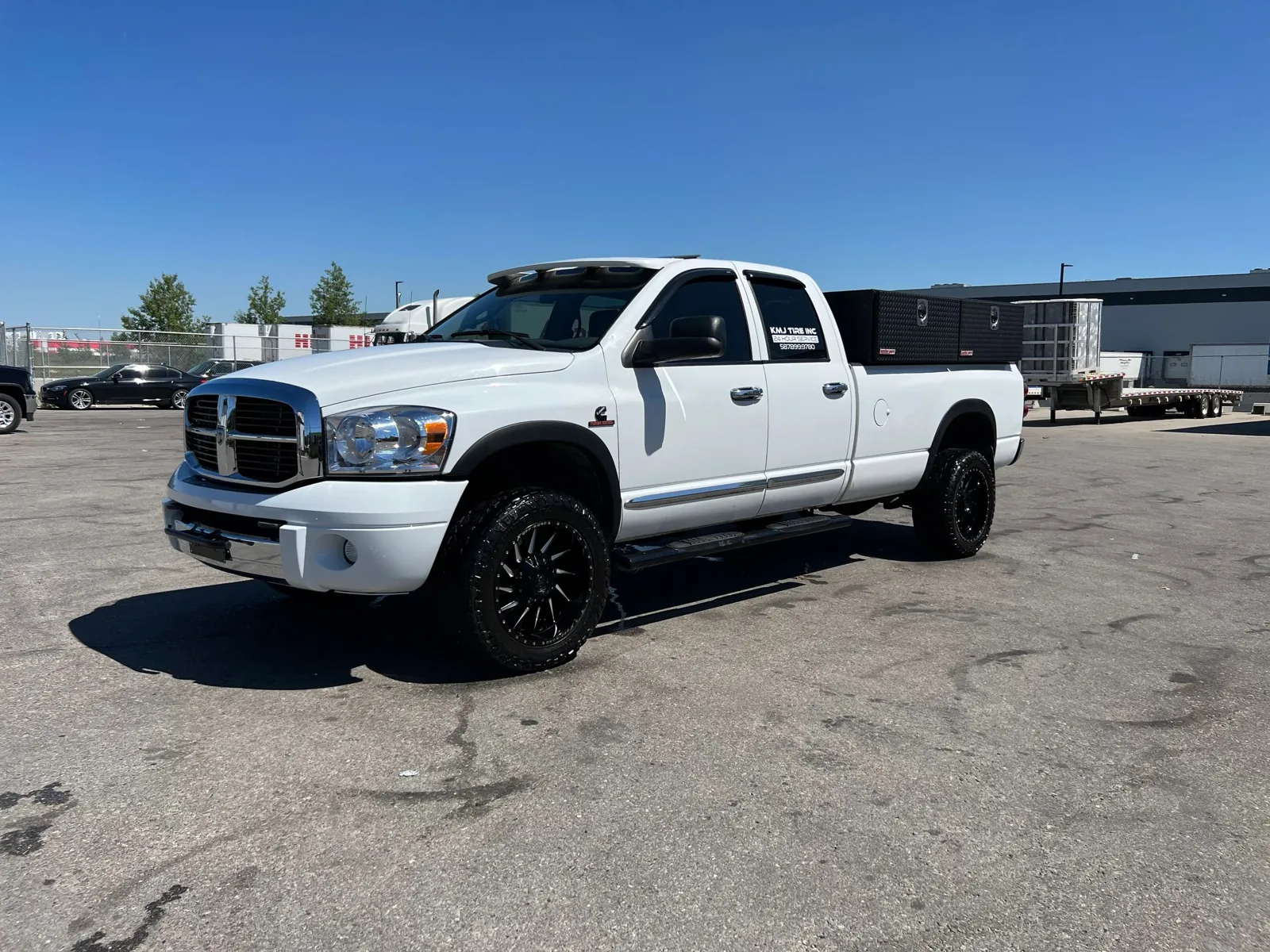
Will a bigger tire work on your lifted pickup just because it clears the fender? No. Space around a parked tire is only one part of the decision. The exact tire, wheel, load requirement, inflation plan, vehicle instructions and modification documentation all need to agree. Before spending money on a set, identify what is actually installed and have the complete combination reviewed. If the lift or wheel specifications are unknown, resolving that uncertainty comes before choosing a tread pattern.
This guide is for Calgary pickup owners who inherited a modified truck, are replacing worn oversized tires, or want a winter set for a truck that no longer matches its original wheel configuration. It is not a lift installation tutorial or a promise that any particular conversion is suitable. KMJ provides tire services and oil changes. Suspension changes, steering concerns, alignment work, electronic calibration and approval of vehicle modifications belong with the appropriate qualified specialists. Keeping those responsibilities separate makes a tire purchase much easier to organize.
Start by describing the truck you have, not the truck online
Two pickups with the same badge can have different original equipment, axle ratings, wheels and modification histories. A photograph from an online discussion may show a combination that looks similar without revealing the details that matter. Even a previous owner's statement that the truck has always run that size is a history note, not a specification. The useful question is not whether someone has made the tire fit. It is whether the documented combination is suitable for this particular truck and its intended use.
Gather the year, model, trim and vehicle identification information, then photograph the original tire placard and certification labels. Record the current tire size from every position. Include prefixes, load range, load index and speed symbol instead of copying only the large size numbers. If the rear tires differ from the front, preserve those differences in your notes. Do not silently assume the arrangement was intentional or approved. A replacement decision should expose discrepancies, not inherit them without discussion.
Next identify the lift or levelling system by manufacturer and part number where possible. An invoice, installation record or readable component label can be more useful than a seller's memory of its advertised height. Ask the suspension specialist to explain what that specific installation permits and requires. For an overview of the information normally needed for a tire purchase, the Calgary tire-buying checklist provides a starting point. A modified vehicle needs that baseline plus the modification records, not a substitute for the baseline.
Separate three changes that often get called bigger tires
A larger wheel diameter, a taller tire and a wider tire are different changes. They may occur together, but they do not have to. A wheel can become larger while a lower-profile tire keeps the overall outside diameter close to the original combination. Another setup may retain the wheel and increase tire diameter. A third may mainly change section width. These differences affect which dimensions and manufacturer instructions need attention; the phrase bigger tires does not identify the work involved.
Toyo's public plus-sizing guidance describes changing tire and wheel dimensions and distinguishes several plus-size arrangements. Its examples are general explanations, not approval for a lifted pickup. In particular, a rule of thumb intended to explain wheel diameter changes cannot establish clearance, capacity or electronic compatibility on a modified truck. Use the explanation to understand the vocabulary. Use vehicle-specific instructions and the exact product specifications to make the actual decision with the relevant professionals.
Write your objective in ordinary language before comparing products: retain the existing wheels, restore a documented specification, obtain an approved seasonal combination, or replace the exact current tire model. Each objective produces a different search. Someone trying to keep an existing set of wheels should not start by choosing a tire that requires a different rim width. Someone seeking predictable winter commuting should not start by maximizing visual size. The goal gives the technical checks a purpose and helps prevent an attractive listing from deciding the whole project.
Read the current sidewall as evidence, not as permission
The tire already mounted on the truck tells you what someone installed. It does not prove what the vehicle should have. Copy the complete designation, manufacturer, product line and any relevant markings before discussing replacement. A sidewall photograph should be readable enough to distinguish a letter from a number. Take several images around the circumference when one frame cannot capture everything. If a marking is hidden, ask for help obtaining it safely rather than crawling beneath an unsupported vehicle.
The guide to tire sidewall information helps organize the different markings. Size, capacity and speed information answer different questions. A large outside diameter cannot compensate for insufficient load capability. An aggressive tread cannot establish winter performance. A load-range letter does not describe every aspect of a tire's suitability. Keeping those categories separate prevents the common mistake of treating one impressive-looking number as an overall rating for the assembly.
Compare all four tires individually, even when their tread looks alike. Tires of similar appearance can differ in size, service description or product version. Record the spare separately rather than copying a road tire's details onto its line. Also note any visible rubbing, cuts, deformation or irregular wear without deciding their cause from appearance alone. Those observations are reasons for professional assessment. They are not a basis for choosing a larger replacement in the hope that the new tire will hide an unresolved problem.
Find the wheel specification before narrowing the tire list
A tire's rim diameter must match the wheel's specified bead-seat diameter, but diameter alone does not establish compatibility. Wheel width, construction, load rating, pressure limits and the wheel manufacturer's application information also matter. Obtain the wheel make and part number rather than relying on its finish or spoke pattern. If the identifying marks cannot be read while installed, arrange a suitable inspection. Do not remove components simply to solve a shopping question unless the work can be carried out safely and correctly.
The exact tire manufacturer's approved rim-width range should be checked for the specific size and product. A measurement from a classified advertisement is not necessarily a bead-seat measurement, and the outside edge of a wheel is not a substitute for its official specification. Similarly, the fact that a tire can physically be mounted is not an endorsement of that pairing. Ask the tire professional to identify the documentation used, particularly when a previous owner combined parts from several suppliers.
The practical value of this step is that it can eliminate unsuitable choices before money changes hands. Perhaps the existing wheel is appropriate for one proposed tire but not another. Perhaps the wheel cannot be positively identified at all. In the second case, the answer is to resolve the wheel question, not to select the most forgiving-looking tire. You can use the main-site tire selection page to explore options once the required specifications are known; a product listing by itself is not a fitment certificate.
Ask a specialist to evaluate clearance through movement
A tire sitting neatly inside a wheel opening is a static observation. Steering and suspension movement create other positions. Cargo, passengers and trailer loading change the truck's operating condition as well. The qualified specialist evaluating the modification needs to determine the relevant checks for that vehicle, including any interaction with suspension components, steering components, bodywork and other nearby parts. This is not a driveway experiment in which the owner deliberately forces contact to see what happens.
Describe existing symptoms precisely. Does a sound occur while turning into a sloped driveway, after loading the bed, or only at one steering angle? Has anyone noticed polished areas, disturbed liners or marks on a tire? Provide observations and photographs where safe, without repeatedly driving to reproduce the symptom. A noise that disappears when the truck is empty does not make the loaded condition acceptable. The condition in which the problem occurs is useful evidence for the person assessing it.
Do not treat trimming a liner, adding a spacer or changing a wheel as an automatic tire-service solution. Those changes can introduce new questions and require their own assessment. This article does not recommend them or supply a universal clearance distance. Obtain a documented answer for the complete arrangement. If the truck needs suspension or steering work before tire selection can be finalized, have the appropriate specialist handle that work. KMJ's tire role does not extend to approving or performing those mechanical modifications.
Keep load capacity separate from the height of the truck
A truck that sits higher does not acquire a higher payload rating just because of its stance. Work from the vehicle's documented limits and the specifications applicable to its modifications. Tires are one part of the load-carrying system, not permission to exceed the rest of it. Tools, passengers, permanent accessories and trailer load all belong in the operating picture. A comparison based on the empty truck can miss the reason the owner bought a pickup in the first place.
USTMA's replacement guidance says to follow the size, load index and speed rating recommended by the vehicle or tire manufacturer, and not to reduce the originally specified size or load-carrying capacity. For a non-original combination, that means obtaining a justified recommendation rather than substituting appearance for engineering. The tire load-index explanation can help you understand the language used in that conversation. It does not replace a review of the actual vehicle and tire combination.
If the pickup works loaded, describe the load honestly. A canopy that remains installed, a bed drawer system and permanently carried equipment are not occasional items merely because they are easy to overlook. Where actual weights are needed, obtain suitable scale measurements and have them interpreted against the applicable limits. Do not invent left-to-right distribution from an axle total. Nor should you divide the truck's maximum rating by four and assume the resulting number defines a safe tire specification for every position and condition.
Establish an inflation plan for the approved combination
The original placard and owner's manual are the starting references for original-equipment tire inflation. When a truck has a different approved tire size or construction, the correct approach is not to copy a pressure from another lifted pickup or inflate every tire to its sidewall maximum. Toyo publishes load and inflation information specifically to assist with optional sizes that may not appear on the placard, while directing owners to their vehicle instructions and professional assistance. That distinction matters when the tire category changes.
Ask the tire professional to explain the recommended cold inflation settings and the source used to determine them. The answer should identify the actual tire specification and any relevant loaded operating condition, not just say that larger tires usually use a certain number. Keep the recommendation with the vehicle records. If the recommendation depends on information that has not yet been confirmed, such as a wheel rating or a load measurement, resolve that dependency before treating the number as ready for use.
The practical tire-care guide is useful for building pressure checks into ordinary ownership. A modified setup still needs a repeatable checking routine. Do not use a softer ride as proof that a lower pressure is suitable, or a firm sidewall as proof that the tire is carrying its load correctly. Pressure is not a tool for concealing rubbing, correcting an unsuitable wheel pairing or compensating for overloaded equipment. Those are separate problems requiring separate answers.
Discuss vehicle systems without promising a universal fix
Changing overall tire dimensions can raise questions about the information the vehicle uses and displays. The appropriate vehicle or modification specialist should determine whether speed indication, distance recording, driver-assistance functions or other systems need evaluation for the proposed combination. The exact requirements depend on the truck and the change. There is no single adjustment described here that makes every larger tire acceptable, and a dashboard that shows no warning does not by itself approve a conversion.
Keep tire-pressure monitoring separate from the inflation calculation. A system's compatibility, sensor requirements and any prescribed relearn procedure should be checked for the vehicle and wheel assembly. Ask what monitoring behaviour to expect after the work, and how an unresolved warning will be handled. Do not accept disabling a warning as a substitute for resolving its cause. Equally, do not assume that the existence of sensors supplies the correct inflation specification for a tire size that differs from the original setup.
This is a coordination task. The tire provider needs the approved tire and wheel information; the specialist responsible for the modification needs to address vehicle-system implications. A written division of responsibility prevents each person from assuming somebody else checked the missing item. For ordinary questions about tire-service arrangements, consult the KMJ service questions page. For calibration or mechanical questions, identify the correct specialist rather than bundling those services into a tire appointment that does not provide them.
Choose for Calgary pavement before choosing a tread image
Many modified pickups spend most of their time on paved roads even if their appearance suggests otherwise. Write down the real mix: urban commuting, highway travel, gravel access, construction sites or recreational trails. Then add the weather in which those trips occur. The most visually aggressive tread may not be the best match for the owner's daily priorities. A tire decision should compare documented performance and intended use, not just the size of the voids between tread blocks.
Noise, comfort, wet-road behaviour and seasonal capability deserve a place beside durability and appearance. Avoid declaring one tire category universally better. Within a category, exact models and sizes may differ, and a truck's approved fitment can narrow the available selection. A useful comparison starts with products that meet the technical requirements, then asks which of those products best supports the actual driving pattern. It does not start with an unsuitable model and search for reasons to overlook the mismatch.
The budget-versus-premium tire guide offers a way to compare value without reducing everything to purchase price. For a modified pickup, include the cost and practicality of maintaining a supported specification. A set that needs unresolved wheel changes is not directly comparable with a documented replacement on existing wheels. Ask for an itemized proposal, but do not mistake a detailed price estimate for evidence that every technical issue has been resolved.
Build the winter plan as its own fitment decision
An oversized warm-season tire does not determine the correct winter combination. Begin again with the vehicle requirements, modification documentation and available approved sizes. A winter set may involve different wheels, but that possibility needs professional review rather than a blanket recommendation to go narrower, smaller or taller. The original wheels may or may not remain suitable after the vehicle has been modified. Keep both the tire specification and the complete wheel assembly in the discussion.
For Calgary winter driving, compare the seasonal characteristics of the exact products being considered. Do not infer snow or ice capability solely from deep-looking tread. The winter tire information page explains the seasonal purchasing context, while the winter-versus-all-weather comparison helps frame the category choice. Neither page supplies authorization for a non-standard wheel and tire combination on a particular lifted truck. Fitment and seasonal performance are two questions that both need satisfactory answers.
Plan where the off-season assemblies will go and how their specifications will remain identifiable. Label records by set rather than assuming both sets share the same inflation recommendation, wheel hardware or service requirements. During a seasonal tire change, the useful handoff is the specification for the set being installed, along with the relevant vehicle instructions. A winter set should not become a collection of leftovers that happens to bolt onto the truck.
Treat the spare as a compatibility question, not a shape
A spare is easy to forget during a tire-size change because it may be hidden beneath the truck. Record its actual specification and condition as part of the project. Then ask the vehicle manufacturer or qualified specialist what emergency use is permitted with the proposed road tires. This is particularly important when the drivetrain has specific tire-matching requirements. Do not invent an acceptable diameter difference or assume that a short trip makes any mismatch harmless.
A full-size-looking spare is not necessarily the same size as the road set. Nor does an oversized spare automatically fit the original carrier or make the carrier suitable for its weight. Those questions belong in the modification review. If the spare arrangement cannot support the approved tire configuration, establish a recovery plan before depending on the truck for remote travel. The solution may involve professional roadside assistance rather than carrying an improvised assembly that has never been checked.
Keep the emergency instructions accessible in the vehicle. Include the location of the correct wheel-lock key if fitted and any restrictions supplied by the manufacturer. This is not advice to change a heavy wheel on an unsafe roadside. If the truck cannot be supported safely, traffic exposure is unacceptable or the equipment is unsuitable, arrange assistance. The planning benefit is knowing the limitations before a puncture, rather than discovering that the spare cannot be used after the truck is already immobilized.
Buying a previously lifted truck requires a second baseline
A used modified pickup can arrive with a folder of receipts, no paperwork at all, or something between those extremes. Separate evidence from assurances. An invoice showing that four tires were purchased establishes a transaction, not the approval of every component around them. A lift installation receipt may identify the hardware without describing later wheel changes. Build a chronology so that the specialist reviewing the truck can see which documents apply to the current configuration.
Ask the seller what has changed since the lift was installed. Were the wheels replaced? Were spacers added or removed? Was a different tire size fitted? Has any rubbing been addressed, and by whom? Record answers without treating them as verified technical findings. A pre-purchase evaluation by the appropriate specialist can identify missing information before the vehicle becomes your responsibility. KMJ can discuss tire needs, but a tire consultation is not a comprehensive mechanical inspection of a modified vehicle.
If you already own the truck, resist the pressure to copy its current tires simply because replacement is due. There are three sensible outcomes: the existing combination is supported and can be renewed; another documented combination is recommended; or unresolved vehicle issues need attention first. The last outcome is still useful. It prevents a fresh set of tires from becoming an expensive experiment. Your baseline should describe what is approved now, not preserve every decision made by earlier owners.
A worked example: the commuter with an undocumented lift
Imagine a Calgary driver who buys a pickup with large all-terrain tires and a seller's description of a levelling kit. The tires are worn, and the owner wants the same appearance. There is no readable wheel model in the advertisement and no installation paperwork. The first task is therefore identification: original vehicle labels, complete tire markings, wheel identification and modification details. No specific replacement size can responsibly be selected from the advertisement alone.
The owner takes those records to a qualified modification specialist and a tire professional. Suppose the wheel information becomes available but the lift remains uncertain. That is progress, not a reason to skip the unresolved part. The specialist needs to establish what is installed and whether the proposed combination is appropriate. Meanwhile, the tire professional can explain which product specifications would need to be checked once the vehicle requirements are clear. A provisional comparison is different from an approved order.
The outcome may preserve the appearance, change it or require restoring a supported configuration. This example deliberately supplies no tire size, pressure or lift height because those are the missing facts, not harmless details. The lesson is how to sequence the work: identify the vehicle, resolve the modification, confirm the assembly and then compare products. That order gives the owner something more useful than a guess based on how much space appears above the tire.
A second example: the pickup that carries tools every day
Consider another owner whose truck has a documented suspension modification and wheel set but whose work has changed. It now carries a permanent tool system and regularly travels with additional equipment. The old tire selection was made when the vehicle was used mainly for commuting. The new problem is not simply finding a tougher tread. It is ensuring that the truck's actual working configuration remains within the relevant vehicle, axle, wheel and tire requirements.
The owner prepares a realistic load inventory and obtains the measurements the professionals require. Those details support a review of tire capacity and cold inflation recommendations for the approved combination. If the vehicle itself is overloaded, a tire upgrade cannot cure that. The operating plan must change. The commercial tire-service information can help a business describe its tire needs, but the truck's documented limits still govern what it can carry.
A small business may also need a repeatable record for multiple drivers. Note the approved tire specification, the expected loading arrangement and who receives reports of damage or pressure loss. The fleet-management page provides context for organizing tire-related service needs. In this example, the important improvement is not an aggressive replacement model. It is a shared specification and a loading practice that do not depend on each driver making a fresh guess.
A third example: one damaged tire on a matching set
A lifted pickup with a documented set develops damage to one tire. The owner finds a different product advertised in the same nominal size and assumes it is an easy substitute. Before proceeding, the tire professional needs the exact model and size of the remaining tires, their condition and the vehicle's matching requirements. Nominal size alone does not settle a mixed-set decision. Product construction and the complete service description remain relevant, along with manufacturer instructions.
If repair might be possible, the appropriate route is a professional assessment, not a conclusion drawn from an exterior photograph. The Calgary tire-repair page describes the service context. No repairability promise is made here: damage location, condition and applicable manufacturer guidance must be evaluated. A tire that has rubbed against vehicle components also raises the unresolved clearance issue; replacing the damaged tire without addressing the cause can leave the underlying problem in place.
USTMA generally recommends replacing all four tires together for optimal performance, and its partial-replacement guidance does not override vehicle-specific requirements. Ask how those requirements apply to this truck before accepting a single-tire solution. If the old model is unavailable, the decision may involve more than one replacement, but the extent must be established from the actual combination. This is not a reason to invent a universal tread-depth difference or guarantee that every same-size tire will behave as an equivalent substitute.
Make the service handoff usable for both providers
When modification work and tire work involve different providers, send a clear summary rather than a loose collection of screenshots. Identify the vehicle, the confirmed modification, wheel specifications, approved tire options and unresolved questions. Name the source of each approval. A note from the suspension specialist about a specific combination is different from a product catalogue page listing available sizes. Both may be useful, but they answer different questions and should not be mixed together.
Before arranging the tire work, confirm whether the truck can safely travel and whether the chosen location is appropriate. The mobile tire-service page is a starting point for discussing access, not a guarantee that every modified truck can be serviced at every address. Vehicle height, assembly size, work area and equipment needs should be described accurately. If the truck has an unresolved safety concern, arrange suitable recovery instead of driving it merely to obtain a quote.
Ask what information will be returned after the tire service: installed product details, relevant inflation recommendations and any tire-related observations that need follow-up. Keep those records separate from mechanical work orders while linking them to the same vehicle. Wheel balancing is a tire-and-wheel service, not approval of the entire modification. The wheel-balancing explanation can help clarify that distinction. A balanced assembly can still belong to a combination whose clearance or vehicle compatibility has not been resolved.
Sort missing information before placing an order
A missing document and a conflicting document require different follow-up. If the wheel part number is simply unreadable, the next step may be a safe inspection to identify it. If two records give different wheel specifications, both should be preserved and the conflict resolved. Do not select the more convenient number or silently replace an older record without explaining why it no longer applies. The person reviewing the assembly needs to know where uncertainty entered the file.
A useful note has three fields: the unanswered question, the person or organization able to answer it, and the decision that depends on it. For example, an unknown approved rim-width range belongs with the tire manufacturer's specification for the exact product; it blocks finalizing the tire-and-wheel pairing. An uncertain lift installation belongs with the modification specialist; it blocks relying on that installation's stated compatibility. This small distinction prevents repeated conversations in which everybody has the same photographs but nobody owns the unresolved question.
Compare written proposals on equal terms
Once the technical requirements are established, request proposals that identify the exact tire product and service description. Compare quantities, wheel-related requirements, the work included and any assumptions. A low-looking total may exclude items that another proposal includes, while a higher total may cover changes you do not need. Ask for clarification rather than guessing. This article does not supply pricing, promise availability or suggest that a particular product is currently on the shelf.
Separate optional appearance choices from necessary compatibility work. If a new wheel is required for a proposed tire, the decision is about a new assembly, not simply a different tire price. If a specialist needs to resolve a vehicle issue first, that is a prerequisite rather than an optional upgrade. A useful proposal makes these boundaries visible. It should also state when an answer remains provisional because a specification or inspection result is still missing.
Keep the daily-use priorities in view as you compare. A commuter may value seasonal capability and supported replacement availability more than the largest possible dimension. A working pickup may place greater emphasis on documented capacity and repeatable maintenance. A recreational vehicle still needs a suitable road configuration for the journey home. There is no need to turn every priority into a numeric score. The aim is a defensible choice among appropriate products, not a ranking of unsuitable ones.
Keep a configuration record after the work is finished
Create one current record that describes the truck as it now exists. Include the original vehicle references, modification documentation, wheel identity, tire details, inflation recommendations and specialist instructions. Date the record and identify which older documents are superseded. This avoids a familiar problem: a future provider sees an invoice for a tire size that is no longer installed and assumes it remains the correct specification. Good records are especially valuable when ownership or the vehicle's work assignment changes.
Track changes to load and use as well as replacement parts. A newly installed accessory, a different trailer or a permanent equipment load may justify another review. Report new rubbing, vibration, pressure loss or visible damage rather than assuming those are unavoidable characteristics of a modified pickup. Do not diagnose the cause from a single symptom or continue driving solely to collect more dramatic evidence. Arrange the appropriate assessment and preserve the observations you already have.
For the next tire discussion, the KMJ contact page gives the direct route to provide vehicle and tire details. Be clear about what has been approved and what still needs a specialist's answer. The most useful request is specific: here is the truck, here is the documented configuration, and here is the tire service needed. That is much easier to act on than asking for whatever size looks right on a similar pickup.
The final decision has more than one acceptable answer
A lifted truck does not have to keep the largest tire previously fitted. A replacement project can reasonably end with a supported version of the current setup, a different approved combination or a decision to resolve vehicle modifications before buying tires. Appearance can remain part of the choice, but it cannot settle wheel compatibility, capacity or the vehicle's operating requirements. Those are conditions the preferred appearance must satisfy, not obstacles to be explained away.
Use a simple readiness test before committing: can you identify the truck and its modifications, identify the wheels, name the approved tire specification, explain the inflation recommendation and state who addressed the vehicle-level questions? Can you describe the spare plan and the seasonal plan without guessing? If a critical answer is missing, pause that part of the purchase and obtain it. This is a practical way to reduce uncertainty, not a demand that every owner become a tire engineer.
The result you want is a pickup whose tire choice makes sense when loaded, turning, commuting and changing seasons, not only when parked for a photograph. Start with the actual vehicle, keep tire services and mechanical responsibilities clear, and preserve the evidence behind the final combination. A tire that fills the wheel opening may look finished. A documented, professionally reviewed setup is what makes the purchasing decision finished.
Sources and the limits of this guide
The primary references reviewed for this article are USTMA's replacement-tire guidance, Toyo's load and inflation explanation and Toyo's introduction to plus sizing. They support the replacement-specification baseline, the distinction between original and optional-size inflation references, and the terminology around wheel and tire dimension changes. They do not approve a lift kit, tire size, wheel, pressure or conversion for your individual truck.
The examples above are hypothetical planning situations, not customer stories or testimonials. No universal clearance allowance, allowable drivetrain mismatch, pressure conversion or calibration procedure is supplied. Those answers must come from the applicable vehicle, tire, wheel and modification documentation and the professionals responsible for the work. That boundary is intentional: a general article can help you assemble the right questions, but it cannot inspect a truck or replace a vehicle-specific technical decision.