Can you drive straight home when your car has been parked for several weeks? Sometimes, but the first decision belongs beside the parked vehicle, not on the highway. Check the tires for visible damage, measure their cold pressures against the vehicle's instructions, and consider what happened while the car was unattended. A tire that is visibly flat, damaged, or unable to retain pressure needs assessment before the vehicle is driven. A dashboard without a warning is not a substitute for those checks.
Long parking creates a particular kind of uncertainty. You know how the car felt when you left it, but you may not know when pressure dropped, whether someone moved it, or whether the weather changed the suitability of its tires. The useful approach is to rebuild that missing picture. This guide follows a parked passenger car from the first walk-around through a cautious return to use, with separate decisions for airport parking, a second household vehicle, and longer indoor storage.
The practical steps here are not a model-specific storage procedure or a complete vehicle recommissioning inspection. Your owner's manual and tire manufacturer's instructions remain the references for pressure, storage preparation, lifting, and any restrictions on movement. KMJ's role here is tire service. Questions about brakes, steering, suspension, batteries, or other mechanical systems belong with the appropriate qualified specialist. A tire check cannot certify the rest of a stored vehicle.
1. Start with the story of the parking period
Before opening the driver's door, reconstruct the simplest facts: when the car was last driven, where it sat, whether the same person had the keys, and whether anyone checked or adjusted the tires. A car left in an airport lot for three weeks has a different information gap from a project vehicle untouched in a garage for a year. Neither duration automatically proves damage, but both deserve more than a glance from the driver's seat.
Ask whether the vehicle stayed on its tires or was supported under an approved storage procedure. If someone lifted it, removed wheels, disconnected equipment, or made pressure changes, you need the handover instructions. Do not assume the car is ready to move because it is back on the ground. A wheel installation or a special storage setup introduces its own verification steps, independent of how healthy the tread looks.
Temperature history is useful context, not a diagnosis. A vehicle left in mild weather and collected during a much colder period may show lower pressures across its tires. That observation does not eliminate a leak, and it does not justify ignoring one tire that differs substantially from the others. Write down what you know rather than trying to reconstruct exact historical pressure readings from weather alone.
Take a photograph of the vehicle as you find it, if doing so is safe and permitted. Include a wider view of its parking position and any obviously affected tire. This is a record for the service conversation, not evidence that a parking operator caused a problem. If you need help interpreting the inspection sequence, Calgary tire-care guidance provides a starting point for everyday tire awareness.
2. Make enough room to inspect without creating a hazard
A parked car can be difficult to access. Snow may hide the lower sidewall, a neighbouring vehicle may block the passenger side, or the parking space may open directly onto a busy aisle. Those limitations matter because they determine whether you can gather information safely. Do not kneel beside moving traffic or reach under an unsupported vehicle to complete a checklist. If inspection access is unsafe, arrange assistance instead of forcing it.
Use ordinary light and a clear view before deciding a tire looks normal. Shadows can hide a low sidewall, while packed snow around the contact patch can make the tire appear better supported than it is. Clear loose surface obstruction only where you can do so without damaging the tire or putting yourself in danger. A frozen wheel or tire that appears stuck to its surroundings is not an invitation to apply power until something breaks free.
Walk around all four positions. Look for an obvious flat, a bulge, a cut, exposed reinforcement, an object in the tread, or a wheel that appears damaged. You cannot see every surface from outside, particularly the inner sidewalls and the tread resting on the ground. Record that limitation. A partial visual check can identify a reason not to move, but it cannot establish that unseen portions are free of damage.
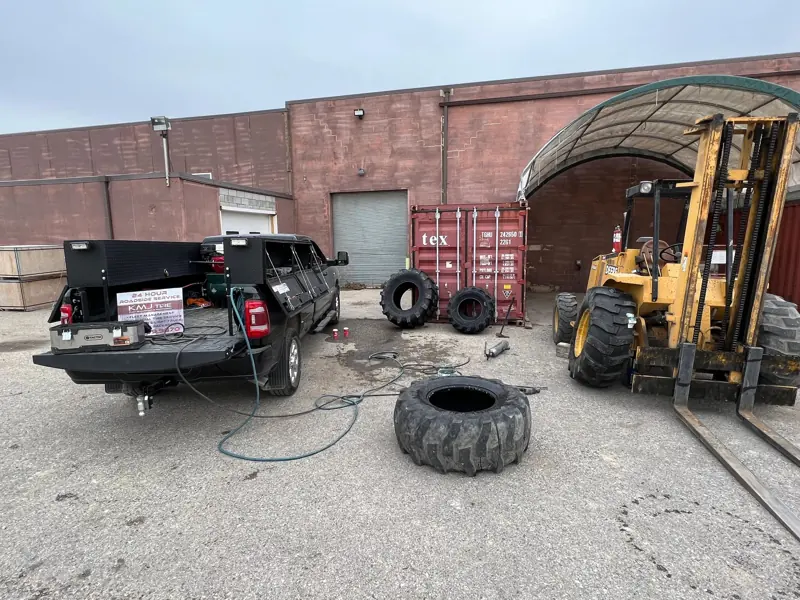
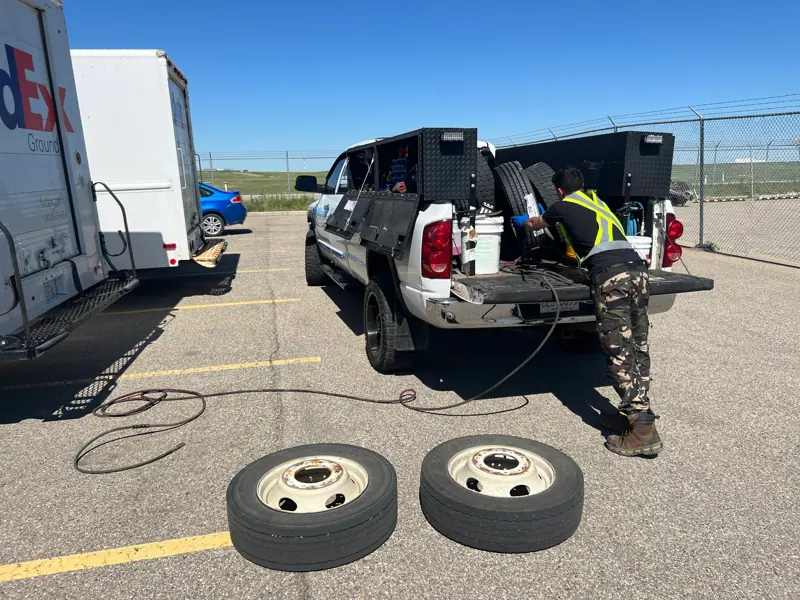
Leave embedded objects alone while arranging assessment. Pulling out a screw to see how deep it goes may release air and make the situation harder to manage. Likewise, do not scrub a suspicious sidewall until the original condition is impossible to photograph. If the setting makes on-site work a possibility, review mobile tire-service options in Calgary, then confirm that the actual location and access conditions are suitable.
3. Read the pressure instruction before using the gauge
The number you need normally comes from the vehicle's tire-information placard and owner's manual, not the maximum pressure moulded onto the tire sidewall. Front and rear recommendations may differ. Some vehicles provide instructions for different loads or operating conditions. If the installed tires or wheels differ from the original specification, obtain the documented pressure guidance for that approved setup rather than assuming the original number transfers unchanged.
A car that has remained parked offers a useful opportunity for a cold-pressure check. Follow the vehicle and tire manufacturer's definition of cold, and consider uneven sun exposure or a heated storage environment when interpreting the readings. Record the conditions. A reading taken after driving to a compressor is not the same baseline as one taken before movement, even if the distance felt short to you.
Use a gauge rather than judging by sidewall shape. Modern tire construction can hide meaningful underinflation from a casual visual inspection. Check that the gauge is set to the same unit used by the pressure instruction, or make a careful conversion before comparing values. A unit mix-up can produce a much larger error than the small variation you were trying to investigate.
Write the actual measurement at each corner before adding air. A four-position record preserves evidence that disappears once all tires are adjusted. For example, note left front, right front, left rear, and right rear in words rather than relying on an unlabeled sequence of four numbers. For help separating size markings from pressure information, use the tire-sidewall information guide. It explains why every number on the tire does not serve the same purpose.
4. Interpret four readings together, not as four isolated tasks
Suppose the placard calls for a particular cold pressure at the front axle and a different value at the rear. Compare each measured pressure with the correct axle's instruction first. Comparing every tire with one single number could incorrectly make a properly inflated rear tire look overinflated. The pattern only becomes useful after you have established the right reference for each position.
If all four are lower than their respective recommendations, time and temperature may be part of the explanation. Tires naturally lose some air over time, and changing temperature changes pressure. But a common pattern is not proof of a harmless cause. Previous adjustment errors, a storage setting that was never restored, and more than one leak are also possible. The practical result is to correct and investigate as appropriate, not to invent a diagnosis from symmetry.
One conspicuously different tire deserves particular attention. Check the gauge connection and repeat the reading without deliberately venting the tire. If the unusual reading remains, record it along with visible findings and the parking history. Do not average the readings or add air until the four numbers look similar without considering whether the low tire has been damaged or moved while underinflated.
An air addition is an action, not a repair record. A tire can reach the intended pressure and still have a puncture, valve leak, wheel-sealing problem, or internal damage. If the pressure loss is unexplained, recurring, or substantial, professional assessment is the next useful step. Calgary tire-repair assessment is about determining what can safely be repaired, not promising that every parked-car flat can be saved.
5. Treat a completely flat tire as a different situation
A visibly collapsed tire changes the plan. Do not drive to the nearest air pump simply because it is nearby. Rolling a vehicle on a severely underinflated or flat tire can damage it, and the driver may not be able to judge that damage afterward from the exterior. The fact that the tire was fine before the trip does not establish when it lost air or whether it has already been moved in that condition.
Tell the person assessing it whether the car was driven, rolled, pushed, or transported after the loss was discovered. Even movement that did not involve the engine can matter to the history. You do not need to estimate a precise damage threshold. Describe the distance and circumstances as accurately as possible, including uncertainty. A truthful unknown is more useful than reassurance based on a guess.
Avoid treating an inflator as permission to reinflate every damaged-looking tire yourself. If there is obvious structural damage, an unusual bulge, exposed material, or uncertainty about a tire that has sat collapsed under load, get professional direction before proceeding. This article is not an inflation procedure for a compromised tire. The safe course may involve on-site assessment, an appropriate spare installed according to the manual, or transport.
Location information is especially helpful here: lot name, level, aisle, height restrictions, gate instructions, and whether there is safe working space. Emergency tire-service information can help frame the available type of assistance, but confirm availability and site suitability directly. Do not assume any provider can work in every underground parkade or can reach a vehicle within a particular time.
6. Understand what a parking flat spot actually means
A tire supports the vehicle through a contact patch that changes shape under load. During normal driving that loaded region continually changes as the tire rotates. During parking, the same region remains against the ground. Depending on the tire, load, inflation, temperature, and parking duration, the tire may retain some of that shape when movement resumes. That is the parking-related flat-spotting discussed by tire manufacturers.
Continental's explanation of flat-spotting distinguishes temporary flat spots from more persistent deformation after prolonged standing. It describes slight initial ride disturbance after some parked periods and notes that temporary effects can disappear as the tires reach operating temperature. That description is useful background, but it is not a remote diagnosis of a particular shaking car.
The important distinction is between a possible explanation and a driving instruction. You cannot identify every vibration as temporary flat-spotting merely because the car was parked. A pressure problem, damaged tire, wheel issue, or non-tire fault can appear at the same time. The vehicle's condition must support movement before you consider how it feels while moving. A severe or worsening symptom is not something to drive through to complete an experiment.
Parking flat spots also differ from tread worn away during a skid. Both descriptions use the word flat, but the underlying event and appropriate response are different. Tell the tire specialist whether you mean a car that stood still or a tire with visibly localized tread wear after a braking event. Precise language prevents a familiar label from obscuring an entirely different problem.
7. Do not turn a manufacturer's example into a universal timer
People understandably want a number: how many days is too long, or how many kilometres should a vibration take to disappear? Flat-spotting does not provide one reliable cutoff for every vehicle and tire. Continental identifies parking duration as one factor among several and discusses more persistent effects with longer standing. A light passenger car on one tire construction will not necessarily behave like a heavily loaded vehicle on another.
That means a month is not a magic point at which every tire becomes damaged, and a shorter stay is not a guarantee that everything is fine. Use the actual condition, pressure history, manufacturer guidance, and severity of symptoms. If the car was already vibrating before storage, parking did not erase the earlier concern. If it was moved during storage, the last stationary period may not be the full story either.
Avoid adopting an internet rule that demands a highway run before inspection. Higher speed increases the consequences of an unresolved tire problem. Nor should you repeatedly circle a lot in the hope that a major thump will vanish. A plausible temporary effect remains only one possibility until the condition has been assessed. A professional may recommend specific next steps after seeing the tires; that is different from applying a generic driving test to an unknown setup.
This is a good place to preserve observations without diagnosing them. Describe whether a disturbance is slight or pronounced, whether it began immediately, and whether it changed during movement that was already safe and necessary. Do not create additional exposure solely to gather data. The tire-service questions page can help you prepare a clearer conversation about what you observed and what still needs checking.
8. Separate the tire return from the vehicle's other systems
A parked vehicle may have concerns that are unrelated to tire shape or pressure. A dead battery, abnormal brake behaviour, fluid leakage, or signs of animal damage require their own assessment. This guide deliberately does not provide mechanical recommissioning steps. If the car cannot be operated normally for another reason, passing a tire walk-around does not make it suitable for a road test.
Likewise, a shaking sensation does not identify its source. The steering wheel, seat, or body may transmit vibration from more than one part of the vehicle. Avoid promising yourself that a balance service must solve the issue simply because it appeared after parking. Tell the provider the timeline and let the inspection determine whether the problem belongs within tire service or should go to another specialist.
Do not work beneath a car supported only by an emergency jack. If inspection requires lifting or removing a wheel, follow the exact vehicle instructions and use appropriately equipped qualified help. A parking-return guide is not a replacement for lifting training, approved support points, or workshop procedures. Vehicles with particular lifting or suspension requirements need those requirements respected, not approximated from a similar model.
KMJ can discuss the tire portion of your return-to-use plan. Mechanical diagnosis, brake work, steering or suspension concerns, and storage-related electrical problems belong elsewhere. Keeping those responsibilities distinct is useful rather than inconvenient: it prevents a tire visit from being mistaken for a comprehensive roadworthiness approval and helps you decide whether transport to another facility should happen before any driving.
9. Recheck whether the installed set suits the season now
A car can leave home in one season and return to use in another. The tires that were appropriate when you parked may not suit the conditions when you collect it. Read the tire's actual model and markings rather than relying on a memory that it had good tires. Condition, tread remaining, weather suitability, and fitment are separate questions; an affirmative answer to one does not settle the others.
In Calgary, a travel delay or an extended work assignment can push a vehicle's return well beyond the owner's original plan. That is a planning example, not a statement about today's forecast. Check current conditions and the forecast for the actual route before movement. If a seasonal tire has manufacturer restrictions concerning cold exposure or operation, follow those instructions. Do not assume warming up through driving is an acceptable workaround.
A winter set at home does not help the first trip out of the parking facility unless you have a safe, feasible changeover plan. Determine whether the car can appropriately travel on the installed tires under the present conditions. If not, consider an authorized on-site service arrangement or suitable transport. Permission to perform work at the parking location is part of that plan, not something to discover after equipment arrives.
For a future return date that falls near a seasonal transition, winter tire selection in Calgary is worth reviewing before departure. Choose a plan around the vehicle's needs and likely conditions without pretending any one tire can guarantee traction. If the trip changes, revisit the plan rather than letting an old calendar entry decide the first drive.
10. Tread depth does not record the months spent parked
A low-use car may have deep tread and still need attention. Tread wear records use imperfectly; it does not capture every environmental exposure, prior pressure event, or age-related change. Read the tire's date information and the manufacturer's age guidance alongside its physical condition. Do not assume that the absence of mileage makes a tire indefinitely suitable for service.
Where date information is only visible on the inner sidewall, have it read safely rather than crawling beneath the car. Keep each tire's information separate. Four tires installed together are not necessarily from the same production week, and a previous replacement may differ from the others. A clear photograph and wheel-position label are often easier to interpret later than an unlabeled note containing several digit strings.
Inspect tread across the width where it is accessible. A casual look at the outer shoulder can miss wear nearer the inside. If uneven wear was present before storage, returning to use does not resolve its cause. A tire professional can assess the tires, while any underlying mechanical issue belongs with an appropriate specialist. Avoid treating a new set alone as proof that an unresolved vehicle problem has disappeared.
Replacement decisions should therefore consider condition, age instructions, fitment, and intended use together. Tire-buying guidance for Calgary drivers can help organize those requirements. A parked-car return is not automatically a four-tire replacement event, but it also should not become an excuse to retain a questionable tire solely because the tread looks substantial.
11. Account for storage pressure changes explicitly
Some manufacturer storage guidance discusses pressure adjustments or other measures to reduce the effects of prolonged parking. These instructions are not interchangeable across all vehicles. If pressure was deliberately changed before storage, write down the instruction used, the actual setting, and the restoration step. The person collecting the car may not be the person who prepared it.
Continental's flat-spotting page includes a modest pressure-increase example with limits. That is not a reason to set every stored car to the tire's sidewall maximum or to add an arbitrary amount before every trip. Vehicle-specific instructions and component limits still govern. If the storage advice and the vehicle instructions appear inconsistent, resolve that conflict with the relevant manufacturer or qualified professional rather than picking the higher number.
At return, distinguish a storage setting from a road-use setting. A note saying pressure increased for parking is incomplete if it does not identify what the normal cold operating target should be. Restore the correct operating configuration using the applicable instructions before road use. Do not bleed air from hot tires to make them match a cold target after you have already driven.
Extra cargo left in the car can complicate the story. Remove unnecessary stored items and evaluate the load you actually intend to carry. More pressure does not authorize an overloaded vehicle, and a higher-rated replacement tire does not increase the vehicle's ratings. The load-index explanation helps distinguish a tire's capacity designation from permission to exceed vehicle limits.
12. Build a sensible plan for the first necessary movement
Movement comes after the stationary checks and after any conditions requiring professional assessment have been resolved. There is no universal self-test that clears an unknown tire for service. If you cannot establish a safe basis for moving, arrange help. An inspection that stops before driving is still a successful decision if it prevents an avoidable problem.
When the vehicle is suitable to operate, keep the first necessary movement manageable and attentive. Avoid combining it immediately with the most demanding trip on your calendar. You do not need to stage a high-speed trial, deliberately hard braking, or abrupt steering manoeuvres to evaluate stored tires. Follow normal safe driving practices, the vehicle instructions, and any directions given by the person who assessed it.
If a substantial vibration, pulling sensation, unusual noise, pressure warning, or visible problem develops, stop in a safe place and seek guidance. Do not keep driving simply because an article explained temporary flat-spotting. The severity and progression of the symptom matter. A tire that loses pressure again after adjustment needs investigation rather than another undocumented top-up and a longer drive.
Before setting out, know where you can safely stop and how to obtain help if necessary. KMJ's Calgary service-area information can support local planning, but it does not replace confirmation of availability or an emergency plan for a remote location. A returning traveller should not have to improvise all of this beside a busy exit ramp with luggage in the back.
13. Example: collecting a car after an airport stay
Imagine a driver returning after several weeks away. They have luggage, a passenger, and a long drive after leaving the airport. Their instinct is to load the car, pay, and join the fastest road home. A better sequence is to pause before loading, identify the installed tires, inspect the accessible surfaces, and measure pressures while the vehicle is still parked and cold under the relevant definition.
In this example, one tire reads noticeably lower than its correct target while the other three are closer to their own targets. That is not enough to diagnose a puncture, but it is enough to change the plan. The driver repeats the reading, photographs the tire, and asks for assessment rather than assuming the entire difference came from colder weather. If the tire is visibly collapsed or damaged, they do not move the car to a more convenient spot on it.
The useful service message contains the vehicle identification, tire size, affected corner, measured reading, placard reference, and whether the car has moved. It also contains the parking location and access restrictions. This allows the provider to address the actual problem instead of first having to ask where the car is or discover that a service vehicle cannot enter the structure.
Meanwhile, the passenger and luggage can travel separately if necessary. That is a logistical choice, not a tire repair. Separating the transport need from the car's return reduces pressure to make a questionable tire finish the journey. The example does not assume a repair outcome, a price, or a waiting time; those depend on assessment and the arrangements actually available.
14. Example: the second car that quietly stopped being used
A second household car often has no formal storage date. One week it was unnecessary, then a month passed, then another driver borrowed it briefly. This is different from a carefully prepared seasonal vehicle because nobody may remember the last pressure check or whether it had a warning during that short trip. Start by asking everyone who used it rather than assuming it remained untouched.
Create a return record with the tire models, wheel positions, pressure readings, visible findings, and any recent driving. If somebody remembers adding air but not how much, write that down as incomplete history. Do not replace uncertainty with a confident story that the car merely sat. A brief trip on a low tire can matter more to assessment than the total number of parked days.
Next, identify why the car is needed now. A short local errand, a full family load, and a long highway trip place different demands on planning, although none permits a damaged tire. If replacement is being considered, describe the intended use rather than buying whatever resembles the old tread. Comparing budget and premium tire choices can help frame performance priorities without assuming price alone proves suitability.
Assign responsibility for the ongoing checks once the car returns to use. Shared vehicles lose maintenance history when everyone thinks another person checked them. A simple dated note is enough: who measured, what was measured, and what action followed. This is an editorial recordkeeping suggestion, not a manufacturer-mandated form, but it makes the next conversation much more productive.
15. Example: a garage-stored car with persistent ride disturbance
Consider a vehicle kept indoors for a longer period under a storage plan. Its owner has followed the return instructions, confirmed the tires' pressures, and found no obvious exterior damage. Once the car is appropriately returned to movement, a ride disturbance remains. The owner has read about flat spots and wonders whether to keep driving until they disappear.
The useful response is to consult a tire professional and describe the actual observations, not to prescribe more speed or a longer drive. Continental notes that more persistent flat-spotting can require specialist advice. Indoor storage does not rule it out, and the parking history does not rule out other causes. A specialist can decide which tire and wheel checks are appropriate and whether another type of assessment is needed.
Bring the storage instructions and records. Was pressure changed? Were tires replaced before parking? Was the vehicle loaded with spare parts or household items? Were wheels removed? These details help distinguish an unchanged parked assembly from one that was altered during storage. They are more useful than saying the tires are practically new without describing their age and history.
If tire replacement becomes the outcome, confirm the complete fitment requirements and the vehicle's matching rules before ordering. Available tire-brand information is a place to begin comparing appropriate products, not evidence of present stock in a particular size. A manufacturer name by itself does not resolve size, load, speed, seasonal suitability, or the condition of the remaining tires.
16. Give the tire provider a record they can act on
A good return-to-use message is factual and short. State the year, make, model, and relevant trim or wheel setup. Then give the tire size and model, parking duration, location type, affected position, and pressure observations. Include whether the vehicle moved after the concern appeared. Photographs should support those facts, not replace them with a collection of close-ups lacking orientation.
Separate what you saw from what you think caused it. Tire looked low is an observation. Parking flat spot is a theory unless assessed. Pressure fell again after adjustment is a useful timeline. Someone must have damaged it is an allegation without evidence. Clear distinctions help the provider choose an assessment path and prevent a guess from becoming the premise of the whole visit.
Ask what the tire appointment will cover and what remains outside it. A pressure or leak assessment, tire condition evaluation, or replacement discussion has a narrower scope than a complete inspection of a long-stored vehicle. If you also have a brake or steering concern, explain that you will need the appropriate specialist. Do not assume the tire-service provider has silently accepted responsibility for unrelated systems.
You can use KMJ's tire-service contact page to explain those findings. Once the required work and safe vehicle movement are understood, arrange a Calgary tire-service appointment. Neither step should be treated as authorization to drive an unsafe car to the location; transportation and on-site suitability need their own decision.
17. Prepare the next parking period while this one is fresh
Once the immediate issue is resolved, preserve what you learned. Note whether there was an identified leak, a tire replacement, a storage-procedure change, or a referral for another concern. Keep that outcome with the starting measurements. Otherwise, months later you may remember only that someone put air in the tires and lose the reason the car needed attention.
For the next extended absence, read the vehicle's storage instructions before departure. Decide who will hold the keys, whether anyone will inspect the car, and how they should report a problem. Do not ask a neighbour to move it occasionally as a substitute for a proper storage plan. Movement has its own requirements, and a short drive does not automatically prevent every storage-related issue.
Give the collecting driver a useful handover: normal pressure references, any deliberate storage changes, tire restrictions, the last inspection date, and outstanding work. Leave enough time before the next demanding trip for assessment if something has changed. The goal is not to eliminate uncertainty with a promise; it is to make uncertainty visible early enough to act on it.
The same record can help organizations with seldom-used passenger vehicles. Fleet tire-service planning may be relevant when several drivers share responsibility, but a fleet label does not change the physical limits of the tires. Identify each vehicle and its actual condition rather than assuming a common parking location means every vehicle needs the same work.
18. A departure checklist that preserves the important decisions
Before moving, establish the parking history and any changes made for storage. Check the actual tire model against current conditions. Read the applicable pressure instructions, measure each position, and record the readings before adjustment. Inspect what you can safely see, and acknowledge what you cannot. Visible structural damage, a collapsed tire, unexplained major pressure loss, or unresolved vehicle concerns should change the plan toward professional help.
After any assessment or service, keep the result and instructions together. Confirm the correct operating configuration has been restored. Understand whether follow-up is required and who is responsible. If a tire was replaced, keep the identification and service record; if another specialist is needed, do not mistake the completed tire work for completion of the whole return-to-use process.
During normal use, continue the manufacturer's regular inspection and pressure-check routine. Michelin's maintenance guidance emphasizes regular pressure checks, condition inspection, and respecting load capacity even for low-mileage vehicles. A quiet parking period did not suspend those responsibilities, and one successful journey does not replace them. The return check is the beginning of renewed care, not a lifetime clearance.
The main lesson is simple: parked does not mean unchanged. Rebuild the facts while the car is still stationary, distinguish possible flat-spotting from a confirmed diagnosis, and let the condition determine whether movement is appropriate. That approach can save needless guessing, help a tire professional assess the real problem, and make the first trip after time away a considered decision rather than an assumption.