Can stronger tires make your pickup ready for a slide-in camper? Only if the truck and camper already form a suitable combination and the tires meet the requirements for that combination. A higher tire load rating does not increase the truck manufacturer's gross vehicle weight rating, axle ratings or camper approval. Start with the truck's paperwork and actual loaded weights, then choose the tires. Starting with an impressive tread pattern gets that order backwards.
A slide-in camper makes tire shopping unusually easy to misunderstand. The truck might drive empty all week, carry a furnished living space on Friday and return with different water levels on Sunday. The rear axle can be heavily loaded even when a whole-vehicle weight sounds reasonable. The camper's advertised dry weight may leave out things that are already attached to the one you own. None of those questions can be settled by looking at the tires from across a parking lot.
This guide is for Calgary pickup owners working through that decision, not for selecting tires for a towable trailer or a motorhome. The examples use invented, clearly labelled weights to explain the arithmetic; they are not ratings for a particular truck, camper or tire. Actual limits belong to the exact vehicle and components. KMJ can discuss tire selection and tire service. Camper installation, structural changes and other mechanical work belong with the vehicle manufacturer and appropriate specialists.
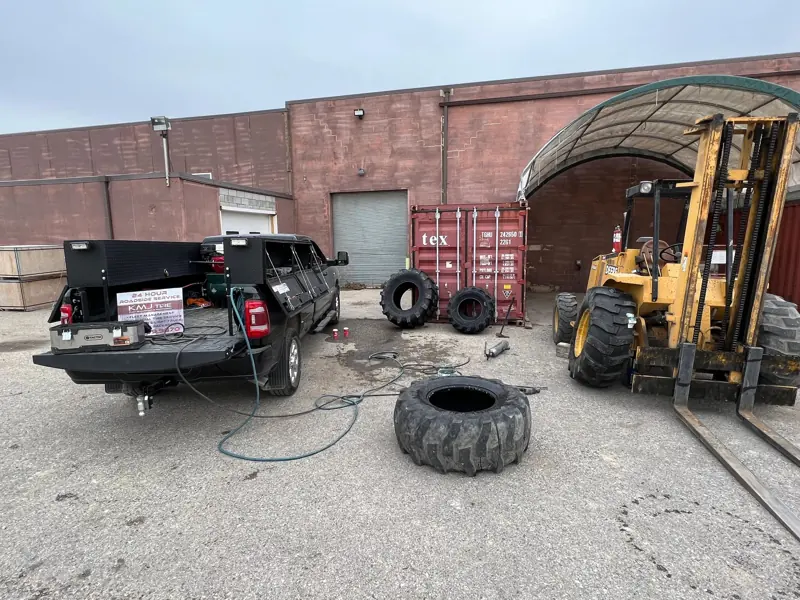
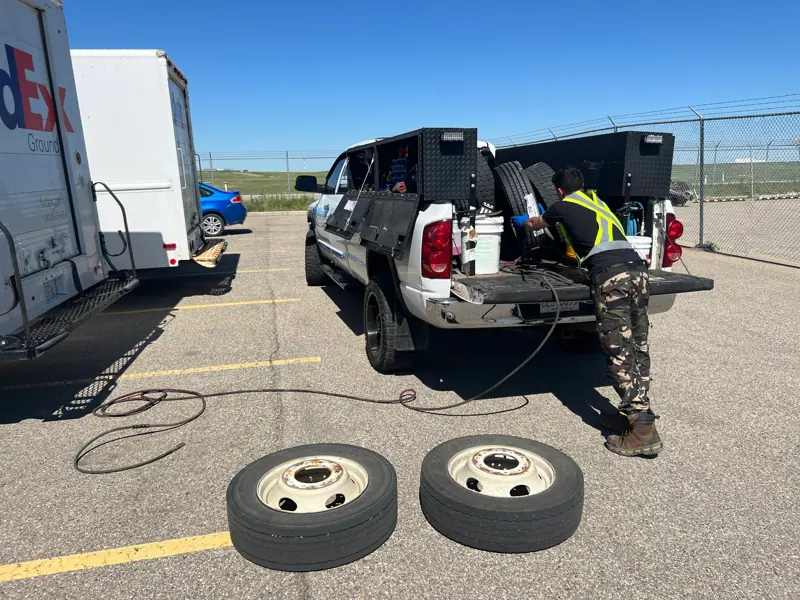
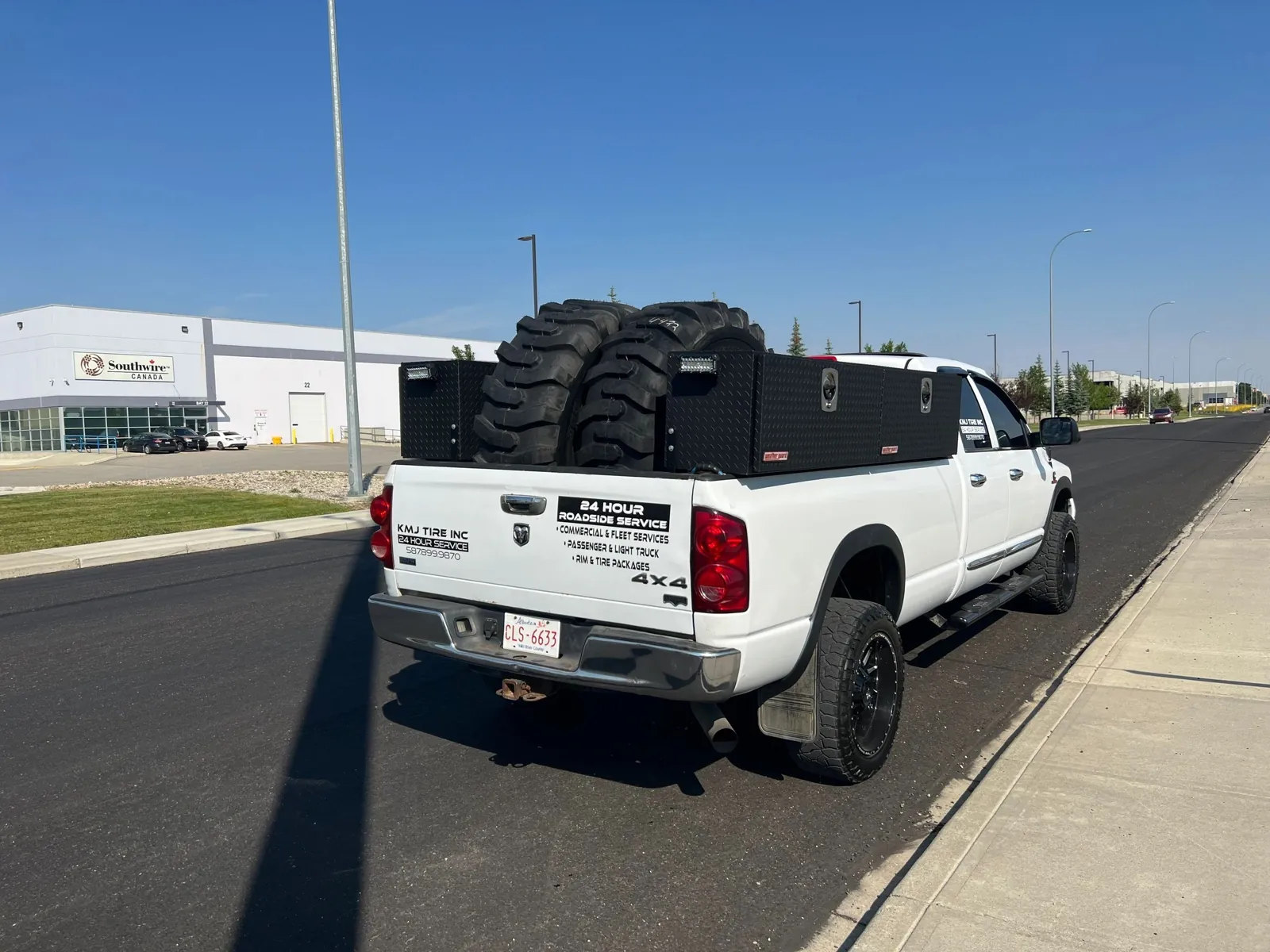
The accompanying photograph shows a real KMJ pickup carrying tires and equipment, not a camper installation. It illustrates why pickup cargo needs to be counted; it does not establish the pictured truck's weights or suitability for any camper.
1. Establish whether the truck is approved for a camper
Before comparing tires, find the owner information for the exact truck: model year, cab, bed, drivetrain and equipment. A badge such as a three-quarter-ton or one-ton designation is not a complete load specification. Two trucks that look almost identical can have different available carrying capacity because engines, cab layouts, options and installed equipment differ. The useful number is the one that applies to your vehicle, not the largest number in an advertisement for that truck family.
Look for a camper-specific information sheet or the manufacturer's camper instructions as well as the tire placard and certification label. Ford's 2025 towing guide, for example, contains a pickup/camper combination selector and explains that qualifying trucks have camper centre-of-gravity information associated with the individual vehicle. It also notes that vehicles not recommended for camper use do not receive that same approval information. That is an example of why a generic payload figure is not the whole answer, not permission to apply Ford's figures to another make or year.
If documentation is missing, ask the vehicle manufacturer or its dealer to identify the correct information using the VIN. Ask the camper manufacturer for the camper's identification, weight definition, centre-of-gravity information and installation instructions. Photograph the labels so the numbers do not have to be reconstructed from memory. Record any equipment added after manufacture separately. A used truck's existing tires or accessories are evidence of what someone fitted, not evidence that the combination was approved.
At this stage, a useful result can be a firm stop. If the truck is not recommended for that camper application, or the loaded combination cannot fit within its limits, buying tires is not the next corrective step. Resolve the truck/camper match first. When the basic combination is suitable, compare tire options for your Calgary pickup with those requirements in hand rather than asking a tire to compensate for a vehicle-selection problem.
2. Keep the different weight limits on separate lines
Gross vehicle weight rating, usually abbreviated GVWR, is the manufacturer's maximum permitted loaded vehicle weight. Gross axle weight ratings, or GAWRs, apply separately to the front and rear axles. The actual scale weights must be compared with the appropriate limits. Being below the overall rating does not automatically mean that both axles are below theirs. Likewise, spare capacity on the front axle cannot simply be transferred on paper to an overloaded rear axle.
Payload information describes carrying capacity, but read its definition carefully. Occupants, cargo and added equipment consume that capacity. A slide-in camper is cargo carried by the pickup; it is not a trailer whose entire weight is supported elsewhere. If a trailer is also attached, its load on the truck introduces another consideration. A large tow rating should never be substituted for a camper carrying rating. The two questions concern different loads and different vehicle limits.
Tires and wheels add their own constraints. A tire's maximum load is tied to its specification and inflation conditions. Wheels also have load and pressure limits, and valves must suit the application. These component ratings do not cancel the vehicle ratings. A sensible worksheet therefore has distinct entries for the vehicle, each axle, the tire specification and the wheel specification. Leave an unknown entry visibly unknown until it is verified instead of filling it with the nearest number from an online discussion.
The reason to separate these limits is practical. If the rear axle is the limiting part of the combination, a tire with a higher published maximum does not solve that limit. If an otherwise suitable setup has an inadequate replacement tire, restoring the correct tire specification matters. Those are different diagnoses with different remedies. KMJ's explanation of tire load index helps translate the tire marking, but the final decision still requires the truck's documents and the precise tire manufacturer's data.
3. Turn dry camper weight into a travel inventory
A dry-weight figure is a starting description, not necessarily the weight that will sit in the truck on departure morning. First establish what that particular figure includes. Factory options, batteries, propane containers, water, dealer-installed items and personal equipment may be treated differently in different documents. Avoid assuming that every manufacturer uses an identical definition. Ask for the definition attached to your camper and compare it with the equipment actually installed.
Make a short inventory in physical locations: camper, truck cab, truck bed or exterior carrier. In the camper, think about bedding, food, cooking equipment, clothing and water. In the truck, include passengers, a toolbox, recovery equipment, running boards or other added hardware, and cargo that stays aboard between trips. Count an item once, in the appropriate category. Do not subtract an accessory from payload a second time if it is already included in the actual baseline scale weight you are using.
Water is a good illustration because its weight is predictable enough for planning. Approximately one litre of water has a mass of one kilogram. An additional 80 litres is therefore roughly 80 kilograms before considering the container. That is not a recommended fill amount; it is a reminder that fluid decisions have a measurable consequence. Fresh water, waste water and portable containers can also occupy different locations, so the distribution of the load may change during a trip even when the total remains similar.
Use the inventory to decide what the scale visit must represent. An empty fridge and an unoccupied cab will not represent a family departure with food and passengers. Conversely, do not add an estimated passenger weight to a scale result that already included the passengers. Write down the configuration alongside each number. This simple bookkeeping is more useful than arguing about whether a camper is generally considered light or heavy, because it describes the combination that will actually travel.
4. Weigh the departure configuration, not a convenient substitute
Find a suitable public scale or weighing service and confirm access, procedure and whether axle weights can be obtained. Follow the operator's instructions. A scale visit should not require improvised positioning, people standing in traffic or lifting a loaded truck. Where individual wheel-position weights are needed, use a service equipped to obtain them properly. Do not attempt to infer precise side-to-side loads by parking partly off an ordinary scale platform.
For the main travel measurement, prepare the truck as it will depart: camper secured according to its instructions, passengers accounted for, normal fuel and planned supplies. Record fuel and water states, passengers present and major removable equipment. Obtain the front axle, rear axle and whole-vehicle readings using the scale's correct procedure. Keep the printed or electronic ticket with the date. If the operator cannot provide a particular measurement, note that limitation rather than inventing it from another reading.
An unloaded truck measurement can also be useful, especially when evaluating the camper before purchase. Here, unloaded should mean a documented baseline, not an undefined empty state. A truck with a full fuel tank, permanently fitted toolbox and usual equipment is a different baseline from a stripped truck. The change between comparable weighings can help explain what was added, but the final loaded readings still need to stand on their own against the ratings.
A weight ticket is a snapshot, not a lifetime certificate. New batteries, a generator, a rear carrier or another traveller can change the result. You do not need to reweigh because a sandwich moved between cupboards, but material changes deserve a fresh assessment. Store the current ticket where both regular drivers can find it. If a tire consultation depends on weights, provide the date and configuration with the numbers so no one mistakes an old summer setup for the present camper.
5. Work through an axle example before choosing a tire
Consider a fictional pickup with a GVWR of 4,500 kilograms, a front GAWR of 2,400 kilograms and a rear GAWR of 2,800 kilograms. Its loaded scale ticket reads 1,500 kilograms at the front and 2,900 kilograms at the rear. The total is 4,400 kilograms. A driver looking only at the total might say there is 100 kilograms left. That misses the rear axle, which is already 100 kilograms over its stated rating.
The correct conclusion is not to buy tires that add another 100 kilograms of advertised capacity. The rear axle limit is still exceeded. Nor should the driver simply move a few heavy objects without considering secure storage and the camper's installation requirements. The combination needs a legitimate loading or vehicle-selection solution and then another measurement. This example is deliberately simple because it shows why a single total can produce a confident but wrong answer.
Now imagine another fictional combination whose total and both axle readings are within their documented limits. That clears those particular checks, not every check. Tire and wheel suitability, the camper's permitted centre-of-gravity region, mounting requirements and the condition of the vehicle still need attention. A passing scale ticket does not reveal a damaged tire or validate an unapproved wheel. Each piece of evidence answers its own question; none answers all of them.
For a rear axle carrying 2,600 kilograms on two tires, dividing by two gives an average of 1,300 kilograms per tire. Average is the important word. It does not establish that each side actually carries exactly 1,300 kilograms. Side-to-side differences matter, particularly with fixed camper equipment. Ask the tire professional and vehicle/camper specialists what additional measurements and allowances the specific application requires. Do not turn the average into a pressure recommendation or select a tire with no further review of the actual loading.
6. Read the complete tire specification, not just the big letters
Owners often arrive with a request for a particular load range because it sounds stronger. Load range is useful information, but it is not a universal weight capacity independent of size. Two tires in the same load range can have different maximum loads. Similarly, two tires with the same nominal dimensions may differ in construction, load index or intended application. The specification must be read as a whole rather than reduced to one familiar letter.
Record the full size, including any prefix, the service description, load range where applicable and exact product model. Photograph both the size marking and the maximum-load information. Passenger-type and light-truck-type tires are not interchangeable merely because a few dimensions appear similar. Any change of tire category or specification requires proper fitment and load/inflation review. Do not assume that the pressure used by the old tires remains suitable after a specification change.
On some light-truck tires, the service description or load markings distinguish single and dual applications. Use the entry that actually applies to the truck. A single-rear-wheel pickup is not a dual application simply because there are two tires on the rear axle. A dual assembly has tires mounted side by side at each relevant wheel position. Confusing those terms can make a copied load figure inappropriate before any arithmetic starts.
The guide to reading tire sidewall information is useful preparation for a consultation. Bring the photographs and the vehicle labels together. Ask the tire professional to state the exact proposed size and service description in the quote, not just the product family. If the recommendation involves a change from the vehicle's original specification, request the supporting fitment reasoning. An attractive model name or an aggressive shoulder design is not a substitute for the required load capability.
7. Treat wheels, valves and dual assemblies as part of the system
Tires are only one part of the assembly carrying the camper. The wheel must be appropriate for the tire size, vehicle fitment, required load and inflation pressure. An aftermarket wheel that bolts onto the truck may still be unsuitable for the intended application. If its markings or documentation are unclear, identify the exact manufacturer and part number. Do not infer a load rating from appearance, finish, diameter or a claim that it came from another heavy-duty pickup.
Valves and any pressure-monitoring hardware also need to suit the operating requirements. A tire change is a sensible time to ask about their condition and compatibility. That does not mean every valve must be replaced with one particular type on every truck. It means the professional selecting the components should know the required pressure and wheel arrangement. Avoid installing convenient accessories without confirming that they are suitable, especially where access to a valve is awkward.
For a dual-rear-wheel truck, fitment has additional details. Tire matching, spacing, wheel specification and the applicable dual-load information need professional review. An outer tire can hide the condition of an inner one, and accessible pressure checks matter. A driver should not treat a flat inner tire as an acceptable way to continue because another tire remains beside it. The remaining tire may be carrying an unintended load, and both need appropriate inspection following the event.
Camper owners sometimes focus on these hardware questions only after experiencing vibration. It is better to document the assembly at selection time. Ask what tire work is included and whether wheel balancing for the pickup's assemblies is appropriate for the job. Balancing is not a remedy for an overloaded axle, an incompatible wheel or an unsuitable camper installation. If a concern involves structural or mechanical components, use a qualified specialist for that assessment rather than folding it into a tire-service request.
8. Get an inflation plan tied to the actual application
The maximum pressure on a tire sidewall is not a universal target for every pickup. Transport Canada's tire guidance distinguishes that marking from the vehicle manufacturer's recommended pressure. Begin with the vehicle placard and owner instructions. If the tire specification or use differs from the original approved arrangement, have the vehicle and tire requirements reconciled by qualified professionals using the correct manufacturer's information. This article cannot supply a safe pressure from the camper's weight alone.
Load/inflation tables must match the tire category, size and application being considered. They are not permission to exceed the tire, wheel or vehicle limits, and a number found in someone else's table is not transferable just because it is expressed in the same units. Ask which data supports the recommendation and whether it applies to single or dual service. Obtain the final front and rear cold-pressure instructions in writing, with the conditions under which they apply.
If the truck alternates between camper-on and camper-off use, ask whether the manufacturer allows different documented operating settings and how to manage that change. Do not simply let air out until an empty truck feels softer, then forget to restore the required setting before loading. Equally, do not create your own loaded setting by inflating beyond component limits. The right plan may be straightforward, but it must be specific to the truck and tires rather than improvised from ride feel.
Use a suitable gauge and check pressures cold, following the relevant instructions. Normal driving warms tires and can increase the reading; bleeding air to chase a cold target while the tires are warm can leave them underinflated later. For broader upkeep, review practical tire-pressure and condition checks. Keep the camper-specific settings with the weigh ticket so another driver does not apply the empty-truck routine to a fully loaded departure.
9. Choose tread for the roads you actually use
Once the load and fitment requirements are established, consider the travel pattern. A pickup that spends most camper kilometres on paved highways has different priorities from one routinely using maintained gravel access roads. Describe the proportion of each, the seasons and the conditions in which you are willing to postpone travel. Be honest about the ordinary trip rather than selecting a tread for the most dramatic photograph in a campsite advertisement.
A more aggressive tread is not automatic evidence of better loaded-pickup stability, winter braking or puncture immunity. Tire design involves tradeoffs, and product-level specifications matter. Explain the driving problem you want addressed: wet-road confidence, winter use, unpaved access, noise or wear expectations. Ask how the candidate fits those priorities after the mandatory load requirements have been met. No tread pattern removes the need to avoid hazards or travel within the vehicle's limits.
Use KMJ's listed tire brands to begin a model discussion, not as evidence that a particular camper-compatible size is currently available. Availability must be checked for the exact specification. If a model is unavailable, compare the replacement candidate from the start instead of accepting something with a similar name. Differences in service description can be more consequential than differences in the appearance of the tread blocks.
A budget-versus-premium tire comparison is most useful after unsuitable options are removed. Price should compare acceptable choices, not justify a tire below the required specification. Ask for an itemized quote showing the actual tires, relevant components and tire services. Keep projected wear or fuel-economy claims tied to credible product evidence; no shop can promise that your loaded truck will reproduce another driver's mileage or handling impressions on a different route.
10. Decide separately how the camper will be used in winter
A snow-capable marking is not a load rating, and a load rating is not a winter-traction test. Both questions matter if the camper stays on the truck during cold-season travel. The peaked-mountain-and-snowflake marking identifies a defined snow-traction qualification; it does not tell you that every marked product performs identically on ice or in all winter conditions. Evaluate the exact model and intended use instead of treating the symbol as a complete comparison.
For dedicated cold-season travel, discuss winter tires for the loaded pickup while preserving the necessary size and load specification. A winter recommendation suitable for an unloaded passenger vehicle does not automatically carry over to a camper truck. The complete vehicle arrangement matters, including dual applications where present. Do not fit winter capability only where the vehicle is driven and assume the remaining wheel positions have no role in directional control.
For a truck used across changing seasons, compare appropriate all-weather tire options with the same load requirements clearly stated. If you are evaluating all-season tires for warmer-weather camper trips, make the travel limits explicit. Product categories are not substitutes for checking the route and conditions. A plan to avoid winter travel is only useful if the driver is prepared to change departure dates when conditions no longer match that plan.
Transport Canada advises against using tires worn close to 4 millimetres on snow-covered roads. That guidance is different from waiting for the final tread-wear indicators to become level. Inspect actual condition well before a winter trip. Plan seasonal tire changes for the camper truck around the vehicle's loading and service access, not just the calendar. Tell the shop whether the camper will remain installed; do not assume the usual appointment arrangement fits a taller, heavier combination.
11. Separate a pressure warning from a loading diagnosis
A tire-pressure monitoring system is helpful, but it is not an onboard scale and it does not certify camper compatibility. A truck can be above a weight limit without showing a pressure warning. Conversely, a pressure warning can signal a real tire issue on a correctly loaded truck. Keep those two questions separate. A normal dashboard display is not evidence that the axle weights or tire specifications have been checked.
Understand how the system on your truck works, including its treatment of the spare and any replacement wheels. Some systems warn only after pressure has fallen significantly. Follow the owner instructions if a warning appears, and measure the pressure when it is safe to do so. If the tire looks damaged, the vehicle feels unstable or there is rapid pressure loss, stop safely and arrange assistance rather than continuing merely to reach a preferred pressure-check location.
When reporting a problem, provide observations: which position, measured pressure, whether the tire was cold or warm, how quickly the reading changed and whether the camper was installed. Avoid converting those observations into a diagnosis such as a bad sensor or a harmless temperature change without inspection. A recurring loss after topping up needs investigation. For a dual arrangement, make sure the inner tires are included in the maintenance routine instead of checking only the easily visible outer pair.
Request a tire-repair assessment in Calgary when appropriate, but do not assume a puncture is repairable before the tire is examined. The location and extent of damage and any history of underinflated operation affect that decision. A loaded camper trip is a poor setting for testing whether a doubtful repair will hold. Share the operating history with the professional, especially if the tire carried the camper while low on air or completely flat.
12. Plan recovery before discovering the spare is unsuitable
Check the spare's specification, pressure, condition and the owner's instructions for its use. A spare can look unused yet still have age-related concerns or be inappropriate for the present setup. If the truck's road tires or wheels have changed, revisit spare compatibility explicitly. Do not assume the original spare remains an unrestricted substitute simply because it was supplied with the vehicle. This is particularly important where matching requirements or a dual configuration complicate replacement.
Consider physical access as well. A camper, rear step, carrier or other equipment may obstruct the spare-lowering mechanism or the tools needed to reach it. Find out before departure, without putting yourself beneath an unsupported vehicle. Consult the truck and camper instructions about access and emergency procedures. A practical recovery plan can be to use qualified assistance; carrying tools is not a requirement to perform a roadside lift in an unsafe place.
A loaded truck may have different recovery needs from the same truck empty. Roadside providers should know the vehicle type, camper presence, approximate overall dimensions and the nature of the problem. Do not promise them that an ordinary tow or tire-service arrangement will work without their assessment. If you are considering mobile tire service for the pickup, confirm the vehicle, access, ground conditions and service scope in advance. A listing of mobile service is not a guarantee that every campsite can be served.
Check the relevant Calgary-area tire-service locations when planning locally, and make separate arrangements for travel elsewhere. Save contact information offline where reception may be limited. Keep the wheel-lock key, if fitted, accessible to the person assisting you. The point is not to carry a workshop in the camper; it is to avoid discovering that an otherwise manageable tire problem is complicated by inaccessible equipment or an incompatible spare.
13. Do not use a tire purchase to explain away handling changes
If the loaded pickup starts wandering, vibrating or behaving differently, document when it happens and seek an appropriate assessment. Tire pressure, damage, fitment and balance are possible parts of the picture, but so are loading and non-tire components. An online guide cannot identify the cause from a brief description. Do not conclude that a stiffer tire will fix every handling concern, and do not treat a new set as proof that a previous loading problem has disappeared.
Tell the professional whether the behaviour occurs empty, with the camper, at particular speeds or after a recent change. Mention newly fitted equipment, an impact, a tire-pressure event or a change in water load. These facts help route the concern. There is no need to reproduce a dangerous symptom for a better description. If the vehicle feels unsafe, stop using it until the problem has been assessed through an appropriate service arrangement.
Mechanical changes, camper supports and structural modifications need their own qualified advice. KMJ's work in this discussion is tire selection and tire service, not approving a camper installation or performing those modifications. Equipment that changes ride height or appearance should not be interpreted as an increase in the vehicle manufacturer's weight ratings. If someone claims a modification changes permitted capacity, obtain the applicable documentation rather than relying on a before-and-after photograph.
It can help to separate the requests on paper: inspect a suspect tire, verify the proposed tire specification, assess the camper installation, and investigate a mechanical concern. Different professionals may own different answers. This keeps a routine tire appointment from becoming an implied certification of the entire vehicle. It also protects the owner from paying for a change that improves one sensation while leaving the underlying constraint unresolved.
14. Use two camper scenarios to test the decision process
Imagine a Calgary couple shopping for a used camper before buying tires for their pickup. The seller provides a dry-weight label and says similar trucks have carried it. The couple first identifies their truck's camper guidance and current equipment, then asks what the camper's label includes. They list the water, batteries, passengers and travel equipment that will be added. If that comparison already shows the combination cannot meet the documented limits, they stop shopping for a tire-based workaround.
If the preliminary match looks feasible, they arrange a suitable verification process before committing to travel. Actual loading and axle measurements then inform the tire discussion. A tire professional receives the truck labels, the proposed camper configuration, the wheel details and the intended routes. The resulting tire quote states the complete specification. This scenario does not guarantee the camper will fit; it shows an order of work that finds a major mismatch before money is spent on the wrong solution.
Now consider an owner whose established camper setup has changed. A heavier battery arrangement and an exterior storage box have been added since the previous scale ticket. The owner notices that the rear tires look more compressed and wants to add air. Visual appearance alone cannot calculate the correct adjustment. The useful response is to review the new load, obtain updated measurements and check the documented limits and inflation instructions, not estimate pressure from how rounded the sidewall looks.
A third question may then emerge: whether the setup remains within its limits but needs an updated tire-service plan, or whether the load itself must change. Those outcomes should not be confused. The first could lead to a professional recommendation within the approved application. The second requires resolving the weight or compatibility issue before departure. In both scenarios, the tire purchase follows the evidence rather than becoming the reason to ignore it.
15. Build a service request that can receive a useful answer
A useful first message is more specific than asking for the strongest truck tires. Describe the truck year, model and configuration; say that it carries a slide-in camper; provide the current tire size and service description; and explain the typical travel seasons and roads. Attach clear photographs of the relevant labels. If the wheel is aftermarket, include its identity and documented rating. Ask what further information is needed before a recommendation can be finalized.
Provide current loaded weights when available, with the configuration and date. If they are not yet available, say so. There is nothing wrong with an initial consultation that ends with a request for better measurements. What causes trouble is presenting an estimate as a scale result or failing to mention that the camper was absent. The professional should not have to discover halfway through a quote that the vehicle carries a large, removable load.
When ready to request a pickup tire-service appointment, confirm whether the camper can remain aboard and whether the overall combination is suitable for the planned service location. Mention access constraints and wheel-lock hardware. Ask for written confirmation of the actual service being booked and the exact tire specification if buying tires. Do not infer availability, appointment duration or a price from this guide; those details need a current response for your vehicle.
Before authorizing the order, compare the proposed tires with the information submitted. Check that the quote has not silently changed size, load index or application during a substitution. Confirm what will happen if inspection reveals damage or an unsuitable component. This is not about making a simple appointment complicated. It is about giving the tire professional enough information to make a relevant recommendation and giving yourself a record of the decision.
16. Keep one compact camper-tire record after the appointment
The finished record can be a small folder rather than a complex spreadsheet. Keep the vehicle and camper identification, relevant manufacturer instructions, current scale ticket, tire specification, wheel information and the written inflation guidance. Add the purchase and service documents and registration information for the tires. Photograph the date markings while they are accessible. These records make future maintenance and any recall inquiry easier without depending on a single person's memory.
Add a short description of the configuration that the record represents. For example: camper installed, normal passengers, travel equipment aboard, and the documented fluid levels. If you later remove the camper for regular commuting, retain the loaded information rather than replacing it with an empty-truck note. Any approved change in operating instructions should be identifiable by configuration. A pressure value with no context can be worse than an obvious blank because it looks authoritative to the next driver.
After significant changes, revisit the relevant evidence. New wheels require fitment review; major added cargo warrants another loading assessment; a tire-pressure loss needs inspection; a changed winter itinerary may require a different traction decision. The record should show what changed and what was rechecked. It does not need a daily diary of every kilometre, but it should prevent last year's assumptions from quietly becoming this year's unexamined plan.
The central answer remains straightforward: choose the tires for a verified truck-and-camper combination, not the camper for an imagined tire capacity. The right tire supports a suitable load at the correct pressure within an approved application. It cannot grant extra axle capacity, certify a camper mount or erase a weight mismatch. Resolve those questions first, and the tire conversation becomes much clearer: exact specification, actual use, appropriate service and a maintenance plan both drivers understand.
Primary guidance and how to apply it
Transport Canada's Riding on Air tire guide supports the distinction between vehicle-recommended pressure and tire sidewall maximums, regular cold-pressure checks, load awareness and matching replacement specifications. It is general guidance, not a camper-specific inflation table. Use your vehicle's current instructions and the tire manufacturer's applicable data for the actual recommendation.
Ford's 2025 RV and Trailer Towing Guide, particularly the pickup/camper combination selector, illustrates vehicle-specific camper ratings, centre-of-gravity information and the need to count equipment and occupants. It applies to the vehicles and configurations identified in that document. Owners of other years or makes need their corresponding manufacturer information rather than copying its tables.
Transport Canada's winter-tire guidance explains the mountain-and-snowflake marking, winter tire matching and the significance of tread remaining above winter-use thresholds. USTMA's tire-care and safety guidance addresses inspections, tire age, pressure monitoring and changes in tire performance that call for professional assessment. These sources inform the principles here; none provides a blanket approval for an unspecified camper truck.