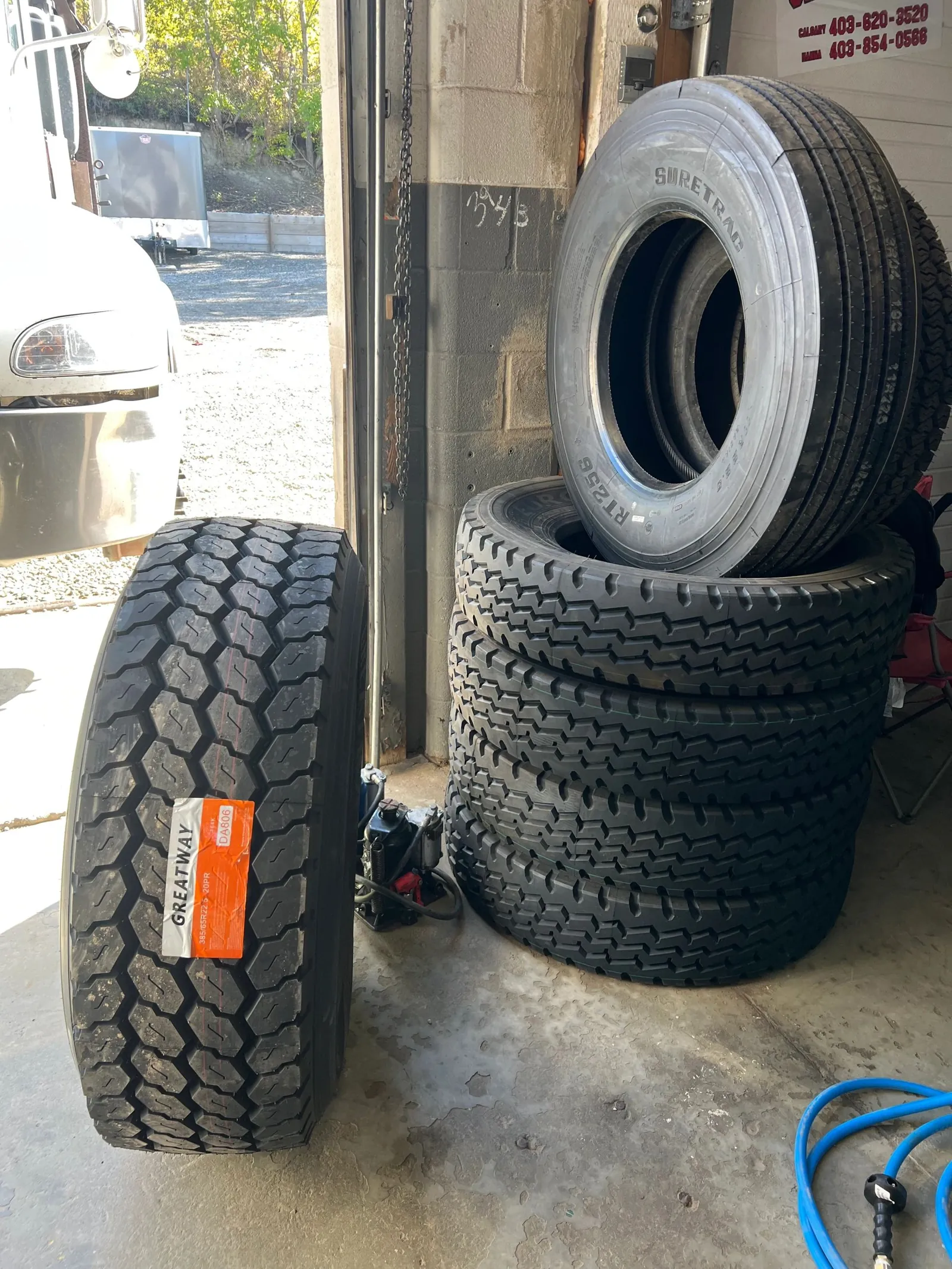
A highway tractor and its trailer can roll on eighteen tires, and it is tempting to think of them as eighteen copies of the same part. They are not. The two tires on the front axle steer the truck. The eight on the drive axles push it. The eight under the trailer mostly follow along, carry weight and resist being dragged sideways through tight turns. Each position asks a different question of the rubber, and the tire that answers one question well can answer another one badly.
So here is the short answer to the question this guide is built around. When you replace a semi truck tire, start with where it will be mounted, then with how that truck actually works, and only then with tread pattern, brand and cost. Michelin's freight guidance puts it plainly: steer, drive and trailer positions place different demands on the tires, and the right choice depends on both where the tire is mounted and how the vehicle operates. Everything below is an expansion of that one idea, written for Calgary owner-operators, small carriers, construction outfits running a few tractors and anyone who has stood in a yard on a cold morning wondering whether the tire in front of them belongs on the axle it is sitting on.
This is general tire education. It is not a substitute for the vehicle manufacturer's instructions, your carrier's maintenance program, the tire manufacturer's published data or the inspection standard that applies to your operation. Where a question moves past tires into brakes, suspension, steering geometry or alignment, that work belongs with a qualified heavy-truck repair facility. KMJ Tire sells and services tires and does oil changes; it does not do mechanical repair, and nothing here suggests otherwise.
Why one tire cannot be the best at everything
A tire is a set of compromises moulded into rubber, steel and fabric. A rib tread with continuous grooves running around the tire tends to give steady straight-line tracking and predictable response. A deep block tread with lots of biting edges tends to give traction when the tire has to transmit torque. A shallower, tougher tread compound can resist wear and rolling resistance on long highway runs, while a deeper, more open tread can deal better with slush and loose surfaces but generates more heat and wears differently.
Every one of those choices costs something. Deep blocks can squirm and wear irregularly on a free-rolling axle. Shallow ribs can struggle for grip when they are asked to push a loaded tractor up a wet ramp. A compound tuned for low rolling resistance may give up some resistance to cuts and chips. Manufacturers balance those trade-offs differently depending on whether a tire is designed for a steer, drive or trailer position, and many tire lines are labelled accordingly.
Michelin's published priorities make a useful starting map. For steer tires, it lists handling, steering response, stability and even wear. For drive tires, traction, durability and wear performance. For trailer tires, rolling efficiency, durability and resistance to irregular wear. The same page notes that some tires are designed to work in multiple positions while others are optimized for one axle and one application. That last sentence matters, because "all position" on a sidewall or catalogue page is a design statement from the manufacturer, not a promise that the tire is the best choice for every job you might give it.
The steer axle: the two tires you notice first
The steer tires are the only ones that directly turn the truck. They also carry a heavy share of the engine weight, and on a single front axle there is no dual partner to share the load if one tire loses pressure. When a steer tire fails, the driver feels it through the wheel immediately, and the consequences can be more serious than a failure on a dual position.
That is why handling, response, stability and even wear lead the steer priority list. A driver wants the truck to track straight without constant correction, respond predictably when the wheel is turned, and behave consistently from the day the tires are mounted until they come off. Even wear is not just a cost question here. A steer tire that wears unevenly can start to change how the truck feels, and irregular wear on the front axle is often the first visible sign that something else in the truck needs attention.
What steer tires tell you about the rest of the truck
Steer tires are honest witnesses. Feathered edges, cupping, one shoulder wearing faster than the other, or a pattern that repeats around the tire can all point toward causes outside the tire itself. Those causes might include inflation that does not match the load, a wheel-end problem, or steering and suspension geometry that has drifted. A tire professional can describe what the wear looks like and how the tire should be handled, but diagnosing and correcting the geometry is work for a heavy-truck alignment and repair facility.
The practical lesson is simple: when steer tires come off with unusual wear, do not just order two new ones and move on. Write down what the old tires looked like, photograph the tread, note the mileage and the pressure history if you have it, and make sure whoever looks after the steering and suspension sees the same evidence. Otherwise the new tires can quietly start wearing the same way.
Steer tires and Calgary roads
Calgary trucks see a mix that is unkind to front tires. There are long stretches of divided highway where a steer tire spends hours running straight, then tight industrial yards in the southeast where the same tire is scrubbed sideways at walking speed around loading docks. Add freeze-thaw potholes, gravel shoulders on the way to job sites, and curbs at fuel stations that were designed with smaller vehicles in mind. A steer tire chosen only for highway mileage may not love the yard work, and a tire chosen for rough job sites may give up some highway smoothness. Neither choice is wrong; it depends on where your truck spends its hours.
Drive axles: where the torque goes
Drive tires take everything the engine and transmission send to the road. They push the truck from a stop, hold it on grades, and carry a large share of the load, especially on a tandem tractor pulling a heavy trailer. Traction, durability and wear performance lead the drive priority list for good reason.
Deeper tread with more biting edges is common on drive tires because traction under torque is the job. On a Calgary winter morning, that traction can be the difference between a loaded tractor pulling away cleanly from a slushy intersection and a driver feathering the throttle while the tires spin. Many drive tire designs also include features intended to keep stones from lodging in the grooves, because a drive axle in a gravel yard picks up plenty of them.
Duals on the drive axle
Most tractor drive axles run dual tires, two per side. That gives redundancy, but it also creates a pairing problem. Two tires bolted side by side on the same hub are expected to share the load. If one is noticeably more worn, a different size, or running at a different pressure, the pair stops sharing evenly. One tire can end up doing more than its share of the work, flexing more and running hotter, while the other is partly along for the ride.
That is why tire professionals pay attention to matching duals by size, tread depth and pressure. The exact tolerances come from the tire manufacturer and industry guidance for the specific product, so this guide will not invent a number. What matters for a fleet owner is the habit: when one dual needs replacing, ask what its partner looks like, and do not mount a fresh tire beside a heavily worn one without a conversation about how they will share the load.
Regional work versus long haul on the drive position
Michelin's freight guidance draws a sharp line between long-haul and regional operations. Long-haul trucks spend more time at sustained highway speeds, where rolling resistance and even wear often carry more weight. Regional trucks make more stops, turns and accelerations over varied roads, where durability, traction and resistance to scrub may matter more. For a drive tire, that difference is large. A tire that delivers long life on a straight highway route may wear quickly when it spends the day pushing a tractor through tight industrial turns, and a rugged regional drive tire may cost more in fuel on a highway-only route.
Many Calgary carriers do both in the same week. A truck might run to Edmonton and back on Monday, then spend Tuesday doing short hauls between yards in the east industrial areas. In that case, look honestly at where the most hours and kilometres go, and which tire-related cost is actually hurting you: early removals, irregular wear, fuel, or roadside events.
Trailer axles: the quiet tires that still do a lot
Trailer tires do not steer and they do not drive. That makes some people treat them as the least important position, and that is a mistake. Trailer tires carry the freight. They roll a very long way, often at highway speed, and on a tandem trailer they get dragged sideways in tight turns because the axles cannot steer. A trailer that sits in a yard for weeks and then goes straight onto the highway asks its tires to do the job with no warm-up and sometimes with pressure that has crept down while it was parked.
Michelin's priorities for trailer tires are rolling efficiency, durability and resistance to irregular wear. Rolling efficiency matters because trailer tires represent a large share of the tire count on a combination vehicle. Durability matters because trailers are often dropped in yards and moved by different tractors and drivers, and they hit curbs. Resistance to irregular wear matters because the scrubbing that happens in tight turns can chew trailer tires unevenly.
Why a drive tire on a trailer is not a free upgrade
It can seem logical to put a deep-lug drive tire on a trailer for "extra grip." But a trailer axle does not push the truck, and deep blocks that make sense under torque can wear irregularly and add rolling resistance on a free-rolling axle. The reverse swap is also a problem: a shallow, efficiency-focused trailer tire moved to a drive position may not provide the traction a loaded tractor needs on an icy grade. Some manufacturers design and approve particular tires for more than one position, and that approval is what counts. Without it, assume that a tire designed for one position is designed for that position.
The sidewall: what to read before mounting anything
Before any truck tire goes on a wheel, someone should read the sidewall carefully. On commercial tires that includes the size, the load range or ply rating, the load index for single and dual use, the speed symbol, the manufacturer's position or application marking where provided, and the DOT code that identifies the plant and the week and year of manufacture. If you want a plain-language refresher, our guide on how to read the sidewall markings on a truck tire walks through each part.
Commercial tires usually show two load index numbers separated by a slash, such as one number for single use and a second, lower number for dual use. That second number reflects the load each tire can carry when it is mounted as part of a dual pair, at the corresponding inflation pressure. A steer tire on a single front wheel uses the single number. A drive or trailer tire in a dual assembly uses the dual number. If the actual axle load divided across those tires is higher than what the tire is rated to carry, the tire is the wrong choice regardless of tread pattern. Our page explaining how load index numbers work covers the general system, and the manufacturer's data book gives the exact figures for any specific product.
Position markings and what they mean
Many commercial tires carry a marking or a product name that hints at the intended position. Catalogues often sort products by steer or all-position, drive and trailer, and Michelin's own tire search is organized that way. If the sidewall or the manufacturer's catalogue says a tire is designed for trailer use only, treat that as an instruction. A trailer-only tire may not be intended for steer or drive service at all, and mounting them there can mean running a product outside the conditions it was designed and tested for.
Pressure: the maximum on the sidewall is not a setting
The most common commercial tire mistake is easy to understand. The sidewall shows a maximum pressure, so someone fills every tire to that number on the theory that more air means more capacity and fewer problems. Michelin's commercial pressure guidance says directly that the maximum pressure marked on a tire should not automatically be treated as the appropriate operating pressure for every application.
The method it describes has four steps. First, determine the actual load on each axle under representative operating conditions, ideally from real loaded weights rather than assumptions. Second, confirm the tire size and whether the axle uses single or dual tires. Third, use the tire manufacturer's load-and-inflation table to match that load to the corresponding cold inflation pressure. Fourth, consider the application and operating conditions, including load distribution, axle position and vehicle configuration, and consult the manufacturer's technical guidance or a qualified commercial tire professional where loads or conditions are unusual.
What underinflation and overinflation actually do
The same source explains the mechanics. A tire running below the pressure needed for its load flexes more than intended, which generates heat and increases rolling resistance. Over time that can contribute to irregular wear, higher fuel consumption and casing damage. Overinflation is not the safe alternative: pressure above what the load requires can change the footprint and wear pattern and affect how the tire responds to road impacts.
On a steer axle, those effects show up as handling changes and front-end wear. On a drive axle, a low tire in a dual pair can push extra load onto its partner. On a trailer, a slow leak on a unit that sits for a week can mean the tire starts its next trip well under specification, and nobody notices until it is hot.
How to check commercial tire pressure properly
The practical routine from Michelin's guidance is straightforward and worth writing into a yard procedure. Check pressure when tires are cold, because driving heat raises the reading. Use a calibrated gauge. Check every position, because a visual inspection cannot reliably tell whether a tire is correctly inflated, and duals in particular hide a low tire well. Compare the reading against the fleet's established cold specification, not against the sidewall maximum. Look at the valve and cap. And if a tire keeps losing pressure, find the cause instead of topping it up every morning.
That last point deserves emphasis. The guidance lists common sources of recurring pressure loss: punctures or damage, slow natural loss through the tire's components, leaks at the valve or where it meets the rim, and leaks at the bead-to-rim interface. Each of those has a different fix. A nail needs a proper commercial tire repair assessment. A valve leak needs the valve looked at. A bead leak may need the tire dismounted and the rim seat inspected. Adding air treats none of them.
Calgary temperature swings and pressure readings
Calgary is famous for chinooks that can move temperatures dramatically within a day. Cold inflation pressure changes with ambient temperature, so a tire set correctly in a heated bay can read noticeably lower after a night parked outside in a cold snap. The answer is not to guess an adjustment; it is to check cold pressure under the conditions the truck is actually operating in, against the specification built from load and the manufacturer's table, and to be consistent about when the checks happen.
Matching the tire to how the truck works
Once position and load are clear, the next question is the duty cycle. Michelin's freight guide lists the factors worth writing down before comparing products: route type, annual distance, load, road conditions, climate and weather, and the operating pattern of braking, acceleration and turning. It also says plainly that for many fleets there is no single tire that is the right choice for every truck.
A useful exercise is to describe each truck in a few sentences before talking to anyone about tires. Here are three hypothetical Calgary examples to show how different the answers can be.
Example one: the highway tandem
A tractor that spends most weekdays running loaded between Calgary and Edmonton, with occasional trips to the B.C. border, at sustained highway speed. Most of its tire wear comes from distance, not from turning. For this truck, rolling resistance and even, long wear probably lead the list across all three positions, with steer tires chosen for stable tracking and the drive tires chosen with enough winter traction for the hills and the cold months. Trailer tires can lean hard toward efficiency, because the trailer's job is mostly straight-line rolling.
Example two: the regional yard truck
A day cab that runs short loads between warehouses in the southeast industrial areas and a rail yard, making dozens of tight turns and starts each shift. Here, Michelin's regional priorities apply: durability, traction and resistance to scrub and irregular wear may matter more than squeezing out the lowest rolling resistance. Steer tires take a beating from slow, sharp turning. Drive tires spin up from stops dozens of times a day. Trailer tires get scrubbed constantly around docks. A tire optimized for long highway runs may come off early on this truck, and a cheaper purchase price can easily lose to an earlier removal.
Example three: the mixed construction hauler
A tractor pulling a gravel or equipment trailer, moving between paved roads and unpaved job sites on the edge of the city. This truck faces cuts, chips and stones that a highway truck rarely sees, and its drive tires need traction on loose surfaces and in mud or snow. Durability and resistance to cuts move up the list. The trailer tires also face rough surfaces and heavy, sometimes uneven loads. This is where the honest conversation about which costs actually hurt, early removal from damage or fuel, becomes the most useful.
None of these examples comes with a product recommendation, because the right answer depends on actual loads, sizes, routes and the products available at the time. The point is that three trucks on the same streets can need three different tire plans.
Winter in Calgary: what changes for semi tires
Commercial trucks in Alberta do not usually switch to a separate winter set the way many passenger cars do. Instead, many carriers choose drive tires with tread designs and markings suited to winter conditions, and lean on the rest of the setup to cope. If you run in the mountains or into British Columbia, check the current provincial requirements for commercial vehicles on the routes you actually drive, because rules differ between provinces and between highways, and they change. That is a regulatory check, not something this guide can answer for your specific route.
What does change in winter is how much the duty-cycle factors matter. Drive tire traction becomes more important when a loaded tractor needs to pull away from a frozen intersection. Pressure checks become more important because temperature swings move readings. Stones and ice packed into drive tread need attention because packed tread does not bite. If you are comparing winter tire options for Calgary conditions on your pickups or service vehicles, the same physics applies, but heavy truck tires are a separate category with their own data books.
Tread depth and replacement timing by position
A replacement decision on a semi should include both the tread remaining and the position. Legal minimum tread depths for commercial vehicles are set by the inspection standards that apply to your operation, and they can differ between steer and other positions. Your carrier's maintenance program or safety officer should confirm the exact numbers that apply to you; this guide is not going to quote them, because the authority is the standard, not a blog.
Beyond the legal minimum, Michelin's off-road tire inspection guidance offers a habit worth borrowing: it recommends measuring tread at several points around the tire rather than at one spot, using a depth gauge or the wear indicators where present, and asking a tire professional to look at abnormal wear or a difference in wear between tires on the same axle. That habit is worth borrowing for every position. One reading on one rib can hide a tire that is worn much lower on a shoulder.
Planning ahead instead of reacting
Fleets that plan tire replacement by position tend to have fewer surprises. Keep a simple record for each truck: the tire size, brand and model at each position, the date and odometer when it was mounted, tread readings at regular intervals, and pressure checks. Over a few months the record shows which positions wear fastest on that particular truck, which lets you budget and schedule instead of reacting to a roadside call. If that recordkeeping is more than you want to run in-house, it is worth asking about fleet tire management for Calgary carriers, which is built for exactly that kind of tracking.
Moving tires between positions
Rotation on a semi is not the same as rotation on a passenger car. Because each position may have a different tire design, you cannot simply shuffle tires around the truck. A steer tire that is still within its own position's limits may sometimes be moved to a trailer or drive position later in its life, when the manufacturer's guidance allows it, but drive tires generally do not go to the steer axle and trailer-only tires stay on trailers.
Whether a particular move makes sense depends on the tire design, the position approvals for that product, its remaining tread, any damage, and how it will pair with whatever it sits next to. If a steer tire is moved to a dual drive position, for example, it has to match its new partner closely enough to share the load. The point is not to forbid moves; it is to make each move a deliberate decision rather than a habit.
Directional and asymmetric drive tread
Some drive tires have tread patterns designed to run in one direction. Moving one of those to the other side of the truck without remounting it on its wheel can make it run backwards. If a drive tire has a rotation arrow on the sidewall, the arrow wins, and the tire professional mounting it should confirm it is pointed the right way.
Damage, casings and the second life of a truck tire
Commercial truck tires are often designed with the expectation that the casing, the structure under the tread, may be retreaded and returned to service after the first tread wears out. Michelin's guidance explains that maintaining tires appropriately during their first life, especially inflation appropriate for the load, can help preserve the casing for evaluation as a retread candidate, and also says clearly that not every casing will qualify. A casing that has run underinflated, overheated, or suffered certain kinds of damage may be rejected.
That has a direct effect on position decisions. Some fleets put retreaded tires on drive and trailer positions and keep new tires on the steer axle; others have different policies. Whatever your policy, the decision about whether a casing is fit for another life belongs to the retreader's inspection, not to someone looking at it in the yard. We covered the difference between retreading, repair and regrooving in a separate article, so this one will not repeat it.
Damage that keeps a tire off the road
Michelin's off-road tire inspection guidance, written for large equipment tires but describing damage that is serious on any tire, lists casing damage that should keep a tire out of service: visible or damaged cords, separation between components, deterioration caused by petroleum or corrosive products, and inner liner abrasion from running with insufficient pressure. It also says that punctures, cuts or dents in the tread, sidewalls or grip area mean the tire should be examined inside and out by a tire professional. Those warnings apply to every position, but they matter most on the steer axle, where there is no dual partner to take over.
Wheels, valves and the parts that hold the tire
A tire is only as good as the wheel it sits on and the valve that holds its air. When tires are replaced, it is a good moment to look at the wheel for cracks, damage and corrosion at the bead seat, and to replace or check the valve. Wheel nut torque should follow the vehicle manufacturer's specification, and many maintenance programs call for a torque recheck after a tire change. If the wheel itself shows damage, that question belongs with whoever services the wheel ends and hubs on that truck.
Balance is a separate topic. Steer assemblies on some trucks are balanced, and a vibration that appears after new tires go on can have several causes. Our explanation of how wheel balancing works covers the general idea, but vibrations on a heavy truck can also come from components that are outside a tire service and need a repair facility.
Talking to a tire supplier about semi tires
A good conversation with a tire supplier saves money, and it is easier when you arrive with the right information. Before calling, write down the truck's configuration, the tire size at each position, the actual loaded axle weights if you have scale tickets, the kind of routes the truck runs, how many kilometres a year it covers, and what problems you have seen with the current tires. Then ask about tires for each position separately, rather than asking for "eight tires for the semi."
It also helps to know what you are optimizing. If fuel is the biggest cost in your business and your trucks mostly run highway, ask about rolling resistance and long, even wear. If early removals from damage are what hurt, ask about durability and resistance to cuts. If roadside breakdowns are the problem, focus on pressure maintenance and casing condition. For a broader look at the price question, our comparison of budget versus premium tire trade-offs applies to commercial tires too: the purchase price is one number among several.
Questions worth asking about any commercial tire
Is this tire designed and approved by its manufacturer for the position I plan to use it in? Does its load capacity at the single or dual rating cover my actual axle loads? What does the manufacturer's load-and-inflation table say about cold pressure at those loads? Is the tread designed for highway, regional, mixed or on/off-road service? What are its traction characteristics in snow and ice? Is the casing intended to be retreadable, and does the manufacturer publish guidance about casing care?
A supplier who can answer those questions from the manufacturer's data is giving you something more useful than a price. If you want to compare brands, KMJ's pages on Michelin tires in Calgary and Bridgestone truck and car tire lines give a starting point, and the Calgary tire buying guide explains the general process.
A simple position-by-position yard checklist
Here is a plain checklist you can adapt for a yard procedure. It is not a regulatory inspection and does not replace one.
For the steer axle, check cold pressure on both tires with a calibrated gauge against your load-based specification. Look at tread depth at several points across each tire, including both shoulders. Look for feathering, cupping or one-sided wear and record it. Inspect sidewalls for cuts, bulges and curb damage. Confirm the valve caps are present and the valves are not damaged.
For drive axles, check cold pressure on every tire, including the inner duals, which are easy to skip. Compare the two tires in each dual pair for tread depth and visible size or wear differences. Look for stones lodged in the tread and remove them carefully. Look for cuts and chunking, especially if the truck runs on gravel. Note any tire that has been losing pressure repeatedly.
For trailer axles, check pressure after the trailer has been parked, before it goes out loaded. Look for scrubbing and irregular wear on the shoulders from tight turns. Inspect for curb damage and sidewall cuts. Check that duals are matched and that both tires in each pair are holding pressure. If the trailer sits for long periods, record how much pressure it loses between trips.
For all positions, record readings, dates and odometer values. Patterns in the record are what turn a list of tire problems into a plan.
When the problem is on the road, not in the yard
Every carrier eventually faces a tire problem away from the yard. When it happens, the first priority is getting the truck and driver to a safe place. After that, the information that helps is the same as in the yard: which position the tire is in, its size, what happened, and whether the wheel looks damaged. A driver who can say "right outside drive dual, 11R22.5, lost pressure and the sidewall is cut" gets a faster and more accurate response than one who can only say "a back tire is flat." That example size is just a format illustration; read the actual size off your tire.
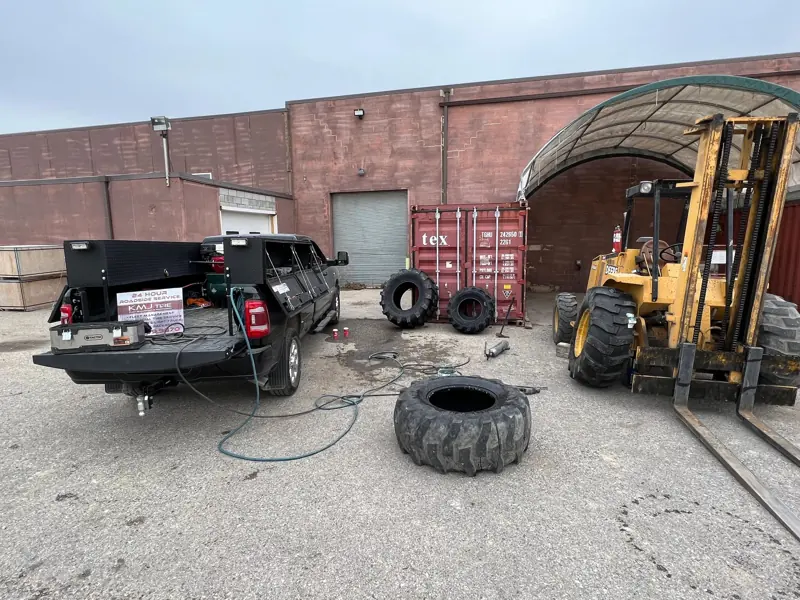
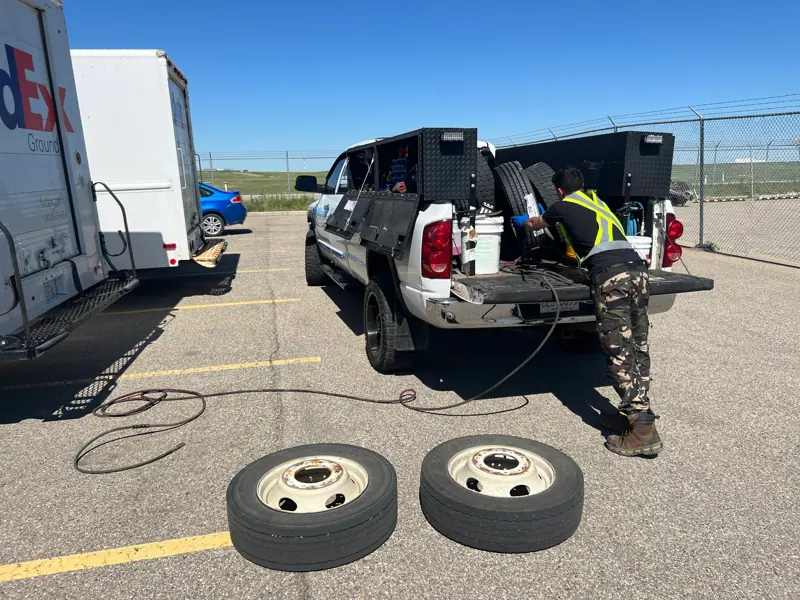
KMJ offers roadside commercial tire emergencies support and mobile tire service for trucks in the yard, so it helps to know in advance which situations those cover and which areas KMJ serves around Calgary. If the damage is to the wheel or hub rather than the tire, a tire service can tell you that, but the repair goes to the appropriate heavy-truck facility.
Mistakes we see repeated with semi tires
The same handful of mistakes comes up again and again with commercial trucks, and most of them are cheap to avoid once you know about them.
The first is inflating every tire to the sidewall maximum. As covered above, the correct cold pressure comes from the actual load and the manufacturer's table, and the maximum is not automatically right.
The second is ignoring the inner duals. They are hard to reach and easy to forget, and a low inner dual can run for a long time before anyone notices, quietly overloading its partner.
The third is mixing tires in a dual pair that do not match closely enough in size, wear or pressure. The pair stops sharing the load evenly.
The fourth is using a tire outside its intended position because it was available. A drive tire on a steer axle, or a trailer-only tire on a drive axle, can mean running a tire in conditions it was not designed for.
The fifth is replacing unusually worn steer tires without anyone looking at why they wore that way. The new tires can wear the same way, and the cause stays in the truck.
The sixth is topping up a slow leak every morning instead of finding it. The leak has a cause, and running a tire repeatedly low can damage the casing beyond its retread value.
The seventh is treating tread depth as one measurement. A tire can show plenty of tread in the centre and be worn low on a shoulder.
Budgeting for semi tires without guessing
Commercial tires represent a real cost, and the temptation is to buy whatever is cheapest per tire. A more useful measure is cost over the tire's working life: the purchase price, the kilometres it delivers on your actual routes, the fuel it affects, the downtime it causes or prevents, and the value of the casing at the end. Michelin's freight guide describes that as total cost of ownership and cost per mile, and the idea holds regardless of brand.
You do not need complicated software to start. A spreadsheet that records the tire, its position, the mounting date and odometer, its removal date and odometer, and the reason it came off is enough to compare products on your own trucks over time. Within a year, you will know more about which tires work on your routes than any general advice can tell you. If spreading the purchase cost makes sense for your business, there is information about tire financing options in Calgary on KMJ's site; terms depend on the provider and your situation, so read the actual agreement.
Pickups and service trucks in the same fleet
Many Calgary businesses running a couple of tractors also run pickups and service trucks, and the position thinking carries over in a smaller form. A light truck does not have dedicated steer and drive tire designs in the same way, but load, pressure and duty cycle still decide the right tire, and the same disciplined checks apply. For those vehicles, the general Calgary tire safety basics and the ability to browse tires by size are useful starting points, and the same commercial team can look at both kinds of vehicle.
Questions owner-operators ask about semi tire positions
Can I run the same tire on all eighteen positions? Some tires are designed by their manufacturer for multiple positions, and a fleet can choose to standardize on them for simplicity. But even all-position tires are usually optimized for a particular application, and a mixed fleet often gets better results from choosing tires position by position. Check the manufacturer's approvals.
Do my drive tires have to match each other across both drive axles? Within each dual pair, close matching matters most because the two tires share the load directly. Across axles, consistent size and type is a sensible practice; tire professionals and the manufacturer's guidance can tell you how much variation is acceptable for a particular product.
Should the steer tires always be new? Many fleets choose new tires for the steer axle as a policy, and some inspection standards treat steer positions differently from others. Check what applies to your operation.
How often should I check pressure? Michelin's guidance says the frequency depends on the fleet's program, application and operating conditions, and that checks should happen as part of a consistent process, not only when a tire looks low. Many operators include a quick check in every pre-trip routine and a gauge check on a set schedule.
What do I do if one steer tire wears faster than the other? Record what you see, replace or move the tire as appropriate, and have a heavy-truck facility look at the steering and suspension. Uneven steer wear is very often a symptom rather than a tire problem. For more general answers, our common tire questions answered page covers the basics.
Getting help with commercial tires in Calgary
KMJ Tire works with owner-operators and fleets on commercial truck tires, including tires for semis and trailers, and offers commercial truck tire service in Calgary along with mobile support for fleets. KMJ does tires and oil changes only and does not repair brakes, suspension, steering geometry or wheel-end components. When a tire problem points to one of those systems, you will be told so plainly, and a heavy-truck repair facility takes that part of the job.
The fastest way to get a useful answer is to send KMJ your axle loads and tire sizes along with a short description of how the truck works and what you have seen on the current tires. If you already know what you need, you can schedule commercial tire work online. Either way, the conversation should start where this guide started: which position, what load, and what kind of work.
The short version
Steer tires steer, drive tires push and trailer tires carry and roll. Each position has its own priorities: handling, response and even wear on the steer axle; traction, durability and wear on the drive axles; rolling efficiency, durability and resistance to irregular wear on the trailer. Choose for the position first, then for how the truck actually works. Set cold pressure from the real load and the manufacturer's table rather than the sidewall maximum. Check every tire, including the inner duals, with a calibrated gauge. Keep dual pairs matched. Treat unusual steer wear as a message about the truck. Write things down. And when a question is about steering, brakes or suspension rather than the tire itself, send it to the people who repair those systems.
Sources used for this guide
The technical points above are drawn from Michelin's commercial guidance on choosing truck tires for freight applications, including its steer, drive and trailer priority descriptions and its long-haul versus regional comparison; Michelin's guidance on commercial truck tire pressure, including the load-based inflation method, cold checks with a calibrated gauge, the effects of under- and overinflation, and common causes of recurring pressure loss; and Michelin's off-road tire inspection guidance on casing damage and measuring wear at several points, applied here as a general inspection habit. The examples of Calgary trucks are hypothetical illustrations, not records of real customers or jobs. Specific pressures, tread limits, load figures and position approvals always come from the tire manufacturer's published data and the inspection standards that apply to your operation.