Which tires should go on a pickup that will push snow around Calgary? Start with the truck's approved plow application, its actual loaded axle weights and its tire specifications. Then choose the winter traction category. An aggressive tread cannot make an overloaded front axle acceptable, and a high load rating does not automatically make a tire good on ice. You need both suitable load capability and suitable grip, on a vehicle that is approved for the equipment attached to it.
That answer changes the buying conversation. Instead of beginning with the deepest-looking tread, bring the truck's labels, the plow identification, the equipment instructions and a description of the complete working load. A pickup carrying a blade, spreader, driver and supplies is a different tire application from the same pickup taking an empty-bed trip to the grocery store. The changes also continue during a shift as spreading material is used and equipment is attached or removed.
This guide concerns road-going pickups used for snow removal, not tire specifications for loaders, tractors or skid-steers. It does not approve a plow conversion or prescribe a universal inflation setting. KMJ handles tires and oil changes; plow installations, vehicle modifications and mechanical concerns belong with the appropriate equipment or vehicle specialists. The useful goal is to arrive at a tire decision with the working configuration understood, rather than asking the tires to compensate for unanswered equipment questions.
1. Define the complete truck before choosing a tread
Write down the model year, make, model, cab configuration, engine, drivetrain and whether the rear axle has single or dual wheels. Include the truck's identification and the original equipment packages relevant to snowplow use. Two pickups with the same badge can have different axle ratings, available payload and approved applications. A description such as heavy-duty four-wheel drive is not enough to select a blade or validate the weight it places on the vehicle.
Next, identify the plow itself, including its mounting equipment and accessories. A borrowed blade that physically connects to a receiver has not thereby passed a compatibility assessment. Changes to the cutting equipment or attachments can matter too. The equipment manufacturer's application information and the vehicle manufacturer's instructions must agree with the actual combination. If a record is missing, ask the relevant manufacturer or authorized equipment specialist to resolve it before treating the truck as ready for work.
For a primary-source example, WESTERN's vehicle-specific snowplow matching tool begins with vehicle type, year, make and model. It explicitly says that an unlisted vehicle does not have an approved application under its guidelines. That is a useful reminder to work from an actual approved match, not from what a similar-looking truck carries. The tool is an example of a manufacturer's process, not blanket approval for every brand or Canadian application.
The tire side of that conversation can start with commercial tire service for Calgary work vehicles, but keep the responsibilities clear. A tire recommendation is not a structural approval of a plow mount. Give each specialist the information needed for their part, and do not assume that approval of one component automatically approves the entire assembled vehicle.
2. Separate four different kinds of capacity
A working truck has several limits that answer different questions. Gross vehicle weight rating concerns the whole vehicle. Front and rear gross axle weight ratings concern the respective axles. Tire load capability concerns each tire in its specified application and inflation condition. Wheels and other components also have limits. Passing one check does not eliminate the others, and adding the tire sidewall capacities is not a new legal or engineering rating for the truck.
A plow pickup can be under its total vehicle limit while one axle is over its own limit. This is why a total scale weight alone can leave an important question unanswered. The front tires may be dealing with the blade and its leverage while the rear tires carry the spreader and supplies. Even where both axle totals are acceptable, uneven side-to-side loading may deserve further assessment. Do not assume a total can always be divided into equal quarters.
Similarly, the load rating printed on a replacement tire is not permission to raise the vehicle's rated payload. If a front axle is overloaded, installing a tire with a larger number does not fix the axle, mounting arrangement or vehicle approval. The equipment configuration needs correction. Tire selection comes after that correction, so that the chosen tire is appropriate for the valid operating load rather than being used to disguise an invalid one.
Use tire load index information for replacement selection to understand the terminology, then obtain the actual specifications for the truck and candidate tire. Keep units visible in every note. A capacity copied without its units, its pressure conditions or its single-versus-dual application can look precise while answering the wrong question.
3. Why the blade changes the front axle differently
A blade carried ahead of the front axle is not simply cargo placed at the middle of the bed. Its position matters. In a simplified static model, weight located ahead of the front axle increases the front-axle reaction by more than the added weight itself and reduces the load supported at the rear. That is ordinary leverage, not evidence that weight has appeared from nowhere. The axle changes still add up to the actual weight added to the truck.
Here is an intentionally simplified arithmetic example, not a setup specification. Suppose a vehicle has a four-metre wheelbase and an added 200-kilogram mass acts one metre ahead of the front axle. Ignoring all other changes, the added front reaction is equivalent to 250 kilograms, and the rear reaction falls by 50 kilograms. Together those changes equal 200 kilograms. The example explains why the blade's catalogue weight cannot simply be added to an unloaded front-axle estimate and treated as a verified answer.
Real plows have assemblies, mounting hardware and operating positions that are more complicated than a single point mass. Braking, turning, road disturbances and blade operation introduce forces beyond that static illustration. You should not calculate a homemade allowable plow weight from this example. Use the approved application, the manufacturer's loading instructions and measured operating configurations, interpreted by the appropriate specialist when necessary.
This also explains why a truck that looks level can still be wrong. Ride height is not an axle scale. An accessory that changes how the vehicle sits does not prove that the load limits have changed. If the nose seems unusually low or the handling changes after attachment, stop treating the issue as a tread-pattern question and have the equipment and vehicle configuration assessed.
4. Weigh the working configuration, not yesterday's empty truck
Prepare a loading description before going to a suitable scale. It should state who is in the cab, the fuel condition, which blade is attached, which spreader is fitted, what material is carried, the tools on board and any prescribed ballast. Follow the equipment instructions for the blade's transport position and for safe scale use. The goal is to reproduce a legitimate road-going working state, not to improvise a test position around people or scale equipment.
Obtain axle information, not just a single total. Where side-to-side loading is a concern, ask a qualified weighing provider about an appropriate method for individual wheel-position assessment. Do not create an unsafe measurement by putting half the truck on a raised platform or guessing at corrections. Save the scale ticket with the loading description. Without that description, a weight record can become impossible to interpret later.
Consider more than the departure state. A full spreader can create the highest rear load, while a depleted spreader can change the balance with the blade still attached. Detaching the blade while leaving rear equipment aboard produces another configuration. The equipment specialist may identify which states require measurement or restrictions. You are checking a range of approved working conditions, not searching for the single most flattering number.
For crews managing more than one vehicle, tire planning for Calgary fleets can be discussed using a separate configuration sheet for each truck. Do not transfer a scale ticket between vehicles merely because they share an engine or body style. Differences in trim, installed equipment and the location of supplies can change the answer before any snow is moved.
5. Ballast is an instruction to verify, not a guess
Some plow applications require ballast, and its amount, location and restraint belong to the particular approved setup. Do not choose a quantity by copying another operator's bed or adding bags until the truck looks balanced. Position affects how weight is shared between the axles. Moving the same load within the bed can change its effect even though the gross vehicle weight stays the same.
Use ballast only as directed by the relevant equipment and vehicle guidance, with suitable securement. Loose material that can slide, tip or roll is not a stable configuration. The instructions also need to distinguish dedicated ballast from usable spreading material. If an approved arrangement depends on a minimum retained load, spending that material during the shift could change the condition on which the setup was assessed. Resolve that point with the equipment specialist instead of assuming the last load can always be emptied.
A rearward mass does not erase the need to check the rear axle or total vehicle limit. It adds weight to the vehicle and changes distribution; it is not free capacity. Nor is extra ballast automatically beneficial after the required configuration is satisfied. Additional loading can reduce remaining capacity for occupants, tools and supplies and may affect handling. The correct question is what the approved configuration requires, not how much can be squeezed into the bed.
Label any configuration notes so another driver can understand them. Identify which secured items are required ballast and which are ordinary supplies. If the plow is removed for a different assignment, review the resulting loading instructions rather than leaving the winter setup untouched by habit. A tire pressure note is only meaningful alongside the configuration it was prepared for.
6. Read the tire specification in full
The nominal tire size is only the beginning. Record the complete size designation, service description, construction category and any load-range or special fitment requirements. A tire that fits the wheel diameter may still be inappropriate for the vehicle. A familiar size number on a sales listing does not prove that its load capability or application matches the original requirement.
For light-truck tires, distinguish the information used for single-wheel and dual-wheel applications where both are provided. The relevant value depends on how the tire is installed. A six-tire truck is not a four-tire truck with two free reserves, and the load cannot simply be redistributed in your head after a failure. Dual-wheel matching and spacing requirements need attention from the tire professional and the applicable manufacturer instructions.
Keep the wheel specification in the same file. Rim width, load and pressure capability, mounting compatibility and clearance are part of a valid fitment. A larger-looking wheel is not proof of stronger capacity, and an aftermarket combination may require additional verification. If previous owners changed the wheels, the original door label may no longer describe everything now fitted, although the vehicle's underlying limits still matter.
A clear photo of each relevant marking helps when discussing truck tire sidewall specifications. Photograph the actual tire rather than relying on a retailer's generic product image. If two listings look identical, compare the complete product specifications before comparing cost. A missing suffix or a different application can be more important than the apparent saving.
7. Pick winter performance for the entire route
A snow-removal truck does more than push through loose snow. It travels between properties, turns into access lanes, stops near pedestrians, crosses polished areas and may travel on faster public roads. Think about the least forgiving surface on the whole route. A tread chosen mainly for digging through soft material may not address the icy stopping and turning problem that dominates another part of the shift.
Transport Canada's winter tire guidance explains the peaked-mountain snowflake symbol and recommends winter tires as a matched set of four for ordinary four-wheel vehicles. The symbol indicates specified snow-traction performance; it does not mean every marked tire has identical ice braking, handling or wear characteristics. For a dual-rear-wheel configuration, get the appropriate whole-vehicle recommendation rather than interpreting that four-tire guidance as permission to leave two positions out.
Dedicated winter tires and all-weather products may both enter the discussion, provided the exact sizes and load specifications are suitable. Compare the particular products and the job requirements. A general category description is not a substitute for manufacturer information about the tire being considered. The Calgary winter tire selection information and winter versus all-weather comparison can help frame those questions without promising that one category suits every plow pickup.
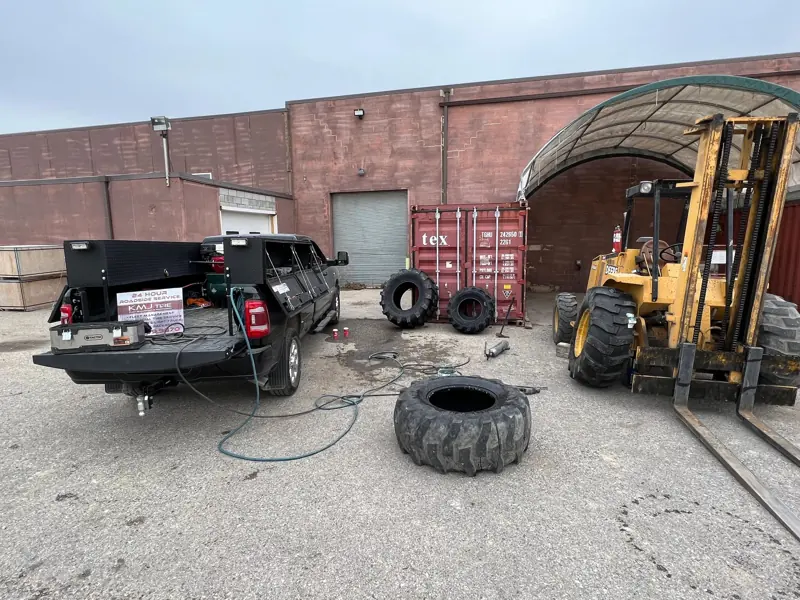
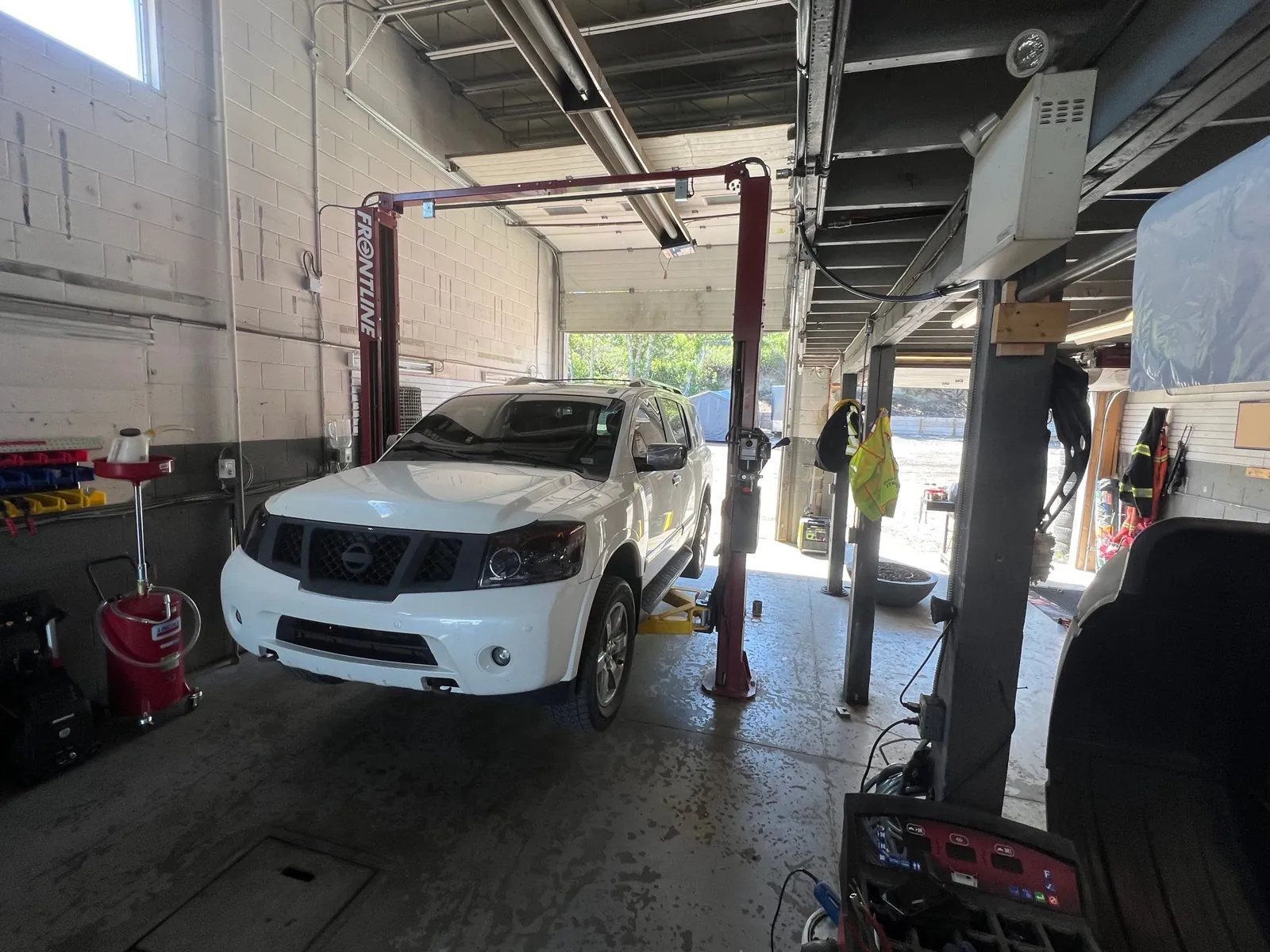
Be especially cautious about judging winter capability from the size of the tread blocks. The hero photograph accompanying this guide shows a real pickup in the KMJ service bay, not a plow-equipped truck or an approved snowplow application. A photograph cannot certify a compound, an ice result, a load setting or the fitment on your vehicle. Those decisions require the exact product and configuration.
8. Four-wheel drive does not answer the stopping question
Four-wheel drive can help distribute driving force, but the tires still determine the available contact with the surface. A truck that pulls away confidently can still have inadequate grip for the next stop or turn. The plow operator also has to account for the road-going equipment configuration and the conditions around the work area. Successful acceleration is not a meaningful brake test.
Do not deliberately test the limits in an occupied lot or on a public road. If steering response, braking behaviour or stability changes unexpectedly, stop the assignment in a safe place and seek assessment. Reducing speed is necessary in poor conditions, but it is not a cure for an overloaded configuration, a damaged tire or an unsuitable tire specification. A scheduled property visit does not make those defects acceptable.
The difference between all-season and all-weather tires is relevant when an existing truck arrives with a set selected for general year-round driving. Confirm what is actually installed before assuming that a familiar sidewall description means winter capability. Then discuss the appropriate matched replacement strategy rather than selecting only the two positions that seem to struggle when starting.
Keep the driver briefing focused on observations and operating limits. There is no need to invent an exact stopping-distance improvement for a tire that has not been tested in the same conditions. Describe what the product is designed for, what the manufacturer supports and what remains dependent on the road, the vehicle and the driver. Honest limits make a more useful purchasing decision than an impressive but unsupported percentage.
9. Establish the inflation plan before the cold shift
Use the vehicle manufacturer's inflation guidance for the approved tire and loading configuration. Where an equipment application or replacement specification needs additional interpretation, have the appropriate qualified professional reconcile the vehicle information with the tire manufacturer's load-inflation data. Do not invent a snowplow pressure by adding a fixed amount to the usual setting, and do not use the maximum on the sidewall as an automatic target.
The USTMA tire-care essentials recommend checking with a gauge when tires are cold, meaning the vehicle has been parked for at least three hours. They also emphasize checks before heavy loading and long trips. For a plow operation, arrange the routine so the driver can obtain meaningful cold readings before moving, rather than discovering halfway through the route that the only recorded values were taken after driving.
Write the approved front and rear targets separately if they differ. Record the actual readings by position, the date and any adjustment made. A single check mark labelled pressure good loses useful information when one tire later develops a slow leak. Use a gauge suited to the required pressure range and confirm that the valve access allows an accurate reading without pulling or straining components.
If the truck was kept in a warm building and will work outside, ask how to follow the manufacturer's cold-weather instructions for that situation. Do not assume an indoor reading will remain unchanged in colder ambient conditions. The practical tire-care information for Calgary drivers is a starting point, but the actual setting must remain tied to the specific vehicle and its valid load.
10. Do not air down to solve a plowing problem
Advice intended for a particular off-road activity does not automatically transfer to a loaded pickup travelling on public roads. Lowering pressure because a truck feels short of traction changes the tire's operating condition and load support. If the specified inflation is needed for the valid load, reducing it can create a different safety problem without fixing the surface or the tire selection.
A truck struggling to push may have a problem of conditions, technique, equipment suitability or loading. It may also need a different approved winter tire. Those possibilities deserve separate assessment. They do not justify turning the valve into a quick traction adjustment. Equally, overinflating beyond the appropriate specification is not a method of creating extra vehicle capacity or protecting a tire against every curb impact.
Pressure rises as tires warm in service. Do not bleed a warm tire down to a cold target simply because the gauge reading is higher at the end of a road transfer. If a pressure warning or unusual reading appears, investigate it using the manufacturer's procedure. An abnormal tire should not be dismissed as ordinary temperature change, but normal warm-up should not be corrected with an uninformed cold-setting adjustment either.
For operators considering a product change, comparing tire options for purchase in Calgary is more productive when the pressure requirement is already documented. Ask whether the candidate meets the application under the correct conditions. Avoid making the desired ride feel or a social-media pressure suggestion the starting constraint.
11. Build a short pre-shift inspection that catches real defects
Before movement, look at every tire and the visible wheel areas in a safe, well-lit place. Inspect for a visibly low tire, bulges, cuts, exposed reinforcement, lodged objects and obvious irregular wear. Pay attention to the inward-facing sides where access allows safe observation, without crawling under unsupported equipment. A plow blade or vehicle raised for access requires the relevant safe-work procedure, not an improvised workaround.
Measure tread at several locations across and around the tire, using a proper gauge and the manufacturer's criteria. Recording only the easiest outer groove can miss a worn area elsewhere. Note the lowest relevant readings and the location of irregular wear. Snow service should not be planned solely around whether a tire has reached its final wear indicators; winter performance can become inadequate before that point.
Transport Canada cautions against using tires worn close to four millimetres of tread on snow-covered roads. Treat that as winter-use guidance, not a promise that every tire just above that measurement is suitable for a plow shift. Condition, age, product design, the vehicle and the duty still matter. If a tire is damaged or irregularly worn, a generous measurement in one groove does not give it a clean bill of health.
Include valves and caps in the walkaround. Check that access equipment is intact and nothing is rubbing or hanging loose. A pressure-monitor display can help, but it does not replace the gauge and physical inspection. The driver needs a simple way to mark a defect and keep the vehicle out of work until the issue has been assessed, rather than leaving the next person to interpret an unexplained warning light.
12. Keep curbs and buried obstacles out of the tire plan
A snow-covered property can hide curb edges, wheel stops, broken pavement and other hazards. Map known obstacles before they disappear beneath accumulation, and follow the site's operating plan. Tire choice is not a substitute for knowing where the edges are. A more rugged-looking tread does not protect every sidewall from a hard impact or eliminate the risk of wheel damage.
After a meaningful hit, stop safely and inspect what can be seen. A new vibration, visible bulge, loss of pressure or changed steering response needs attention. Do not keep working merely because the tire still holds some air. Damage may not be fully visible with the assembly on the vehicle, and a tire that was driven significantly underinflated can require internal assessment before any repair decision.
If a puncture is suspected, describe the event and the subsequent driving accurately when arranging tire puncture assessment in Calgary. A repair decision depends on the injury, its location, the tire's condition and the applicable repair policy. It is not established by the size of the object visible from outside. Do not remove an embedded object beside an active work lane just to find out how quickly the air escapes.
Mechanical symptoms after an impact need the appropriate vehicle specialist. Tire replacement or wheel balancing for a verified tire-wheel issue should not be presented as a universal cure for steering, brake or suspension problems. Separate the observed symptom from the proposed service so the real cause is not hidden behind a convenient purchase.
13. Plan for salt use and changing loads during the route
Spreading material is cargo, and its consumption changes the vehicle's mass and distribution. Start with the permitted full condition and understand the approved low-material condition as well. A route plan that assumes the truck is identical from first property to last misses this change. Keep required ballast distinct from material intended to be spread, and obtain equipment guidance if the two are being treated as interchangeable.
Do not add an extra load simply because there is empty space in the hopper or bed. Volume is not weight, and different materials or moisture conditions can change the load associated with a given container. Use reliable material and equipment information and actual weighing where required. The permitted amount also depends on everything else already carried, including the driver, passengers, tools and attached equipment.
Record any significant configuration change before handing the vehicle to another operator. A note that the spreader is nearly empty can matter, but it should not be the only description if minimum retained loads or other instructions apply. Likewise, a new tool chest or additional equipment should not become invisible cargo simply because it stays in the truck all winter.
A practical supervisor check is to compare the truck in front of you with the configuration sheet, not merely with the vehicle number on the key tag. If the equipment has changed, update the assessment before continuing. The purpose is not paperwork for its own sake; it is to stop a tire and loading recommendation made for one arrangement from silently being reused for another.
14. Choose between products using comparable evidence
Once size, capacity and application are settled, compare exact products in that specification. Ask about winter category, intended use, published manufacturer information and any restrictions relevant to the work. Avoid comparing a winter tire in one size with a different construction or load range in another size and assuming the trade-off is only price. The valid shortlist begins with products that meet the actual requirements.
Brand pages can help you find the right discussion, including Michelin tire options in Calgary, Toyo truck tire choices and Falken tire selection. These are starting points for checking a current fitment, not claims that a specific size is available or that every tire under a brand name is intended for plowing. Obtain an actual product recommendation and current availability for your truck.
Compare cost across the complete approved arrangement. The purchase may involve tires alone or a suitable seasonal wheel set, plus the necessary tire-related service. Do not omit fitment verification or required components to make one option appear cheaper. On the other hand, a more expensive product is not automatically the better match simply because the work sounds demanding.
The budget-versus-premium tire comparison is useful when it leads to a discussion of trade-offs rather than a blanket ranking. For snow-removal duty, ask what evidence supports the choice on the surfaces you face, how the tire should be maintained and what would trigger removal from winter service. Those answers are more useful than an unsupported promise of a certain number of winters.
15. Treat chains and studs as separate compatibility decisions
Traction devices have their own fitment requirements and restrictions. A tire size appearing on a chain package does not establish clearance on the truck, especially where the vehicle has specific wheel or equipment configurations. Consult the vehicle and device manufacturers for permitted locations, clearance and operating limits. Do not assume that a plow attachment or a four-wheel-drive badge makes every traction aid acceptable.
If studded tires are being considered, verify the tire's suitability for studding and the rules for every jurisdiction in which the truck will travel. The Calgary tire-studding information can help begin that discussion, but the decision must also account for the particular tire and operating conditions. Studs are not a workaround for incorrect capacity, poor condition or an unapproved equipment setup.
Consider the worksite as well as the highway. Property requirements, surface protection and the equipment operating plan may affect what is suitable. An operator should not discover a conflict only after arriving for the first assignment. Keep these questions separate from tread preference so a device is not purchased on the assumption that it will solve every icy situation.
Any approved device must be used according to its instructions. If a chain or other aid loosens, interferes or damages a tire, stop and follow the safe procedure rather than attempting to finish a section of the lot first. The route needs a fallback when conditions exceed the valid equipment setup. Sometimes that means changing the assignment or using different approved equipment, not adding another improvised accessory.
16. Make the spare and roadside plan match the working truck
Check the spare before the season, including its specification, condition and required pressure. A spare that is adequate for an unloaded vehicle may have restrictions that matter with the work equipment attached. Consult the vehicle instructions for temporary-use limitations and for the permitted way to manage a disabled tire under the current load. Do not assume that fitting any wheel that bolts on is a valid return-to-work plan.
The location of a failure matters too. A dark roadside, an icy slope or a property entrance with moving vehicles is not a suitable place to improvise lifting and heavy-wheel handling. A plow-equipped truck may introduce additional access and stabilization questions. Tell the service provider about the attached equipment, actual loading, tire size and exact location before assistance is arranged.
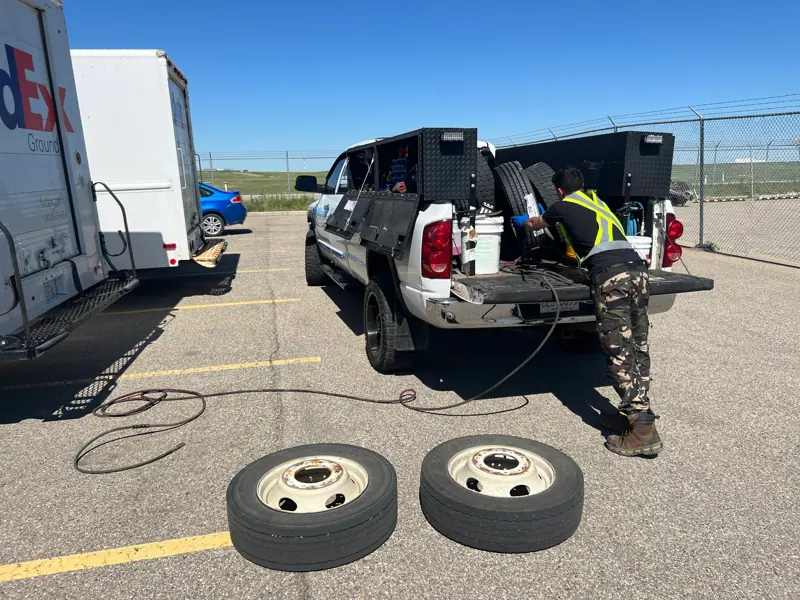
Discuss mobile tire service suitability in advance, including whether the vehicle and location can be handled safely. A service page is not a promise that every snowplow, every roadside position or every hour is covered. Confirm the actual scope and availability when help is needed. Keep a safe recovery alternative for situations where tire work cannot reasonably be performed where the truck stopped.
Store the relevant records where another responsible person can access them if the driver is unavailable. The useful information includes the configuration sheet, tire specifications, equipment contacts and the plan for stopping the assignment. A prepared response should reduce pressure to drive on a damaged tire merely to reach the next property or avoid disrupting the route.
17. A worked planning example without invented specifications
Consider a hypothetical Calgary contractor with one pickup used for summer deliveries and winter snow removal. The owner initially wants a more aggressive replacement set because the truck struggled on a polished lot last season. There are no trustworthy axle records for the winter configuration, and the blade was transferred from another vehicle. The first decision is not which tread to buy. It is to verify that the current truck and blade form an approved application.
After the equipment questions are resolved, the contractor documents the blade, mounting hardware, spreader, prescribed ballast, normal occupants and tools. A suitable weighing process establishes the relevant loads in the required working states. The tire professional then checks the complete tire and wheel specifications against the valid application. If a limit is exceeded, the configuration is corrected before a tire order is treated as the solution.
Only then does the owner compare winter-capable products appropriate to that specification. The route includes public-road transfers and icy entrances, so the discussion is broader than pushing through loose snow. The owner records the chosen product, approved pressure guidance, inspection routine and replacement triggers. None of those steps requires a made-up stock claim, a generic pressure figure or a claim that a particular brand will transform the truck.
The result is a defensible operating plan rather than a dramatic purchase story. If the spreader or blade changes next year, the owner knows which parts of the assessment must be revisited. If a driver reports a defect during a shift, the record makes clear what normal should look like and who can decide whether work resumes. That continuity is the practical value of doing the load work before the tread comparison.
18. What to bring to the tire conversation
Bring readable photos of the vehicle labels, the complete existing tire markings and the wheel details available to you. Add the approved plow application, relevant equipment instructions, scale records with their loading descriptions and a short route summary. Note whether the truck has dual rear wheels, whether any components have been changed and whether previous tire problems involved impact, pressure loss or uneven wear.
State your priorities in working terms: icy road transfers, gravel access, short property movements, long shifts or a mix. Avoid asking for the strongest tire without explaining what strength is meant to solve. Load capacity, puncture resistance, winter grip and wear are different considerations, and a product can involve trade-offs between them. The tire professional needs the problem described accurately to compare valid options.
Use KMJ's tire fitment enquiry page for a concrete discussion of the tire work. Keep equipment approval and any mechanical repairs with the appropriate specialists. Once a suitable set is identified, current specifications, availability and service arrangements should be confirmed for that exact vehicle; this guide does not promise a product or a slot in advance.
The central decision remains straightforward: approve the equipment combination, verify the loads, match the tire and wheel specification, then choose traction for the whole route. Maintain that combination with meaningful pressure records and inspections. A snowplow pickup needs tires that can carry its legitimate working load and help it steer and stop in winter conditions, not merely tires that look ready to push a pile.