Can you rotate the tires, replace just the worn pair, or use four identical winter wheels when your car has wider rear tires? Sometimes, but none of those decisions follows from appearance alone. A staggered setup needs an axle-by-axle fitment check. Start with the vehicle's approved front and rear specifications, identify the actual wheels, and then decide what service or replacement is permitted. Do not move a wider rear assembly to the front merely to even out wear.
This guide is for Calgary drivers trying to maintain a car that already has different front and rear fitments, not for designing a custom conversion. The useful outcome is a clear plan: which parts belong where, which tires can move, what measurements matter, and what to do if only one axle needs attention. A factory staggered arrangement is different from an unknown set of aftermarket wheels, even if both look equally tidy in the driveway.
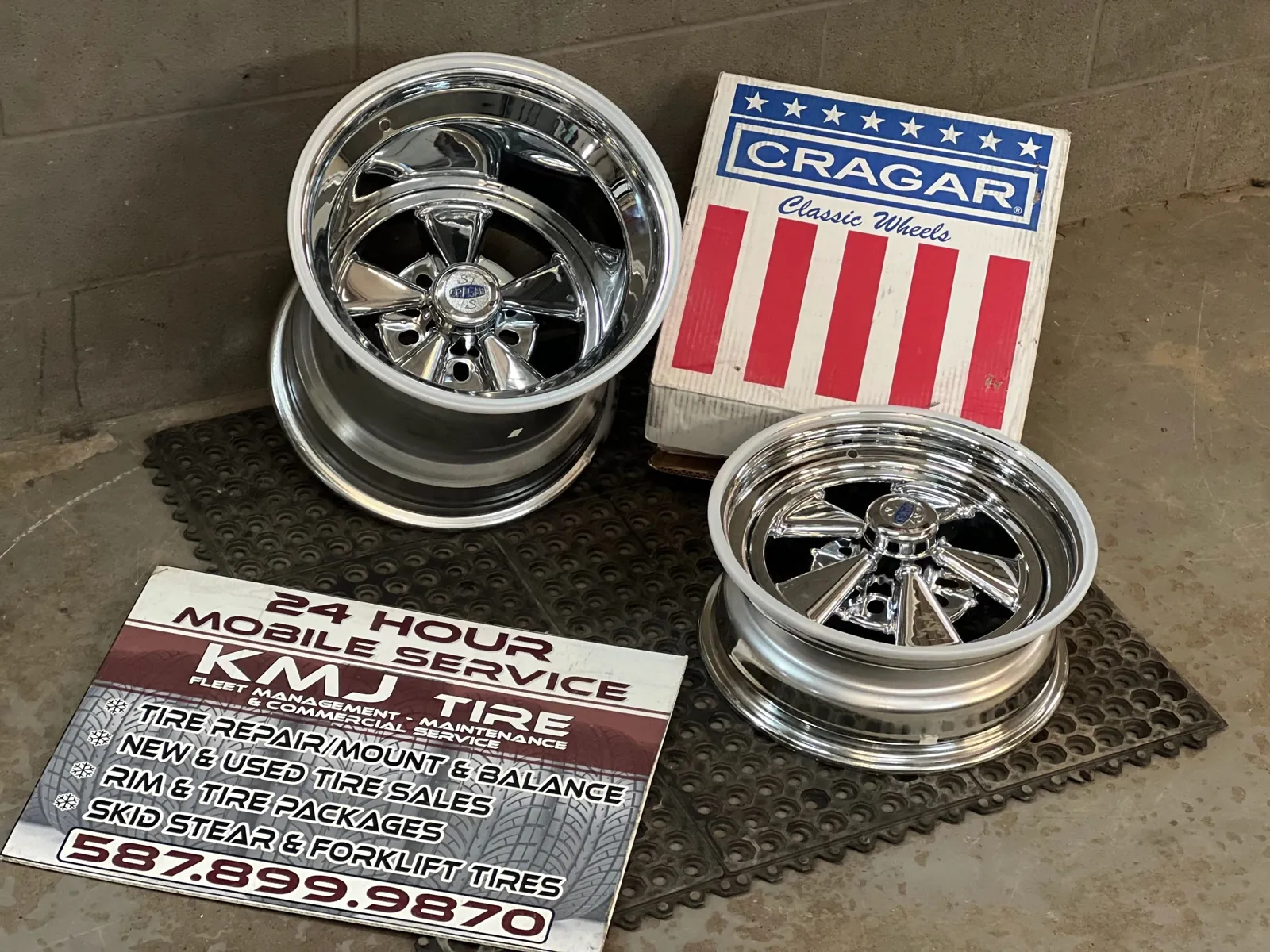
The wheel photograph accompanying this article comes from KMJ's existing photo library. It illustrates why identifying the wheel matters separately from identifying the tire. It does not establish a particular vehicle fitment or prove that the pictured wheels form a staggered set. Throughout the guide, numerical examples explain the decision process; they are not recommendations for a specific vehicle.
1. Establish what is actually different front to rear
People use the word staggered for several arrangements. The front and rear tires may have different section widths, different wheel diameters, or different combinations of width and aspect ratio. Wheels can also differ in width or offset while carrying tire sizes that look similar. Therefore, writing down only the diameter, such as eighteen inches, leaves most of the compatibility question unanswered.
Begin with the complete tire size and service description from each position. Record the brand and model too. Then separate what you can see from what still needs verification. A tire sidewall tells you the tire's nominal size; it does not reliably tell you the width or offset of the wheel underneath. Those details may be stamped on the wheel or documented in its part number. Do not crawl under an unsupported vehicle to look for them.
A useful four-position record names driver front, passenger front, driver rear, and passenger rear. That avoids the ambiguity of a note reading simply left tire when somebody is facing the car. Photograph each accessible sidewall with enough surrounding detail to identify its position. If the two tires on one axle do not match, keep that discrepancy visible instead of copying the clearer sidewall onto both lines.
For help decoding the markings before requesting a fitment assessment, KMJ's tire sidewall information for replacement planning provides a starting point. The goal is not to memorize every code. It is to give the person verifying the setup the exact information needed to distinguish an approved difference between axles from an accidental mismatch within an axle.
2. Find the authority for the setup, not just its history
A previous owner's invoice can identify what was fitted. It cannot, by itself, prove that the combination was suitable. The same is true of photographs showing the car wearing those wheels for several years. Past use is evidence of history, not a substitute for the manufacturer's requirements. Start with the tire information placard, the correct owner's manual, and any applicable manufacturer-approved alternate fitment information.
Match the information to the actual vehicle variant. Model year, drivetrain, trim, wheel package, and brake package can matter. Two cars with the same badge on the trunk may not accept the same wheel assembly. A broad catalogue result that omits those distinctions is not enough to settle the question. If the vehicle has been modified, say so before anyone treats the original specification as a complete description of its present condition.
Michelin's Canadian guidance explicitly distinguishes manufacturer-designed front-and-rear size differences from casual mixing. It recommends the vehicle manufacturer's specified sizes or approved options. That is the important exception to understand: an intentionally staggered factory arrangement is not made wrong by being different front to rear, but the existence of that exception does not approve every combination someone can bolt on.
Keep a simple evidence hierarchy in your notes. Vehicle-specific documentation establishes the intended arrangement. Tire and wheel manufacturer data establish component compatibility. The existing parts show what is actually installed. If those sources disagree, resolve the disagreement before ordering. The Calgary tire-buying planning guide can help organize the conversation, but it cannot replace the fitment documentation for your exact car.
3. Read nominal diameter arithmetic without treating it as approval
Tire-size arithmetic explains why a wider tire can have a lower aspect-ratio number yet a similar nominal overall diameter. Consider a hypothetical 225/45R18 front tire and 255/40R18 rear tire. The first sidewall calculation is 225 multiplied by 0.45, giving 101.25 millimetres. The second is 255 multiplied by 0.40, giving 102 millimetres. Both have an eighteen-inch wheel diameter, or 457.2 millimetres.
Adding twice the sidewall height gives nominal overall diameters of 659.7 and 661.2 millimetres. Their calculated difference is only 1.5 millimetres, roughly 0.23 percent of the smaller figure. That looks close. It still does not tell you whether the two products are approved together on any particular car. These are illustrative dimensions, not a fitment prescription or a universal acceptable tolerance.
The calculation uses standardized size markings, not a measurement of loaded rolling circumference. Actual products have published dimensions, approved rim-width ranges, construction differences, and operating characteristics. Wear changes the situation further. A spreadsheet that shows similar numbers cannot confirm brake clearance, wheel load rating, fastener compatibility, or the vehicle's permitted front-to-rear relationship.
Use the calculation to ask a better question: which exact product specifications and vehicle requirements confirm this combination? Do not use it to dismiss a manufacturer's narrower restriction. Avoid borrowing an acceptable percentage from an unrelated online discussion. A rule quoted for a different drivetrain or wheel package may answer a completely different problem. Close arithmetic is a screening observation; approval requires the right evidence.
4. Treat tire load capacity and wheel suitability as separate checks
A wider rear tire is not automatically capable of carrying whatever the vehicle needs. The service description, inflation requirements, and application all matter. Record the load index and any relevant construction designation from the actual proposed product. Compare those against the vehicle's requirements for that axle. Do not assume a similar-looking performance tire is equivalent merely because its section width is greater.
The wheel has its own responsibilities. Diameter, width, offset, centre bore, bolt pattern, fastener seating, clearance, and load suitability are separate pieces of the fitment assessment. A tire may be suitable for the vehicle but unsuitable for a particular wheel width. A wheel may accept the tire yet fail another requirement on the vehicle. Those are two different rejection reasons, and neither is corrected by adding more inflation pressure.
If an online seller advertises a set as fitting many models, ask what supports the claim for your specific variant. Part numbers are more useful than descriptions such as sport rims or premium alloys. Preserve photographs of markings and the seller's specifications, but have them interpreted by a qualified tire professional. Never grind, space, or alter components simply to make an unverified combination appear to clear.
KMJ's load-index explanation for choosing suitable tires is useful background for understanding the number. It is not permission to increase the vehicle's payload. Better-rated tires do not rewrite the vehicle manufacturer's axle or gross weight limits. For a driver, the practical instruction is straightforward: document the required capacity and obtain a product that meets the complete application, not just one attractive specification.
5. Work out whether any rotation is allowed
Ordinary rotation diagrams often assume four interchangeable assemblies. That assumption can fail on a staggered car. If the rear tire or wheel belongs only on the rear axle, a front-to-rear swap is not a maintenance shortcut. The rear assembly may have the wrong size, offset, clearance, or other characteristics for the front position. A rotation interval does not override a position restriction.
Side-to-side movement also needs checking. A directional tire has a required rolling direction. Moving its complete wheel assembly to the opposite side can reverse that direction. An asymmetric tire has an inside and outside orientation, which is a different concept. Some products impose additional restrictions. Read the actual markings and the manufacturer's instructions instead of deciding from the visual pattern alone.
There may be a permitted side-to-side pattern, a remounting procedure requiring separate assessment, or no useful rotation at all. Do not assume remounting is always worthwhile or allowed. It changes the work involved, and it does not repair existing wear or make incompatible wheel positions interchangeable. Michelin's rotation guidance specifically notes that staggered fitments may limit or prevent normal rotation.
Ask for the permitted movement to be written in plain language on the service record. For example: front and rear assemblies are not interchangeable; consult the vehicle-specific instructions for any lateral movement. If a previous invoice lists a generic four-wheel rotation, clarify what actually happened. It might be a billing label rather than a detailed position record, but the ambiguity should not carry forward into the next service visit.
6. Replace the missing rotation benefit with better observations
When tires cannot move between axles, wear differences cannot be redistributed in the usual way. That makes consistent inspection more useful, not less. Record tread readings across each tire and keep the positions fixed in the notes. A single best-looking measurement from the middle groove can hide a worn shoulder. Where access is limited, arrange a proper inspection instead of reaching into unsafe spaces.
Choose a record format you will continue using. Date, odometer, position, tread observations, cold pressure, and any new symptom are enough for a useful history. Use the same measurement units throughout. If one report uses millimetres and another uses thirty-seconds of an inch, label both clearly and convert carefully before comparing. A unit error can create a dramatic apparent change that did not occur.
Suppose the rear pair is wearing faster than the front pair but remains even across each tread. That observation supports planning, not a diagnosis. Driving demands, vehicle design, inflation, alignment, and other factors may contribute. If one inner edge is wearing much faster, capture that pattern and arrange assessment. Do not conclude that all unusual wear is normal merely because the car has a performance-oriented setup.
A shake through the seat or steering wheel deserves its own description: when it starts, whether it follows speed, and whether it began after an impact or service. KMJ provides wheel balancing for tire-and-wheel assemblies. Balancing is not the same as alignment, and neither a balance nor a new tire is a blanket answer to every vibration. Mechanical concerns need an appropriate specialist.
7. Understand why replacing the worn front pair can be complicated
General consumer advice often says to put the deeper-tread pair on the rear for stability in wet conditions. That guidance does not authorize putting a front-only size on a staggered vehicle's rear wheels. When the front pair wears out first, the usual move-the-old-fronts-back or put-the-new-pair-behind formula may simply be unavailable. The car's approved axle assignments still apply.
This is where a full-set assessment matters. The decision should consider the condition of both axles, the vehicle's matching requirements, the proposed product, and the tire manufacturer's guidance. Replacing four may be appropriate in some circumstances. Replacing the correctly specified front pair may be permitted in others. There is no honest universal answer without the actual measurements and documentation.
Do not try to solve the conflict by purchasing a rear size for the front, reversing the wheels, or selecting a different category on one axle. Those changes introduce new fitment or handling questions. The practical request is: please assess whether an axle-only replacement is acceptable on this configuration, and explain the remaining tread and compatibility requirements. That is more useful than insisting on a two-tire answer before the inspection.
Also separate wear from age and damage. A rear pair with deep tread may still have a condition issue that rules it out. Conversely, the front pair needing replacement does not by itself prove the rear pair is defective. Ask for the specific reason behind each recommendation. A clear explanation should name a measured condition, a product requirement, or a vehicle limitation rather than relying on a vague claim that staggered cars always need four.
8. Give all-wheel drive its own compatibility review
Some staggered vehicles also have all-wheel drive. The fact that the factory specified different front and rear sizes does not mean the drivetrain ignores rolling differences. It means the approved configuration was designed as a combination. Wear, a different tire model, an incorrect axle assignment, or a replacement with different actual dimensions can change that combination.
Look up the manufacturer's tire matching and replacement instructions for the specific vehicle. Do not substitute a universal tread-depth difference or circumference percentage. If an instruction is unclear, obtain clarification through the appropriate vehicle or tire technical source. A statement that the sizes are almost identical on a calculator is not the same as confirmation that the drivetrain requirements are satisfied.
Gather the information before an urgent replacement is needed: exact front and rear products, current measurements, and the procedure for a damaged single tire. This does not guarantee that a single replacement will be possible later. It simply reduces the chance of making the decision from memory beside a disabled car. Keep the records with the vehicle rather than only on the phone of the person who originally bought the set.
Never interpret the absence of a dashboard warning as approval. The driver may receive a warning for some problems, but not every unsuitable combination announces itself immediately. Equally, a warning after a tire change should not be dismissed as harmless until checked. The correct response is to reconcile the installed parts and service steps with the vehicle's requirements, then involve a mechanical specialist if the issue extends beyond tire service.
9. Plan winter around a complete approved combination
A Calgary winter plan needs to answer two questions at once: is the tire appropriate for the season, and is the complete front-and-rear arrangement approved for the vehicle? Solving only one is insufficient. A suitable winter tread in the wrong application is not a satisfactory result. Nor does a correctly sized summer tire become appropriate for snow because the vehicle has all-wheel drive.
Transport Canada recommends winter tires in sets of four and explains that summer and all-season compounds lose elasticity as temperatures fall. Its general advice against mixing sizes should be read alongside vehicle-specific guidance for intentionally staggered original equipment. Preserve the approved front-and-rear arrangement unless a documented alternate setup is established; do not improvise four identical sizes to satisfy a simplified general statement.
When planning winter tires for Calgary driving, start by checking whether the same suitable tire model is available in both approved axle sizes and service descriptions. Availability must be confirmed at the time of purchase. A product name appearing in a catalogue does not establish that the complete combination can be supplied, and the rear size can be the limiting half of the decision.
If you are considering all-weather tire options for Calgary use, apply the same full-set approach. Do not put an all-weather pair on one axle and retain a different seasonal category on the other as a substitute for a coherent plan. Also make sure you are not confusing that category with all-season tires for appropriate driving conditions. The labels are a starting point for discussing the product and route, not interchangeable promises.
10. Consider a square winter setup only with documentation
A square setup uses the same tire size at all four corners, although wheel details still need confirmation. Some owners consider one because it may simplify rotation or seasonal purchasing. Whether it is an option depends on the car. Do not assume a narrower front size can be fitted on every rear wheel, or that four wheels from a lower trim clear the brakes on a higher trim.
The approval question includes tire load capacity, approved wheel widths, wheel dimensions, clearance, fasteners, pressure guidance, and any drivetrain restrictions. A set that physically mounts while the car is raised may still be unsuitable during steering movement or normal operation. These are not checks to improvise by driving around until something rubs. The vehicle and component documentation should establish the combination first.
If a verified alternate package exists, keep its specification separate from the original staggered summer package. Record which set uses which pressures and what rotation is allowed. Make sure the person performing a future changeover knows that the winter and summer arrangements differ. A note reading winter wheels without sizes, positions, or supporting documentation is easy to misinterpret after a season in storage.
For seasonal tire changes with the correct set identified, send the configuration details ahead of time. If no suitable alternate can be verified, maintaining the approved staggered arrangement with an appropriate complete winter set may be the practical path. Convenience is a reason to investigate an alternate, not a reason to bypass the vehicle's fitment requirements.
11. Keep front and rear pressure targets distinct
The car may specify different cold pressures front and rear. Do not average them into one convenient number. Do not copy the pressure from whichever sidewall is easiest to read: the sidewall marking is not the vehicle's everyday target. Use the vehicle's tire information label and applicable manual instructions for the installed approved arrangement and operating conditions.
Write down each target alongside the axle name and its source. Then record the measured pressure separately. That distinction prevents a common recordkeeping mistake in which yesterday's measured value becomes tomorrow's supposed specification. If a verified alternate wheel package has different guidance, attach that guidance to the package record and have it confirmed before use.
Transport Canada recommends measuring when the tires are cold and checking regularly, at least monthly. A tire can look normal while being underinflated. A pressure-monitor display is helpful but does not replace the maintenance instructions. After a changeover, confirm that any required sensor or position-learning procedure has been completed for that vehicle. The screen should not be trusted to identify a corner until its mapping is known to be correct.
For example, a display showing the passenger rear low while a gauge finds the driver front low creates a location question as well as a pressure question. Record both observations and have the system and actual tire checked. Do not keep adding air to the displayed corner while ignoring the physical measurement. The tire-care basics in KMJ's Be Tire Smart guide support this habit of checking rather than guessing.
12. Compare tire models as paired specifications
A staggered replacement search has two linked product requirements. Finding a promising front tire is only half the task. Confirm the corresponding rear product, including model name, service description, and any relevant manufacturer-specific designation. Similar names can describe different versions. Preserve the exact product identifiers in a written comparison instead of using a shortened nickname for the whole family.
Start with suitability, then compare priorities such as wet performance, winter use where applicable, comfort, tread-life expectations, and budget. Do not assume that the least expensive front size leads to the least expensive suitable complete set. Nor should a high price be treated as proof that the product is correct for the car. An unsuitable premium product is still unsuitable.
Use budget-versus-premium tire guidance for Calgary buyers to frame the trade-offs without inventing a guaranteed lifespan. A car that cannot perform ordinary axle-to-axle rotation may have a different maintenance experience from the vehicle used in an online review. Product warranties also have their own terms. Ask how staggered use affects any applicable coverage rather than assuming the advertised headline applies unchanged.
The tire brands available through KMJ in Calgary page helps begin a product discussion, but current size availability requires a live check. If the preferred model is unavailable in one axle size, pause the purchase decision. Ask for a complete compatible alternative instead of mixing whichever two pairs happen to be easiest to source. Compatibility is a set-level decision even when the boxes arrive separately.
13. Handle a damaged single tire without making a roadside fitment decision
A puncture or impact is frustrating on any vehicle; a staggered arrangement adds identification work. Before arranging replacement, establish the affected corner, the exact tire, and whether the tire was driven with low or lost pressure. A photograph of a screw in the tread cannot establish repairability. The tire's internal condition and the location and nature of damage require appropriate inspection.
KMJ's Calgary tire-repair information explains the service context. A repair is not automatically available, and a replacement is not automatically limited to one tire. If the damaged tire cannot be repaired, the remaining set's condition and the vehicle's matching requirements shape the next decision. Avoid committing to a replacement quantity before those facts are known.
Do not remove a visible object just to see whether air escapes. Do not continue driving on a flat or visibly damaged tire because the nearest available replacement is inconvenient. Move out of immediate traffic danger as circumstances safely permit and arrange assistance. If the vehicle has a temporary spare, use only the vehicle's instructions about permitted axle placement, speed, distance, and installation procedure.
Some vehicles have no spare, and some have instructions that make roadside substitution more complicated. Review those instructions at home while the car is undamaged. A temporary wheel that fits the bolt pattern is not automatically appropriate for every position. Likewise, a used assembly advertised for the same model name is not a ready-made emergency solution without checking the exact variant and requirements.
14. Label seasonal sets so axle identity survives storage
Staggered sets should leave the vehicle with a clear identity record. Label each assembly's last installed position and identify the front-only or rear-only role where applicable. Keep those two concepts separate: last position is a historical fact, while permitted position is a fitment rule. A rotation decision may change one without changing the other.
Use labels that remain legible and will not damage the components. Keep a duplicate list away from the tires, with photos and part numbers if available. Bags are helpful for organization, but a bag label can become separated from the assembly. Do not rely on one handwritten mark as the only evidence, especially when multiple household sets look similar.
At the next changeover, compare the physical components with the record before installation. An assembly placed in the wrong storage stack should not silently acquire a new identity. If one tire was replaced during the season, update the list with the actual product and service date. Record any new repair or inspection finding too, so it is not rediscovered as an unexplained surprise months later.
Storage does not restore tread, erase damage, or suspend age-related considerations. Review condition before the set goes away and again before it returns to service. That creates time to resolve a worn rear pair or missing specification before the weather changes. It also prevents a rushed decision in which the only remembered fact is that the set worked last winter.
15. Send a useful service request without overloading it
A concise request can carry the information that matters. Include the vehicle year, model, trim, drivetrain, and relevant wheel package; the front and rear tire specifications; whether the wheels are original or aftermarket; and the reason for the visit. Add current tread observations or a symptom description if you have them. Send clear photos rather than a long list copied from an unrelated forum.
State the uncertainty directly. For instance: the rear tires are wider, the wheel markings have not yet been checked, and I need to know whether any rotation is permitted. That gives the technician a question to answer. By contrast, requesting a standard rotation while withholding the staggered setup invites unnecessary confusion at the vehicle.
For mobile tire service planning in Calgary, provide access information and the exact work being considered. A suitable location and the required equipment must be confirmed; a mobile service request is not an assurance that every job can be performed in every parkade or driveway. Review KMJ's service-area information rather than assuming a particular address is covered.
When ready to arrange the visit, use the online tire-service booking page and include the configuration notes. KMJ's scope is tire services and oil changes. If the wear pattern or symptoms suggest an alignment, suspension, brake, or other mechanical concern, arrange that work with an appropriate specialist. Describe it as a separate requirement, not as an unconfirmed service included with the tire work.
16. Worked example: worn rears on an otherwise familiar set
Imagine a driver whose car has a documented factory staggered configuration. The rear pair is approaching replacement while the front pair has more tread. The driver wants to order the same rear model again. The first step is to confirm the exact rear specification and inspect the fronts, not simply to copy the size from an old invoice.
The assessment checks the rear wear pattern, the condition and measured tread of the front pair, product compatibility, and any vehicle-specific matching limits. If the car has all-wheel drive, its requirements are included explicitly. The fact that the rear size is correct does not settle whether the new and retained tires form an acceptable combination.
Now suppose the original rear model has been discontinued. That changes the product decision. A successor with a similar name may have different characteristics, and availability of one rear size does not guarantee that mixing it with the existing front product is acceptable. The driver asks for an assessment of compatible replacement choices, including a complete set if needed, with the reasoning recorded.
The practical result is not a universal two-tire or four-tire verdict. It is a decision supported by identified parts and measured condition. The driver also receives an explanation of the wear observations and a plan for follow-up. If the rear inner shoulders show abnormal wear, the maintenance plan includes appropriate investigation rather than assuming fresh rubber has removed the cause.
17. Worked example: an attractive winter wheel offer
A second driver finds four used wheels advertised for the same model family at an appealing price. Their current summer setup is staggered, and the seller says four identical winter wheels will simplify everything. The driver has a plausible idea, but not yet a verified package. Before money changes hands, the exact wheel part numbers, dimensions, condition, and vehicle variant need checking.
The review asks whether the proposed wheels clear the car's actual brake package and meet the vehicle and tire requirements. It checks which tire size is approved on those wheels for this vehicle, what load and service descriptions are required, and what pressure and sensor arrangements apply. It also examines whether the components have damage or an uncertain history.
If the documentation does not support the combination, the low price is beside the point. The driver can ask about a different verified package or retain the original approved arrangement with suitable winter tires. The important saving is avoiding a purchase that cannot safely be used, not finding a way to rationalize an already purchased set.
If an alternate is confirmed, the driver keeps its evidence with the seasonal record. The winter set and summer set get separate specification sheets, even though they belong to the same car. During future service, nobody has to infer whether the four equal winter sizes are intentional or a mistake. That small organizational step preserves the value of the original fitment work.
18. A final decision sheet you can keep with the vehicle
Before approving tire work on a staggered car, make sure the record answers six questions. What is the vehicle's approved front-and-rear arrangement? What is physically installed? Which movements between positions are permitted? What condition is each tire in? What replacement combinations are allowed? And which questions still need a qualified answer? Blank fields should stay blank until verified, not fill themselves through assumption.
For the component record, include complete tire sizes and service descriptions, brand and model, wheel identifiers, and whether each item is restricted to an axle. For maintenance, include cold-pressure targets with their source, condition observations by position, and any relevant matching instructions. For seasonal planning, identify each set separately and preserve the documents supporting any alternate configuration.
Use the information to make the next decision smaller. You should not need to re-investigate the car's entire history every time a tire loses air. At the same time, do not let an old record overrule a new inspection or a changed component. A useful record is specific enough to guide service and flexible enough to show when something no longer matches.
The central principle is simple: staggered fitment is a coordinated front-and-rear arrangement, not permission to mix parts casually. Keep the approved positions intact, measure the actual condition, and verify any replacement or winter alternate as a complete combination. That gives a Calgary driver a workable maintenance plan without turning a routine tire decision into an experiment.
Sources and the limits of this guide
Michelin Canada's guidance on changing tire sizes and specifications supports using manufacturer-specified sizes or approved alternatives and recognizes intentionally different original front and rear sizes. Its general information is not a replacement for vehicle-specific requirements; this guide deliberately does not adopt a universal allowable circumference difference.
Michelin's tire-rotation guidance explains that directional tires and staggered arrangements can restrict normal rotation. Continental's explanation of tread patterns describes directional rolling orientation and asymmetric inside-and-outside features. Actual movement permissions still come from the installed product and vehicle instructions.
Transport Canada's Riding On Air guidance supports regular cold-pressure checks, vehicle-label pressure references, inspection, and following manufacturer rotation instructions. Transport Canada's winter-tire guidance supports a complete winter set and appropriate seasonal selection. No example above establishes a particular vehicle's fitment, a current product price, or live inventory.