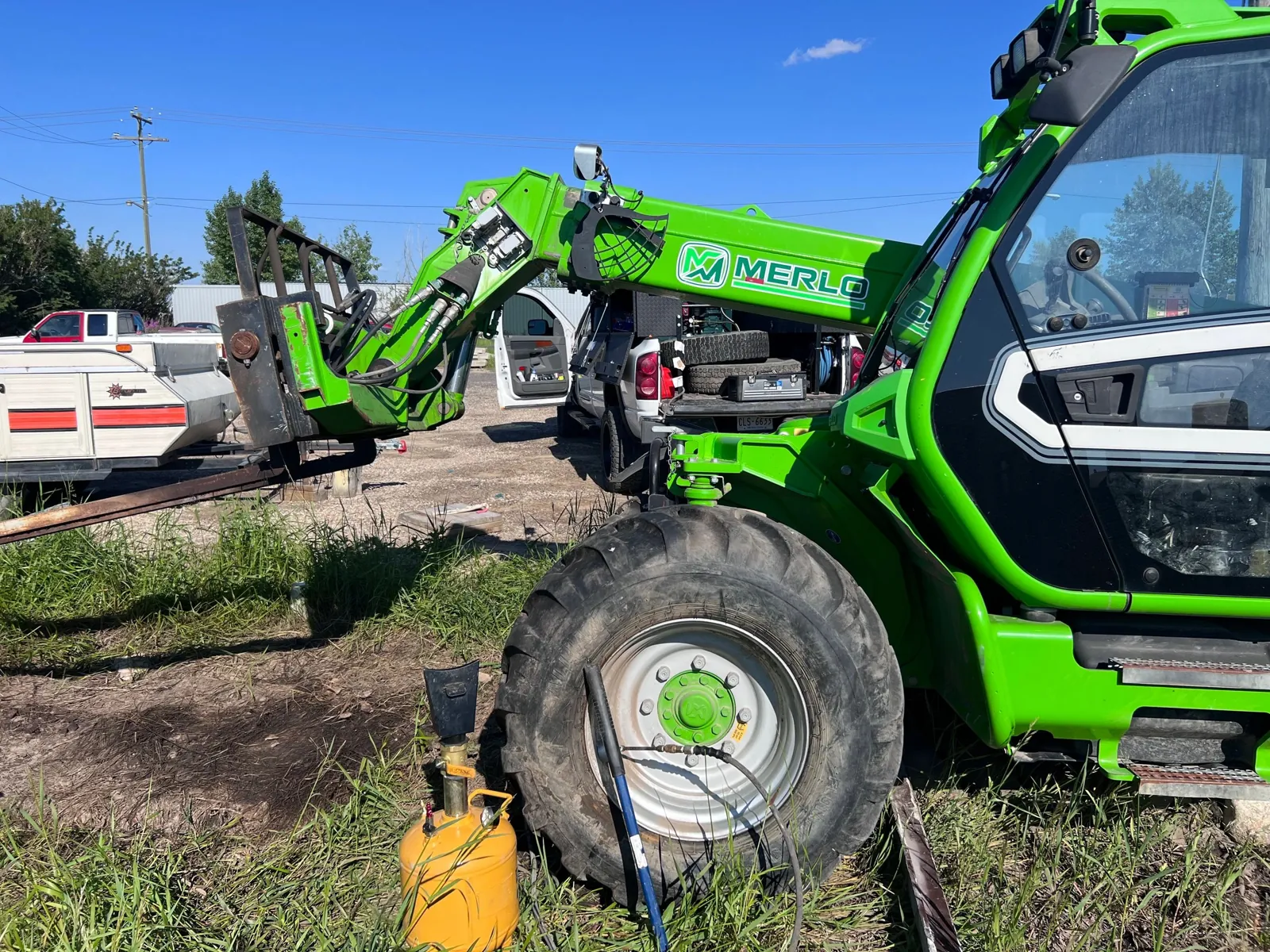
A telehandler needs a tire before it moves to the next Calgary-area worksite. Can you order another one with the same size on the sidewall and carry on? Not safely on that information alone. Identify the machine and its serial-specific instructions first, confirm the approved tire and wheel specification, and have the condition and proposed replacement assessed by the appropriate qualified people. A familiar size is a starting clue, not a complete approval.
The distinction matters because a telehandler is a lifting machine, not simply a rough-terrain vehicle. Tire specifications and inflation can be part of the conditions behind its operating limits. Changing a tire may therefore raise questions that go beyond tread, puncture resistance or whether the bead fits a wheel. The right question is whether the assembly preserves the configuration the manufacturer permits.
This guide helps an owner, dispatcher or site supervisor prepare a useful tire enquiry and avoid preventable delays. It is not operator training, a lifting plan, a repair procedure or permission to move a damaged machine. KMJ's role discussed here is tire service. Machine diagnosis, structural assessment, hydraulic work, stability approval and configuration changes belong with the equipment manufacturer or an appropriately qualified specialist.
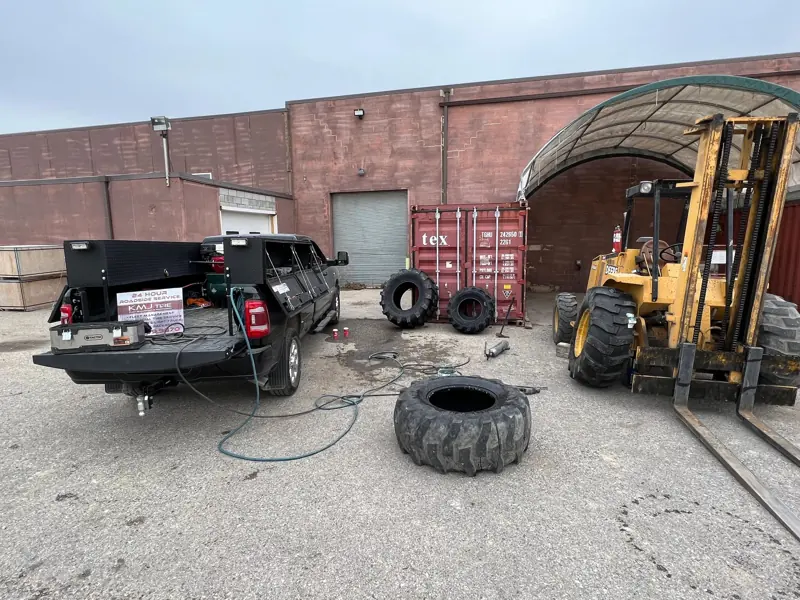
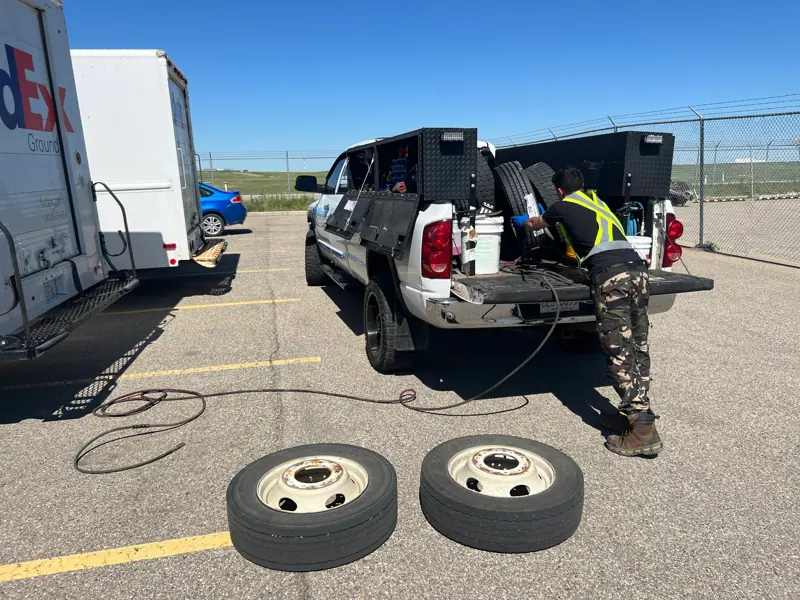
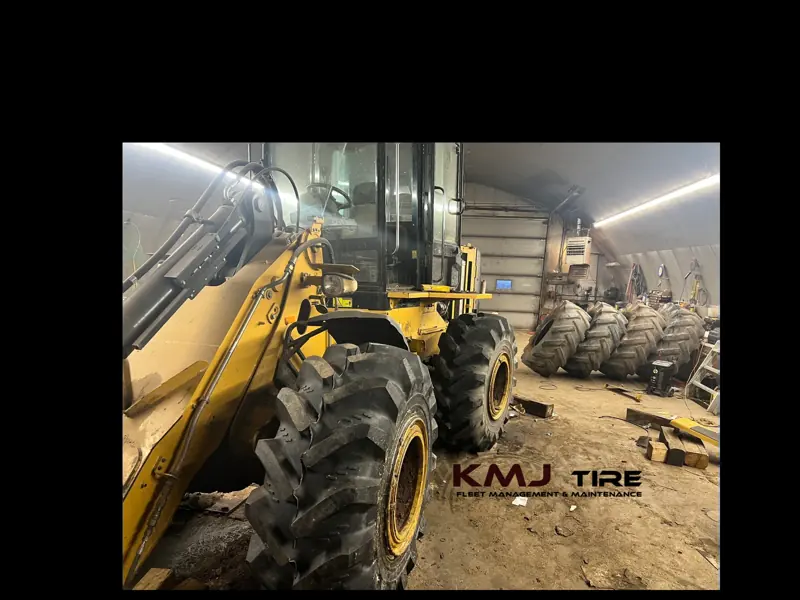
The real KMJ library photo shows a Merlo telehandler wheel with tire-service equipment nearby. The Genie manual cited below is a separate, clearly identified example; its specifications are not instructions for the pictured machine.
1. Identify the machine before identifying the replacement
Start with the manufacturer's name, exact model, serial number and the information plate. Keep those details together in the service request. A model name remembered from a rental invoice may identify a product family without identifying the version standing in the yard. Photographs of the plate and whole machine help the recipient see what the written description refers to, provided they are taken from a safe position.
Serial ranges matter. The official Genie operator-manual library separates product documentation, and its telehandler index lists different manuals for different serial ranges within a model. That organization is a practical warning against downloading the first document with a familiar model name and assuming it applies. Confirm the range and publication with the owner or manufacturer if there is doubt.
The attachment also belongs in the description. Record what is fitted and which load chart and operating instructions are present. Do not use this article to decide whether an attachment is authorized. The information simply helps prevent a tire enquiry from treating the machine as a bare chassis when its actual configuration is relevant to the person reviewing it.
For a business starting a local enquiry, commercial tire service in Calgary is a useful service category to discuss. It is not blanket acceptance of every machine, wheel type or site condition. Supply the identification before assuming that a provider has the equipment, product access or authorization needed for this particular job.
2. Understand why the load chart is part of the tire conversation
A load chart is not just a number printed in the cab. Its conditions matter. As one manufacturer-specific example, the Genie GTH-5519 manual, part number 1405678, states that charted loads depend on conditions including firm, level ground, a level frame, correct load placement, properly sized and inflated tires, and good operating condition. That manual applies only to its stated machine range.
The useful general lesson is to check the actual manufacturer's conditions rather than borrowing the numbers from that example. A tire decision cannot be isolated from the permitted machine configuration. If the tire is unsuitable or its inflation is wrong, the fact that a proposed load appears below a headline capacity does not make the arrangement acceptable. The chart's assumptions have to remain true.
Do not calculate a replacement tire requirement by dividing a machine's published weight by four. Loads are not necessarily shared equally during operation, and the tire's role cannot be reduced to a static arithmetic average. Reach, attachment, ground, movement and the operating configuration all matter to the machine's approved use. The responsible equipment specialist must resolve the specification rather than accepting a homeowner-style load estimate.
Keep a copy of the applicable chart and manual reference with the service paperwork. Nobody needs to improvise a new lifting calculation during a tire conversation. The aim is to give the qualified reviewer the correct context and to make any uncertainty visible before money is spent or a machine is returned to work.
3. Read the existing sidewall without treating it as the specification
Photograph the existing tire's size, construction markings, brand, model, rating and other relevant identifiers. Capture the full sidewall as well as close views, because a cropped image of the size can omit the part of the marking that distinguishes one construction or rating from another. Record each tire separately if the machine does not carry an obviously uniform set.
Those photographs establish what is fitted now. They do not prove that the current fitment is approved. An older machine may have received replacements from several owners, and its service history may not explain every choice. Compare the observed markings with the machine's documentation and the manufacturer's permitted specification instead of copying a previous decision whose basis is unknown.
A general explanation of tire sidewall markings can help a reader organize the photographs, but road-tire examples should not be stretched into an industrial-equipment approval. An unfamiliar marking needs clarification from the product supplier or manufacturer. Do not rewrite it into a more familiar passenger-tire format just because that format is easier to enter on an online form.
Use exact transcription rather than a description such as big agricultural tire or standard construction tread. Two tires that look similar from across the yard may have different specifications. A clear written record also prevents a telephone enquiry from losing a letter or suffix. If a character is unclear, mark it as uncertain and send the original image rather than guessing.
4. Size, rating and construction need separate confirmation
The dimensions printed on a sidewall do not describe everything that matters. The machine maker may specify a construction, ply rating, tire type or particular approved option in addition to size. The cited Genie manual explicitly warns against replacing factory-installed tires with a different specification or ply rating. That is a model-specific instruction, not a rule to reinterpret as permission whenever one number happens to match.
Ask the supplier to state the complete proposed product and how it relates to the machine's approved requirement. If an alternative is being considered, identify who is responsible for confirming it. A cross-reference from a retail catalogue can be useful product information, but it is not automatically authorization from the equipment manufacturer to change the machine's configuration.
The familiar concept of load index in tire selection illustrates why capacity information should not be omitted from a request. However, not every industrial tire is specified in the same way as a passenger or light-truck tire. The proper comparison must use the applicable industrial product data and machine requirements rather than forcing unlike ratings into a simple ranking.
Be especially cautious with phrases such as heavier duty, more plies or stronger replacement. A product can sound more robust while still being unsuitable for the approved application. The useful answer is a documented fitment, not a superlative. If the chain of approval cannot be explained, keep the substitution unresolved and ask the machine manufacturer for the missing decision.
5. Air-filled, foam-filled and other constructions are not casual swaps
A machine may have different permitted tire options, but the fact that options exist somewhere in a product family does not mean they are interchangeable on your machine. The applicable instructions must identify what is allowed. Establish whether the fitted assembly is air-filled, foam-filled or another construction before discussing pressure checks, replacement handling or a proposed change.
The GTH-5519 example manual distinguishes air-filled tire pressure maintenance from machines equipped with foam-filled tires. It also warns against replacing stability-critical items with items of different weight or specification. These points show why a fill or construction decision belongs in the equipment review. Do not treat foam filling as a universal puncture solution that can be added without checking the machine's requirements.
An apparently flat or damaged tire should not be approached with a pump before its construction and condition are understood. A service provider needs accurate information about what is present. If the owner does not know whether an assembly contains fill, say so. A previous owner's comment or a vague mark on an invoice is worth investigating, not enough to establish the answer by itself.
Avoid changing constructions merely to reduce inconvenience on a debris-prone site. The right process is to review the environment, the permitted configurations and the manufacturer's requirements with qualified people. A tire choice cannot correct poor housekeeping, an unsuitable travel route or operation outside the machine's limits. Removing the cause of repeated damage may be more important than finding a different casing.
6. Use the machine's pressure instruction, not a yard rule
There is no general pressure figure in this guide. Obtain the applicable specification for the actual machine, approved tire configuration and stated measurement conditions. Confirm the units. A number copied from another telehandler, a road truck or the maximum marking on a sidewall is not a substitute for the correct instruction.
Record where the specification came from. A pressure field in a fleet spreadsheet should identify the manual or approved instruction behind it, not simply contain a number that has been copied forward for years. If the machine or tire configuration changes, the source needs review. A helpful habit is to keep the instruction alongside the inspection record so the next person can verify it without relying on memory.
Use appropriate equipment and trained personnel for the required inspection and service. This article does not provide an inflation procedure for heavy equipment assemblies. A visible problem, unexplained loss or uncertainty about a wheel requires professional assessment; repeatedly restoring pressure does not establish that the assembly is sound. Do not use the machine as a test platform while trying to discover the source of a leak.
General tire-care habits and condition awareness are useful background, but industrial-equipment instructions control this application. The important habit is disciplined verification: correct machine, correct specification, appropriate measurement, recorded result and a defined response to a discrepancy. None of those steps is improved by choosing a convenient generic number.
7. Keep operator observations separate from repair decisions
An operator can observe a cut, an object in the tread, a missing component, an unusual appearance or a change from the last inspection. Reporting those facts is valuable. Declaring a casing repairable, deciding that a wheel is structurally sound or approving continued operation is a different responsibility. The site needs a clear route from observation to qualified assessment.
The cited Genie manual includes tires and wheels in the pre-operation inspection and requires the relevant checks for its machine. Use your own machine's inspection procedure rather than treating this article's examples as a complete checklist. The tire issue may be visible, but the machine still has other inspection requirements that a tire service cannot replace.
Write observations in plain language. For example, a report might say that a section of sidewall has a visible cut and attach a safely taken photo. It should not say superficial damage unless a qualified assessment established that conclusion. Keeping facts separate from interpretation helps the specialist understand the issue and prevents a reassuring adjective from becoming informal permission to operate.
An enquiry about tire repair assessment in Calgary should include the industrial application and exact assembly information. Do not assume passenger-tire repair limits, road-hazard practices or temporary fixes apply to a telehandler. The tire and machine requirements, damage and service capability all have to be considered before a repair decision can be made.
8. A temporary product is not an automatic recovery plan
It can be tempting to treat a leaking equipment tire as a short interruption: add a product, move the machine, and arrange proper attention later. That sequence needs to be rejected when it conflicts with the manufacturer's instructions. The GTH-5519 manual used here specifically warns that temporary flat-tire repair products can lead to tire failure and compromise machine stability.
Do not generalize a road-car emergency kit into an equipment procedure. Nor should a product's label be read as approval from every machine manufacturer. A promise that something seals punctures says nothing by itself about the complete lifting-machine configuration. The correct response is to consult the applicable instructions and the responsible service provider before adding anything to the assembly.
Tell the provider if a substance has already been introduced. Concealing that information can complicate assessment and service. Record the product name and what is known about its use without attempting to clean out or dismantle the assembly yourself. A candid history gives the professional a better starting point than an unexplained leak accompanied by assurances that nothing unusual happened.
Where the situation is urgent, emergency tire-service enquiries should describe the machine's actual location, state and access constraints. Urgency is not a reason to promise a response time, assume a tire is available or move equipment against instructions. Confirm what assistance can be provided and let the site's responsible people manage the machine's isolation and surrounding work.
9. Wheel condition belongs in the same conversation
A replacement tire does not make a questionable wheel acceptable. Supply photographs of the assembly and describe any known impact, deformation, corrosion, missing hardware or previous repair. The recipient may need further inspection before determining what work is appropriate. Avoid sending only the tire size and discovering later that the wheel prevents the planned service from proceeding.
Do not dismantle an equipment wheel to identify its construction for a quotation. Some assemblies present hazards that require specialized knowledge and procedures. If the wheel type is unknown, provide the machine identification and safe exterior photographs, then let a qualified provider determine what further information is required. There is no do-it-yourself disassembly or inflation instruction in this guide.
The same distinction applies to fasteners and seating surfaces. A tire enquiry does not authorize guessing a tightening value, substituting hardware or straightening a component. Manufacturer procedures govern those details. A general road-wheel discussion should not be copied onto industrial equipment because the tools look similar or because someone has previously worked on truck wheels.
Keep the service scope explicit: tire assessment and any confirmed tire work, wheel assessment where the provider is qualified, and separate referral for machine or structural concerns. This prevents a request for rubber from silently expanding into a mechanical job. It also avoids treating a completed tire installation as proof that every part of the equipment has been inspected and approved.
10. Describe the site surface, not just the postal address
A provider needs to know more than where the machine is parked. Describe whether it is on a firm prepared surface, gravel, mud, an indoor slab or another environment, and whether access changes with weather or ongoing work. These are planning facts. Do not declare the area safe for service simply because a pickup was able to drive into it earlier.
The machine manufacturer controls its operating limits, while the site's responsible people manage site hazards and access. A tire provider must determine whether the requested service can be performed safely under the actual conditions. Those responsibilities need to meet before work begins. A location pin is not a substitute for a discussion about ground, overhead restrictions, traffic and the machine's state.
For Calgary-area dispatch planning, review tire service coverage areas and confirm the specific location. A yard described as near Calgary may still have access rules, travel requirements or site conditions that affect the response. Do not infer availability or a fixed travel charge from a coverage map; obtain a current answer for the actual request.
If conditions change after the enquiry, update the provider. A delivery may block the access route, a thaw may soften the ground, or another contractor may occupy the proposed work area. Describing that change before arrival is practical coordination, not an unnecessary delay. It lets the responsible parties decide whether to proceed, relocate through an approved plan or make different arrangements.
11. Separate traction complaints from ground suitability
A tire that looks aggressive does not authorize work on unsuitable ground. The Genie example manual identifies ground conditions, machine configuration, load position, inflation and operator inputs among factors affecting stability. Treat this as a reminder to use the complete operating instructions, not as a list from which one improved tire can cancel the other constraints.
When a driver reports slipping, record the circumstances without prescribing a tread pattern immediately. Was the issue observed during an authorized movement? What surface was present? Had the route changed? Was the machine in its permitted configuration? These questions help the equipment supervisor and manufacturer determine the appropriate response. They do not invite an untrained person to test limits until the symptom becomes obvious.
Do not lower inflation to imitate an off-road vehicle technique unless the machine manufacturer explicitly permits the relevant procedure and qualified personnel control it. A telehandler's approved operation has its own requirements. Advice for recreational trail driving, lawn equipment or a pickup is not a valid source for altering a lifting machine's tires.
If the machine is used around an acreage or agricultural property, farm tire-service planning can help frame a service enquiry. The location does not make a telehandler tire equivalent to a tractor tire, and the service category is not approval for an agricultural-pattern substitution. Keep the machine identity and its permitted tire specification at the centre of the request.
12. Cold weather adds planning questions, not a new tire rule
Calgary-area equipment can move between heated buildings, outdoor yards and different surface conditions. The useful response is to follow the machine's cold-weather and tire instructions and record relevant circumstances. Do not invent a universal seasonal pressure increase or assume that a tire suitable for one machine becomes suitable for another because both work outdoors in winter.
Snow and ice can obscure damage or make an assembly harder to inspect. Arrange an appropriate inspection environment through the responsible site personnel rather than asking someone to rush a check in an unsafe position. The absence of an obvious problem under dirt or snow is not proof that the casing and wheel are sound.
The GTH-5519 example manual explicitly addresses mud, snow and ice on the machine tires, ramps and transport deck before loading. That is a manufacturer-specific transport instruction, not a complete loading procedure reproduced here. It demonstrates why a tire-service completion and a transport-readiness decision are separate events. The haulier and equipment owner need to follow their applicable instructions.
For the road-going support vehicle, winter tire choices for Calgary roads are a separate planning matter. Keep that vehicle's needs on a separate line of the work order. The pickup that brings operators to the site and the telehandler that handles materials do not share one tire specification simply because they work for the same business.
13. Plan mobile service without assuming the machine can move
An on-site visit can reduce unnecessary movement, but it still needs an agreed scope and suitable conditions. Explain whether the machine is operable, whether the tire concern affects movement, and what the owner or manufacturer has instructed. Do not move it into a more convenient parking spot just to make a service request easier if that movement is not authorized.
When discussing mobile tire service for an equipment enquiry, provide machine identity, assembly details, safe photographs, ground description and access information together. State any uncertainty openly. A useful provider response may be that more information or a different service arrangement is needed. That is better than a premature promise based on a generic description of a flat tire.
Arrange a named site representative who can explain access rules and coordinate with the responsible equipment personnel. The representative should know which machine is involved and where the approved work area is. A technician arriving to a locked gate or a different machine creates avoidable delay, even when the tire information in the original request was accurate.
Confirm the boundaries of the visit in advance. Tire work does not include releasing a machine from every site restriction, approving a load chart, repairing hydraulics or certifying a lifting operation. If another problem becomes apparent, the right outcome may be a referral or a continued hold on the machine. Completion should describe the work actually performed, not a broader assurance nobody was authorized to give.
14. Make a replacement enquiry complete enough to review
A good enquiry can be short while still carrying the essential information. Include the machine identification, applicable manual reference, approved tire specification if known, current markings, construction, quantity, damage description, wheel concerns, location and desired timing. Add the name of the person responsible for approving the equipment decision. This is much more useful than asking for a price on a size alone.
The preparation principles in buying tires in Calgary apply at a broad level: the vehicle or machine and its use come before a product choice. For this industrial application, go further and supply the serial-specific requirements. Do not expect a consumer fitment form to contain all the fields necessary for a lifting-machine review.
Ask the provider to distinguish confirmed information from pending information. The product may be identified while availability remains unconfirmed. The service location may be acceptable while the wheel still needs assessment. A clear quotation should not turn those separate questions into an implied guarantee that everything will be completed at a particular time.
Keep optional alternatives separate from the approved requirement. If an alternative product is proposed, request the details and the basis for its acceptance. The final record should make it clear who confirmed compatibility and what specification will be supplied. Verbal shorthand such as equivalent equipment tire is not enough when the actual machine instructions require a particular configuration.
15. Compare cost only after the technical question is settled
A low price on an unsuitable assembly is not a useful saving. First confirm the permitted product and service scope, then compare the actual quotations. Ask which tasks and items are included, what depends on inspection, and what remains outside the quotation. Avoid treating a product-only figure as the final cost of a completed on-site equipment job.
The general discussion of budget and premium tire decisions can help separate a price label from a useful specification. For a telehandler, the machine's approved requirements remain the first filter. A premium marketing description does not make an unapproved substitution acceptable, and a lower-priced option is not automatically unsuitable if the correct qualified approval supports it.
Consider the cost of uncertainty as a planning issue rather than inventing a downtime figure. Missing serial details, wrong construction information or an inaccessible machine can create additional visits or delay. Those outcomes are not universal charges, but they are reasons to provide an accurate request. Good information helps the provider assess the job before commitments are made.
Do not manufacture urgency to force a decision. Explain the real operational deadline and ask what is actually possible. If the required product or service cannot be confirmed in time, the equipment owner needs another authorized operational plan. The pressure to finish a project does not alter tire compatibility, ground requirements or the rules for returning a machine to use.
16. A fictional site move: resolve three different questions
Consider a fictional contractor moving a telehandler from a paved storage yard to a gravel construction site. During the required inspection, the operator reports a damaged tire. The dispatcher finds a matching size online and assumes ordering it will settle the problem. A better process divides the situation into three questions: what is permitted, what is damaged, and how can service and transport occur safely?
First, the owner supplies the machine plate and applicable manual. The proposed tire is compared with the full required specification, not merely its size. The wheel's condition is still uncertain, so the provider explains what assessment is needed. The dispatcher records those as separate open items instead of telling the site that a replacement has already been approved.
Second, the site representative describes the machine's current position and access. The equipment supervisor decides how the machine is to remain controlled pending service under the site's procedures. No one orders an operator to drive it onto a trailer just because the destination is nearby. Transport is planned only after the responsible parties establish what is allowed.
Third, after the confirmed work, the owner retains the service document and completes the applicable return-to-use process. The article's fictional example ends there; it does not invent a price, time saving or successful lift. Its value is in separating decisions that are often compressed into one hurried instruction to get a tire and move the machine.
17. Rental machines need an owner-approved path
With rented equipment, the person using the machine may not be authorized to approve substitutions or repairs. Notify the rental owner through the required process and provide the factual observation, machine identity and location. Do not assume that permission to operate the equipment includes permission to change its tire construction, introduce a product or arrange an undocumented repair.
Ask who authorizes the service, who supplies the approved specification and how the work is to be recorded. If several companies are involved, make those responsibilities explicit. The rental owner, site contractor, operator and tire provider may each hold part of the information. An email or written work instruction that connects them can prevent one person's assumption from becoming another person's work order.
Photograph condition at handover when it is safe and appropriate under the rental agreement. These records are not a way to avoid honest reporting; they establish what was observed and when. If the machine arrives with a concern, report it before putting it into use. Do not wait until return and expect an old photograph to replace the required operational response.
KMJ's tire-service questions and answers can help a customer prepare a local enquiry, but the rental contract and machine instructions still govern authority and operation. Confirm the specific task with the provider and owner. Generic service information cannot settle liability, ownership permission or acceptance criteria for a particular rented telehandler.
18. Keep the fleet record tied to the physical machine
A fleet spreadsheet should identify the actual equipment unit and its serial number, not only a nickname such as yellow loader. Record the tire specification source, fitted products, position, date of work and relevant service documents. If the machine changes owners, yards or internal unit numbers, preserve the link between the records and the physical equipment.
Record what was changed, not just that tire work happened. A casing replacement, an assembly replacement and an assessment with no replacement are different outcomes. If a tire moves position, update that fact without deleting its earlier history. The next person should be able to understand what the machine carries now and which questions were resolved by the last visit.
For businesses coordinating several vehicles and equipment units, fleet tire-management support is a useful discussion to scope. Separate road vehicles from industrial machines in the information supplied. Their inspection requirements, tire specifications and service decisions can differ substantially even when the same administrator handles the invoices.
An exception list is as important as the completed entries. Keep unresolved fitment questions, unreadable markings, pending wheel assessments and manufacturer enquiries visible with a responsible person and next action. A tidy record of only the successful jobs can hide the machine that still needs attention. Documentation is useful when it drives the remaining decision, not when it merely makes a dashboard look complete.
19. Verify the handback without expanding the service claim
At handback, compare the paperwork with the agreed scope. Confirm which tire or assembly was addressed, what product was fitted if replacement occurred, and what observations or unresolved concerns the provider recorded. Ask for clarification if the document uses vague wording. A specific work record is more useful than a broad statement that the equipment is good to go.
The equipment owner remains responsible for the applicable inspection, functional checks and release process under the machine instructions and site procedures. A tire provider's completed task should feed that process rather than replace it. If the job uncovered a wheel, axle, steering or structural concern, the relevant specialist must address it; KMJ is not being presented here as a mechanical repair or equipment-certification business.
When arranging the agreed tire-service time, Calgary tire appointment information is a scheduling resource, not confirmation that an unusual industrial task has been accepted. Establish the machine-specific scope first. A time selected through a general form does not prove the required product, equipment, site access or specialist approval is in place.
After the handback, retain any manufacturer or provider instructions that apply to the completed work. Do not substitute a generic road-wheel follow-up interval for the machine's requirement. The correct next check, if specified, should come from the applicable instruction and be assigned to the responsible person. A documented handover closes the tire task while preserving the machine's ongoing maintenance obligations.
20. Keep product research distinct from fitment authority
Online product pages are useful for discovering terminology and possible suppliers. They are less useful when a reader treats a logo or size listing as proof of machine compatibility. The tire brands available for Calgary enquiries can start a supplier conversation, but it is not a telehandler approved-product list and does not establish current inventory for a particular industrial tire.
Ask for the exact product data relevant to the proposed assembly. A brand may produce many categories of tires, and experience with its road products does not establish the suitability of a different line on a lifting machine. Equally, a catalogue image that resembles the current tread cannot resolve construction, rating, weight or manufacturer restrictions.
Keep three documents separate in your thinking: the machine's permitted requirement, the tire manufacturer's product data, and the provider's proposed service scope. They need to agree, but none should be silently substituted for another. If the documentation appears contradictory, stop the procurement decision and obtain clarification from the appropriate source before the assembly is ordered or installed.
The KMJ business and tire-service overview helps identify the local provider behind an enquiry. It does not claim authorization from every equipment manufacturer or promise every industrial service. A competent request allows a provider to say exactly what it can do and what must be referred, without turning general familiarity into an unsupported approval.
21. A practical request you can send without guessing
Prepare one message with the machine make, model and serial number; the applicable manual reference; the current tire markings and construction if known; and the specific concern. Attach safe photographs of the identification plate, whole assembly and visible issue. State which facts are confirmed and which remain uncertain. Include the owner or rental-company authorization route so the recipient knows who can approve the work.
Add the location, surface, access constraints and whether movement is currently permitted by the responsible equipment personnel. Explain the operational timing honestly without claiming that the machine must be moved regardless of condition. Ask for confirmation of service capability, required assessment, proposed product information and any remaining approvals. This creates a concrete conversation instead of a request for a price detached from the machine.
Use KMJ's contact details for a scoped tire enquiry when you have that information ready. No price, stock quantity, appointment availability or site acceptance is promised in this guide. Those are live questions for the actual request. A clear description gives the provider the best opportunity to answer them accurately.
The decision before the next site move is therefore straightforward, even when the technical details take time: identify the machine, preserve its permitted configuration, assess the actual condition and coordinate the service and transport responsibilities. The tire is part of the equipment's operating assumptions. Treating it that way helps avoid a wrong purchase, an unsupported substitution or a rushed move based on information that never applied to the machine in the first place.