The tires on a car behind a motorhome are not automatically resting. If the car is being towed with its wheels on the road, those tires are still rolling, carrying load and encountering the surface. Before choosing tires or planning a long RV trip from Calgary, first confirm whether your exact car can be towed by the method you intend to use. Then build a tire plan for that approved arrangement, not for a similar-looking vehicle you saw at a campground.
The towing method changes the tire job. Four-wheel-down towing puts the car's four tires on the road. A tow dolly carries an axle and has tires of its own. A trailer carries the car and transfers the road-running task to the trailer tires. These are not interchangeable setups, and a better tire cannot make an unapproved towing method acceptable.
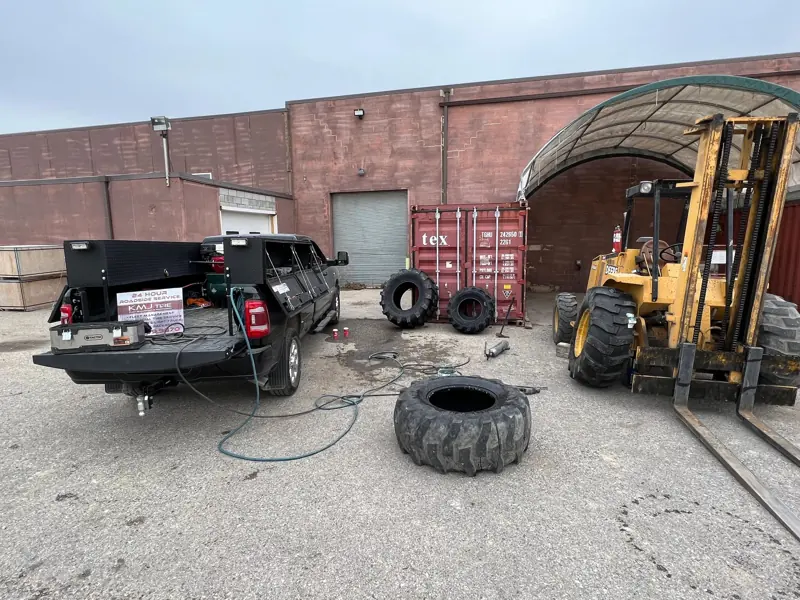
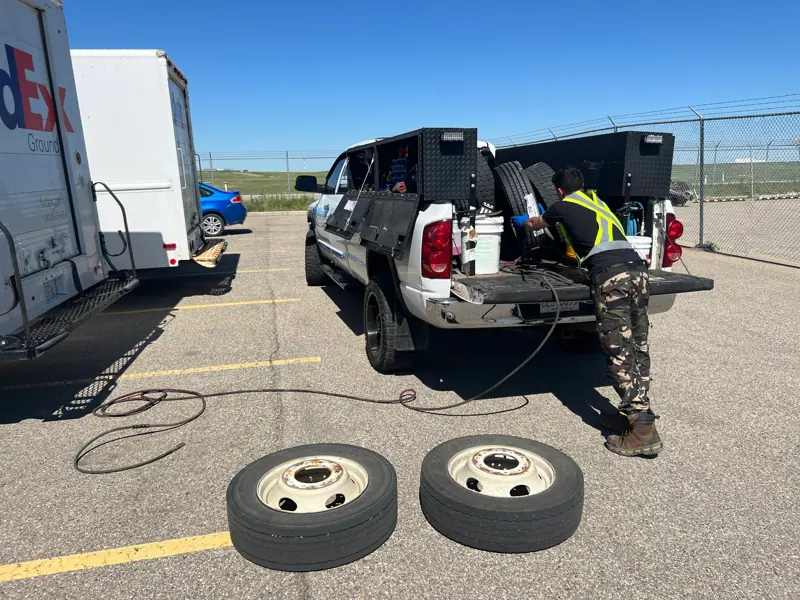
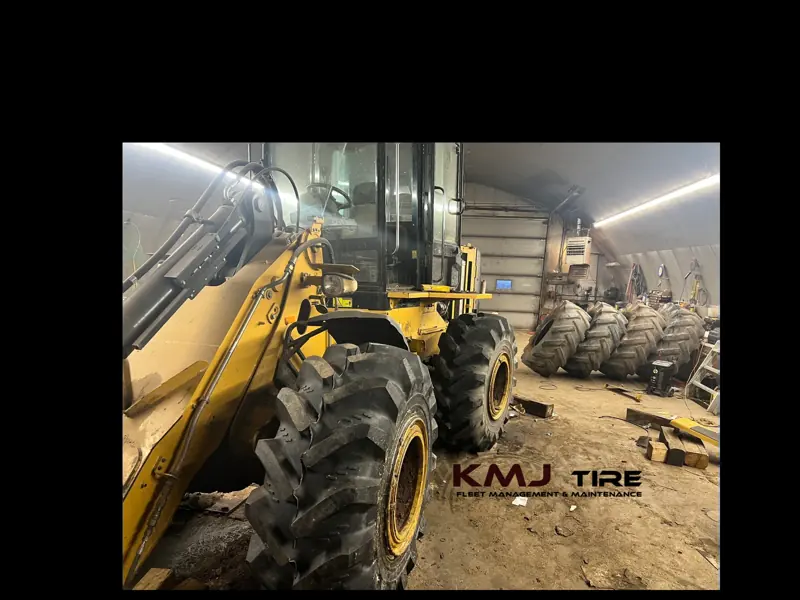
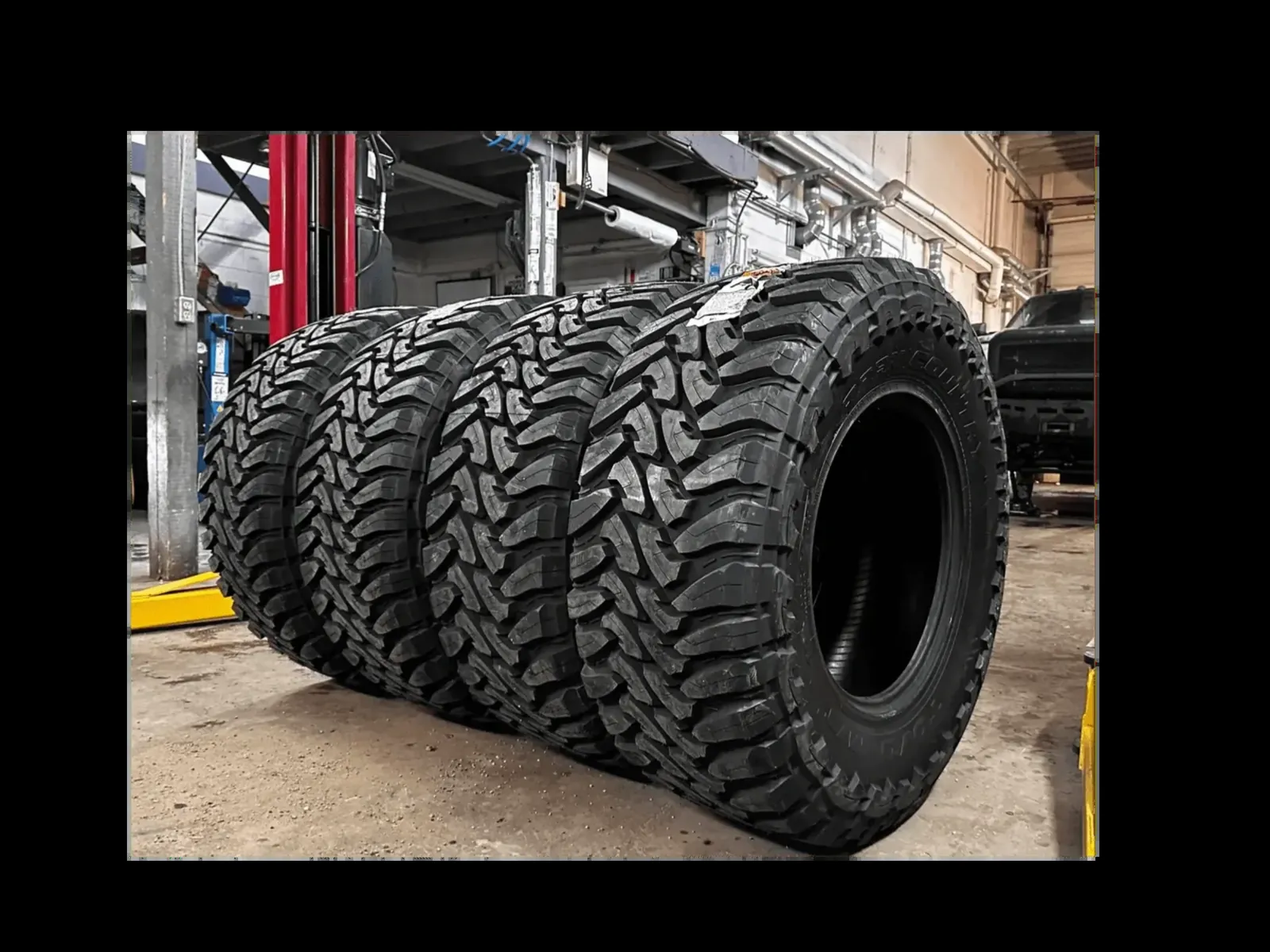
This guide focuses on the passenger car that accompanies an RV: how to prepare its tires, avoid muddled specifications, keep track of its use, and return it to ordinary driving at the destination. It is not a procedure for setting a transmission, installing towing hardware or choosing a supplemental braking system. Those instructions belong to the vehicle and equipment manufacturers and qualified towing specialists. The KMJ library photograph illustrates real loose tires in the shop, not an approved towing setup or a product recommendation for your car.
Answer the towing-permission question before shopping
Find the recreational towing section of the owner's manual for the exact vehicle. Model year, drivetrain, transmission and equipment can matter. A generic description such as “small SUV” or “four-wheel drive” is not sufficient. Nor is the fact that a tow bar can physically be attached. A vehicle needs explicit instructions for the intended towing arrangement, not just a convenient place to connect hardware.
Ford's flat-towing guidance gives a useful example of the correct research path: identify the vehicle, consult its model-year towing guide and follow the owner's manual. It does not provide blanket approval for every Ford. Apply the same discipline with your own manufacturer rather than borrowing approval from another model or year.
Do not confuse emergency towing with recreational towing. A recovery instruction may address getting a disabled vehicle to safety under particular limits. It is not automatically permission to pull that vehicle behind a motorhome for a holiday. If the manual distinguishes the two uses, read the section that matches your trip. Ask the manufacturer to resolve any ambiguity before buying tires, a dolly or a towing package.
Once the method is confirmed, a Calgary tire purchase discussion becomes much more useful. You can explain whether the car's tires will roll behind the coach, ride on a trailer, or alternate between towing and daily driving. Tire selection can then support the approved use without pretending to approve the towing system itself.
Draw the combination and identify the rolling tires
Make a simple sketch of the motorhome, connection equipment and accompanying vehicle. Circle every tire that will touch the road in travel. This sounds basic, but it stops owners from applying one vehicle's pressure or replacement assumptions to another. A motorhome tire, a dolly tire and a passenger-car tire can have very different specifications and service instructions.
In a four-wheel-down arrangement, the car's tires remain road-running components. In a dolly arrangement, the dolly adds its own tire positions while part of the car remains on the road, subject to the specific approved setup. With a full trailer, the trailer tires take the road-running role while the car is cargo. Do not treat the tires supporting the car on the trailer deck as though they are also supporting the trailer's entire load.
Give each group a name in your notes: coach, car, dolly or trailer. Put the relevant manual and tire information beside that group. When someone says “check the tires,” the drawing shows what that includes. It is particularly helpful when one traveller normally maintains the car and another normally handles the RV.
KMJ's tire sidewall information can help you recognize the markings you are recording. The purpose is identification, not combining all the numbers into one universal rule. Keep each tire's size, service description and vehicle position attached to its own equipment rather than copying the clearest label across the whole combination.
Keep the car specification separate from the coach
Start the car's tire discussion with the car's approved specification. Do not fit a higher-looking load number simply because a large motorhome will be pulling it. Towing the car does not turn it into a commercial trailer, and a tire advertised for trailers is not automatically suitable for installation on a passenger car. The application matters as much as the numbers.
Likewise, the coach's inflation routine is not the car's routine. Some RV tire decisions involve measured loads and manufacturer load tables. That does not mean you should ignore the passenger vehicle's placard or invent a new pressure for its tires. Ask the vehicle manufacturer whether the approved recreational towing instructions call for anything specific, and use the applicable guidance for that car.
If a previous owner changed the wheels or tire size, identify that change before departure. The placard describes an original configuration; a modified arrangement may need proper fitment review rather than an assumption. A towing setup with multiple undocumented modifications is not made reliable by inflating every tire to the largest number visible on a sidewall.
The tire load-index explanation helps frame the capacity discussion, but it cannot certify a whole combination. Tire capacity does not raise the vehicle's ratings or approve a towing method. Treat tire suitability, vehicle limits and towing-system compatibility as connected questions that still require separate answers.
Inspect before the car disappears behind the motorhome
An accompanying car can be easy to overlook once the trip becomes an RV project. Its tires may have been acceptable for short errands but not recently examined before a long journey. Look at each accessible tread and sidewall before hookup, and arrange professional inspection where condition or history is uncertain. Pay attention to damage, unusual wear and recurring pressure loss rather than focusing only on whether the tread looks deep.
A tire with a bulge, exposed material, severe damage or unexplained loss needs attention before travel. Do not plan to judge it from the motorhome mirror after departure. You are farther from the car and may not feel its changes the way you would while driving it. A concern that would stop you from driving the car should not be dismissed because the car will be towed.
Ask about a suspicious condition in plain language. Describe which tire, what changed, when it was noticed and whether the car was driven or towed afterward. Avoid diagnosing a belt problem, wheel problem or vehicle mechanical fault from one photograph. A tire professional can assess tire-related concerns; mechanical symptoms belong with the appropriate vehicle specialist.
For a puncture or leak, review Calgary tire repair services and have repairability assessed before making the trip plan. Not every puncture is repairable, and a repair decision must consider the tire's actual condition and history. A planned towing journey is not a reason to relax that assessment.
Establish a cold-pressure routine that survives travel days
Make pressure checking part of preparation before the combination has been travelling, using the relevant vehicle and tire instructions. Use the car's specified cold-pressure guidance rather than borrowing the coach's numbers. A tire can be warm from rolling behind another vehicle even when the car's engine was not operating; engine status is not the definition of a cold tire.
Write the intended settings with their units and vehicle positions. If the front and rear specifications differ, keep that distinction visible. A note that says only “car pressure” can lead someone to apply one value everywhere. If the setup has changed from the original specification, resolve the correct guidance before departure rather than making an adjustment at the fuel stop.
A reading after travel is useful information, but it is not a reason to bleed a warm tire down to a cold specification. Follow manufacturer guidance on checking and correcting pressure. If a tire is substantially low or has lost pressure unexpectedly, investigate the cause and its service history rather than simply adding air and continuing the towing itinerary.
The Be Tire Smart resource is useful background for maintaining a consistent routine. The practical goal is repeatable conditions and correctly identified specifications. You want the next person checking the car to know what was measured, when it was measured and which instruction the target came from.
Do not assume the dashboard will warn the RV driver
A passenger vehicle's tire-pressure monitoring system was designed around that vehicle's operating conditions. Before relying on it during recreational towing, ask how it behaves in the required towing mode. Do not assume that sensors will transmit, that a display will stay active or that any warning will be visible to the motorhome driver. Those details are system-specific.
An accessory monitoring system can also have limits. Sensor compatibility, reception, display location and setup instructions need to be checked for the actual combination. A device working while the vehicles are parked close together does not by itself prove reliable operation throughout the trip. Follow its manufacturer's installation and testing procedure rather than inventing a signal-range test.
Monitoring supports inspection; it does not make an unknown tire condition acceptable. Establish what you will do when a warning appears or a reading disappears. A blank display is not the same as a normal pressure reading, and a driver should not spend time troubleshooting a screen while moving. Find a safe stopping place and use the agreed procedure.
If you need help separating ordinary tire-service questions from equipment questions, use KMJ's tire questions page for the tire appointment and take towing electronics to the appropriate supplier. Do not assume that a tire shop installs or certifies an RV monitoring system merely because it services the car's tires.
Track rolling use when the odometer is uncertain
Ask the vehicle manufacturer whether distance is recorded while the car is in its specified recreational towing mode. Odometer behaviour varies; do not make a universal claim that a towed car always records, or never records, those kilometres. Until you have the answer, keep a separate trip record so the tire's rolling use is not lost in a dashboard assumption.
A simple log can show the car's starting odometer, distance driven independently and approximate distance towed on its own tires. Label estimates honestly. This is not a new service interval or a substitute for manufacturer maintenance instructions. It is useful history for discussing wear, rotation and inspection when the odometer alone may not describe all use.
For a car carried on a trailer, the distinction matters in the opposite direction. Its tires are not rolling along the highway during that part of the journey, while the trailer tires are. Do not assign the same road kilometres to both tire groups just because both reached the destination. Your equipment sketch makes the accounting straightforward.
If the tires later look unexpectedly worn for the dashboard mileage, share the towing history during the assessment. That information is more useful than concluding that the product must be defective. The budget versus premium tire guide can help compare future purchases, but no price category removes the need to understand how the existing tires were used.
Keep the accompanying car from becoming an unplanned cargo hold
An RV trip has a way of producing extra chairs, tools, groceries and boxes. Before placing them in the car, check the vehicle and towing instructions for what is permitted and how the load affects the combination. Do not assume that an empty driver's seat means the rest of the car can be filled without limit. The car still has load restrictions, and the towing system has its own ratings.
Record what will actually travel in the car, including permanent accessories. An advertised curb-weight figure does not describe every packed vehicle. If measured weights are needed to verify the combination, use a suitable weighing plan with guidance from the appropriate vehicle or towing professional. Do not estimate compliance from how level the car looks.
Keep tire load capability within that wider decision. A tire with a greater stated capacity cannot raise the car's axle rating, the motorhome's combination rating or a towing component's rating. If a capacity question remains unresolved, changing tires is not a complete answer. Remove or redistribute cargo only in a way that remains consistent with the applicable instructions.
For a household also managing work vehicles, commercial tire fleet planning information illustrates the value of maintaining separate vehicle records. An RV-and-car combination benefits from the same organizational discipline, even though its technical requirements must come from the actual recreational vehicles and towing equipment involved.
Seasonal tires still have a job after arrival
Think about how the accompanying car will be used after it is disconnected. It may be the vehicle you drive to a trailhead, grocery store or medical appointment. A tire choice that ignores those independent trips is incomplete. The towing journey is only one part of its use, particularly when a Calgary departure and destination have different weather conditions.
Do not treat the motorhome's traction equipment as a substitute for appropriate tires on the car. Nor should a tire category be selected solely because the car is not providing propulsion during towing. It still needs the correct specification and condition, and it needs to be suitable when driven normally at the destination.
Review route requirements and expected conditions before departure and again before the return. This guide does not declare a current provincial requirement or forecast. Check the responsible road authorities for the actual route and dates, and do not assume that a campground recommendation covers every jurisdiction you will cross. Keep equipment requirements separate from a decision about whether conditions are suitable to travel.
The Calgary winter tire information page can support a seasonal tire conversation. Explain the full itinerary and the car's independent driving role. That is more useful than asking for a generic “RV towing tire,” which may obscure the ordinary passenger-car requirements that still apply.
Treat a tow dolly as another tire-maintenance object
A dolly adds tires and instructions instead of removing the need for planning. Identify the dolly by its own make and model, obtain its manual and record its tire specification. Do not set dolly pressure from the passenger car's placard. A used dolly with missing labels or unknown tire replacements needs identification before it becomes part of the trip.
Ford's tow-dolly guidance again points owners to the towing guide and vehicle manual. It is not approval to tow any drivetrain on any dolly. The car's permission and the dolly's compatibility both matter, including the arrangement specified by their manufacturers.
Inspect the dolly tires before loading the car, when access is easier. Ask the equipment supplier about tire condition, correct replacements and spare arrangements. Do not interpret visible tread alone as evidence that a long-stored dolly is ready. If its maintenance history is unknown, allow time for inspection instead of scheduling first use immediately before a long departure.
Keep dolly-specific hardware, restraints and mechanical inspection with qualified towing-equipment specialists. KMJ's role discussed here is tire work within its confirmed scope, not dolly certification. When seeking tire help, provide the dolly information and ask whether the particular tire job can be handled rather than assuming every shop services every equipment application.
A full trailer changes the problem rather than erasing it
Carrying the car on a trailer means the trailer becomes the road-running carrier. Its tire specification, axle limits, loaded distribution and equipment instructions need their own review. The fact that the car's four tires are off the highway does not prove the loaded trailer is suitable for the motorhome or ready for the journey.
The car's position and loading procedure belong to the trailer and towing-system instructions. Do not move it forward or backward based only on a visual preference for a level-looking combination. Ask an appropriate specialist how to verify the loaded arrangement and its ratings. Tire selection alone cannot correct an unsuitable carrier, overloaded axle or incompatible connection system.
Retain the car's normal tire checks as well. It will need to be loaded, unloaded and driven at the destination, and a flat tire on the deck can complicate those activities. If a car tire needs attention while secured on a trailer, stop and plan safe access; do not improvise a lifting operation among restraints and ramps.
For tire-service logistics, KMJ mobile service information can help you begin a conversation. Describe the actual setup, location and access. Confirm feasibility before expecting work around a loaded trailer. A mobile listing is not a guarantee that any parking area, roadside shoulder or trailer deck is an appropriate work site.
Use a two-person handover without splitting accountability
Many RV travellers divide tasks: one person prepares the coach while the other prepares the car. That can work well if the final handover is explicit. It fails when each person assumes the other checked the car's tires because they were busy with the towing connection. Write down who owns each check and who confirms the completed sequence.
Keep the manufacturer's towing procedure separate from the tire checklist, then connect them at a final review. The tire checklist should identify the positions checked, readings or concerns, and any unresolved work. It should not contain improvised instructions for transmissions, steering locks or braking equipment. Those steps must come from the correct manuals and training.
When a task is interrupted, mark the last completed step rather than relying on memory. A phone call, weather change or neighbour's visit can break a familiar routine. Restart the relevant verification from a clear point. Checking a task twice is less troublesome than discovering that both travellers remember it being discussed but neither actually did it.
Save contact information before leaving. KMJ's contact details are useful for pre-trip tire questions, while towing equipment and vehicle manufacturer contacts belong beside their respective instructions. One phone number should not be expected to answer every technical question across the entire combination.
Departure example: a car that is approved, but not prepared
Consider a fictional couple whose vehicle manual permits their intended recreational towing method with specific instructions. They have the correct towing equipment, but the car has mostly done short local trips since the last RV holiday. One tire needs air more often than the others, and the stored service notes do not explain why.
The approval answers the towing-method question. It does not answer the tire-condition question. The couple should have the pressure loss assessed before departure and provide the history, including previous towing use. They should not decide that the car's tire matters less because the coach will be doing the pulling. A tire concern remains a concern when the car is behind another vehicle.
If a repair or replacement is recommended, the decision should follow inspection and the vehicle's tire requirements. The couple should then confirm that the completed tire work has not been confused with preparation of the towing system. A tire invoice does not mean someone has set the car into its required towing mode or inspected every towing component.
Booking early enough to address findings is more practical than building a departure plan around an assumed quick fix. Use tire-service booking information to arrange the tire appointment, explain the intended use and ask what information to bring. No part of that example promises a same-day repair or a particular product's availability.
Replacement example: one tire needs attention away from home
Suppose an accompanying car develops a tire problem during a trip. First deal with the immediate safety and recovery situation. Do not continue simply because the campground is close, and do not assume a temporary spare permits the same towing operation as the normal set. Consult the vehicle's instructions for both the spare and recreational towing before combining those uses.
When seeking a replacement, provide the full existing tire specification and the vehicle's requirements. Explain whether the car will be driven independently or towed afterward. If only one tire is being replaced, ask about matching requirements for that vehicle rather than applying a universal rule about tread differences. The fact that it is an RV companion does not make those requirements disappear.
A product recommendation needs to be checked against the actual application, not merely a familiar brand name. You can prepare with tire brand information, but current supply and the complete replacement specification must be confirmed directly. Do not accept a visually similar tire as a complete fitment assessment.
Once the tire issue is resolved, follow the required towing preparation again. A service visit may have changed the vehicle's state or involved moving it under its own power. Do not reconnect and leave on the assumption that yesterday's towing setup remains valid. Use the manufacturer's procedure and your written handover to re-establish readiness.
Plan a stopping response before the first warning
Agree on a simple response to a tire warning, unusual movement or a visible problem with the accompanying car. The driver should concentrate on controlling the combination and finding an appropriate stopping place. A passenger can help observe and locate information when safe. Do not make a roadside diagnostic plan that requires anyone to walk into traffic or touch a hot or damaged assembly.
Once stopped safely, distinguish what is known from what is suspected. You may know that a monitor lost a reading, that one tire appears low or that the car is not tracking as expected. Those observations do not establish the cause. Preserve them for the appropriate service provider and follow recovery guidance rather than trying successive adjustments at the roadside.
Know what roadside coverage actually includes for the coach, towed vehicle and separate dolly or trailer. Ask about the combination before departure, including whether additional transport may be needed. A policy covering the car during ordinary driving may have details worth clarifying for recreational towing. This is a question for the provider, not something a tire guide can guarantee.
For local tire assistance, the Calgary emergency tire-service page is a starting point. Confirm current availability and explain the complete combination. Where people are endangered, use the appropriate emergency response. Where towing-system or vehicle mechanical work is required, arrange the qualified specialist rather than describing it as routine tire service.
Campground arrival is a change of operating mode
Unhooking the car is not merely removing a connection. The vehicle must be returned to its normal driving state according to its instructions. Keep that process under the control of someone familiar with the required sequence. A tire guide cannot supply a universal set of ignition, transmission or steering steps because those are vehicle-specific.
Once the car is ready for ordinary driving, inspect accessible tires and review any warning or unusual event from the towing leg. If a problem was observed, do not erase it from the plan because the vehicle now feels normal at low speed. Arrange the appropriate assessment. A parking-lot impression is not a substitute for evaluating damage or recurring loss.
Think about the destination's first independent trip. It might involve a fully loaded car, different road surfaces or colder mornings than the departure point. Restore the normal pre-drive habit rather than treating the car as a piece of luggage that simply arrived. Check the relevant pressure guidance under appropriate conditions, and follow the vehicle's normal operating instructions.
Keep notes about any adjustments or tire work during the stay. Those notes become part of the return-trip preparation. If another person uses the car, make sure they know about unresolved concerns and any temporary arrangement. The fact that the motorhome is parked for a week does not suspend the car's ordinary maintenance needs.
Store the combination with the next departure in mind
After returning home, record tire concerns while the details are fresh. A minor observation can become difficult to describe after months of storage. Note which tire was involved, the circumstances and whether the issue was resolved. Do not leave the next departure depending on a vague memory that “one of them needed air last time.”
Store the car, dolly or trailer according to their manufacturers' instructions. Different equipment may have different storage needs, and this article does not prescribe a universal lifting, unloading or inflation method. Avoid using a generic internet storage tip as permission to exceed a tire or vehicle instruction. Arrange appropriate advice if the storage configuration is unusual.
Before the next season, review condition and records rather than assuming that low driving mileage means no maintenance is needed. Time, storage history and actual use all matter to an assessment. If the car's tires rolled for a substantial part of the RV journey, make sure that history is available even if the dashboard figure has barely changed.
When scheduling local tire work after storage, check KMJ service areas and confirm access for the specific vehicle or equipment. A narrow storage lane, locked compound or tightly packed driveway may need planning before a service appointment. Describe the site accurately instead of assuming it is equivalent to an open shop bay.
Build a trip file that answers the right questions
Keep the exact vehicle manuals or approved instructions available offline where possible. Record the vehicle identification details used to choose them. A saved guide for the wrong year can be less useful than a clear note that the correct guide still needs to be obtained. If the manufacturer issues updated instructions, replace the old working copy and note the change.
Add a tire section with the car's size and service information, photographs of the relevant placard and markings, purchase or service records and any unresolved questions. Keep the coach, dolly and trailer records separate. You should be able to answer “which tire group is this number for?” without guessing from a photograph's background.
Include the towing-equipment contacts, roadside coverage details and the agreed warning response. The file is not meant to turn an owner into a technician. Its purpose is to reduce missing information when speaking with a qualified person, especially away from home or when the person who normally handles maintenance is unavailable.
Review the file before changing the car or towing equipment. A replacement car can look almost identical while having different towing permissions. A new dolly or wheel set also deserves a fresh compatibility review. Do not carry an old approval across to new equipment solely because the previous combination worked on several trips.
Questions worth resolving before you leave Calgary
Ask the vehicle manufacturer whether the exact car is approved for the proposed method and which instructions govern setup, operation and return to driving. Ask about any limits and required procedures, including how the vehicle's tire monitoring and odometer behave in that mode. Do not guess the answers from another owner's experience.
Ask the towing-equipment specialist whether the chosen equipment is compatible with the actual loaded combination and what inspections, checks and operator training are required. Keep those questions outside the tire appointment unless the provider explicitly has the relevant expertise and scope. A tire replacement does not certify towing hardware, braking equipment or vehicle systems.
Ask the tire professional about the condition, specification and suitability of the car's tires for the approved use and the independent driving planned at the destination. Provide the towing history and any pressure-loss concern. If a spare or temporary tire might be needed, obtain the applicable vehicle instructions before assuming it can be used while towing.
Finally, ask the travellers whether the departure plan has enough time to resolve an unexpected finding. A checklist has little value if every problem must be ignored to meet a departure hour. Move the trip when necessary, or change the approved transport arrangement with proper advice. Do not pressure a tire choice into solving an unresolved towing-permission question.
Buying a used RV-and-car package needs two reviews
A seller may offer the motorhome, accompanying car and towing equipment together. That can save shopping time, but it does not transfer verified compatibility merely because the vehicles have travelled as a pair. Obtain the exact vehicle identities, equipment details and instructions, then have the arrangement reviewed by appropriate professionals. Previous use is history, not manufacturer approval.
Look at the tire records for the car separately from the coach's service binder. The coach may have detailed maintenance receipts while the smaller car has very little documentation. Ask whether the car's tires were replaced, whether its wheels remain original and whether its reported distance includes towing use. Treat unanswered questions as gaps to resolve, not as proof that anything is wrong or as a reason to assume everything is fine.
Photograph the current tire specification and condition before agreeing on any promised replacement. A phrase such as “fresh tires before pickup” leaves too much unstated. Ask what size and service specification will be fitted, who will assess compatibility and what paperwork will identify the completed work. Avoid accepting an unspecified tire upgrade as compensation for an unresolved towing-system concern.
If the purchase changes who performs the setup, obtain proper instruction before the first trip. The seller's quick demonstration may omit details that the manual requires. Your tire checklist can support that training, but it cannot replace the manufacturer's recreational towing procedure or the towing-equipment supplier's instructions.
Make a service request that does not overpromise the job
A useful request begins with the car's year, make, model and current tire size, followed by the intended approved towing method. Add the actual tire concern: pressure loss, damage, replacement planning or a pre-trip condition review. Explain that the car will also be driven normally at the destination. That gives the tire provider a clear job without implying that they are being asked to certify the entire RV combination.
Bring photographs when access or markings are uncertain, but do not expect photographs to settle every condition question. The provider may need the vehicle or tire physically present. Describe any previous repairs and whether a tire was used while low. Those details are relevant even if the car was being pulled rather than driven under its own power at the time.
Confirm the proposed work before it starts. Ask what the inspection can establish, what would require a vehicle or towing specialist, and whether the chosen replacement specification needs further confirmation. If the answer introduces a new requirement, update the departure checklist rather than treating the appointment as a generic completion stamp.
Afterward, keep the invoice and the provider's instructions with the trip file. Note any recommended follow-up and unresolved observations. The best handover is specific: the tire work completed, the information still needed and the separate towing preparation that remains your responsibility. That clarity protects the usefulness of the service visit without claiming more was inspected than actually was.
What a complete tire plan looks like
A sound plan starts with an approved towing method for the exact car. It identifies every road-running tire group, keeps each group's specifications separate, and addresses condition before departure. It explains how pressure will be checked, what monitoring can and cannot show, and how rolling use will be recorded when the odometer is not a complete answer.
It also follows the car beyond the highway towing leg. The vehicle must be prepared for independent driving at the destination, checked again for the return and stored with its history intact. A car carried on a trailer still needs normal tire care, while a dolly or trailer brings additional tire responsibilities of its own.
Use the vehicle and equipment manufacturers for towing permission and procedures. Use appropriate specialists for towing systems and mechanical work. Bring tire inspection, repair and replacement questions to a tire professional with the actual specifications and trip details. Keeping those responsibilities clear is what turns a collection of wheels behind an RV into a plan you can understand and verify.