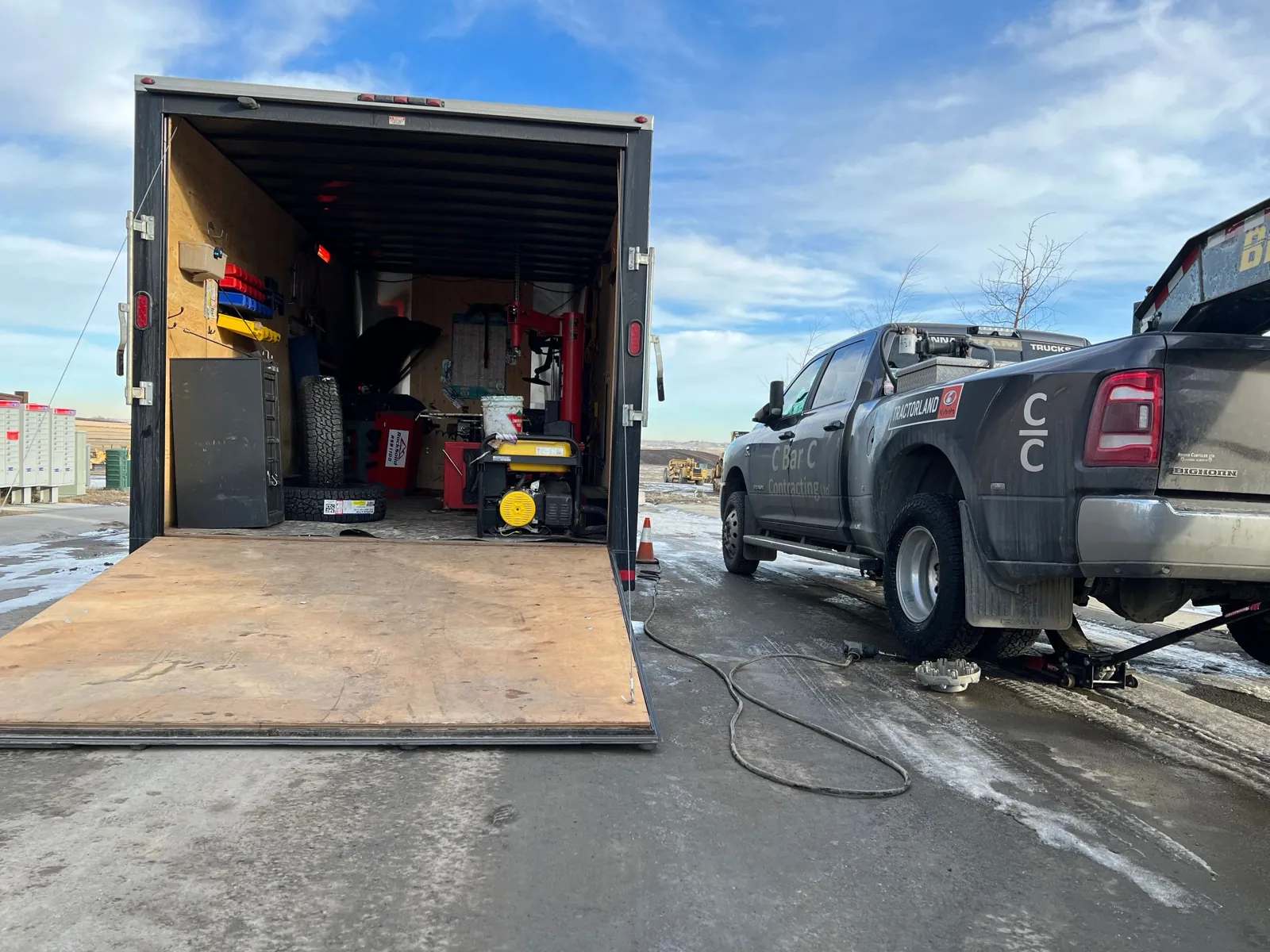
Your utility trailer has plenty of tread, holds air in the driveway and only travels a few times a year. Is that enough to load it for a highway trip? No. Before loading, you need to identify the trailer's required tire specification, inspect the actual tires and wheels, establish the correct cold pressure, and check the loaded trailer against its ratings. A quiet year behind the garage does not answer any of those questions.
This guide is for the owner who uses a small enclosed or open utility trailer for household moves, yard materials, tools or recreational equipment. It is not a guide to commercial transport compliance, agricultural implement tires or motorhome tires. Those applications have different requirements. The aim here is to turn a vague question about whether the tires look okay into a short list of decisions you can actually resolve before departure.
A tire shop can help identify and assess tires. A trailer specialist is the appropriate place for questions about its structure, axles, bearings, brakes, coupler and electrical systems. Those jobs are not interchangeable. KMJ's work is tires and oil changes, not trailer mechanical repairs. When requesting commercial tire service in Calgary, describe the trailer and tire size first so the shop can confirm whether that particular tire job is within its equipment and service scope.
1. Begin with the trailer, not the tire you found online
Start by locating the trailer's identification and certification information, its tire placard where fitted, and its owner's manual. Photograph these while the trailer is empty and accessible. Record the make, model, year and identifying number along with the original tire and rim specifications. A faded sticker is a reason to contact the trailer manufacturer, not a reason to assume that the tires currently installed are correct.
Previous owners may have substituted a convenient tire, changed wheels or mixed components. Even a tire that has remained mounted for years may be the wrong reference for a replacement order. The markings on the existing sidewall tell you what is installed. The trailer documentation tells you what was specified. Compare the two rather than treating them as the same source of truth.
If you cannot find the original documents, send the identifying details and photographs to the manufacturer or an appropriate trailer specialist. Ask for the approved replacement specification and the inflation instructions for your configuration. Keep the response with the trailer records. You do not need to become an engineer to own a utility trailer, but you do need an authoritative starting point.
Before buying replacement tires in Calgary, make a one-page note with three columns: required equipment, equipment currently installed, and unresolved differences. That prevents an attractive online listing from becoming the specification simply because it is available. It also makes a service conversation much faster than trying to remember letters and numbers from a muddy sidewall.
2. Understand what an ST marking does and does not tell you
An ST designation identifies a special trailer tire application. It is not a statement that any tire carrying those letters fits any trailer. Size, construction, permitted rim, load capacity and pressure requirements still have to agree with the trailer and wheel specifications. Nor is an ST tire a substitute for a passenger-vehicle tire merely because the nominal dimensions look similar.
Some trailers have manufacturer-approved specifications that use other tire types. That does not create a general permission to substitute a light-truck or passenger tire on yours. If an alternative is proposed, ask for the approval and the relevant load and inflation information for the exact application. A forum report about somebody else's trailer is not approval for your axle, wheel and operating conditions.
Read the complete description rather than just the large size numbers. Photograph both sidewalls if necessary and safe, without crawling under an unsupported trailer. A tire's identifying information may not all be on the outward-facing side. The shop can finish identification with the wheel removed during an appropriate service appointment.
Use the main site's tire sidewall information guide to organize the questions, but keep the trailer manual beside it. General car-tire explanations are useful vocabulary, not a replacement for application-specific instructions. The most useful question is not whether one marking sounds stronger. It is whether the complete proposed tire-and-wheel assembly is approved for this trailer and its actual use.
3. Separate the trailer rating from the tire rating
A trailer has a maximum permitted loaded weight established by its manufacturer, and its axles have their own ratings. The tires and wheels have limits too. Increasing one component's stated capacity does not automatically increase the trailer's allowable weight. The frame, axle assembly, coupler and other components do not become more capable when a higher-rated tire is installed.
Similarly, adding the maximum capacities printed on the tire sidewalls does not necessarily tell you the allowable cargo weight. The trailer itself weighs something. Permanently installed cabinets, a spare wheel, ramps and tools add weight before cargo goes aboard. Coupling load and axle loading must also be considered using the manufacturer's method rather than improvised arithmetic.
Here is a deliberately simplified planning example, not a rating for any actual trailer. Suppose the documented maximum loaded trailer weight is 1,400 kilograms and the empty trailer with its permanently carried equipment weighs 500 kilograms. The subtraction leaves 900 kilograms before accounting for anything missing from that empty measurement. It does not prove that 900 kilograms can be piled wherever convenient, or that the towing vehicle can handle the combination.
Keep those limits on separate lines in your worksheet. If an upgrade proposal changes the tire specification, request confirmation of the wheel's suitability and the resulting operating instructions. The tire load information resource can help explain capacity language, but it cannot re-rate a trailer. Treat load calculations as a way to find the limiting condition, not a way to explain it away.
4. Find out what your cargo really weighs
Utility-trailer loads are often estimated visually. A half-full box looks modest, and a few pieces of equipment look manageable. Density makes that approach unreliable. Wet material, masonry and compact machinery can consume the allowable load long before the trailer looks full. The number of trips that feel inconvenient has no relationship to the tire capacity.
Use documented equipment weights, supplier information and an appropriate scale. For a load of bulk material, ask the supplier how it will be measured and what uncertainty remains. Do not translate a volume into a precise weight without knowing the material and its condition. A scoop, a bag and a bucket are not standardized mass measurements simply because the container looks familiar.
Weigh the actual configuration you will tow, including items usually forgotten in planning: spare, jack if carried, ramps, straps, toolbox and any equipment permanently mounted inside an enclosed trailer. An old empty-weight figure may no longer describe the trailer after several owner modifications. Label the measurement with its date and configuration so it remains useful later.
An axle or whole-trailer reading may still conceal an uneven side-to-side distribution. If the load arrangement is asymmetric, discuss a suitable weighing method with a scale operator or trailer specialist. Do not assume that each tire supports exactly half an axle reading. Weight verification is not overkill for an occasional owner; it is the step that replaces an unreliable impression with information you can act on.
5. Load position matters even when the total is acceptable
A load can be within the trailer's total rating and still be arranged badly. Heavy items pushed against one side can concentrate load on one tire. Moving cargo toward the rear can change the coupling load and towing behaviour. A tall, unsecured item can shift after departure and create a different loading condition from the one you checked in the driveway.
Follow the trailer and towing-vehicle instructions for placement, coupling load and restraint. There is no universal arrangement that works for every trailer design and every cargo. If you are transporting machinery, obtain its approved tie-down points and securement instructions. If the load cannot be positioned within all the applicable limits, use a different transport arrangement rather than improvising around one favourable scale number.
Consider a homeowner carrying a narrow but heavy cabinet along one wall of an enclosed trailer. The centre aisle looks spacious, so there is a temptation to add more goods. Yet floor space says nothing about side-to-side loading. Repositioning and securing the cabinet may matter more than whether another box will fit behind it.
Cargo securement is outside a tire replacement decision, but it directly affects the forces the tires must carry. Finish the loading plan before choosing a departure pressure from the approved instructions. Do not deliberately lower pressure on one side to make a trailer sit level. If the trailer sits unevenly, determine the reason with an appropriate specialist instead of using the tires to hide the symptom.
6. Establish cold pressure without borrowing the truck's number
The pressure suitable for the towing vehicle is not automatically suitable for the trailer. They are different vehicles with different tires, loads and specifications. Read the trailer manufacturer's instructions and the tire manufacturer's guidance for the exact tire. Resolve discrepancies with the manufacturer or a qualified tire professional before towing.
Check pressure when the tires are cold according to the applicable guidance, before the trip heats them through use. Use a gauge suited to the pressure range involved and measure every road tire. Looking at sidewall bulge is not a dependable measurement. Tires of different construction can look different at their correct operating pressures, and a lightly loaded tire can conceal a problem visually.
The maximum figures on a sidewall are not a universal prescription for every vehicle. Conversely, copying a familiar passenger-car placard pressure onto a trailer may be seriously wrong. The correct answer comes from the trailer instructions and the approved tire, load and wheel combination. If a required pressure would exceed a component's limit, stop and resolve the mismatch.
Record the selected cold target, where the instruction came from and the actual readings. A small notebook can separate gradual pressure loss from a memory of having checked sometime last month. The site's practical tire-care guidance is a useful reminder of regular measurement, but trailer-specific pressure must come from trailer-specific information. An air compressor is a tool for reaching the correct target, not for choosing it.
7. Deal with pressure changes as evidence, not inconvenience
A trailer that sits unused is easy to forget. Check it before loading, leaving enough time to investigate a low reading. If you first discover a problem after the cargo is secured and the family is waiting, the pressure to explain it away becomes much stronger. Build the check into the preparation day rather than the final departure minute.
Temperature affects pressure, so comparisons are most useful when you record the conditions and whether the tires were cold. Nevertheless, one tire repeatedly losing pressure relative to the others deserves investigation. A leaking valve, a puncture or a wheel-related leak cannot be identified reliably from a single glance. Repeated top-ups do not establish that the tire is safe.
Do not bleed a warm tire down to a cold target simply because the reading increased during travel. Follow the applicable manufacturer instructions. If a reading is unexpected, stop safely and investigate rather than experimenting with pressure changes on the roadside. A monitoring system, if fitted, provides information; it does not decide what caused a warning or make an unsafe stopping place suitable for repairs.
When arranging tire repair assessment in Calgary, explain how quickly pressure changed, whether the trailer was loaded and whether it was driven while low. Repairability depends on the exact damage and tire, including internal condition. A small visible puncture does not guarantee a repair, especially when the use history suggests operation with inadequate pressure.
8. Inspect more than the tread facing the driveway
Look over the accessible tread and sidewalls for cuts, cracks, bulges, distortion, exposed material and anything lodged in the tread. Examine the inner-facing side where it can be seen safely. Do not crawl underneath a trailer supported only by a jack or reach into a position where the trailer could move. Ask a service professional to inspect areas you cannot safely view.
A tire can retain deep grooves while becoming unsuitable for service for another reason. Occasional use may produce very little tread wear, which is exactly why tread alone is an incomplete test. Long storage, impacts, pressure history and physical damage all matter. A tire that looks clean after washing has not passed an internal inspection.
If you find a bulge, separation-like distortion, exposed cords or significant damage, do not load up and tow to the shop as a test. Describe the condition and arrange a safe service or transport plan. Photograph it from a safe position, without inflating a visibly damaged assembly to see what happens. A photo can help triage the call, but it cannot certify the tire.
Check clearances too. Look for evidence of rubbing on a fender, frame or nearby hardware. A different tire size may have reduced the available space, and loading can change clearances. Do not trim components or fit another tire to compensate for an unexplained contact point. That is a trailer configuration question requiring the appropriate assessment before a replacement is selected.
9. Treat age as a separate question from appearance
Find the tire identification and manufacturing-date information and record it accurately. Ask the tire manufacturer about its age and service-life recommendations for the exact product. Also check the trailer manufacturer's guidance. There is no single birthday at which every trailer tire everywhere changes from acceptable to unacceptable, and this guide does not invent one.
An older spare deserves particular attention because it may have never worn down. Its unworn appearance is not evidence of recent manufacture or suitability for another long trip. The same applies to a used trailer sold with tires described as nearly new. That phrase may refer to tread, time since purchase or the seller's memory, none of which establishes the full history.
When date information is incomplete or cannot be read safely, ask the shop to identify it during inspection. Keep the photographs with invoices and note which wheel position each belongs to. If tires were replaced at different times, the set may have several different histories. A single receipt tucked in the glovebox does not necessarily cover all of them.
For replacement planning, compare available tire brands through KMJ only after confirming the application. A brand directory is not a live promise that a specific trailer size is stocked or approved. Ask for the exact product details and manufacturer guidance, then make an informed decision about whether the present set should remain in service.
10. Inspect wheels and valves as part of the assembly
A new tire does not resolve every fault in the assembly. Wheels have size, load and pressure requirements, and their condition matters. Visible damage, significant corrosion, cracking or distorted mounting areas need appropriate assessment. A wheel that accepts the tire bead is not necessarily approved for the pressure, capacity or trailer fitment involved.
Valve suitability also matters, especially if a replacement specification changes operating pressure. Ask whether the valve and any monitoring hardware are appropriate for the application. A fresh cap is useful protection, but it does not repair a leaking valve or make an unsuitable component suitable. Do not add extensions or monitoring devices without checking compatibility and the component manufacturer's instructions.
Wheel fitment involves more than the number of fastener holes. The mounting arrangement, centre opening, offset, fastener seating and clearance must be correct for the trailer. Avoid buying a spare wheel merely because it seems to bolt on. An incorrectly matched wheel can create problems that a tire-only inspection will not solve.
If you are reviewing tire options by size, keep the wheel information alongside the tire information. Ask the service provider to confirm the proposed assembly rather than approving a tire name in isolation. For hubs, bearings, studs or other trailer mechanical concerns, use a suitable trailer specialist. KMJ does not offer those mechanical repairs, and a tire appointment should not be presented as a substitute.
11. Do not let a second axle create false reassurance
A tandem-axle trailer has more tires, but that does not mean a failed or flat tire can be ignored. Losing support at one wheel changes the loading and behaviour of the remaining assembly. Continuing a trip because there are still three round tires visible is not an acceptable replacement for the manufacturer's instructions and a safe recovery decision.
Tandem trailers also deserve careful inspection after tight manoeuvring. Tires can experience lateral scrub as the trailer turns, and wear patterns may raise questions about operating conditions or trailer geometry. Do not diagnose the cause from a pattern alone. An inspection may need both tire expertise and a separate trailer mechanical assessment.
When replacing one tire, discuss compatibility with the remaining tires, including size, construction, capacity, condition and the manufacturer's matching requirements. A purchase based only on nominal diameter can overlook meaningful differences. Ask what must match across the trailer and whether the remaining tires are still suitable before authorizing a single replacement.
An owner who notices one worn shoulder should bring photographs of all wheel positions, the loading history and any recent impact or modification. That information is much more useful than requesting the toughest tire available. If an axle or suspension issue is suspected, the appropriate specialist should resolve it. Otherwise the replacement may inherit the same operating problem, no matter how impressive its product description sounds.
12. Make the spare a complete, verified plan
A spare is useful only if it is suitable, serviceable and available when needed. Check its pressure, age, damage and fitment before the trip. Verify that the mounted assembly fits the trailer, not just that the tire size resembles the road tires. Confirm the correct fasteners and any limitations of the spare arrangement from the manufacturer's instructions.
Think about access with the trailer loaded. A spare buried under household furniture is not readily available. A carrier that cannot be opened because of cargo or a lock whose key is elsewhere can turn a prepared-looking setup into an unusable one. Secure the spare properly for travel and confirm that its mounting does not obstruct required equipment or create another hazard.
If the trailer has no approved spare arrangement, decide what roadside assistance or transport option you will use. Do not assume a passenger-vehicle jack can safely lift a loaded trailer or that an improvised lifting point is acceptable. Lifting and support must follow the trailer manufacturer's instructions and require suitable equipment and conditions.
Keep the tire size, wheel details, trailer description and assistance contacts in your phone and somewhere accessible offline. Read about KMJ emergency tire services, then confirm availability and trailer compatibility when assistance is needed. A website description is not a guaranteed response time, a promise of immediate stock or permission to work beside fast-moving traffic.
13. Respect the exact product's operating limits
Do not assume that all trailer tires share the same speed capability or that a road's posted limit is suitable for every loaded combination. Consult the tire markings and current manufacturer information, the trailer manual and any applicable restrictions. Operate within the most restrictive relevant limit and reduce speed further when conditions require it.
A different product may have different instructions even when its nominal size is identical. Be especially careful with general advice to add pressure in exchange for speed. Never apply a rule from a different tire or an old chart without confirming that it belongs to the exact product and permitted wheel assembly. Increasing pressure does not independently authorize faster towing.
Heat, damage, load and inflation are connected operational concerns. A tire that was driven underinflated may have damage you cannot see from outside. Letting it cool and adding air does not prove that the structure recovered. Explain any such event to the service professional before returning the tire to use.
For most occasional owners, the useful planning question is whether the trip can be completed comfortably within the equipment's instructions, with time for safe stops. If the schedule only works by pushing a trailer to its limit, change the schedule. No tire choice can make an overloaded, poorly maintained or badly secured combination into a sensible highway plan.
14. Keep winter decisions specific to towing
A trailer does not become ready for winter simply because the towing vehicle has suitable winter tires. Inspect the trailer tires and confirm that the trailer and towing vehicle are appropriate for the planned conditions. Ask the tire manufacturer about the intended use and limitations of the specific trailer product rather than transferring passenger-car advice without checking.
Snow, ice, slush and poor visibility affect the whole combination. Allowing more time, postponing a trip or using another transport option may be the better choice. Tire selection is only one part of that decision. Braking systems, lighting, coupling and load restraint remain separate preparation responsibilities for the owner and the relevant service specialists.
If the towing vehicle needs attention, winter tire guidance for Calgary drivers can start that discussion, but it is a different specification from the trailer behind it. Do not interpret a tread symbol or an aggressive-looking pattern as blanket approval for all winter towing. Check the actual product documentation and the requirements of the route.
Before departing after a snowfall, make sure the trailer is accessible for inspection and that required lights and identification are visible. Remove snow or ice that could create a hazard according to safe handling practices. If conditions prevent a proper check or safe loading, delay. The objective is not to tick a winter-tire box; it is to choose a trip the entire combination can undertake appropriately.
15. A short gravel trip still needs a load check
A nearby transfer station, landscaping supplier or acreage can feel less demanding than a highway journey. Short distance does not cancel load limits, sharp debris or the consequences of a tire failure. A trailer can be overloaded before it leaves the supplier's yard, regardless of how close home is.
Look at the access route and unloading area before committing to a load. Deep ruts, sharp edges, steep transitions and soft ground can create problems that tire selection alone cannot solve. Ask whether a different pickup arrangement, smaller load or delivery service would be more suitable. Do not use lower pressure as an improvised method for crossing a rough patch without manufacturer guidance.
After returning from a debris-prone area, inspect the accessible tires for damage and check any suspicious pressure change. Avoid pulling out an embedded object simply to see whether the tire still holds air. Discuss it with a tire professional and arrange assessment. A tread object and a sidewall injury are different repair questions, and neither should be judged solely from a distant photograph.
For owners outside the city, review KMJ's tire service areas and provide the actual location and access conditions when enquiring. A rural address can involve gates, limited turning space or unstable ground. Those details matter when deciding whether mobile tire work is feasible or a different transport plan is needed.
16. Store the trailer with a return-to-service routine
Follow the trailer and tire manufacturers' storage guidance. Choose a suitable location, protect tires from avoidable damage and inspect the trailer periodically. Do not assume that covering the tires or parking indoors means they can be ignored until the next season. Pressure loss and age do not depend on mileage accumulating.
If storage guidance calls for supporting or unloading components, use the specified method and appropriate equipment. This article is not a set of jacking instructions. An improvised support under the wrong part of a trailer can be dangerous, and a loaded trailer should never be treated like an empty garden cart.
When bringing it back into service, begin before loading. Check identification, pressure, visible condition, spare and wheel fitment records. Arrange any required mechanical trailer inspection separately. Evidence of rubbing, persistent pressure loss or unusual wear should be resolved while the trailer is still easy to access, not after the load is strapped down.
Take a dated set of photographs after the inspection and keep it with your notes. These are useful for tracking changes, though they are not a safety certificate. An annual reminder can prompt the inspection, but it cannot establish a universal replacement interval. Base replacement on manufacturer guidance, condition and history rather than a calendar shortcut borrowed from another owner's trailer.
17. Three loading-day examples that change the decision
First, consider an enclosed trailer used to move a student's belongings. The owner checks pressures and sees plenty of tread, but the spare has a different wheel and there is no record that it fits. The immediate task is not shopping for a more aggressive tread. It is identifying the road assembly, verifying the spare and arranging assistance if a compatible spare cannot be prepared in time.
Second, imagine a homeowner collecting paving materials. The trailer looks only partly full, but the supplier's weight information exceeds the remaining documented capacity. A higher-capacity replacement tire would not authorize the load. The sensible choices are a smaller quantity, several appropriately planned trips or delivery using suitable equipment. Reducing speed is not an exemption from a rating.
Third, a contractor has a tandem trailer with one tire that repeatedly needs air. The other three seem fine, and the job site is close. That pattern calls for assessment of the leaking assembly and disclosure of any operation while low. It does not justify continuing until the tire visibly collapses. The load and access information should be included in the service request.
These examples are hypothetical, not customer stories. They illustrate three different blockers: missing compatibility evidence, excessive cargo and unresolved condition. Each produces a different next action. Buying tires is appropriate only when the specification and assessment lead there; it is not the universal answer to every trailer preparation problem.
18. Ask for a quote that identifies the actual assembly
A useful enquiry includes trailer make and model, the required specification, current tire markings, wheel details, number of tires, approximate use and the reason for replacement. Add clear photographs and disclose pressure-loss events or damage. Explain whether the trailer is empty, loaded, parked safely and accessible for the proposed work.
Request the exact tire model and size, the relevant capacity and operating guidance, and confirmation of compatibility with the existing wheels. Ask what the quoted work includes, such as mounting, balancing where applicable, valves and disposal. Get current pricing and availability directly; neither this guide nor a general product page establishes stock or an all-in price.
When considering budget and premium tire choices, compare suitable products first. A lower price on an unsuitable assembly is not a meaningful saving. Equally, a more expensive product does not eliminate the need to check fitment, inspect the remaining components and follow its instructions. Match the application before comparing the extras.
Businesses managing several trailers may benefit from a shared record of specifications, inspections and replacements. The main site's fleet tire management information provides a starting point for a tire-service conversation. That does not transfer trailer mechanical maintenance or regulatory responsibilities to the tire shop. Keep responsibility for each part of the combination clearly assigned.
19. Decide between mobile work and bringing it in
Do not tow a trailer with a suspect tire merely because the shop is nearby. Describe the problem first. A tire-service provider can discuss whether an on-site assessment is appropriate, whether the trailer needs to be unloaded or whether another recovery arrangement is necessary. The answer depends on the actual tire, location, load and safe access.
For mobile tire service in Calgary, provide photographs of the surroundings as well as the tire. A narrow alley, sloping driveway or soft storage area may be unsuitable for the required work. Permission to access a site, clearance around the trailer and the ability to secure the work area should be settled beforehand.
If bringing a loose wheel for service is appropriate, arrange removal and support using the trailer manufacturer's instructions and competent help. Transport the assembly securely. Do not leave a trailer precariously supported while a wheel is away, and do not treat a jack as a long-term stand. Those handling decisions belong to the safe service plan, not an improvised shortcut.
Use KMJ's contact page for a trailer tire enquiry to confirm scope and practical arrangements before travelling. Once the job and specification are agreed, request a tire appointment online. A submitted request is not a confirmed time or a promise that a particular product is waiting. Obtain confirmation of both the appointment and any ordered parts.
20. Keep a departure card, not a pile of assumptions
Your departure card should record the trailer identity, required tire specification, current tire details, approved cold-pressure target and measured readings. Add the loaded-weight information and the source of the loading instructions. Include the spare's condition and fitment status, assistance contacts and any unresolved concerns. If an important line is blank, resolve it before loading or departure.
Then make a separate operational check for the rest of the trailer and towing vehicle using their manuals. That includes the applicable coupling, restraint, lighting and braking checks. A tire inspection does not certify those systems. If specialist work is needed, book it with an appropriate provider and do not present a tire invoice as evidence that the entire trailer has been inspected.
The simplest decision rule is useful here: known specification, acceptable condition, verified loading and a workable assistance plan. If one is missing, choose the specific next action that supplies it. Obtain the manual, measure the load, arrange an inspection, replace an unsuitable assembly or postpone the trip. Avoid the vague promise to keep an eye on it when the unresolved issue requires evidence.
A utility trailer earns confidence through preparation, not through being used infrequently. The useful question on loading day is not how many kilometres the tires have travelled. It is whether this particular assembly, in its present condition, is suitable for the load and journey you are about to give it. Answer that before the ramp goes up, and the tire purchase or service decision becomes much clearer.
Reference notes: use the document that matches your equipment
For an example of why the complete product specification matters, consult Carlstar's Radial Trail HD technical table. It lists tire sizes alongside rim widths, rated loads, pressures and rated speeds. Different entries within that single product family do not all share the same figures. The table is evidence that you must identify the exact version, not a recommendation to fit that model or use one listed pressure on your trailer.
NHTSA's TireWise maintenance and aging guidance explains why regular gauge checks, physical condition and age all matter, including for infrequently used tires and spares. Its passenger-vehicle examples should not be transplanted into trailer specifications. Use those general inspection principles while obtaining your actual tire requirements from the trailer and tire manufacturers.
The safety material linked by Carlstar also stresses correct tire-and-rim matching and inspection for wheel damage. Those professional service instructions are not a do-it-yourself mounting guide. In particular, do not take inflation values used during a mounting procedure and treat them as the operating pressure for your loaded trailer. Service procedures and road-use instructions answer different questions. Keep the current trailer manual, the chosen tire's documentation and your service record together so future decisions do not depend on a remembered number from an unrelated chart.